Last updated on March 1, 2013
Update 18:00(CET)/16:00(UTC)/01:00(JST)
The new JAIF update is out. Temperature of the core in Reactor one has gone down and pressure gone up slightly. They have added the water level of the radioactive water in the tunnels they are trying to empty. They now write that they suspect the pressure vessels of reactor number 2 and 3 are no longer airtight but they don’t think there are any holes or crack. A cryptic statement and I wish they would release more information on what they mean exactly. Doesn’t seem possible to exclude a small breach in a few control rod guide tubes due to dripping corium(molten core material). At the same time the temperature readings in the lower head of reactor 3 excludes that the entire bottom has gone out due to massive melting through the vessel. In reactor 2 one neither has any temperature reading from bottom head or any pressure reading within the vessel.
Update 11:00(CET)/09:00(UTC)/18:00(JST)
JAIF has released a update (data from 07:30 JST today) and radiation trends and NISA has an update from yesterday(06:00(JST) march 31).
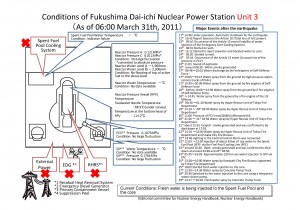
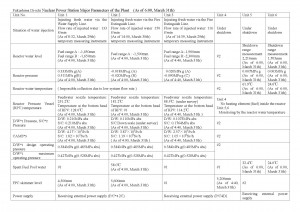
Reactor 1:
Water level in the core: 1.65 (1.65) meters below the top of fuel assemblies
Flow rate of injected water: 133 liter/minute
Core pressure: 583(612) kPa
Containment pressure: 175(210) kPa
Core temperature(feedwater nozzle): 256.2 (251.2) Celsius
Core temperature(bottom head): 128 Celsius
Dose rate within containment: 41.7 Sv/hour
Reactor 2:
Water level in the core: 1.5 (1.5) meters below the top of fuel assemblies
Flow rate of injected water: 150 liter/minute
Core pressure: unknown
Containment pressure: 110 (110) kPa
Core temperature(feedwater nozzle): 181.2 Celsius
Core temperature(bottom head): Unknown
Dose rate within containment: 38.7 Sv/hour
Spent fuel pool temperature: 58 Celsius
Reactor 3:
Water level in the core: 2.25 (2.3) meters below the top of fuel assemblies
Flow rate of injected water: 116 liters/minute
Core pressure: 117 (121) kPa
Containment pressure: 173 (176.4) kPa
Core temperature(feedwater nozzle): 88.5 Celsius (under review)
Core temperature(bottom head): 114.2 Celsius
Dose rate within containment: 25.7 Sv/hour
Pressures and temperatures seems to be quite stable, albeit high in the number 1 reactor. Nothing new really on the status of the 3 reactors. A temporary pump used to pump water into the number 2 spent fuel pool has malfunctioned and we can see a increasing trend in the water temperature.
They are shifting around water in different places to be able to make room somewhere to pump away the junk water in the basements of the turbine buildings. In order to be able to access the coolant pumps needed to restore the proper cooling of the reactors.
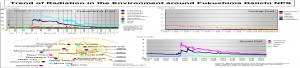
The JAIF radiation trends show that there was big emissions during the 15th and 16th and after that a declining trend. There doesn’t seem to be any continuous emissions from the plant and the emission spikes corresponds with the venting of the containments and following explosions and fires in the reactor buildings. Unless a new need to vent the containments arises, then there shouldn’t be any new big emissions. By now the I-131 content of the reactors have decayed down to a quarter of initial amount and for every week(8 days to be precise) they can prevent venting the amount will further be cut in half. I-131 will stop being a problem after about 80 days, by that time the amount will have been reduced to one thousandth of the initial amount. Cs-137 will of course continue to be a problem with a half life of 30 years.
TEPCO has once again measured wrongly activities in water, but it is likely the ground water around the plant is contaminated. Source of the contamination is unknown but TEPCO suspects its been carried by rain after the initial ventings.
Situation is serious, but it doesn’t seem to deteriorate anymore.




Links(English)
Reuters Japan nuclear crisis drags on
George Monbiot describes the double standards used to evaluate nuclear
Blogs(English)
Charles Barton Nuclear Safety and George Monbiot
NEI nuclear notes Appeal of small reactors might increase after Fukushima
Rod Adams Monbiot debates Caldicott
Links(Swedish)
SvD Svenskar tror på kärnkraft
Blogs(Swedish)
Fröjdhpunkt Så mycket hade kärnkraft kunnat minska utsläppen
Inslag.se Pudelns kärnkraft
Warning: Declaration of Social_Walker_Comment::start_lvl(&$output, $depth, $args) should be compatible with Walker_Comment::start_lvl(&$output, $depth = 0, $args = Array) in /var/www/nuclearpoweryesplease.org/public_html/blog/wp-content/plugins/social/lib/social/walker/comment.php on line 18
Warning: Declaration of Social_Walker_Comment::end_lvl(&$output, $depth, $args) should be compatible with Walker_Comment::end_lvl(&$output, $depth = 0, $args = Array) in /var/www/nuclearpoweryesplease.org/public_html/blog/wp-content/plugins/social/lib/social/walker/comment.php on line 42
“Så sent som igår berättade kärnkraftbolagets vd Tsunehisa Katsumata, efter att han gjort en djup bugning och bett om ursäkt till alla drabbade, att fyra av stavarna på kärnkraftverkets reaktorer, som innehåller radioaktiva material, är fullständigt förstörda och aldrig kommer att kunna användas igen.
– Vi har inte lyckats kyla reaktorerna, men vi lägger ned maximal kraft på att försöka stabilisera dem, sa han under en presskonferens i Tokyo, skriver Daily Mail.”
http://www.aftonbladet.se/nyheter/article12816422.ab
It has been obvious since the start of seawater injection into the cores that they will never be used to produce electricity again, so its a very redundant statement by the CEO.
It telling because it shows just how late TEPCO is in acknowledging facts to the public, probably to keep the impact on the company’s value down
Well they where saying it already weeks ago. Can’t remember the first time I saw such a statement. So he seems to be repeating an earlier announcement.
But yeah, TEPCO isn’t a shining example of transparency and very likely the company will go bankrupt after this. Like I wrote somewhere else, I don’t think anyone will shed any tears over that!