Last updated on March 1, 2013
22:00(CET)/20:00(UTC)/05:00
Not much newsworthy to report today. JAIF report as usual on the status of the reactors. No new NISA update on the reactor status in English but in Japanese, some values are taken from IAEA rather than NISA. Links to graphs are links to the blog #FNPP1 and Irradiation. Pressure is continuing to rise in the number one reactor but still quite low. Seems like there is some kind of leakage out of the containment in number one, otherwise one would have expected higher pressure due to the nitrogen injection. Pumping of water from the number 2 turbin building basement is ongoing but slow, TEPCO say the work can take weeks.
| Reactor 1 | Reactor 2 | Reactor 3 | |
| Water level (meter)* | -1.65 | -1.5 | -2.2 |
| Flow rate(liters/min) | 100 | 116.67 | 116.67 |
| Core pressure (kPa) | 1034 | 100*** | 100*** |
| Containment pressure (kPa) | 190 | 100*** | 100*** |
| Wetwell pressure (kPa) | 165 | – | 168 |
| Feedwater nozzle temp (Celsius) | 204.5 | 166.9 | 92.2 ** |
| Bottom head temp (Celsius) | 119.0 | 208.0 | 116.0 |
| Containment dose rate (Sv/hour) | – | 27.9 | 16.9 |
| Wetwell dose rate (Sv/hour) | 10.3 | 0.653 | 0.653 |
| *Distance from top of assembly | |||
| – broken gauges or missing data | |||
| ** Probably faulty reading | |||
| *** IAEA states atmospheric pressure |


Yesterday NISA released this info about how much activity has escaped from the Fukushima reactors and compare it to Chernobyl.
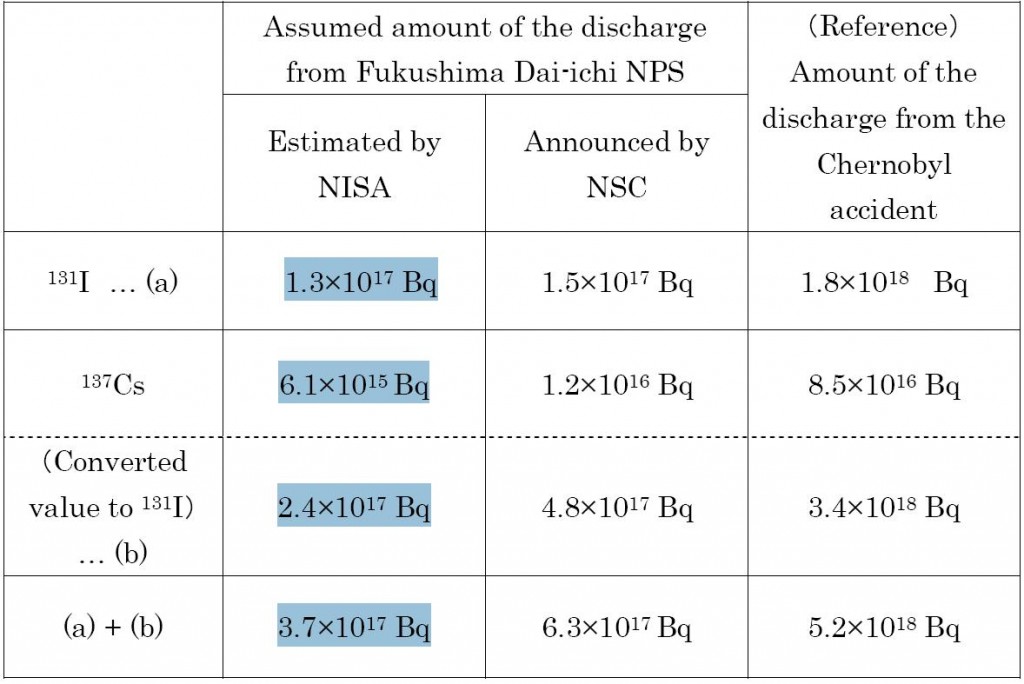
Like I said yesterday its roughly 10%. The move from 5 to 7 on the INES scale has gotten a lot of media attention, but what does it really mean? Nothing became worse yesterday than it has been, no dramatic event changed the rating etc. What happened is that NISA estimated that the release of I-131 and Cs-137 is beyond a treshold of what is considered “Major release of radioactive material” acording to the level 7 definition:
Level 7.
- Major release of radio active material with widespread health and environmental effects requiring implementation of planned and extended countermeasures
That is all, NISA hasn’t made any statement about health impacts. They certainly don’t claim the effects will be as severe as the effects where from Chernobyl. One can at this point exclude the possibility that Fukushima will be as severe. So what are the differences?
- In Chernobyl 134 workers got exposed to high enough radiation(over 1 Sievert) to develop symptoms of acute radiation sickness, 28 of them died during the first year following the accident, two others died from injuries not related to radiation. A lot of kids got exposed to I-131 due to no quick warnings not to drink milk and no supply of iodine pills. 4000 kids got thyroid cancer and 15 died due to it. 600 000 liquidators where exposed to doses around 100 mSv.
In Fukushima so far 22 workers have been exposed to over 100 mSv, the highest getting 198 mSv, thus there where 30 000 times as many people exposed to 100 mSv or more in Chernobyl compared to Fukushima so far! The only two deaths at the power plant was direct deaths due to the tsunami. No one has died due to the nuclear accident itself, not from any of the explosions, not from radiation etc. Dose estimates for the people outside of the evacuation zone, especially the people within 30km, has not been given so far.
- In Chernobyl the radionuclide release was directly into the atmosphere and it was going on for several days driven by the graphite fire. Other radionuclides than I-131 and Cs-137 could easily escape and was spread (even though Cs-131 is the biggest issue). The areas around Chernobyl where not quickly evacuated. The core blew apart due to a runaway chain reaction(a inherent weakness to that design that was well know, but the Russians ignored it and built them anyway),
In Fukushima it is still not entirely clear what caused the majority of release, it was either the venting of the containments or due to the breach in the number 2 wetwell. Regardless of the cause the atmospheric emissions was much smaller in magnitude, took place during a shorter time period, after the civilian population had already been evacuated! We are seeing pretty much only Iodine and Cesium(trace levels of other radionuclides have been detected, but no large release of them has been reported). The cores are largely intact, two of the containment vessels are likely breached but by far from cracked open like eggs. The cause of the emissions are partial meltdowns of the cores, a much slower process than the runaway explosion in Chernobyl. After the first few days of venting where over the majority of leakage goes into the sea, although that is not a “good” thing it is unlikely it will have any measurable impact on health. Anything going into the sea will get diluted fairly quickly. Even if the total release will increase to the same size as the ones from Chernobyl the different release path means it will have much less impact on public health or the environment.
Those two points alone mean that Fukushima is not another Chernobyl. The public health effects will not be as large and the environmental impact will be smaller. It remains to be seen how large surface areas have gotten high Cs-137 fallout, that will be the determining factor in how large areas will be unfit for farming or living on.


Links(English)
Reuters Japan struggles with nuke plan
World Nuclear News Fukushima workers start emptying trench water
Blogs(English)
Atomic Insights Rational Answer to Carl Pope’s Dismissal of Nuclear Technologies
Depleted Cranium Shameful Reporting From the New York Times
NEI Nuclear Notes Wednesday Update
Atomic Power Review Boiling Water Reactors Part 1 and Part 2
Atomic Power Review Fukushima Daiichi developments… Tuesday evening
Atomic Power Review A couple of afternoon updates….
Links(Swedish)
Aftonbladet Tyvärr har jag fått rätt
SvD Fukushima inte lika allvarligt som Tjernobyl
Blogs(Swedish)
Den blinde Argus Kortsiktighet, instabilitet och populism
Begrundat och plitat Fukushima, risken för nya olyckor, och sanningens ögonblick
Tänkvärt? Eller inte Fukushima likvärdig med Tjernobyl.
SNF’s blog Fukishima kan vara värre än Tjernobyl
Nolow Kärnkraftverk
Hovbergs blog Nukleära utrymningsområden<
Röda Berget Skräcken för strålning skapar nya offer
Harald i Uppsala Reflektioner 13 april
Warning: Declaration of Social_Walker_Comment::start_lvl(&$output, $depth, $args) should be compatible with Walker_Comment::start_lvl(&$output, $depth = 0, $args = Array) in /var/www/nuclearpoweryesplease.org/public_html/blog/wp-content/plugins/social/lib/social/walker/comment.php on line 18
Warning: Declaration of Social_Walker_Comment::end_lvl(&$output, $depth, $args) should be compatible with Walker_Comment::end_lvl(&$output, $depth = 0, $args = Array) in /var/www/nuclearpoweryesplease.org/public_html/blog/wp-content/plugins/social/lib/social/walker/comment.php on line 42
“Those two points alone mean that Fukushima is not another Chernobyl. The public health effects will not be as large and the environmental impact will be smaller.”
How can you be so sure about that? Not very scientific of you.
I guess you didn’t read the points since it is explained there….
I read the points but they are somewhat sketchy as there is still lots of missing facts about this accident that no one including you know anything about.
As for the workers several of them apparently have been working without adequate protective clothing and some has been said not to even had dosometers while working in high radiation areas.So one has to take Tepcos information with a large grain of salt.
So you don’t think one can draw any conclusion based on the fact that in Chernobyl 600 000 liquidators where exposed to 100 mSv while in Fukushima there isn’t even that amount of people within a 30km radius from the plant?
One can not draw any conclusion considering that one reactor completely blew apart spreading the core material unhindered while in Fukushima the pressure vessels and containments are still there?
One can not draw any conclusion based on the fact that most of the release of radionuclides are now into the sea rather than into the atmosphere?
One can not draw any conclusion based on the screening of kids thyroids that so far has not detected any dangerous levels?
Sure TEPCO might be hiding information, who knows. But I know for a fact that they are not hiding 600 000 workers on the plant area out of sight of media.
Johan your comparision is flawed.
As fuel from Fukushima also seem to have been spread unhindered for large distances and in some directions more than enough to cause healthproblems in the future.
As for Chernobyl it seems 600.000 liquidators is a quite exaggerated figure http://www.irpa.net/irpa10/cdrom/00666.pdf
How many people total do you think are needed to fix Fukushima? Because as you know it’s gonna take years and years to clean up after the accident.
It seems that Tepco are searching high and low to find dayworkers to help them at Fukushima.
http://www.nytimes.com/2011/04/10/world/asia/10workers.html?pagewanted=2
Per… this is getting old real fast…
Before the accident, you anti-nukes went “A nuclear accident will without doubt cause scores of dead, and massive health problems!”.
Now we’re looking at Fukushima… a triple meltdown and a burning fuel pool… and your predictions have proven to be wildly wrong. But your tune remains exactly the same, only now you have modified the lyrics slightly by saying “It might, possibly, cause health problems!” while your tone, pitch and tempo remains exactly the same.
This overwhelming desperation to paint nuclear power to be the biggest danger in the history of mankind…this insane urge to try to make poeple frightened… it’s getting bloody tiresome.
Here you go… this post is all about people like you.
Per do you have a source for large amounts of fuel being spread unhindered? I have seen mentioned that small amounts where spread from the number 4 spent fuel pool. Thats it, nothing compared to a supercriticality explosion like in Chernobyl.
600 000 is the number IAEA states. The article you link to say around 300 000. 300 000 or 600 000 in Chernobyl compared to so far 22 in Fukushima is quite a large difference regardless of IAEA is right or not. So it does not change my point number 1 in the slightest.
The number of people that it will take to fix Fukushima will be something similar per reactor as the number of people that fixed TMI. I don’t have a figure for how many that was but it was not some kind of mass mobilization of a huge work force. Lets see what estimates Toshiba and Hitachi will give.
As far as TEPCO hiering people to Fukushima now, I don’t see the point you are trying to make? We are still not talking hundreds of thousands of workers.
“Before the accident, you anti-nukes went “A nuclear accident will without doubt cause scores of dead, and massive health problems!”.
Well I didn’t say that but Fukushima will unfortunately result in the above.
Maybe you are not so concerned because Fukushima isn’t in Europe?
“This overwhelming desperation to paint nuclear power to be the biggest danger in the history of mankind…”
Nuclear power has the capability to be just that, so to not even acknowledge that is like you and your friends in the industry do is quite frankly utter lunacy.
P.S.
Mr. Karnerfors as I said earlier my name is not Per. Call me NPNT if you don’t want to write Nuclear Powernothanks.
Hmm you write
“This overwhelming desperation to paint nuclear power to be the biggest danger in the history of mankind…”
Nuclear power has the capability to be just that, so to not even acknowledge that is like you and your friends in the industry do is quite frankly utter lunacy.
Really? Explain how?
How is it that an energy source that has killed at most a few thousand in 50 years is a bigger danger than its main competitor that kills millions every single year.
why should we acknowledge an assertion that is absolutely ridiculous and shows gross ignorance about the basics of physics?
Well I didn’t say that but Fukushima will unfortunately result in the above.
Here we go again…
Nuclear power has the capability to be just that
Two million people die every year in India alone from pollution cause by fossil fuels and dirty biomass combustion. Pardon me if I don’t regard Fukushima with the kind of dread you wish me to, because it’s nonsense.
Mr. Karnerfors as I said earlier my name is not Per.
If you want to be called by anything other than Per – which I will remind you again is what you named yourself when visting this site before – I suggest you give us your real name.
“do you have a source for large amounts of fuel being spread unhindered? I have seen mentioned that small amounts where spread from the number 4 spent fuel pool. Thats it, nothing compared to a supercriticality explosion like in Chernobyl”
In Chernobyl only a small part of the fuel got spread outside of the plant, the same goes for Fukushima.
“600 000 is the number IAEA states. The article you link to say around 300 000. 300 000 or 600 000 in Chernobyl compared to so far 22 in Fukushima is quite a large difference regardless of IAEA is right or not. So it does not change my point number 1 in the slightest.”
In Fukushima surely more than 22 have been exposed to more than the allowed dose.
Tepco refuses to say how many of their contractors workers have gotten large doses of radiation.
And in Chernobyl not all 300.000 workers reached the max dose. You are comparing apples with bananas.
“The number of people that it will take to fix Fukushima will be something similar per reactor as the number of people that fixed TMI. I don’t have a figure for how many that was but it was not some kind of mass mobilization of a huge work force. Lets see what estimates Toshiba and Hitachi will give.”
Come on! You know that cleaning up Fukushima requires lots more workers than TMI.
“As far as TEPCO hiering people to Fukushima now, I don’t see the point you are trying to make? We are still not talking hundreds of thousands of workers.”
No and so many were of course not used during the first month of Chernobyl either.
In Chernobyl only a small part of the fuel got spread outside of the plant, the same goes for Fukushima.
I am very interested in hearing how core fragments went through pressure vessels and containments with enough force to be spread a large distance? Please explain
Come on! You know that cleaning up Fukushima requires lots more workers than TMI.
Really, why? In both cases we have partial meltdowns. What will complicate Fukushima is that the containments are more radioactive and that the plant area itself is contaminated. That doesn’t however imply it will take 10 times more people.
Explain where the bigger labor force is needed, what part of the dismantling will need a work force of hundreds of thousands?
In Fukushima surely more than 22 have been exposed to more than the allowed dose.
And you get this piece of information from? You accuse us of claiming we can see the future. But apparently you can see all the way to Japan and also check the dosimeters and have a much better grip on the work force at Fukushima than either NISA or IAEA has. Impressive!
And in Chernobyl not all 300.000 workers reached the max dose. You are comparing apples with bananas.
if you have a problem with IAEA stating that 600 000 liquidators got exposed to on average 100 mSv then I suggest you take it up with them.
Well someone (You?) wrote “600 000 liquidators where exposed to doses around 100 mSv.”
And then you wrote “if you have a problem with IAEA stating that 600 000 liquidators got exposed to on average 100 mSv then I suggest you take it up with them.”
That doesn’t compute and is downright dishonest.
And as I stated 600.000 Chernobyl-workers likely is exaggerated. IAEA has several agendas as we all now both political and economical.
As for the workers at Fukushima those officially 22 are the Tepco-workers exposed to more than 100 mSv. How many of their workers and their contractworkers who have gotten close to 100 mSv or more we don’t know, because Tepco won’t tell.
“That doesn’t however imply it will take 10 times more people.”
It probably does.
(Not) Per: “IAEA has several agendas as we all [k]now both political and economical.”
Oh… are we talking about things people “know” again? 🙂
Seriously, if I have to choose between IAEA and some anonymous blog-troll whose name is (not) Per… guess who gets my vote.
And (Not) Per, in what way does it not compute that Johan references a fact he has gotten from a source?
Well someone (You?) wrote “600 000 liquidators where exposed to doses around 100 mSv.”
And then you wrote “if you have a problem with IAEA stating that 600 000 liquidators got exposed to on average 100 mSv then I suggest you take it up with them.”
That doesn’t compute and is downright dishonest.
Dishonest how? I made the statement and linked to the IAEA report as reference. if you had bothered opening the report then you would see a table on page 14 that shows how many people where exposed to different dose levels. If you think that is a lie then you need to show credible evidence that there was indeed significantly less than 600 000 and that the average dose to that group was significantly less than 100 mSv.
And as I stated 600.000 Chernobyl-workers likely is exaggerated. IAEA has several agendas as we all now both political and economical.
I am very interested in hearing why you think IAEA would EXAGGERATE the number of exposed workers in Chernobyl if their agenda is to to downplay the incident?
As for the workers at Fukushima those officially 22 are the Tepco-workers exposed to more than 100 mSv. How many of their workers and their contractworkers who have gotten close to 100 mSv or more we don’t know, because Tepco won’t tell.
No, what it means is that you assume that is the case, but you don’t have a single shred of evidence to back it up. Nothing states that the 22 are specifically TEPCO workers, what is written is plant workers. That would include subcontractors. Give credible links to for instance governmental statements that support your assertion. Otherwise it is just your own guess.
But assuming you are right, say there are 200 workers exposed to more than 100 mSv. How does that change my general conclusion? 200 or even 2000 are still a lot less than 600 000.
“That doesn’t however imply it will take 10 times more people.”
It probably does.
Please explain to me how you come to that conclusion?
“Dishonest how? I made the statement and linked to the IAEA report as reference. if you had bothered opening the report then you would see a table on page 14 that shows how many people where exposed to different dose levels. If you think that is a lie then you need to show credible evidence that there was indeed significantly less than 600 000 and that the average dose to that group was significantly less than 100 mSv.”
Dishoest because you compare as it pleases you and your agenda.
As for the 600.000 figure not being correct I gave you a link which showed this.
“I am very interested in hearing why you think IAEA would EXAGGERATE the number of exposed workers in Chernobyl if their agenda is to to downplay the incident? ”
They wan’t to downplay deaths but exaggerate how many really worked there, that goe hand in hand in their wish to show that Chernobyl was a serious accident, but not so serious that it led to massdeaths, even though there is proof that it did.
“No, what it means is that you assume that is the case, but you don’t have a single shred of evidence to back it up. Nothing states that the 22 are specifically TEPCO workers, what is written is plant workers. That would include subcontractors. Give credible links to for instance governmental statements that support your assertion. Otherwise it is just your own guess.”
Nope
”
The Tepco-company refused to say how many contract workers had been exposed to radiation.”
http://www.nytimes.com/2011/04/10/world/asia/10workers.html?pagewanted=2
“But assuming you are right, say there are 200 workers exposed to more than 100 mSv. How does that change my general conclusion? 200 or even 2000 are still a lot less than 600 000.”
But 300.000 as is the more accurate figure at Chernobyl did not work during the first month there!!!
“That doesn’t however imply it will take 10 times more people.”
It probably does.
“Please explain to me how you come to that conclusion?
Like”
Because of the high radiation, but also because of the construction and placement of Fukushima makes it much harder to clean up and repair. How many more earthquakes are gonna happen in that area while they are working, nobody knows?
Dishoest because you compare as it pleases you and your agenda.
Cast iron Pot… say hello to copper Kettle. 😀
Per if it is 200 compared to 300 000 or 22 compared to 600 000 doesn’t really matter. What matter is that there is vastly less people exposed to significant amounts of radiation. How can this simple point be so hard for you to grasp? You are nitpicking and attacking strawmen.
Even if every single worker at Fukushima was exposed to 100 mSv it would still be many orders of magnitude less than the number of liquidators in Chernobyl exposed to that dose.
Because of the high radiation, but also because of the construction and placement of Fukushima makes it much harder to clean up and repair. How many more earthquakes are gonna happen in that area while they are working, nobody knows?
And how does this imply the workforce has to be significantly larger (i.e more than 10 times as many per reactor)? I suggest you give a phone call to the decommissioning groups at Toshiba and Hitatchi. I am sure they will need your vast expertise in reactor dismantling, combined with the depth of knowledge in radiation biology that you formerly displayed.
“if it is 200 compared to 300 000 or 22 compared to 600 000 doesn’t really matter. What matter is that there is vastly less people exposed to significant amounts of radiation.”
But you are comparing what happened at Chernobyl over a long period of time to what has happened in Fukushima during just a month. How many shorttime workers that have worked at Fukushima for the last month nobody knows except maybe Tepco, and they are mum about it.
“And how does this imply the workforce has to be significantly larger (i.e more than 10 times as many per reactor)? I suggest you give a phone call to the decommissioning groups at Toshiba and Hitatchi.”
Because radiationrisks at Fukushima is going to be at a higher level for a longer time than at TMI, because of the severity of leaks etc. and earthquake damages so the amount of people needed are going to be many times more.
How many no one knows. And counting in earthquake-effects surely prolongs the operation.
And Toshiba already have stated that this is gonna give them lots of work and income.
“Because of the emergency, Toshiba’s engineers — those who are helping Tokyo Electric and those planning the decommissioning — are working without a formal contract. But the Japanese-American team submitted a proposal to Tokyo Electric on April 4 that lays out a long-term plan to remove and transfer spent fuel as part of a larger project.
Toshiba has not been told when a decision will be made on the proposal, which might ultimately be worth billions of dollars.”
http://www.nytimes.com/2011/04/08/world/asia/08toshiba.html
Ofcourse it will give them lots of income, its a work that will span 10-20 years and involve quite a low of engineers.
But nothing you write even hints of the possibility that the work force required will be counted in 100’s of thousands instead of thousands. Nothing either implies how hundreds of thousands would be exposed to in the neighborhood of 100 mSv.
I don’t in any way dispute that the cleaning will be harder than in TMI. What I dispute is the notion that the work force will be a large fraction of the number of liquidators used after Chernobyl. It wouldn’t surprise me if 2-5 times as many man hours per reactor will be spent in Fukushima compared to TMI. But we are still not talking even close to 100 000 workers.
“I don’t in any way dispute that the cleaning will be harder than in TMI. What I dispute is the notion that the work force will be a large fraction of the number of liquidators used after Chernobyl. It wouldn’t surprise me if 2-5 times as many man hours per reactor will be spent in Fukushima compared to TMI. But we are still not talking even close to 100 000 workers.”
If the radiationrisks at Fukushima stays high for a longer period they probably will need at least that amount of workers in total, but we’ll see what happens. Hopefully most of those won’t get up to the allowed max dose. Just as most people working in Chernobyl did not get that high dose.
Just like when we where discussing the insurance issue you are missing the point I am trying to make, i.e genera order of magnitude. It doesnt matter if its 20, 200 or even 2000 at Fukushima or if was 600 000 or 300 000 at Chernobyl. The general conclusion is
# exposed workers at Fukushima << # exposed workers at Chernobyl
How can you be so sure about that? Not very scientific of you.
Like Johan said: read and think.
It’s like we’re staing watching two different motor vehicle accidents. In the first one, the car has been crushed against the front of a lorry, killing everyone instantly, and then charred the remains.
In the other, three cars and a trailer of gas cans are bent, dented, their chassis are damaged beyond reapir and they are seeping fuel onto the ground. But everyone got out safely and now the rescue services are carefully working on securing the scene, taking appropriate measures to protect themselves in the case of a deteriorating situation.
To this we are saying “Ok, it looks as if the second accident won’t be a serious as the first one”, to which you say “How do you know that, huh, huh HUH?! How can you be so sure?!”
Well… becase we can take in facts, analyze, hypothesize and extrapolate? What did you think?
<sarcasm> Oh, right… I keep forgetting: we’re raging apologists that will say anything as long as it doesn’t paint nuclear power in a bad light… right, thanks for reminding me, you beacon of truth, light and enlightenement… </sarcasm>
“Well… because we can take in facts, analyze, hypothesize and extrapolate? What did you think?”
Amazing that you & Johan have the gift of being able to see into the future. But it doesn’t seem very scientific as you don’t have all the facts. And Fukushima unfortunately isn’t over yet.
As for your car analogy I’d say four trainwrecks leaking toxic chemicals would have been a much truer analogy to the Fukushima accident.
Amazing that you & Johan have the gift of being able to see into the future.
Oh dear… allow me to chuckle when you on this very page then write later write:
Well I didn’t say that but Fukushima will unfortunately result in the above.
So now suddenly you have a crystal ball that can see into the future, isn’t that amazing! Ours is apparently broken and unreliable, but yours is in perfect working order. 🙂
I don’t need a crystal ball to state what I stated, unfortunately there is no question that People will die because of the Fukushima accident and there will be other healthproblems related to it and this you very well know. Or don’t you?
Japan raises INES-level to 7.
“The reassessment to a “major accident” with “widespread health and environmental effects”
To re-iterate my previous statement: please read the post before you start shouting off comments…
Good summary and analysis. However, 10 % of the amount of release of Chernobyl is still surprisingly and disappointingly much in my modest opinion.
I hope that the Japanese countermeasures prove better than those of the Soviets. And I guess that so far they do.
Yes, it’s disappointing. Then again… concidering the beating the reactors took… I’m still a bit surprised there wasn’t more.
Yes 10% is certainly to much. Light water reactor safety will be looked at in a new light after this just as it was after TMI.
Still, I have to say that its impressive to get this much radionuclides out of a reactor.
If you had hardened the venting channels, and had a very basic filtering system, these emissions would have been cut by a factor 1000.
I really hope that if Sweden get an accident of this scale, then we call for international help as soon as humanly possible. You can always send people home, and pay their expenses, if it turns out that the situation is as dangerous as you feared. We should probably train for this, especially with the French and German authorities.
Some new data has indicated the largest releases might actually have been at the same time as the explosion in the number 2 wetwell that breached it. In that case its possible that filters would not have helped. I guess we will have to wait for more analysis.
But if they had been equipped with filters I guess they would have vented earlier and that could possibly have avoided the damage to the number 2 wetwell and the whole damn mess with exploding reactor buildings would have been avoided.
Lets hope NISA will make a strict requirement that all Japanese plants be equipped with proper filtration systems ASAP!
Johan wrote :”all Japanese plants”. Make that all the plants in the world.
Hardened venting and handling of hydrogen seem quite reasonable measures for accident mitigation.
Iirc, the pressurised containment venting filters in Sweden have a legal requirement to remove 99,9% of the nuclide’s that can cause ground contamination.
If they work like they they do according to the best models, they will remove 99,99%.
So, the residual risk really are the cases when the filters for some reason do not work.
The general public will judge nuclear power severely, on a world wide basis. Even if this is unreasonable, from a public relations standpoint, that is what the industry will have to start from.
Of course, having it as a global standard pretty much goes without saying. I was surprised that Japan was not equipped with it since I assumed it is world standard after TMI. One thing I severely misjudged.
My suggestions on how this all could be handled in the best way, and also respond to some criticism, is that the global nuclear industry forms a joint insurance company with the duty to insurance against any accident. No matter how severe.
The company would of course have its own inspectors and make thorough investigation before setting the insurance rate for a plant. If such a company existed, then obviously a plant without filters would have a much more costly insurance that would in essence force every plant owner to install such things.
WANO could be the seed for such a insurance company.
What should we advocate if we want to know what happened at Fukushima? How do we know that people do not lie or falsify radiation measurements for example?
My advice would be to do good measurements, with built in quality control. Also, the people doing the measurements should be drawn from all over the world.
_ IF _ there is a conspiracy to either cover up, to exaggerate, then if you have more people doing independent measurements / readings / photos / etc, the harder it would be to keep the truth hidden.
A fun example is from the now decommissioned Barsebäck nuclear power plant in Sweden. There was a very small release of radioactive water, which the control room personnel reported to SKI, the nuclear regulatory agency at that time, even though the release was way below the limits where it actually had to be reported.
A journalist found out about this, and asked the CEO about this, and the he denied that there had been a release of radioactive water. The journalist wrote an article about “Cover-up: Radioactive water released from Barsebäck”. This must be one of the worst cover-up’s in history 😀
Oh, and do not hire nice and social people for the accident analysis reports. Hire people with a documented record for getting into trouble for speaking the truth instead.
The nuclear industry is unfortunately horrible communicators. That thing you mention about Barsebäck is a perfect example.
I think a large scale cover up of how much radionuclides are emitted is impossible. There are monitoring stations all over the world, together with meteorological data any radiation authority in the world should be able to calculate the source term and discover how large the release was. I am a bit surprised we are not seeing more estimates done this way, only one I saw was during the second week from Austrian meteorologists.
It’s impossible to hide the extend of a nuclear accident because radionuclides are so trivially easy to detect. One could only wish other pollutants where as easy.
On the plus side about the Barsebäck incident, it does show that they are not diabolical masterful conspirators. At all 😀
It is not enough for a coverup to be almost impossible. If that is the case, it also needs to seem like it. Reality and perception both.
Levels of generalized trust varies widely in the world.
“The macro perspective on generalized trust” By Martin Paldam
http://mit.econ.au.dk/vip_htm/MPaldam/papers/GT-short.pdf
A fun fact about Sweden is that the people here have the worlds most extremist political views. (Extremist defined as deviation from a world average.)
http://www.worldvaluessurvey.org/wvs/articles/folder_published/article_base_54
According to the paper by Martin Paldam, most people in the world do not trust other people, in general. 30% trust, 70% distrust.
Look kids..
Less bad does not equal good.
This sort of arguments is just embarrassing no matter what you think about nuclear power.
Listen grandpa…
Not Perfectly Good does not equal Satantic Evil That Must Be Vanquished From The Face Of The Earth either…
Fact remains that all sources of power are bad in one way or another. And all of them have their advantages. All of it resides in the grey area.
And if you think it’s “embarassing” to acknowledge that, well maybe you shouldn’t be bothering about this debate in the first place but leave that to those that have the guts for it. 😉
Lind, no energy source exists in a vacuum. Everything is comparison. There are not absolute standards one can use, only energy sources compared to each other.
What we want is obviously the least bad energy source to produce our energy.