One of the frustrating parts about being a proponent of nuclear power is when people rag at you for showing them facts that nuclear accidents aren’t that big a deal. After all… “everyone knows” that a nuclear accident is a catastrophe unlike all others and that a “meltdown” means instant death to thousands of people, cancer to millions and huge tracts of land made uninhabitable for centuries… as told by various groups out there.
So when you point out to them that the TMI meltdown had zero casualties, that the Fukushima triple meltdown and explosion/fire in a fuel pool is presently holding the zero and that the prognosis is slowly starting to look hopeful, and that the current death toll from Chernobyl correspond to the number of people killed in US motor vehicle accidents in one day, people tend to take great offense at you questioning the supposed “truth” about nuclear power. I have been called quite a few unflattering things for this heinous crime of not being upset about nuclear accidents and – even more blasphemous – trying to calm other people about them as well.
Therefore it was with a great sense of recognition I read Lewis Page’s piece “Mummy, mummy, there’s a nuclear monster!” in “The Register today. I won’t steal his glory but I will point out two core pieces and quote them:
This is the problem that everyone faces, who describes nuclear incidents as they really are – that is: insignificant. You are accused of being heartless, of failing to care about or empathise with people who are terribly frightened. You have committed the same sin as bracingly telling a toddler that there is no monster under his bed and that he should go back to sleep.
Part of the problem here is that in the case of nuclear dangers it is rather as though the toddler had a mentally troubled aunt or uncle who, in addition to telling the kid fairytales at story time, insists that the monsters in the stories are real.
The people in charge of story time here are the media, and like many of us finding ourselves troubled by bizarro in-laws, the media fails – seldom really even tries, often enough – to prevent the mad aunt telling the kids rubbish.
[….]
Some of us at least are getting a bit sick of the idea that you simply aren’t allowed to tell frightened people quite bluntly to act their age – and we’re getting more than just a bit sick of irrational or unscrupulous fairytale-spinners making them frightened in the first place.
That is pretty much it: you are considered a villain for telling people “Oh stop whining you baby, it’s just a nuclear accident!”. You’re being painted as an arsehole for not playing along with paranoia and prejudice. They are calling you foul names and questioning your moral character for trying to make people less scared.
It’s one of those things that makes me want to bang my head against the desk and tell people to go overdose on their stress- and angst-hormones if they are so much in love with them. It feels like getting yelled at by a drunk relative for taking his/her bottle away. Why would I bother?
Well… I must, because it’s the right thing to do. If I didn’t, then I’d be an arsehole for real, wouldn’t I? If I firmly believe that someone is wrong in their actions and beliefs, and that they are hurting because of these beliefs, would you suggest I play along? Or should do as I would to the same human being if they had been 25-75 years years younger, by telling them that there is no monster waiting to eat their toes?
The worst part is – of course – that some people have a very strong self-interest in keeping others scared of the nuclear monster under the bed. Let me show you another example…
With “information” like that, is it any wonder that people are frightened? Those who made that video are the ones that should be called heartless, for using and abusing people’s fears simply to advance their position and get more influence.
But good news are no news. It’s easier to sell a story of Doom & Destruction than telling people that things are actually not very bad at all. You’re considered the weird one for not being a paranoid alarmist professing the impending end of life as we know it.
Facts… keep speaking the facts… that’s how you eradicate fear, prejudice and misconceptions. I have so far not met a single person who have learned the facts about nuclear power and who has since remained genuinely scared of it! Keep pushing the facts…
Let me close up this post with a video of a fellow swede that has opened up many people’s eyes and minds by showing the cold hard facts in a very funny and interesting manner: Hans Rosling. Enjoy… I did. 🙂
Världens kärnkraftsmotståndare har kastat sig över olyckan i Fukushima med ohöljd frenesi. Innan man ens lyckats få hejd på olyckan och börjat samla in fakta eller göra analyser börjar ropen skalla på avveckling. Miljöpartiets Maria Wetterstrand och Lise Nordin säger i Dagens Nyheter 2011-04-08 “Det är hög tid att även den svenska regeringen drar några slutsatser för den svenska energipolitiken”. Att dra förhastade slutsatser och komma med ogenomtänkta beslut är det som sänkt svensk kärnkraft. Och nu vill Miljöpartiet begå samma misstag igen.
Skillnaden mellan en kärnkraftsmotståndare och någon som arbetar med eller förespråkar kärnkraft är att för motståndaren är Fukushima slutet på diskussionen, medan för arbetaren och förespråkaren så är det början. Miljöpartiet vill redan nu, innan olyckan i Japan ens är till ända, kasta fram politiska beslut om kärnkraften i Sverige. Detta är inte bara förhastat, det är farligt. Det var exakt den typen av beslut som efter händelserna på Three Mile Island och i Tjernobyl gjort att svensk kärnkraft nu fungerar sämst i Europa.
Nordin och Wetterstrand säger att man “utan problem” kan stänga två reaktorer under mandatperioden. Inte en enda villaägare som nu svär över elräkningen efter att en (1) reaktor krånglade i vintras håller med om det. De ser att förslaget inte är “utan problem”.
I vintras gick den svenska effektreserven och importen för fullt för att täcka upp bortfallet av reaktorn. Smutsig olja och gas ökade i ett slag de svenska utsläppen av koldioxid med upp till 40 000% per kiloWatt-timme. Det är inte “utan problem”.
Ända sedan 1970-talet har vi i Sverige lyssnat på vackra löften ifrån politiker som Wetterstrand och Nordin; politiker som lovar stort i energifrågan men levererar lite. För 30 år sedan hette det att till 2010 kommer det förnybara att kunna ersätta kärnkraften och det fossila. Vi vet att det inte blev så. Men ingen av de politiker som tog detta verklighetsfrånvända beslut finns idag kvar att utkräva ansvar ifrån.
Nu säger det avgående språkröret Maria Wetterstrand att det “utan problem” går att stänga fler reaktorer, trots att den sortens löften havererat svensk kärnkraftsindustri. Det kan hon göra, för hon vet att inte ens under denna mandatperiod kommer hon att behöva ta ansvar för vad som händer om beslutet är dåligt.
Vi säger att det räcker nu. “Prognoser” är inte gott nog. “Potential” är inte gott nog. Att politiker i en debattartikel påstår att nedstänging är “utan problem” är inte gott nog.
Maria Wetterstrand och Lise Nordin, om ni vill stänga svensk kärnkraft kräver vi att ni tar personligt och fullt ansvar för att ersättare kommer på plats. Era vackra ord ger oss inte en enda kiloWatt-timme. Kraftverk är vad som ger oss energi, inget annat. Först när ni har sett till att dessa finns på plats och är i produktion är det tillfälle att kräva nedstängning av reaktorer i Sverige, inte en sekund tidigare.
Tvåhundra TWh fossil energi går in i den Svenska energibalansen varje år, energi som årligen dödar ca 5 000 svenskar och orsakar miljardkostnader i sjuk- och hälsovård. Det påstådda energiöverskottet på 23 TWh som Maria Wetterstrand och Lise Nordin utlovar kommer att lämna 90% av det fossila kvar. Trots detta vill de istället stänga ren svensk kärnkraft. Det är inte “utan problem”.
för det oberoende nätverket Nuclear Power Yes Please
Michael Karnerfors, civ. ing, Lund
Johan Kihlberg, fysikstuderande, Stanford
Mattias Lantz, forskare i fysik, Uppsala universitet
Johan Kreuger, ekonomistuderande, Handelshögskolan i Stockholm
Nils Rudqvist, doktorand i strålningsfysik, Göteborgs universitet
Klas Färd, Elektroingenjör Stockholm
(Notera: nedanstående kan innehålla spår av ironi 😉 )
Efter den stora jordbävningen och tsunamin i Japan så har vi sett hur oerhört känsliga vissa energislag är när katastrofen sker. Återigen har både fossil energi och vattenkraft skördat åtskilliga liv och orsakat stor skada både omedelbart och långsiktigt.
Fujinuma dammen i Fukushima brast under jordbävningen och den efterföljande flodvågen dödade minst 4 personer. I Chiba exploderade och brann Cosmo Oils raffinaderi obehindrat i 10 dagar. Hur många liv som gick förlorade i den inledande explosionen är okänt och vilka långsiktiga effekter på hälsa och miljö den stora branden och dess giftiga utsläpp kommer få vet ingen ännu, men helt klart är konsekvenserna stora och utsläppen har vid det här laget spritts över hela norra halvklotet.
Göteborg nästa? (Bildkälla: Twitter @odessey)
Dessa händelser manar till eftertanke. Hur intelligent är det egentligen att ha samhällen som Boden, Luleå och Umeå utefter fördämda älvar? Vill vi verkligen ha ett raffinaderi ett stenkast från Göteborgs centrum? Mitt svar är nej! Vi måste omedelbart avveckla vattenkraften, till en början de dammar som är ett direkt hot mot svenska städer. Vad många vattenkraftsförespråkare försöker dölja för allmänheten är att utsläppen från detta kraftslag tenderar att följa vattendragen ut i havet och spridas till jordens alla hav. Avsevärda delar av utsläppen dunstar dessutom och sprids med moln över hela jordens yta, stora landarealer drabbas årligen av dessa nedfall, ibland med katastrofala följder. Förra veckans monsunregn i Thailand är ett skrämmande exempel.
Dessutom måste Preems raffinaderi med omedelbar verkan läggas ner. Tror någon på allvar att Preem kommer ta ansvar om raffinaderiet exploderar och Göteborgs stad blir obeboelig för oöverskådlig framtid med cancerepidemier och andra sjukdomar som följd?
Med kärnenergi och andra moderna hållbara energikällor kan vi med lätthet ersätta vattenkraften och oljan. Det är dags att vi tar itu med det nu, innan katastrofen är ett faktum! Ska vi låta olje- och vattenkraftslobbyn stå oemotsagd med sina lakejer inom Miljöpartiet när de propagerar mot de betydligt säkrare energikällorna som kärnkraft? Ska vi låta dom lägga ner säker energiproduktion för att kunna klämma några år till ur gamla förfallna dammar och petrokemiska anläggningar som kan haverera när som helst? Vill vi verkligen förlita oss på över 100 år gammal farlig och föråldrad teknik när det finns säkra och miljövänliga alternativ? Banqiao-katastrofen visade oss redan för över 35 år sedan att vattenkraften aldrig kan vara en säker källa till energi. Trots detta har Sverige ännu inte dragit några slutsatser av denna ofattbara katastrof där vi fortfarande inte vet det totala antalet offer, vi vet bara att det rör sig om hundratusentals oskyldiga som fick sätta livet till på grund av energigirigheten och likgiltigheten hos ett fåtal styrande.
När ska vi lära oss historiens läxor? Vattenkraft och olja är föråldrade kraftslag som tillhör en era som vi måste lämna bakom oss innan vi ser fler människoliv gå till spillo.
Damm-katastrofer är åtminstone vackra efteråt... dock dog 356 människor av detta. (Klicka för bildkälla)14 Comments
George Monbiot, environmentalist and journalist… and once a strong opponent to nuclear power has faced an “unpalatable truth”: the anti-nuclear lobby lied to us.
The article is only about 30 years overdue… but I cannot stop smiling when I read this. Monbiot did what everyone should do: check the facts, think for yourself, dare to think you may have been either right or wrong.
The unpalatable truth is that the anti-nuclear lobby has misled us all
I’ve discovered that when the facts don’t suit them, the movement resorts to the follies of cover-up they usually denounce
Over the last fortnight I’ve made a deeply troubling discovery. The anti-nuclear movement to which I once belonged has misled the world about the impacts of radiation on human health. The claims we have made are ungrounded in science, unsupportable when challenged, and wildly wrong. We have done other people, and ourselves, a terrible disservice.
Thank yo so much for this George. Along with Mark Lynas and Patrick Moore, you have shown that “green” does not have to mean “unscientific zeal”.
Studio Ett på Sveriges Radio ringde på lunchen idag fredag och frågade om jag kunde vara med i en liten debatt om kärnkraftsdebatten, något som vi i NPYP önskat länge (om än inte just där). Eftersom eftermiddagen ändå såg ut att drabbas av akut arbetsbrist fick jag chefens tillåtelse att flexa ut tidigt och pös iväg ned till SR i Malmö för andra gången på kort tid. Lite allmäna kommentarer om inslaget…
Att tyskarna är på hugget som inslaget nämner är sant, men bilden är långt ifrån så enhetlig som man ger sken av. Sedan Fukushima-krisen kom igång har vi fått ett antal förfrågningar från tyskar – och en ifrån italien – om användning av grafiken med Den Leende Atomen. Jag var också på en affärsresa till Berlin i december, och hade då på mig en knapp med “Nuclear Power Yes Please”… och på bara en dag fick jag två spontana mycket uppskattande kommentarer från tyskar. I Sverige har jag hittils fått en sådan kommentar på över ett år.
Sedan noterar jag att tyskarna nu är på väg att göra exakt samma misstag som vi i Sverige gjorde 1980 och framåt: snabba, panikslagna beslut som enbart går på känslor, och inte överväger fakta. Det finns ingen fakta från Fukushima att tillgå än… idag har man exakt samma fakta som man hade för 4 veckor sedan. Beslutet att snabbstoppa 7 reaktorer i Tyskland har redan i ökade stoft- och koldioxidutsläpp gjort mer skada än vad Fukushima gjort i Japan. Minns att ungefär 25 personer per TWh dör en för tidig död på grund av luftföroreningar från kolkraft. De är lite som att försöka stoppa potentiall blödning i handen genom att skilja armen ifrån kroppen.
Göran säger att det var ca 500 personer på deras möte på Sergels Torg. Faktum är att en sympatisör till oss där och kollade runt lite, så vi räknade för skojs skull hur många som syntes på bilderna. Resultatet kan ni kolla på bilden nedan om ni känner för. Vi fick det till ca 220, plus lite som kom och gick. 🙂
Maxantalet som kom till FmKK's Stockholms-aktion (klicka på för full storlek)
13m 35s får jag frågan varför debatten är så “lam” i Sverige. Saken är den att politikerna ville aldrig ha debatten, utom möjligen Torbjörn Fälldin, han som vände Centern emot kärnkraft från att ha varit pionjärerna för kraftformen. Alla fyra kärnkraftskommunerna var starka Centerfästen och de ville ha kärnkraft hos sig. De kämpade med näbbar och klor för att få den, vilket de också lyckades med. Men sedan kom som sagt Fälldin och började ställa till oreda i frågan, vilket orsakade en het och infekterad debatt. Fälldin krävde en folkomröstning om kärnkraft men detta ville inte moderaterna eller sossarna gå med på, och inte heller fick han stopp på kärnrkaften som han trodde att han skulle få vilket slutade med att regeringen Fälldin I tvingades avgå 5 oktober 1978.
Det som är lite skrämmande är att nu uppför sig dagens Centerparti på ungeför samma sätt, det vill säga de går med på en uppgörelse med en förhoppning att den i praktiken ändå inte kommer att betyda något.
Efter regeringen Fälldins avgång övergick makten till Ola Ullstens Folkparti-regering, och tiden knatade på mot valet på hösten 1979. Socialdemokraterna hade redan sedan tidigare gnällt på Centern och anklagade dem för att fördröja kärnkraftsutbyggnaden, och som följande video från 1977 visar ansåg Palme att kärnkraften behövdes.
Men sedan slog olyckan på Three Mile Island till. Om opinionstrycket mot kärnkraft var starkt tidigare blev det bedövande nu. Problemet för politikerna var dock att vi var beroende av att av energi. Utbyggnaden av älvarna var stoppad och 70-talets oljekris låg färskt i minnet. Dessutom var miljörörelsen under uppseglande och påminde alla om hur miljövidrigt olja var. Ingen av politikerna ville ta vare sig det ena eller andra beslutet. Att ge med sig och tillåta kärnkraft var livsfarligt, vilket regeringen Fälldins avgång bevisade. Och att snabbt stänga kärnkraften skulle innebära att Sverige blev mycket starkt oljeberoende (igen).
Palme satt i en räxsax för att hälften av sossarna ville ha kärnkraft, andra hälften vill ha bort den. SAP var på väg att spricka på mitten. Så för att rädda partiet inför valet 1979 gick han med på en folkomröstning. På det viset undvek han att kärnkraften blev en valfråga 1979.
Så till slut det blev halv-mesyren att man skulle stänga kärnkraften… om 30 år. På det viset slängde man den heta potatisen ifrån sig och kunde andas ut. Nu var kärnkraften någon annans problem…
…vårt problem.
Vis 15m 00s får Göran en fråga och svarar att han anser svenskarna vara “godtrogna” och antyder att vi är lättlurade. Inte bra där Göran. Inte förolämpa intelligensen hos de du försöker övertyga. 🙂
Sedan anklagar Göran politikerna för att inte ha följt folkomröstningsresultatet. Faktum är att omröstningsresultatet – om man nu skall bry sig om det – var följande: “Kärnkraften avvecklas i den takt som är möjlig med hänsyn till behovet av elektrisk kraft för upprätthållande av sysselsättning och välfärd. För att bl.a. minska oljeberoendet och i avvaktan på att förnybara energikällor blir tillgängliga används högst de 12 kärnkraftsreaktorer som i dag är i drift, färdiga eller under arbete.“. Här står alltså i klartext att kärnkraften skall inte stoppas förrän ersättning är på plats! Om då ersättningen vägrade infinna sig, tja, då är det enligt omröstningen rätt att rekatorerna finns kvar, för det var det man röstade på!
Att jag sedan tycker att hela omröstningen är en fars och inget annat än politiskt rävspel gör dock detta ganska irrelevant. 😀
Göran gnäller på pressen – speciellt Bonnier-koncernen – och tycker att han får inte föra fram “Sanningen om kärnkraft”. Tja Göran… det är kanske för att det är din “sanning” du försöker framföra, och att du inte argumenterar den så bra. Vi har på NPYP petat hål på din argumentation tidigare. Särskilt spännande är det när du i samma artikel refererar till tre olika personer där en av dem säger tvärt emot de två andra.
Göran påstår att kärnkraftsindustrin har en väldigt stark lobby som gör mycket väsen av sig och att FmKK och andra anti-kärnkraftere inte kan tävla med detta. Argumentet är “De har helsides-annonser”. Det är ingenting i sammanhanget… det är bara helt vanlig reklam och innebär nästan ingen påverkan alls. Jag har under de senaste åren när jag nu varit aktiv i debatten sett betydligt mer av Göran än vad jag har sett av bolagen.
Förr vågade man sticka ut lite… “Fälldin-läge”.. sådant ser man inte idag. 🙂
Riksdagdebatten kommenterar vi mer när programmet kommer upp på SVT Play.
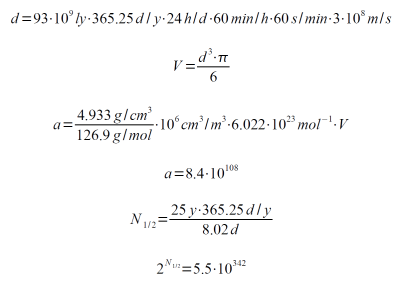
This is not so much an April Fools joke as it is a little riddle. It connects to a current event… and to things that happened in the last century. And of course it has something to do with nuclear power.
What are these equations?
This is a comparison between two estimated values… what are they?
Update: we have a winner! Tony scored a perfect bullseye. I’m quoting him here:
‘a’ is the number of iodine atoms that would fill the known universe, if the iodine were at ‘normal’ temperature/pressure.
the second number is the number of radioactive iodine atoms you would have needed, when Chernobyl exploded, in order to have one radioactive iodine atom left today.
An added trivia is that the estimated number of atoms in the known universe is approximately 10^80.
The upshot of all this is this: there is not a single atom of Iodine-131 released by Chernobyl in existence today. The last atom decayed in no more than 4 years after the accident.
Anxiety, fear, panic or resignation and passiveness . That’s what many people experience under the current overload of information spread by media and various interest groups. We believe that a sound mind doesn’t need other people to tell it what to think, what to fear or what to trust. It needs clear facts.Here you can find explanations in plain language from nuclear professionals . Ask questions, learn the facts and form your own opinion.
NISA has released their update, link 1, link 2, link 3. I have also reattached the earlier JAIF figures at the bottom of the last update to see if it will fix the bug that gives an error when one clicks on the pictures.
As usual the NISA figures are between (). The NISA data is 3 hours older than the JAIF data.
Reactor 1:
Water level in the core: 1.65(1.65) meters below the top of fuel assemblies
Flow rate of injected water: 7.2 cubic meters per hour
Core pressure: 476 (477) kPa
Containment pressure: 270 (270) kPa *note, in the last update I misstakenly wrote 370 kPa as containment pressure.
Core temperature(feedwater nozzle): 195.3 Celsius
Core temperature(bottom head) 146.3 Celsius
Dose rate within containment: 35.1 Sv/hour
Reactor 2:
Water level in the core: 1.1 (1.1) meters below the top of fuel assemblies
Flow rate of injected water: 18.6 cubic meters per hour
Core pressure: unknown
Containment pressure: 116 (115) kPa
Core temperature(feedwater nozzle): 107 Celcius
Core temperature(bottom head): 100 Celsius
Dose rate within containment: 43.4 Sv/hour
Spent fuel pool temperature: 57 Celsius
Reactor 3:
Water level in the core: 2.3 meters below the top of fuel assemblies
Flow rate of injected water: 14.5 cubic meters per hour
Core pressure: 139 (139) kPa *note, I wrote the wrong pressure in the last update
Containment pressure: 106.6 (106.6) kPa
Core temperature(feedwater nozzle): 37.6 Celsius (sounds like an error on equipment)
Core temperature(bottom head): 106.1 Celsius
Dose rate within containment: 36.1 Sv/hour
Due to my error with containment pressure in the last update I withdraw my speculation that its hard to control the pressure in number 1. Rather it seems like the situation is fairly stable. Otherwise not much new information.
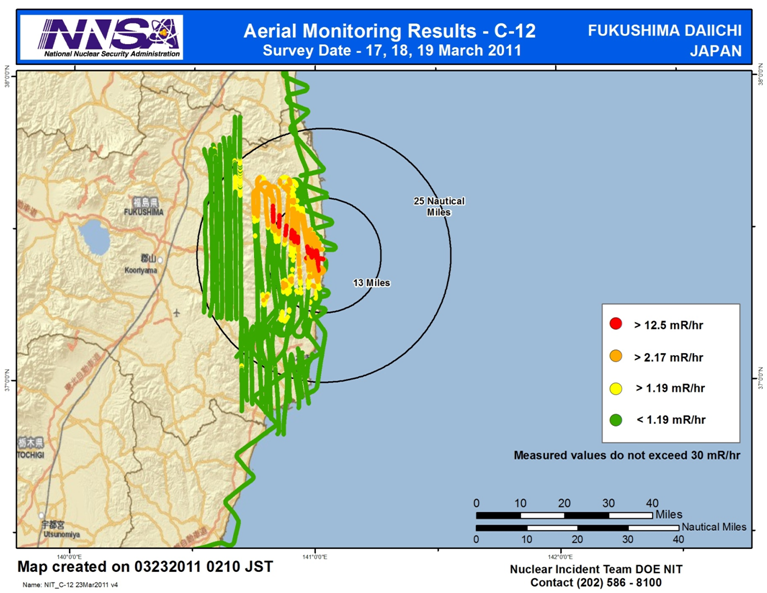
The US Department of Energy has done some arial surveys around Fukushima Daiichi and released the data. I have one pictures from it below(hats of to http://neutroneconomy.blogspot.com/ where I found the pictures). The dose rate unit used on the picture is millirad. 1 millirad=10 microgray =* 10 microsievert *that equality between gray and sievert is only valid for gamma radiation. Gray measures the energy deposited while sievert is weighted in such a way that it expresses a cancer risk. For gamma the weighting factor is 1.
Update 12:00(UTC)/13:00(CET)/21:00(JST)
No NISA updates have been released yet today, JAIF has released their update as usual(one hour old as of writing this).
Reactor 1:
Water level in the core: 1.65 meters below the top of fuel assemblies
Core pressure: 476 kPa
Containment pressure: 370 kPa
Core temperature(feedwater nozzle): no new data
Core temperature(bottom head) no new data
Dose rate within containment: no new data
Reactor 2:
Water level in the core: 1.1 meters below the top of fuel assemblies
Core pressure: unknown
Containment pressure: 116 kPa
Core temperature(feedwater nozzle): no new data
Core temperature(bottom head) no new data
Dose rate within containment: no new data
Reactor 3:
Water level in the core: 2.3 meters below the top of fuel assemblies
Core pressure: 202 kPa
Containment pressure: 106.6 kPa
Core temperature(feedwater nozzle): no new data
Core temperature(bottom head) no new data
Dose rate within containment: no new data
All 3 reactors are now cooled with freshwater instead of sea water. It seems hard for them to get the pressure in the number one reactor under complete control. In JAIF’s written update they say lights are on in all control rooms now. Levels of radioactive materials in the seawater around the plant is climbing. TEPCO is releasing updates on activity in both sea and air, I have attached levels as pictures in the bottom of this update.
The ground deposits of I-131 the prefectures around Fukushima ranges from less than 1 to 16 kBq per square meter. The cesium ground deposits ranges from less than 0.1 to 1.9 kBq per square meter(here are the last 3 MEXT updates on ground deposts link 1, link 2, link 3). The data form the worst effected prefectures are however omitted, we hope MEXT will make those figures available asap! As a comparison the ground deposits of cesium due to Chernobyl ranged from a couple of hundreds to a couple of thousand kBq per square meter.
Not much to add today. The radiation levels in the sea outside Fukushima I are sky-high. The long term effects are hard to predict now since a sea contamination is entirly different from a land contamination, where land is basicly a 2D area, which leads to a thin and high concentration on the surface, and where rains soon concentrate the contamination to “hotspots”. The sea on the other hand is a 3D volume where currents quickly dilute any contaminant by dispersing them over very wide areas.
The JAIF updates from 10:00, 16:00 and 21:00 (JST) for March 26 are pretty much uniform. The big news is that freshwater injection to the cores of 1, 2 and 3 has started as opposed to using salty sea water. Apart from that nothing new. The radiation readings at the main gate (1 km out) has stayed at 170 μSv/h all day. The west gate read 147 μSv/h at 13:30.
There has been no further info yet on the status of the exposed workers or the status of the reactors. Only news about the reactors is that both number 1 and number 3 have now switched to fresh water injection into the core and number 2 was supposed to follow promptly. I end todays updates with a few video clips of the explosion in one of the refineries that was hit worst by the earthquake and tsunami. This disaster has struck so many lifes, so many industries and so many towns that it is hard to fathom.
Uppdate 16:30(UTC) / 17:30(CET) / 00:30(JST)
The 2 workes taken to hospital reportedly got a dose to their feet and lower legs between 2-6 Sieverts from beta radiation. They also got close to 200 mSv from gamma and an unknown internal dose.
They have not shown any signs of acute radiation sickness so far. But the dose to the legs are very worrying and in the worst case might mean amputation.
Update 14:15 (UTC) / 13:15 (CET) / 22:15 (JST)
New updates from JAIF and NISA(link 1, link 2, link3). JAIF status is from 15:00 JST and NISA updates from 10:00 and 12:30 JST. As before the first number is from the JAIF update and the number within () is from the older NISA update.
Reactor 1:
Water level in the core: 1.65 (1.65) meters below the top of fuel assemblies
Core pressure: 450 kPa (450 kPa)
Containment pressure: 295 (295) kPa
Core temperature(feedwater nozzle): 197.8 Celsius
Core temperature(bottom head) 153.6 Celsius
Dose rate within containment: 38.9 Sievert/hour
If one looks at the JAIF status updates one can see a very encouraging piece of information, they have switched from seawater to fresh water injection into the pressure vessel! That is one significant step in the direction of stabilizing the reactor since seawater injection could never be a permanent solution. They are still not using the internal pumps however. The temperature of the core seems to have been brought under control and the high containment pressure is on a slowly declining trend. We can only keep our hopes up that they will be able to avoid venting the containment.
Reactor 2:
Water level in the core: 1.20 (1.2) meters below the top of fuel assemblies
Core pressure: unknown
Containment pressure: 120 (120) kPa
Core temperature(feedwater nozzle): 107 Celsius
Core temperature(bottom head) 105 Celsius
Dose rate within containment: 45.6 Sievert/hour
Reactor 3.
Water level in the core: 2.3 m below the top of fuel assemblies.
Core pressure: 139 (139) kPa
Containment pressure: 107 kPa
Core temperature(feedwater nozzle): 42.8 Celsius (probably junk)
Core temperature(bottom head) 111,6 Celsius
Dose rate within containment: 51 Sievert/hour
Preparations are being made to switch from seawater to fresh water for reactor 2 and 3. If it goes as quickly as for number one it should be done within half a day. Work with electrical equipment on going.
We have earlier warned for the possibility that molten material in the core can be lying on the bottom of the vessel and eating its way through, now that seems unlikely considering how low the bottom head temperatures of the vessel are. All of them are below 200 degrees.
Dose rate at main gate around 200 micro sievert per hour.
Update 12:30 (UTC) / 11:30 (CET) / 20:30 (JST)
TEPCO is preparing to switch from salt water to fresh water for the core cooling. From NHK:
TEPCO says it intends to switch over from pumping sea water to pumping fresh water into the 3 reactors, as salt in the sea water could cause corrosion and buildup, hampering the smooth flow of water inside the structures.
The company has been pumping seawater as an emergency measure.
The power company also says preparations to switch to fresh water were completed at the No.1 reactor on Friday afternoon. Operations to pump fresh water into reactors No.2 and No 3 are expected to start later in the day.
Update 10:00 (UTC) / 11:00 (CET) / 19:00 (JST)
Here are the status tables from the JAIF update described below and summary.
Reactor 1:
Water level in the core: 1.7 meters below the top of fuel assemblies
Core pressure: 465 kPa
Containment pressure: 310 kPa
Core temperature(feedwater nozzle): no new info yet today
Dose rate within containment: no new info yet today
Pressure has decreased by about 60-80 kPa in both vessel and containment since yesterday.
Reactor 2:
Water level in the core: 1.10 meters below the top of fuel assemblies
Core pressure: unknown
Containment pressure: 120 kPa
Core temperature (feedwater nozzle): no new info yet today
Dose rate within containment: no new info yet today
Reactor 3.
Water level in the core: 2.3 m below the top of fuel assemblies.
Core pressure: 139 kPa
Containment pressure: 107 kPa
Core temperature (bottom head): no new info yet today
Dose rate within containment: no new info yet today
Containment damage is again suspected on number 3, otherwise no major changes since yesterday. Let’s hope the containment is not damaged! Luckily the reactors in the possibly damaged containments are behaving more stable than the number one reactor (that has a undamaged containment).
…so far seventeen workers have been exposed to more than 100 mSv of radiation.
100 mSv is the limit where an increase in cancer risk has been proven. At 100 mSv, the lifetime risk of getting cancer increases from about 25-32% to 29-36%.
Keep in mind that this does not say whether or not any of these workers will actually get any cancer, much less die from it. It is safe to assume that just as after Hirosima/Nagasaki, the medical authorities will keep those exposed under very close watch, meaning their chances of getting diagnosed early and thus surviving any cancer will be quite good.
The other change is that the radiation reading at the main gate has gone up again:
The Main Gate: 259.0μSv/h at 11:00, Mar. 25
The pressure in the #1 containment vessel is moving up and down. #2 is stable. The #3 pressure is slowly decreasing. With the worries of a leak from #3, this may have more than one explanation, not all of them good.
Monitoring results of seawater sampled at the coast near the Fukushima Dai-ichi NPS on Mar. 23rd showed that radioactive Iodine, Cesium, Ruthenium, and Tellurium exceeding the regulatory limit were detected. Also, monitoring results of seawater sampled at coasts within about 16km from the Fukushima Dai-ichi NPS in Mar. 23rd showed that radioactive Iodine and Ruthenium exceeding the regulatory limit were detected.
Nuclear Safety Commission of Japan reported the result of preliminary calculation of exposure dose in the surrounding area of Fukushima Dai-ichi NPS.
The dose rate mesaured at the main gate has dropped slightly, from 209.4μSv/h at 12:00, Mar. 24 to 193.8μSv/h at 06:00, Mar. 25.
Water supplies continue to show taints of Iodine-131, but the readings fluctuate and it’s still hard to make out a general trend. Tokyo is no longer under a recommendation not to drink the tap water, but concerned citizens continue to use bottled water to some extent.
Following the latest findings, the Tokyo officials said it will no longer warn against consumption of tap water in the metropolitan area.
”I believe readings will go up and down. But even if levels exceed standards temporarily, it will be no problem as long as they stay (most of the time) within the range throughout the year,” Tokyo Gov. Shintaro Ishihara said at a news conference. ”I hope people in Tokyo would act calmly.”
Still, people in the capital area — located about 220 kilometers from the crippled Fukushima Daiichi nuclear plant — and elsewhere continued to buy up limited supplies of bottled water from shops and vending machines.
The government has asked that people in the 20-30 km zone around the crippled Fukushima plant to evacuate volontarily out of concern for supplies for daily necessities.
The Japanese government has encouraged people living within 20 to 30 kilometers of the troubled nuclear plant in Fukushima Prefecture to leave voluntarily, with concerns over access to daily necessities rather than resident safety prompting the advice, top government spokesman Yukio Edano said Friday.






“Mummy, mummy, there’s a nuclear monster!”
Published by Michael on April 13, 2011One of the frustrating parts about being a proponent of nuclear power is when people rag at you for showing them facts that nuclear accidents aren’t that big a deal. After all… “everyone knows” that a nuclear accident is a catastrophe unlike all others and that a “meltdown” means instant death to thousands of people, cancer to millions and huge tracts of land made uninhabitable for centuries… as told by various groups out there.
So when you point out to them that the TMI meltdown had zero casualties, that the Fukushima triple meltdown and explosion/fire in a fuel pool is presently holding the zero and that the prognosis is slowly starting to look hopeful, and that the current death toll from Chernobyl correspond to the number of people killed in US motor vehicle accidents in one day, people tend to take great offense at you questioning the supposed “truth” about nuclear power. I have been called quite a few unflattering things for this heinous crime of not being upset about nuclear accidents and – even more blasphemous – trying to calm other people about them as well.
Therefore it was with a great sense of recognition I read Lewis Page’s piece “Mummy, mummy, there’s a nuclear monster!” in “The Register today. I won’t steal his glory but I will point out two core pieces and quote them:
This is the problem that everyone faces, who describes nuclear incidents as they really are – that is: insignificant. You are accused of being heartless, of failing to care about or empathise with people who are terribly frightened. You have committed the same sin as bracingly telling a toddler that there is no monster under his bed and that he should go back to sleep.
Part of the problem here is that in the case of nuclear dangers it is rather as though the toddler had a mentally troubled aunt or uncle who, in addition to telling the kid fairytales at story time, insists that the monsters in the stories are real.
The people in charge of story time here are the media, and like many of us finding ourselves troubled by bizarro in-laws, the media fails – seldom really even tries, often enough – to prevent the mad aunt telling the kids rubbish.
[….]
Some of us at least are getting a bit sick of the idea that you simply aren’t allowed to tell frightened people quite bluntly to act their age – and we’re getting more than just a bit sick of irrational or unscrupulous fairytale-spinners making them frightened in the first place.
That is pretty much it: you are considered a villain for telling people “Oh stop whining you baby, it’s just a nuclear accident!”. You’re being painted as an arsehole for not playing along with paranoia and prejudice. They are calling you foul names and questioning your moral character for trying to make people less scared.
It’s one of those things that makes me want to bang my head against the desk and tell people to go overdose on their stress- and angst-hormones if they are so much in love with them. It feels like getting yelled at by a drunk relative for taking his/her bottle away. Why would I bother?
Well… I must, because it’s the right thing to do. If I didn’t, then I’d be an arsehole for real, wouldn’t I? If I firmly believe that someone is wrong in their actions and beliefs, and that they are hurting because of these beliefs, would you suggest I play along? Or should do as I would to the same human being if they had been 25-75 years years younger, by telling them that there is no monster waiting to eat their toes?
The worst part is – of course – that some people have a very strong self-interest in keeping others scared of the nuclear monster under the bed. Let me show you another example…
With “information” like that, is it any wonder that people are frightened? Those who made that video are the ones that should be called heartless, for using and abusing people’s fears simply to advance their position and get more influence.
But good news are no news. It’s easier to sell a story of Doom & Destruction than telling people that things are actually not very bad at all. You’re considered the weird one for not being a paranoid alarmist professing the impending end of life as we know it.
What can we do to break the trend? How can we make people stop being scared of things that are not scary, and focus on the real dangers out there, such as fossil fuels that are killing literary millions of people every year?
Facts… keep speaking the facts… that’s how you eradicate fear, prejudice and misconceptions. I have so far not met a single person who have learned the facts about nuclear power and who has since remained genuinely scared of it! Keep pushing the facts…
Let me close up this post with a video of a fellow swede that has opened up many people’s eyes and minds by showing the cold hard facts in a very funny and interesting manner: Hans Rosling. Enjoy… I did. 🙂
EDIT: as commented below… there is more on www.gapminder.org. 😉
18 Comments