Back when the cold war was still hot, and everyone was searching for communists in the closet, nuclear was still fresh and awe inspiring. The fascination with everything nuclear spawned a tremendous variety of projects and ideas to realize the full potential of nuclear energy and find out its utility in many different applications. When looking back at those projects in this age, after being born into a “precautionary principle” ruled society, some of the ideas might seem like utter madness or amazing brilliance. Pretty much without exception all those projects involved solid engineering and the scientists back then dared to think big, really really big. It is fascinating to look back at those days and realise how many times the world was within centimeters of big revolutions in energy production or space travel. Many of the projects share the same depressing end, getting shut down by political, rather than technical, reasons. Thinking big might not be fashionable anymore in the west, but it will never cease to be educational and it gives hope for what we can accomplish in this century. That is why I will dedicate some time to write a series of “Nuclear History” blog posts that looks into the crazy, the fascinating and the plain ingenious projects of the first nuclear era. A maths warning is in its place, I will not be afraid to throw in equations into the blog posts if I feel it will explain something better than words. I am using MathJax to write the equations and it might not display properly if you read this through a RSS feed, in that case just jump to the blog. If you are put off by equations just skip them and read the text and graphs, they should be self explanatory anyway.
This first post will be about one of my favorites, the fission rocket!

Let us start back in the 50’s. In 1954 the first nuclear powered submarine, USS Nautilus, was launched into the seas and the development of a nuclear jet engine for bomber planes were under way. The grand space race had just started and it was only natural to ask what part nuclear energy could play. In 1955 the Atomic Energy Commission and the US Air Force got together and started the Rover program, the original goal of the program was to create a nuclear driven ICBM. Parallel to this a project called Pluto was started with the goal of creating a nuclear driven ramjet for a cruise missile that could potentially cruise for months on end carrying a large arsenal of nuclear weapons. Both programs where hedges against the possibility that conventional (chemical rocket driven) ICBM’s might not work as well as was hoped. After the success of traditional chemical ICBM’s in the end of the 50’s and beginning of the 60’s project Pluto became redundant and was cancelled (one must also mention that it was so dirty that one could have ignored weaponizing it and just letting it fly low over cities and the radiation from the darn thing would take care of business). Project Rover was left in a position where its military value was diminished but the possibility of a nuclear rocket was still intriguing. Therefor Rover was handed over from the Air Force to the Space Nuclear Propulsion Office (SNPO) which was a collaboration between NASA and ACE started in 1961. Rover continued as the development program for the rocket itself, regardless of what end use it would have, and a new program called NERVA (Nuclear Engine for Rocket Vehicle Application) was started to examine the utilization of the Rover rockets for civilian space exploration. I will a bit sloppily refer to both projects as NERVA.

But before we look into the developments that took place in those two programs, lets stop for a moment and ask what advantage does nuclear energy have in space exploration? After Gagarins first flight into space in 1961 it became blatantly obvious that it was possible to put people in space with chemical rockets, so why even bother with nuclear rocket? Was it simply because nuclear was the cool kid on the block? The traditional rocket engineers certainly did not want anything to do with nuclear, they understood chemicals perfectly well, thank you very much! The nuclear engineers on their side was equally oblivious to the demands of space flight.
The match between space and nuclear isn’t obvious until one starts to look into what is really important for good rocket performance. There are two key parameters that rule supreme, thrust and specific impulse. Thrust is just what it sounds like, the force the rocket is producing, good old fashion Newton’s second and and third laws (for those who have forgotten, the first law is force equals mass times acceleration and the second law is, every action has an equal and opposite reaction). You need a hell of a lot of thrust to overcome Earths gravity well! Specific impulse is a bit more complicated, it is a measure of the efficiency of a rocket engine. It tells you how much mass a rocket needs to expel in order to achieve a certain amount of velocity. In space the only mass you have to play with is the mass you bring and the only way to gain velocity is to throw some mass in the opposite direction of where you want to go. The less mass you need to bring to achieve a certain velocity the cheaper it is to send that bloody thing into orbit. Impulse is just another word for momentum (force) and specific impulse is the momentum gained per unit mass of propellant expelled. Total impulse given by the propellant to the rocket is just the mass of the propellant times the effective exhaust velocity of the propellant. If we assume constant thrust and constant exhaust velocity we can get the specific impulse by dividing the total impulse with the total propellant mass and all that is left is the effective exhaust velocity.
$$I_{sp}= \frac{\int F dt} {m} = \frac{\int \frac{dM}{dt} V_e dt}{m} =\frac{MV_e}{M} = V_e$$
Where:
$$I_{sp}$$ = specific impulse
F = Force
$$V_e$$ = effective exhaust velocity
M = total propellant mass
Now that is a lot of word simply to state that exhaust velocity is important. I go through all of this to explain the concept of specific impulse since it is a term one never gets away from when reading about rockets. Sometimes specific impulse isn’t defined as above either, but it preserves its importance. In another definition, for some reason I don’t understand at all (after all I am only a physicist and not a rocket scientist), specific impulse is often defined per propellant unit of weight (on Earth) instead of unit of mass. The strict definition of weight is the force a mass experiences in a gravitational field. A scale doesn’t really measure your mass in kilos, it measures your weight in Newtons! Using that one then ends up with a definition if specific impulse that looks like this.
$$I_{sp} = \frac{V_e}{g_o}$$
Where:
$$g_0$$ = gravitational acceleration at earths surface (9.81 m/s^2)
In the first definition specific impulse has the unit of velocity, m/s, and in the second definition it has the unit seconds. So if you see people talking about specific impulse of this and that many seconds you know the reason. I explain this because I will consistently use the second definition of specific impulse from now on due to the fact that it is more common to find tables in units of seconds.
Now to realise why specific impulse is important lets have a look at the famous rocket equation formulated by Tsiolkovsky. This equation tells you how much velocity a rocket will gain from a given amount of propellant with a certain exhaust velocity.
$$\Delta V=V_e*Ln(\frac{M0}{M0+Mr}) = I_{sp}*g_0*Ln(\frac{M0}{M0+Mr})$$
Where:
$$\Delta V$$ = the speed given to the rocket
$$V_e$$ = rocket exhaust velocity
$$M_0$$ = Rocket mass without propellant
$$M_r$$ = propellant mass
$$g_0$$ = Gravitational acceleration at the earth surface
The higher the specific impulse the higher the $$\Delta V$$, that much is obvious. Looking at the masses involved is even more enlightening. So lets breaks out the $$M_r$$ term from the last equation and we get:
$$M_r = M_0*[e^{\frac{\Delta V}{I_{sp}*g_0}}-1] $$ = $$M_0[e^{\frac{\Delta V}{V_e}}-1]$$
Lets plot this function! Lets assume we want to go from low earth orbit to orbit around the moon. This will require a $$\Delta V$$ somewhere in the neighborhood of 4000 m/s (to get into low earth orbit in the first place one needs about 10 000 m/s, but lets assume we are already there). Lets also assume we want to deliver about 55 tons of material there. That is about the weight of the Apollo command module plus the lunar lander module plus the empty weight of the S-IVB last stage of the Saturn V rocket. This will give the resulting plot with Isp’s ranging from 100 to 1000 seconds (exhaust velocities of 981 m/s to 9810 m/s).

There are two blue X drawn on the plot. The first X is drawn at the $$I_{sp}$$ value 475, this happens to be the specific impulse that the third stage of the Saturn V rocket had, the part of the rocket that was supposed to give the final $$\Delta V$$ to go to the moon. It turns out that the reaction mass according to the plot above for $$I_{sp}$$ = 475 is 75 metric tons. In reality the S-IVB burned about 80 tons of fuel to reach the moon, so we are playing in the correct order of magnitude here! What about the second X drawn with a $$I_{sp}$$ of 925? To jump forward a bit in time, that happens to be the $$I_{sp}$$ of the final NERVA design, how much reaction mass does that correspond to? 30 tons! Less than half of the S-IVB, a dramatic reduction and a potential cost saver!
To show an even larger advantage for the nuclear rocket, lets look at missions requiring higher $$\Delta V$$. In the figure below I have plotted the reaction masses needed given an $$I_{sp}$$ of either 475 or 925 seconds. At the far right end of the graph one can see the propulsion mass needed to deliver 550 tons from Earth to landing on Mars.

For the nuclear rocket one would need a propellant mass of about 1200 tons while the chemical rocket needs 4900 tons. Given that the weight to launch something into low earth orbit right now is over 2000 US dollars per kg the cost saving on mass alone is close to 7.4 billions! To be fair to the chemical case, the cost to get things into orbit might be cut by a factor of 10 within the foreseeable future (if space x manages to make a reusable rocket), but even in such an optimistic case the potential cost saving might be close to one billion dollars.
The above plots shows why a nuclear rocket is desirable, but it doesn’t explain why a nuclear rocket performs so much better compared to chemical rockets. Why does a nuclear rocket have a much higher $$I_{sp}$$ ? Lets first consider how a chemical rocket works, in a chemical rocket the energy source and the reaction mass is one and the same. You mix two chemicals, they explode in a semi controlled fashion and the resultant products are sprayed out through the rocket nozzle and creates thrust. A common example of liquid rocket fuel is hydrogen and oxygen. There is also examples of solid fuels, the boosters for the space shuttle is one example that uses some kind of aluminum mixture. The chemical reaction heats the reaction products and throws them out of the rocket with a certain velocity. Temperature of a gas is proportional to the average energy of the gas molecules and energy is simply $$E=\frac{mV^2}{2}$$. Velocity of the particles are then $$V=\sqrt{2E/m}$$ and we instantly see that the smaller the mass, with a given temperature, the higher the particle velocity. Ideally, whatever we heat up, we want it to to be made of as light a particle as possible. In chemical rockets we don’t really have the luxury of choice, the reactions that gives the most energy doesn’t necessarily also give the reaction products with the smallest masses. The smallest possible mass is the hydrogen atom since it is the lightest element. The hydrogen + oxygen reaction is one of the most energetic chemical reactions, but the product of the reaction, water molecules, is 18 times heavier than the hydrogen atom. A heated hydrogen gas with the same temperature as a heated water gas will have a velocity more than 4 times higher.
A chemical rocket will never have the ideal propellant due to the fact that one has to introduce other compounds since the energy is generated by the compounds themselves. To have the ideal propellant the energy production has to be separate from the propellant. This is where a nuclear reactor finally enters the picture. If the heat source is nuclear fuel rods and the propellant is hydrogen heated by flowing over the rods. Then one can indeed get a pure flow of hydrogen out of the rocket. In that way one can maximise the $$I_{sp}$$ from the energy produced. Why can’t one do this with chemicals, may be by having some kind of contained chemical that produces heat that is transferred to a pure hydrogen gas? It is due to the fact that chemical reaction releases so little energy compared to nuclear reactions, this means the mass of the chemicals needed for the reaction would be as large or larger than the mass of the propellant. Fission however releases about a million times more energy from the same amount of mass compared to a chemical energy source. The energy required to put the space shuttle in orbit, of the order of $$10^{13}$$ joules, is contained in such a petty amount as roughly 100 grams of uranium. With fission it becomes feasible to separate the energy production from the propellant without having the energy production part being to massive. We can then have a rocket that runs with the same temperature as the best chemical rockets but have 4 time the $$I_{sp}$$ .
In reality everything isn’t quite so rosy, one can not expect to put 100 grams of uranium togheter with some hydrogen into a rocket and easily get a $$I_{sp}$$ that is 4 times higher than the space shuttle rocket. The $$I_{sp}$$ will rather be a bit more than double because hydrogen atoms form H2 molecules and thus the specific weight of the propellant is only one ninth of the weight of water. Hydrogen needs to be heated to over 5000 degrees Celsius before it forms free hydrogen atoms. Also a full reactor weights significantly more than 100 grams of uranium, even if only 100 grams needs to be fissioned to produce the total energy, one still needs a hefty amount of uranium for the reactor to go critical in the first place.
But even taking into accounts those pessimistic facts the nuclear rocket is still very promising. This first part of the series is already long enough. So lets save the fun stuff for the next part. Then we will look at what kind of things they actually built during the NERVA program and the basis for the reactor designs!
Johan


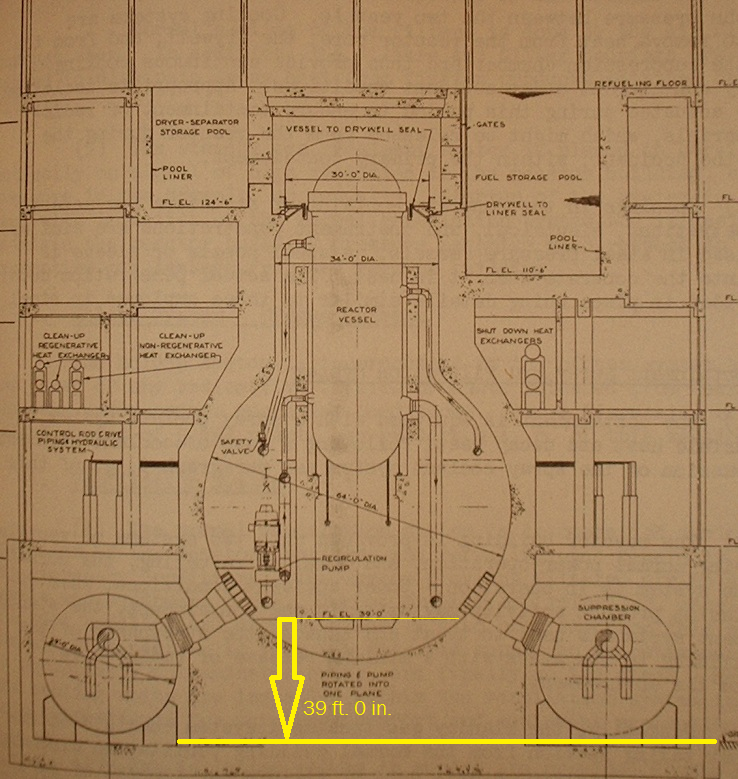
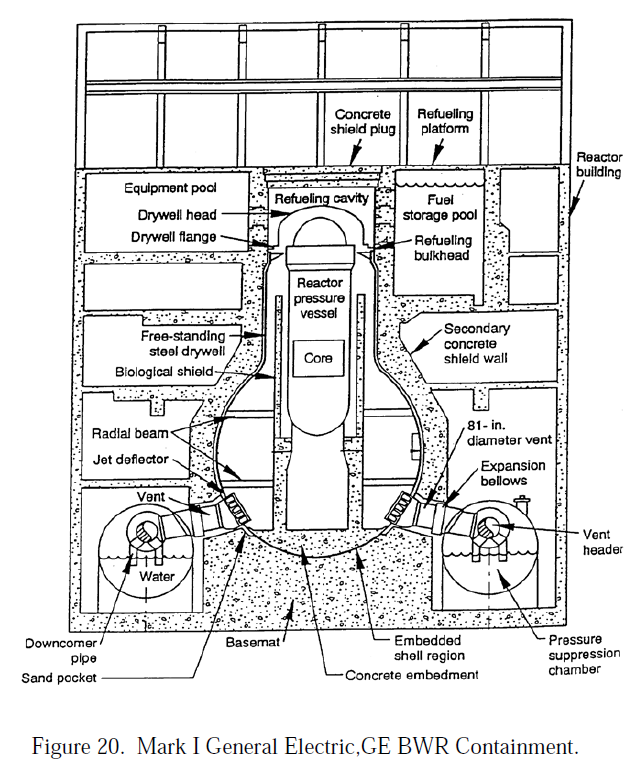
 Den 18onde och 19onde så händer absolut ingenting. Om man läser fotnoten på den bilden så ser man att de exkluderat en mätare (TE-2-3-69F3) som faktiskt satt i botten. Med den inkluderat så såg det ut såhär.
 Aha säger väll alla som vill växla till panikväxeln, temperaturen steg faktiskt i botten. Men sanningen är snarare den att vi har konsekvent sett att temperaturmätare som går sönder först visar en stegrande temperaturutveckling som man inte kan se någon annan stans. TE-2-3-69F3 är exempel på det och TEPCO lär nog meddela samma sak för TE-116-14L#1 och TE-116-14L#2. Vi har tidigare även sett med andra mätare(Will Davis har skrivit om det länk 1, länk 2).


Good news of 2011 in review
Published by Johan on January 5, 20122011 was in many ways a depressing year for nuclear energy. The Tōhoku earthquake and tsunami that caused the Fukushima accident changed many things. Germany’s political leaders went into unreasonable panic and Merkel immediately ordered the shut down of 10 reactors and soon followed that up by a decision to reinstate the previous nuclear phase out plans. With a bit of humor one can state that the Japanese Tōhoku earthquake and tsunami permanently shut down more reactors in Germany than it did in Japan. Switzerland also decided on a phase out plan that is in many ways similar to the phase out plan Sweden was following for many years. Maby the swiss will look at Sweden and learn how badly it worked, only time will tell. Fukushima also temporarily put a break on the rapid nuclear build in China and the future of nuclear in Japan is very unsure.
But this blog post is not about the bad things that happened in 2011, instead we will look at the good things that happened! Here comes a partial list of things that makes us all raise our glasses in cheers of a promising future.
The biggest good news is the rationality that most countries showed after the Fukushima accident. Germany’s panic didn’t spread and most countries that had plans to expand, renew or start a new nuclear fleet has publicly stated they will stick to the plans. In China, without a doubt the most important country for new nuclear projects, their ambitious program has only been downsized slightly and the focus has been shifted towards generation 3 reactors like AP1000 rather than the indigenous generation 2 designs. Plans in the US seems to be going straight ahead after the recent approval by NRC of the AP1000 design and the developing countries are one by one embracing nuclear as a clean and safe energy source for the future. We applaud the maturity most government have shown despite the, at times, ridiculous media coverage.
The year has been an exciting one for small modular reactors (reactors with an electric power less than 300 MW). NuScale was brought back from the brink of bankruptcy by an hefty investment from the engineering company Flour, one of the largest engineering firms in the US. The NuScale design is quite interesting and innovative and I encourage everyone to check out their homepage and have a look. Babcock and Wilcox and their 125MWe mPower design seems to be steaming on right ahead with a cooperation announced with TVA to build 6 reactors at their Clinch river site. The first unit is supposed to be constructed by 2020 and we hope that ambitious time plan will hold up. All depends on the ponderous NRC review process.
B&W’s mPower within its containment structure
Westinghouse doesn’t want to be left in the dust on the small modular market and they presented their own design this year, abandoning their earlier IRIS modular project. The new small reactor is about double the size of mPower at 225 MWe. The whole reactor will be sited underground (a common feature of many small modular reactors) and construction time is projected to be 18 months.
China, not surprisingly, also has a modular PWR in the works, a 100-150MWe design, I haven’t read much about it but it is going to be an interesting fight on what modular PWR will hit the market first. If I was to make a bet then I bet on the Chinese, due to the slow pace of NRC. But mPower sure looks promising and B&W has long experience with submarine reactors which should speed up their development process significantly.
All modular reactors however aren’t light water reactors. There are also several generation 4 designs in the works and news have popped up on several of the during 2011. Bill Gates have several time made the news discussing the traveling wave reactor concept that is being developed by Terrapower, with Gates as one of the biggest investors. The latest information is that Gates was in talks with China about the reactor. The traveling wave concept is a cool one, the basic idea is that one has a fairly large core where most of it is subcritical and composed out of depleted uranium. In the center, or at one edge of the core depending on design, one “ignites” the core with a load of highly enrichment uranium. The area closest to the critical zone will slowly get it is depleted uranium converted to plutonium and become critical while the starting critical zone slowly gets depleted. The whole thing is a fast spectrum reactor with liquid metal coolant so it is capable of breeding. In this fashion a criticality wave travels through the reactor over a time span of say 50 years, continuously producing power. The appeal of the design is that one can basically bury the whole thing, push the on button and then walk away and let it produce power for decades without any need for refueling or major maintenance. The reactor is still in the basic design stage at this point in time and god knows what roadblocks Terrapower will stumble upon. But it is very heartening to see a man like Gates involved and if China gets interesting things can move on quickly.
When talking about China, China is already building a generation 4 modular reactor, the Chinese version of the pebble bed reactor. I worked for a year with Pebble bed reactors and it is a very interesting type of reactor. They don’t have the high fuel utilization of fast breeders but they have plenty of other perks, most of all it’s passive safety. A pebble bed reactor is as close to idiot proof as even the most gifted idiot can imagine. The fuel in a pebble bed reactor consists of tiny particles of uranium surrounded by thin but extraordinarily sturdy layers of silicon carbide and pyrolytic carbon. All these particles is compressed into a ball together with a bunch of graphite and this ball is then surrounded by another layer of graphite to make a pebble about the size of a tennis ball. To fuel the reactor one throws in a whole bunch of these balls into a cylinder that is made out of even more graphite. The whole thing is cooled by blowing Helium through it. What makes this reactor so safe is the thermal intertia of the whole system, the extreme durability of the fuel particles and the very strong negative feedback.
If the temperature of the reactor goes up all the neutrons getting slowed down in the graphite will get slowed down slightly less, this makes fission a bit less probably for each time a neutron hits a uranium atom and the fission chain reaction dies. However we all know that even though fission has ceased, heat is still being generated by decay products and this is where the thermal inertia comes into play. The reactor is pretty much a immense volume of graphite with some fuel particles in there. All that graphite can soak up huge amounts of heat and the whole core is very large in size so there is a lot of surface area to radiate away the heat. Combined this means that even if the cooling systems fail completely the equilibrium temperature of the system, due to decay heat production, will be far less than the temperature required to compromise the fuel particles. One can pull out all the control rods, shut down the cooling systems, go for a 2 week vacation in the Maldives and then return to a intact and naturally shut down reactor. All that is needed to resume operation is to just turn on the cooling again. No damage to system, no catastrophic meltdown, no electric systems needed at all for emergency situations. If the Fukushima reactors, or Chernobyl, or TMI had been pebble beds nothing at all would have happened. Pebble bed reactors also has more versatility than light water reactors due to the fact that they produce much higher temperature heat. The massive industrial heat market then opens up for nuclear energy and it is a market that is larger than the electricity market. The Chinese pebble bed reactor is a potential game changer that one should follow carefully.
More exciting developments in China is the grid connection of Chinas fast experimental reactor. It is a tiny reactor at 20 MWe but it is a strong sign that China is not leaving any stone unturned in their strive for nuclear dominance. The follow up to this fast reactor will be the construction of two BN-800 fast sodium cooled reactors China is buying from Russia with planned construction start in 2013. All the talk of generation 4 reactors being sci-fi is obvious nonsense.
Perhaps the most intriguing news during 2011, at least to me, was the launch of a very high profile Chinese project to develop a molten salt reactor using a thorium fuel cycle. In 20 years they expect to have a commercial molten salt reactor running. So far China has been very secretive with any kind of details about the project. There are many ways to make a molten salt reactor and we are eagerly awaiting any information. But some industry insider information I have heard tells me the project is a big deal politically and already to big to be allowed to fail. I am greatly looking forward to finding out more about the project and reading the first papers they publish. One can only hope they won’t keep it all secret for long but the fact that they dont participate in the generation 4 cooperation regarding the molten salt reactor hints that they want to do this all by themself. The molten salt reactor is perhaps the most promising of all the generation 4 designs, it is however also the design with the most question marks attached to it.
A even more surprising development is the attempts by General Electric to launch their sodium cooled fast reactor design in Sweden and the UK. It is surprising because it shows a lot of confidence in their design and it would be very interesting if one got built in Europe. Sweden is an unlikely market since it would (unfortunately) not fit the general plan in Sweden to treat spent nuclear fuel as waste instead of a resource. For the same reason I doubt the idea will get approval in the UK, but one can always hope.
As far as waste goes developments are happening in Sweden. The company in charge of developing and building a repository (SKB) for the Swedish spent nuclear fuel has progressed to the point that they have handed in an application to start building the repository. If built this would be the first civilian repository in the world and the second repository in operation. The first repository in operation is the american Waste Isolation Pilot Plant that is used to store military transuranic waste (elements heavier than uranium). One can only hope that once the Swedish repository is in action the old mantra “there is no solution to the nuclear waste problem” by the anti nuclear crowd will finally be silenced. But they didn’t go silent after WIPP started so I guess that is to much to hope for. The swedish anti nuclear NGO’s like Naturskyddsföreningen and MKG are fighting SKB tooth and nail now when they are on the verge of loosing the waste fight. Spreading FUD wherever and whenever they can.
Those are a small selection of the good news from 2011 that I can remember of the top of my head. Many other things have of course happened, like the approval to build one more reactor in Finland and the developments in the Czech republic, Poland and many other countries. If I have missed some big happy news please let me know in the comments!
Hope all readers of this blog will get a splendid 2012!
Johan
6 Comments