Skip to content

Author: Johan

Welcome Fukushima progress

We are now over 3 months into the Fukushima accident, progress is creeping along at a steady pace. Since our last update there has been lots and lots of new and I won’t try to cover it all. The biggest news I want to share now is that TEPCO has gotten some kind of recirculation cooling working, it was reported today by Will Davis at Atomic Power Review(by far the best blog to keep an eye on for Fukushima news, I highly recommend to read it).

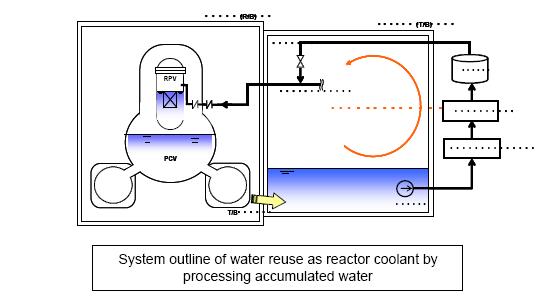
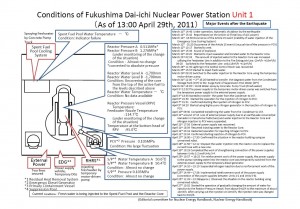
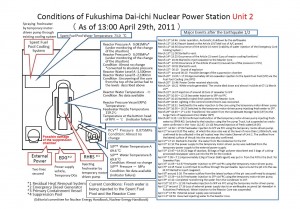
In short water is leaking out of the containment buildings into the turbine buildings, the water is pumped from the turbine buildings into the water treatment facility, then from there its pumped back into the reactor. Its like I described in the last update on may 18th (shown on the picture below) and one of the steps in the plan TEPCO released that month.

If everything goes well now the volumes of contaminated water will start to creep down, a proper toast is in order!

Another fairly recent news is that NRC announced that the spent fuel pools in Fukushima never went dry. That really calls into question Chairman Jaszco’s recommendation for a larger evacuation zone for american citizens in Japan than what the Japanese authorities had decided.

There has also been a lot of bullshit flying around about the situation in Fort Calhoun due to the river flooding around the nuclear power plant. Claims about goverment cover ups, Russian authorities warning about disaster etc. I haven’t bothered to look more in detail into it yet, but so far the reactor has both working diesels and connection to the external grid and quite a bit of margin before the river even comes near to flood over the flood protections. Here is a good post by Neutron Economy about the situation.

Why I’m not worrying about Fort Calhoun (and you shouldn’t either)


Links(English)
Rod Adams Ted Rockwell – Fukushima: It’s Not About Radiation, It’s About Tsunamis
NEI Nuclear Notes Friday Update
World Nuclear News Fukushima cover on its way
The Neutron Economy Expected Doses Over a Year and Evacuation of Fukushima Towns
Will Davis How the Misinformation Superhighway affects Nuclear Energy
Will Davis JAIF Public Opinion Poll Data


Links(Swedish)
Med örat mot rälsen Kärnkraften igen
Kultur Ska vi glömma Fukushima?
Seppo Laine Mycket värre än man kunde tro


Status for each reactor

/Johan

4 Comments

Day 68: Video of work at Fukushima and a encouraging PDF

TEPCO has released a video that shows work being done at the Fukushima plant. Very interesting to watch.

One gets a real sense for the devastation the tsunami inflicted while watching that clip.

TEPCO also recently released this PDF file that gives an overview of work being done. I will add some pictures from it:

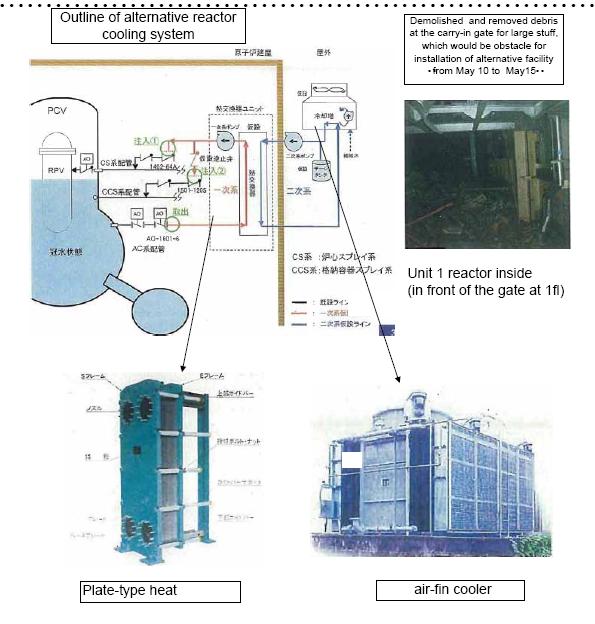
In the above picture one can see how they plan to rig up the new heat exchangers for reactor 1. Within the reactor building, but outside the containment, they will put a water to water heat exchanger. They will pump water from within the containment through this heat exchanger, where it transfers the heat to a secondary circuit that in turn flows to a heat exchanger outside of the reactor building that dumps the heat to the air. This is the original plan TEPCO had before they realized the full extend of the damage to the number 1 core and containment, so it is not sure they will progress as described. But the secondary heat exchanger and its piping is already being built.

Tepco also shows the above picture on how they plan to reuse leaking water from the containment as cooling for the reactor. It is not clear how the two plans are connected to each other. I would assume the second plan is the one that is going to be used instead of the first plan. Instead of taking water directly out of the containment they will use the existing leakage paths, purify the water and pump it back into the reactor.

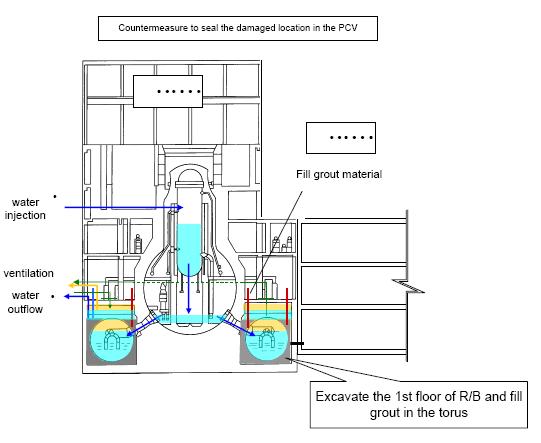
For the number 2 reactor shown above the main problem is to stop the leakage from the suppression pool. They plan to excavate the reactor building in order to access the room where the suppression pool is housed and then fill the entire volume with grout. Considering that (probably) the suppression pool is leaking at number one as well then maby this plan will be implemented there as well (just my speculation).

Both in unit 2 and 3 are they planning to reuse the leaking water in the same manner as in unit 1.

In the rest of the document they give some basic information on how they plan to clean the massive amounts of contaminated water that exists on the site, some details on the protective building they want to build around the reactors and how to prevent more contamination of soil, water etc. Well worth scrolling through, massive work is certainly ongoing at the site and it seems TEPCO has a solid plan that they are implementing.  Of course more surprises will without a doubt pop up during work, but it looks promising. We are still waiting for more in depth information on the situation of the number 2 and 3 reactors.

English blogs:
All Things Nuclear TEPCO Says Core of Unit 1 Melted
Atomic Power Review Fukushima Daiichi update, Weds. morning 5/18

English News:
New York Times Venting Failure in the Nuclear Reactors at Fukushima Daiichi
Reuters UK nuclear power gets green light

/Johan


6 Comments

Day 67: Complete meltdown of the number 1 core

During the last days a lot of news has been released by TEPCO. TEPCO has released this presentation that gives more details of the events that took place in the number 1 reactor from the beginning of the earthquake up until now. To summarize the content of the presentation.

  • The water level gauge has been giving wrong readings, the reading has been stating that the water level is about 1.7 meters below the top of the fuel assemblies. In reality the water level has been 8 meters below the top of the fuel assemblies, this means the entire length of the fuel has been uncovered completely.
  • TEPCO now assumes the RCIC system failed after the tsunami (another news release indicates it was manually shut down!!)
  • 16 hours after the earthquake the entire core had suffered a meltdown and all of it dropped down to the lower part of the pressure vessel.
  • The temperature readings on the vessel indicate that the core is still mostly within the vessel and adequately cooled.
  • Some parts of the core is suspected to have melted small holes in the bottom of the containment, which explains why they could not increase water level despite increasing pump rate.

They don’t mention the reading of the pressure gauge that indicates the vessel pressure is about 14 atmospheres. I was personally fooled by this reading and assumed the number 1 vessel is in better shape than the number 2 and 3 reactors. The question is what readings can be trusted at all.

Due to this new information on the status of the reactor TEPCO has decided to scrap the original plan to flood the containment up to the level of the fuel assemblies. Since all the fuel is now located at the bottom of the vessel there is no need to flood the containment that high.  The containment is also confirmed to be breached and water leaking out of the it like in the case with reactor number 2.

Another theory for the explosion in the number 4 reactor building has appeared. The videos from the pool show that it is largely intact and no major fuel damage can be seen. That means it seems unlikely hydrogen from a zircalloy+water reaction in the spent fuel pool can be the cause of the explosion. Instead TEPCO now believes hydrogen leaked into the number 4 building from a shared ventilation system with the number 3 reactor.

TEPCO is going to do more complete analysis of the status of reactor 2 and 3 and the information will be released within days. It will be interesting to see if the RCIC system (see this blog post for a description of the system) worked in the other 2 reactors and, if it did, to what extent it mitigated the consequences of the station blackout.

Work is progressing on all fronts to build a enclosure around the number 1 reactor, to build a water processing plant, create more redundancy in the electricity supply, clear the area of debris and to pump away the junk water from the turbine halls and trenches. IAEA as usual reports the release of radioactive material and dose rates.

The Fukushima accident has unfortunately seen its first death with a 60 year old worker that lost consciousness  while working on a drainage system to the radioactive waste storage. He was brought to a hospital but could not be revived. So far there is no report that the death was related to radiation.


News English:
WNN Fukushima fuel melt confirmed
WNN Theory for Fukushima Daiichi 4 explosion
WNN Revisions to Fukushima restoration roadmap

Blogs English:
Depleted Cranium Worker Dies at Fukushima Nuclear Plant
Atomic Power Review Core totally demolished at Fukushima Daiichi No. 1

Blogs Swedish:
TEM funderingar <Är kärnkraft förnybart?
Den blinde Argus Kärnkraft och rädsla
Supermiljöbloggen IPCC: Förnybart kan ersätta fossila bränslen
Fourfact Blinkar jätten?
Skattepolitik och samhällsfilosofi Inga elbilar i Sverige om Tyskland stänger kärnkraften?
Ann-Kristine Johansson Kärnkraftsdiskussion
Nina Drakfors Japan, kärnkraftshaveriet fortsätter och kräver strålningsdödstal
Supermiljöbloggen Amerikansk kärnkraft dåligt rustad för katastrofer

/Johan

Comments closed

Day 58: Dose rates climbing in the number 2 wetwell

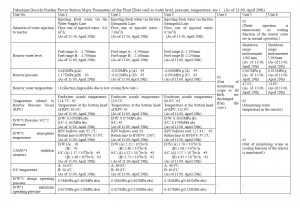
Another week has passed and more steps have been taken to get the situation under control. Lets start with the usual reactor status table  made out of NISA data:


Reactor 1 Reactor 2 Reactor 3
Water level (meter)* -1.7 -2.1 -2.15
Flow rate(m3/min) 8 7 9
Core pressure (kPa) 1390
Containment pressure (kPa) 120 60 102
Wetwell pressure (kPa) 110 183.2
Feedwater nozzle temp (Celsius) 119.8 115.6 202.1
Bottom head temp (Celsius) 96.9 151.9
Wetwell temperature (Celsius) 51.4 66.8 40.0
Containment dose rate (Sv/hour) 22.7 12.2
Wetwell dose rate (Sv/hour) 1.1 148 0.480
*Distance from top of assembly
– broken gauges or missing data

Everything looks pretty stable except the wetwell dose rater in the number 2 reactor. It has increased to well over 100 Sv/hour from 37.1 in the last update I made (i wrongly wrote 0.371).  I haven’t been able to follow the news so closely the last week so I have not seen if this has been mentioned in any TEPCO press release. Below is a graph of the increase. If anyone know of any action done on the number 2 reactor, starting the 3 or 4th of may please write a comment to this blog post.


A air filtration system has been connected to the reactor building of reactor number 1. The purpose of it is to get airflow through the building and clean out the air activity by filtrating the air. It is hoped that it will be enough to allow workers to enter the building and work safely without getting to much dose.

Kyodo reports that TEPCO plans to send in workers on monday in order to measure dose rates within the building. Seems strange that they would send in people when they have already used robots once for that purpose.

A longer video clip of the number 4 spent fuel pool can be seen over at Atomic Power Review. It doesn’t appear to be very damaged.

The big news of the week is that the prime minister of Japan has asked Chubu electric to shut down its Hamaoka nuclear power plant. Hamaoka has 3 operational nuclear power plants, all of them quite new. Started at 1987, 1993 and 2004. The newest one is a ABWR and would presumably have state of the art eartquake protection. The reason for the prime ministers request is a estimate that the site  has a high probability to be hit by a 8.0 earthquake within 30 years. If the reactors indeed can not handle such a quake then the closure request is rational. But it does smell a bit like political posturing at this point. There is no legal precedence for such a situation and it is not clear if Chubu electric has to obey the request.


Links(English)
WNN Filters for Fukushima Daiichi 1

Blogs(English)
Atomic Power Review Japan updates: Fukushima Daiichi, Hamaoka
NEI NEI Weekly Update on Fukushima Daiichi – 5/6/1

Blogs(Swedish)
Effekt Monbiot brottas med sig själv
Genusnytt En KARL ska väl tåla lite strålning…
Forskarbloggen Hur många döda efter Tjernobyl?
inas insikter Tjernobyl idag / Fukushima imorgon?
Begrundat och Plitat Cesium och Jod verkar ge spikes i Fukushima när man gläntar på dörren …

/Johan

2 Comments

Day 50: First year dose estimates

As the pace of events is winding down in Fukushima so are our updates.

JAIF and NISA updated data below in the table, click the links to see the time graphs from the FNPP1 blog:


Reactor 1 Reactor 2 Reactor 3
Water level (meter)* -1.7 -2.1 -2.25
Flow rate(m3/min) 6 7 6.5
Core pressure (kPa) 1175
Containment pressure (kPa) 105 75 103.3
Wetwell pressure (kPa) 105 179.6
Feedwater nozzle temp (Celsius) 114.7 119.2 80.6
Bottom head temp (Celsius) 95.0 112.9
Containment dose rate (Sv/hour) 24.8 17.0
Wetwell dose rate (Sv/hour) 1.5 0.371 0.527
*Distance from top of assembly
– broken gauges or missing data

Temperatures, pressures etc look quite stable. Pumping of water form the tunnel connected to the number 2 turbine building is marginally successful. Spraying of a resin to bind down radioactive material to the ground, and prevent it from stirring up into the air, is ongoing all over the plant area. TEPCO has managed to get a camera in to investigate the number 4 spent fuel pool and world nuclear news report that the damage is limited, below is a picture from WNN of the pool.

Atomic Power Review writes that NISA has doubts about TEPCO’s plans to flood the containments. The doubt is regarding the structural integrity of the containments with the added strain from such a huge amount of water. Flooding the containment is a part of TEPCO’s plan to restore recirculation cooling to the reactor so it will be crucial to see how TEPCO responds to NISA and if they can show the containments can handle it. If they can not show it conclusively, then they will have to devise a new plan on how to restore cooling. In my last post I was questioning why they would want to flood the containments in the first place, but then realized that if the reactor vessels are broken and leaking, then the only way to submerge the fuel completely is to raise the level of water in the containment to the same level as the top of the fuel assemblies within the reactor vessel. I don’t see why this would be needed for the number one reactor, since it seems like it is holding pressure very well and must be pretty intact. But might be the only way for the number 2 and 3 reactors.

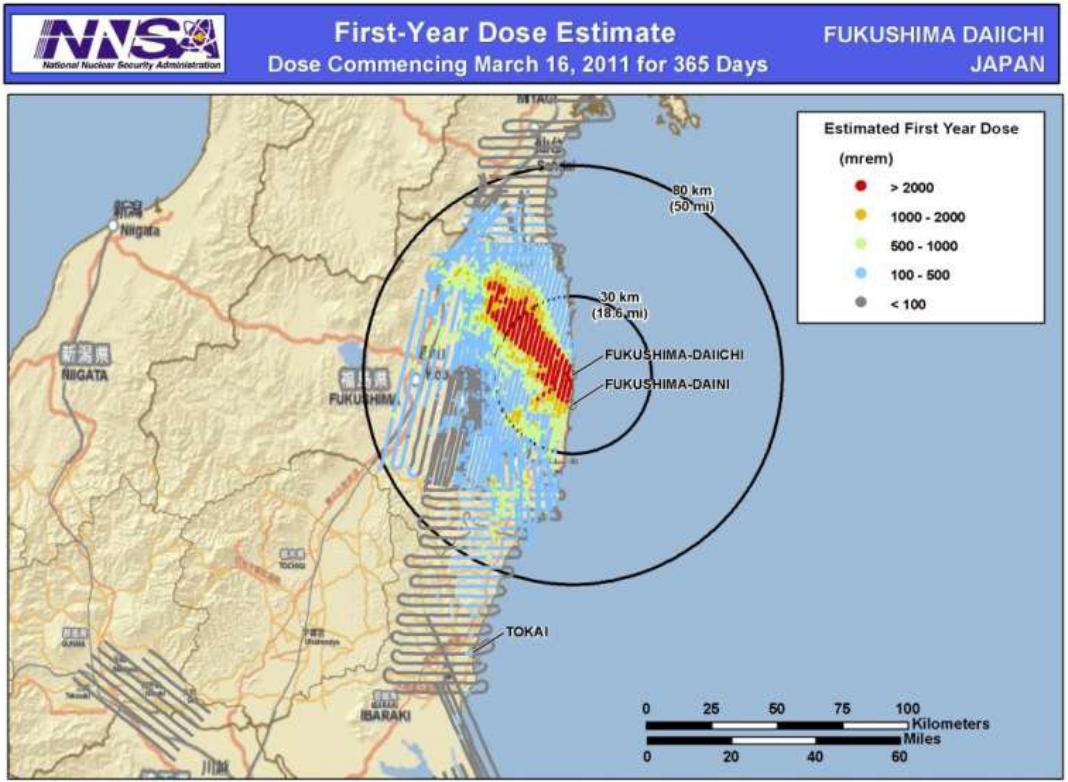
Over at The neutron economy one can read a blog post on the expected first yearly dose relased by the US department of energy, below is a map of it.

The dose rate is based on the following assumptions:

  • Assumes no reduction for spending time indoors
  • Takes into account decay of the radionuclides
  • Takes into account gamma ray from ground deposits and inhalation of stirred up particles from the ground

The map is using the common american unit millirem. One millirem is equal to 0.01 millisievert. The red area marks the area where one would get more than 20 mSv/year if one lives there given the above assumptions.  Yellow area is 10-20 mSv, green area is 5-10 mSv and blue area 1-5 mSv. Neutron Economy also shows a picture with more detail of the over 20 mSv area that can be found in this link. Close to the plant it will be up to 200 mSv and in some hot areas 100 mSv. Some of the hot areas are outside of the initial 20 km evacuation zone and that explain the new evacuation areas. It is not immiedietly dangerous to be in those areas but one probably does not want to live there. It will be interesting to hear what plans will be made to clear out the areas. Outside of Fukushima dose rates are down to natural backgrounds levels according to IAEA. Seems like bans on shipping of most kind of food products have been lifted.

More information about exposed workers have been released, so far it looks like this:

  • 200 – 250 mSv             2 workers
  • 150 – 200 mSv             8 workers
  • 100 – 150 mSv             11 workers


In summary one can say that the situation as far as radiation levels are concerned is improving. Radiation levels are decreasing everywhere. The situation with the reactors are fairly stable, but long term cooling is still a big question mark.

/Johan

Links(English)
World Nuclear News No significant damage to fuel at unit 4

Blogs(English)
NEI Nuclear NotesWeekly Updated
Atomic Power Review NISA instruction to TEPCO
The Neutron Economy Expected Doses Over a Year and Evacuation of Fukushima Towns

Blogs(Swedish)

Dagens Kotka Tre härdsmältor på samma plats
Fourfact webloggen Naturligt kärnkraftsmoratorium
Stockholmscollage Vad har uranpolitikerna att frukta
Svensson En annan värld – kampen mot kärnkraft
Akkomp’s blogg Som ett smycke


11 Comments

Day 42: How is a core cooled?

Tepco has released more information about their plan to stabilize the Fukushima reactors(link 1, link 2). Their table of measures to be taken is hard to read, but the schematic of the plan is quite enlightening and i have attached it below.
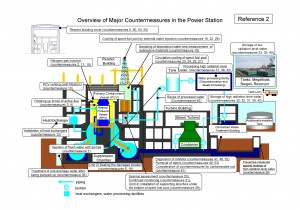
They are basically facing 4 problems, ensuring long term cooling of the cores,  ensure cooling of the spent fuel pools, prevent release of radioactive material and mitigate the consequences of the releases that will continue for a while. I want to speak a bit more about cooling in this blog post since it is the most crucial problem.

As I have written before (and I will repeat it again, bear with me), the most important thing is to get circulation cooling going again. The current way of cooling the reactor, by pumping in water, letting it boil and then venting the steam out into the containment, is not a long term solution since one is continuously adding water to the system. The volume of the containments are large, but not infinite.  One can’t put more and more water in there without it sooner or later coming out out somewhere, somehow. We are seeing that in the large leakage from the number 2 reactor. Cooling by circulation simply means one pushes water into the core somewhere and take it out somewhere else. The water taken out is then run through a heat exchanger that cools the water by dumping the heat into a heat sink (the ocean). There are a bunch of different cooling systems in a reactor.

During normal operation of a BWR(boiling water reactor), heat is carried by steam from the core, the steam passes through a turbine that generates electricity and then the seam goes through a condenser that cools it into a liquid state again, before its pumped back into the core. The condenser in turn is connected to water flow from the sea, a river or some other big body of water that keeps the condenser cool so it is able to condense the steam.

When the reactor is shut down there is still decay heat that needs to be removed. One does not want to produce steam during shutdown so the normal cooling by letting steam go through the main steam line out to the condenser is not an option. All BWR’s has recirculation pumps that takes some of the core water and recirculates it within the vessel, during normal operation this is done to control the steam level in the core. Connected to this recirculation loop is pumps and pipes that can lead water to a heat exchanger that dumps heat to some heat sink before it is circulated back. This system is used to provide cooling during shutdown and is called the Residual Heat Removal (RHR) system. It’s capable of getting rid of the decay heat (heat that continues to be produced from decay of fission products, long after the fission chain reaction is shut down) and keeping the water in the reactor at below 100 degrees Celsius.

The above two options both require electricity do drive pumps, both for the internal circulation but also to get seawater to the heat exchangers that cool the water in the internal circuit. If for some reason pumping power is lost there is a system that kicks in and can run for a short time period (hours). The system is called the Reactor Core Isolation Cooling (RCIC) system. It works by using a temporary heat sink. All BWR has something called a “wetwell”, the wetwell is a water filled volume within the primary containment below the reactor pressure vessel (that contains the core). In an emergency one can shut the main steam outlet and the main feedwater inlet to isolate the containment from the sounding environment. The steam generated in the core is instead diverted into a small turbine that drives a pump that pumps water into the core from the wetwell or from a water storage tank. After passing through the turbine the steam is dumped down into the water in the wetwell. When mixing with the water the steam will condensed and can be pumped back into the core, at the cost of heating up the wetwell water. When the wetwell water gets close to boiling point it can no longer absorb any heat and it  stops acting as a heat sink. When that happens no more water gets returned to the reactor and water level starts to drop in the core. Usually it can absorb a couple of hours worth of decay heat. This system was the system that was cooling all the Fukushima reactors for the first hours after the accident. It is almost a passive system, it doesn’t require any large amounts of electricity but it do require some small power from batteries for control.

The trouble in Fukushima started after the RCIC shut down. There was no power to start up the RHR and water level started to drop causing the fuel in the core to be damaged and release radioactive material into the water in the core. As a emergency move TEPCO then started to inject water into the core to cover the fuel again, without having anywhere to dump the steam getting produced. They have been doing that during all the time so far. The hope was that they would be able to restart the RHR system after recovering power to the reactor. But the tsunami drenched all the switchboards for the control room and also flooded the turbine hall basement where apparently a lot of the equipment related to the RHR is located. Leaks from the core afterwards contaminated this water so much that workers can not get to the equipment to restore the RHR.

The dilemma for TEPCO is that they can’t repair the equipment for the RHR as long as the cores are leaking radioactive water, but the cores will continue to leak as long as TEPCO continues to inject water into the cores without having restored the RHR circulation. So what can they do in a situation like this? They have desperately been trying to find some way to pump out enough water to be able to start repairs, but to no good. Even if they could it is doubtful the repairs can be made quickly, likely the entire system is completely trashed after having been drenched with salt water for weeks. That leaves TEPCO with only one option, create a new RHR loop.

What they are planning to do as far as I can tell is to install a bunch of heat exchangers somewhere with access to seawater. Then they will pump water out of the reactors, through the heat exchangers and then back in. Just like the RHR would do. The difference is that they are going to have to pump the water in pipes straight out of the containment and reactor building. One would normally never do such a thing since the risk of a leakage is not trivial and due to the radioactivity of the water, once they start pumping, no one will be able to be close to the pumps or pipes. It would not be very pleasant for instance if a new earthquake where to rip the pipes apart while they are pumping, but the option of not doing anything isn’t really an option at all and if they can get that cooling working then they could more briskly get to work on restoring the real RHR system.

What confuses me at this point is where they will connect the new temporary system. First they where talking about connecting it to the feedwater line and some kind of fire extinguishing system, both connecting to the reactor vessel. That would be ideal since it would prevent crap from getting out of the core and into the containment, which is the main problem, since the containment on the number 2 reactor is leaking and causing the big problem in the turbine hall basement. But now, from the plan I posted above, they indicate will instead flood the containment and connect one end of the temporary RHR to it while the other end goes into the core. They will in other words circulate water:

From core -> into containment -> out of the containment through a heat exchanger -> then back into the core.

I don’t see how this solves anything since it is the amount of water present in the containment that seems to be causing the leakage problem in the first place! But I guess their plane will become more clear in the future.

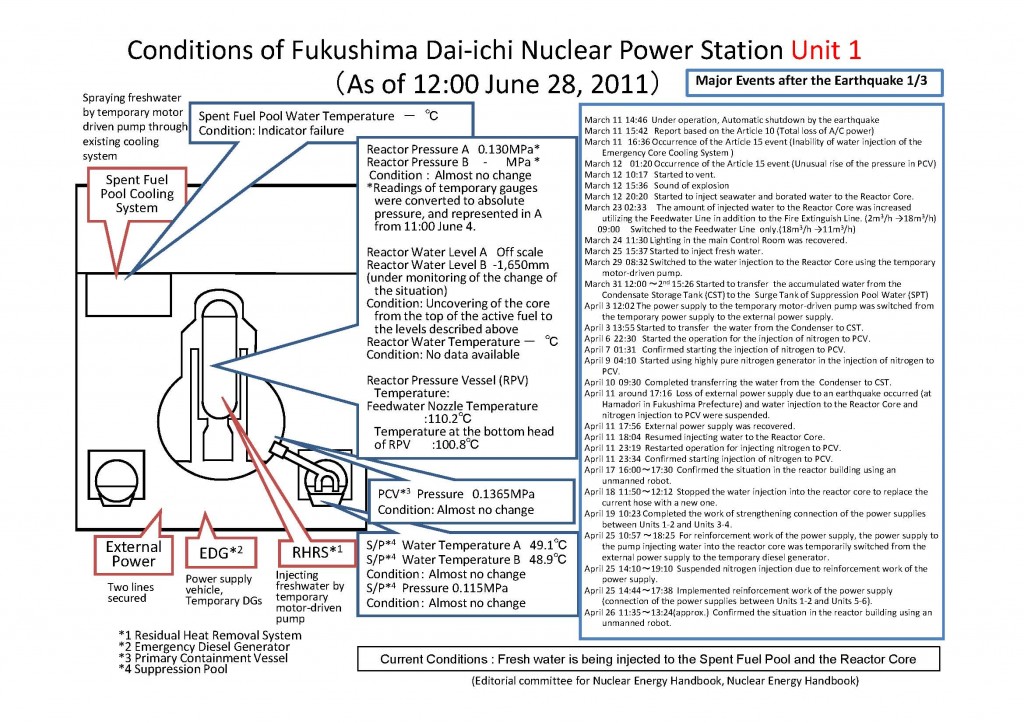
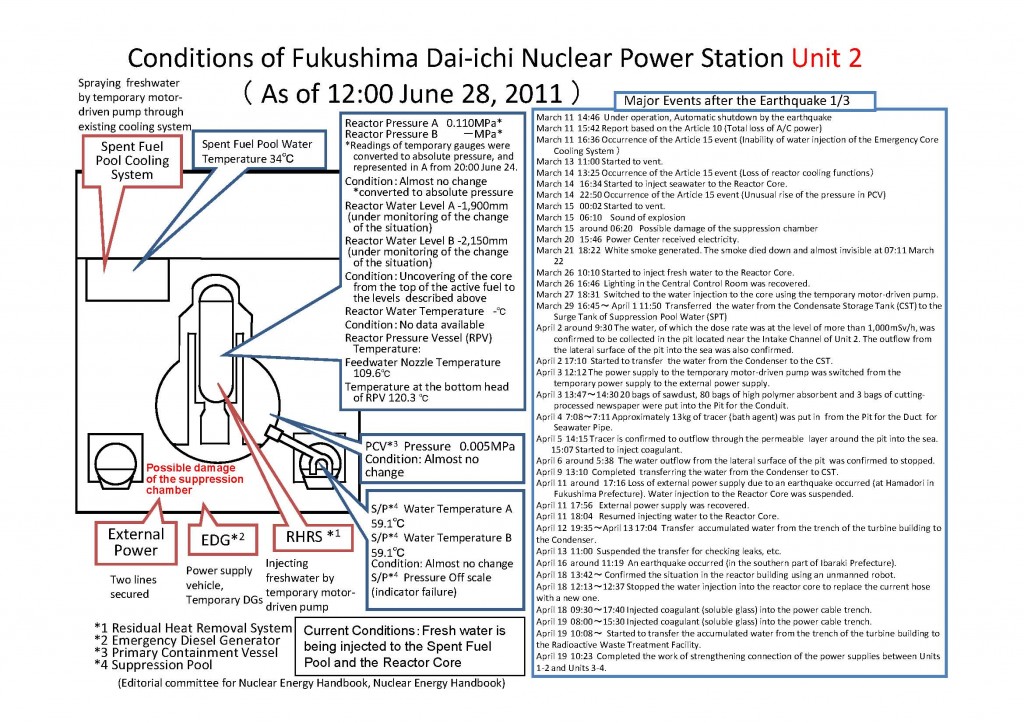
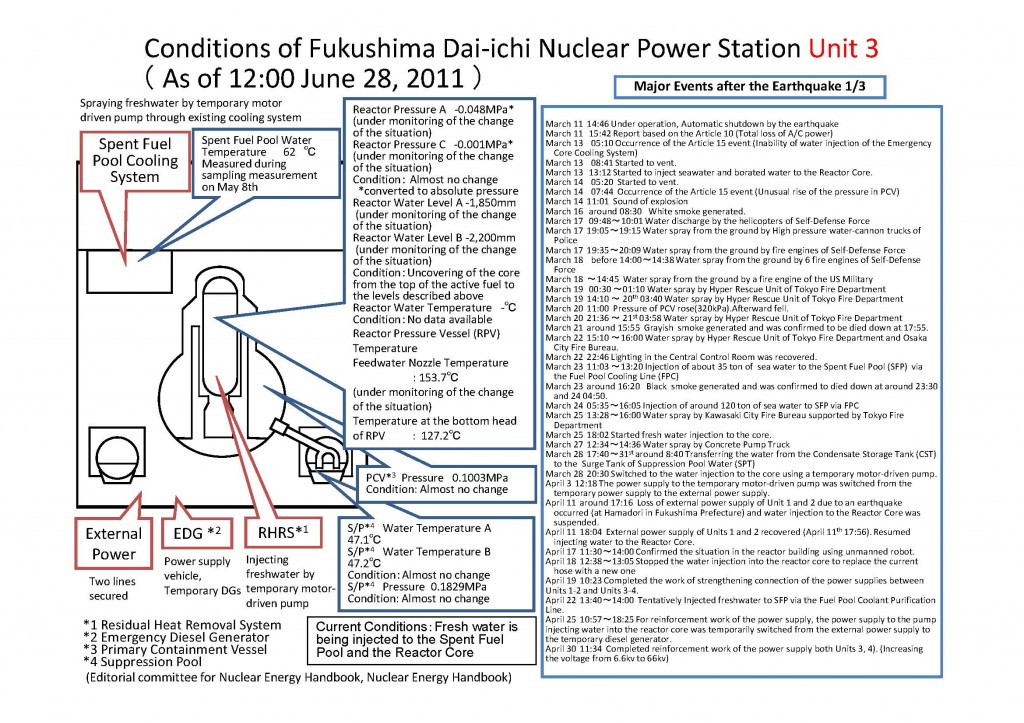
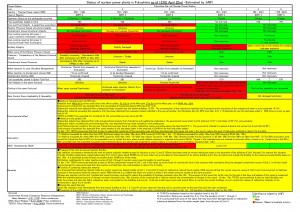
As for other news. There is nothing new about the status of the reactors as can be seen from the pictures below, temperatures in all three reactors continue to go down. Pressure in number one reactor seems to have stabilized a bit and the declining trend in radiation levels around Fukushima continues.


Links(English)
World Nuclear News Roadmap for Fukushima Daiichi restoration
World Nuclear News Plans for Fukushima basement pumping
Kyodo News Japan bans residents from remaining within 20-km of Fukushima plant

Blogs(English)
Brave New Climate Energy debates in Wonderland
Depleted Cranium Assessing the Long Term Danger to Fukushima Workers
NEI Nuclear Notes TEPCO’s Plans to Stabilize Fukushima-Daiichi
NEI Nuclear Notes Analysis of Replacing Japan’s Nuclear Plants With Other Technologies
Atomic Power Review AREVA awarded water treatment plant contract…
Damian Carrington Unsure about nuclear power? Here’s the five questions you must answer to decide
NEI Nuclear Notes ANS Nuclear Cafe – “Why is there irrational fear of radiation?”
NEI Nuclear Notes Italy, Poland (and Its Neighbor Germany), Exxon
All Things Nuclear Cleanup Lessons from TMI for Fukushima?

Links(Swedish)
Uppsala Tidning ”Ompröva kärn­kraftsbeslutet”

Blogs(Swedish)
Jinge Vad har vi lärt oss?
Svensson Fukushima lika allvarligt som Tjernobyl
Supermiljöbloggen Kina gör svängom efter Fukushima
Förbannad Pacifist Marianne Stieger: En strålande framtid
Kunskapssamhället Säkerhetszon runt Fukushima

/Johan
13 Comments

Day 39: TEPCO’s plan to restore cooling

It seems like TEPCO has realized it will take some time for them to restore the internal circulation pumps in reactor 1-3. The equipment has been drenched in salt water for some time now and the highly radioactive water in the turbine halls makes it very hard to do any kind of work. The normal cooling works by having water circulating through the core, then going through a heat exchanger that transfers heat from the water to an outer circulation loop that transports the heat to some kind of heat sink (in this case the ocean). The form of cooling that TEPCO has been doing since this accident started is to simply pump water into the cores, where it boils and creates steam that they then blow down into the wetwell. This means water is going into the building, but not leaving it. As anyone can realize that can’t go on forever until water comes out somewhere because the wetwell and containment doesn’t have infinite volume to store water. All the crap water that has been leaking into the sea is a result of this cooling method.

Since they have to try to prevent more leakage into the sea and they can’t get the internal cooling working TEPCO was left with the choice to build a new closed loop with new heat exchangers. All one really need is a pipe where one can put water into the reactor and another pipe where one can take the water out. Connect that to a heat exchanged and voila you have new circulation cooling without any need to fill the wetwell with steam. That is exactly what TEPCO is going to do.

That isn’t a solution without problems though. The reactor circulating through the core will become very radioactive due to the partially melted fuel, so any pumps and pipes used will be dangerous to approach. Everything has to be set up in such a way that once started it will run quite reliably, because repairing things won’t be easy. It would also be quite dirty if the pipes or pumps starts leaking so they better make them tight.  Still it seems like a better and more long term solution than what they doing right now and it seems to be necessary in order to get rid of the radioactive water in the turbine halls, in order to get access to the real pumps and restore/replace them. Right now water is leaking out as quickly as they can pump it away.

The above strategy is a part of a bigger plan to stabilize all the reactors, stop all leakage of radioactive material and put all 3 reactors into cold shutdown. TEPCO estimates it will take 6-9 months before its all finished. Among other things TEPCO will build up storage and processing facilities for the radioactive water, build covers over the damaged reactor buildings , somehow repair the breach in the number 2 wetwell (one article mentioned “sticky concrete”) and inject nitrogen into all the containments.  Atomic Power Review has a nice short list.

It is positive that TEPCO seems to have a long term plan, lets hope they will be able to proceed with all the steps without to many unexpected problems.

TEPCO has driven around inside the reactor buildings with a robot equipped with radiation detectors and the dose rates within the buildings are around 50 mSv/hour. A worker could only work there for 5 hours before they exceed the maximum allowed dose limit. I wonder how they plan to deal with that and I also wonder how they have measured it.

The status of the reactors are fairly unchanged. Temperature going down in the number one reactor.

Dose rates are going down, the gamma dose rates are according to IAEA

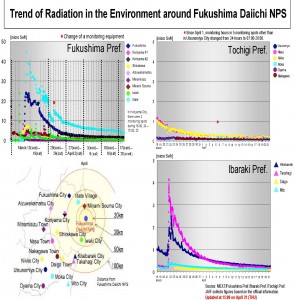
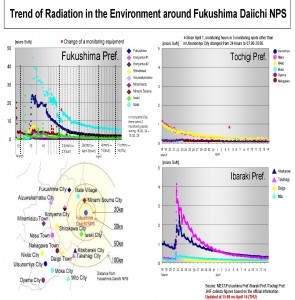
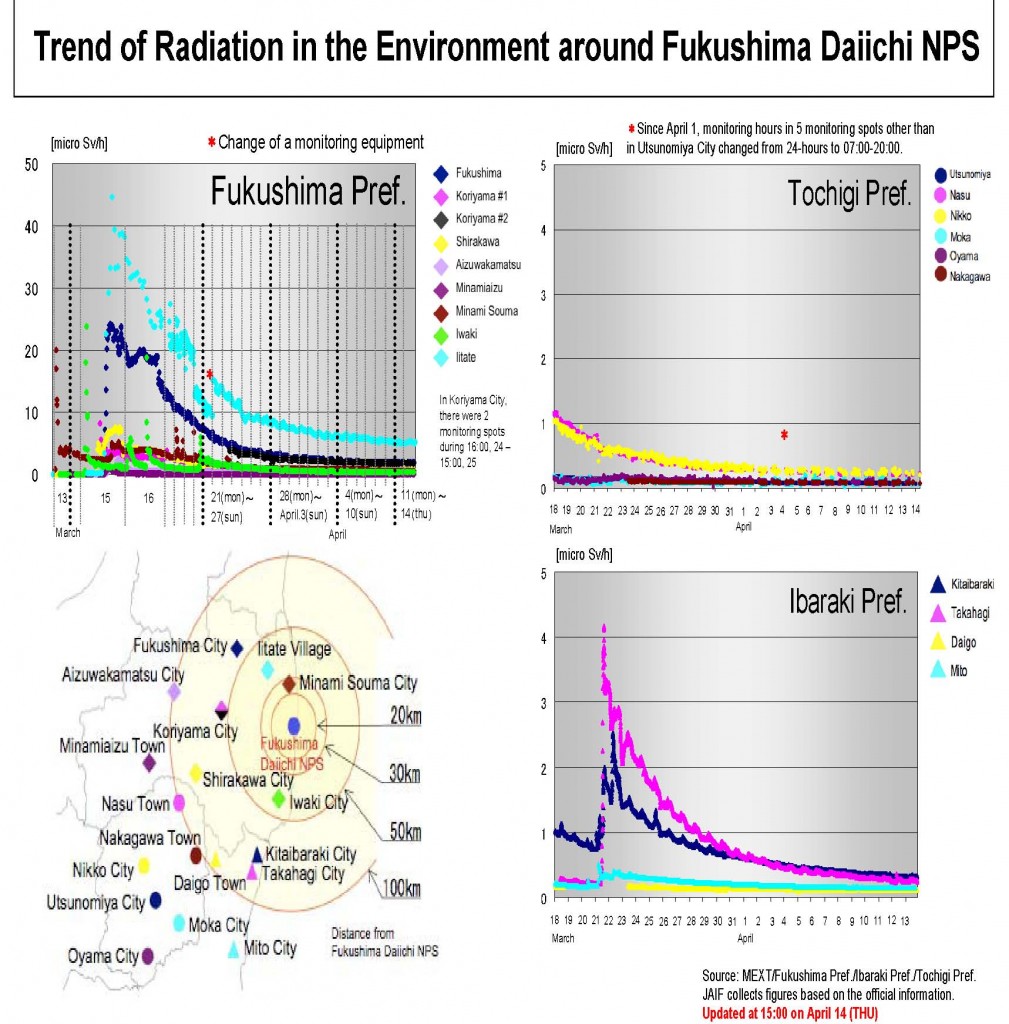
Gamma dose rates are measured daily in all 47 prefectures. The values tend to decrease over time. For Fukushima, on 18th April a dose rate of 1.9 µSv/h was reported. In the Ibaraki prefecture, a gamma dose rate of 0.13 µSv/h was reported; in all other prefectures, reported gamma dose rates were below 0.1 µSv/h.

Dose rates are also reported specifically for the Eastern part of the Fukushima prefecture, for distances beyond 30 km from Fukushima-Daiichi. On 16th April, the values in this area ranged from 0.1 to 25 µSv/h.

Only in a few prefectures, I-131 or Cs-137 is detectable in drinking water at very low levels. As of 16th April, one restriction for infants related to I-131 (100 Bq/l) is in place in a small scale water supply in a village of the Fukushima prefecture.


The areas with a ground contamination of more than 1 MBq/m^2 of Cs-137 sounds quite limited, seems like there are some hot spots west of Fukushima. From IAEA:


Only in a few prefectures, I-131 or Cs-137 is detectable in drinking water at very low levels. As of 16th April, one restriction for infants related to I-131 (100 Bq/l) is in place in a small scale water supply in a village of the Fukushima prefecture.

On 15th and 16th April, the IAEA Team made measurements at 44 different locations in the Fukushima area at distances ranging from 20 to 58 km, West from the Fukushima nuclear power plant. At these locations, the dose rates ranged from 0.6 to 37 µSv/h. At the same locations, results of beta-gamma contamination measurements ranged from 0.03 to 2.8 Megabecquerel/m2. The highest values were observed at distances of less than 30 km from the power plant.

On 17th April, the IAEA Team made measurements at 17 different locations in the Fukushima area at distances ranging from 20 to 62 km, North and Northwest from the Fukushima nuclear power plant. At these locations, the dose rates ranged from 0.4 to 3.3 µSv/h. At the same locations, results of beta-gamma contamination measurements ranged from 0.03 to 0.27 Megabecquerel/m2.

I hope someone will soon release maps of ground contamination so one can get a sense for how much land will be unusable.


Links(English)
World Nuclear News Robots investigate Fukushima reactors
World Nuclear News Roadmap for Fukushima Daiichi restoration
Reuters  Opposition to huge India nuclear plant hardens
Reuters Special Report: The nuclear industry’s trillion dollar question
Reuters Japan nuclear operator aims for cold shutdown in 6-9 months
Reuters Inside Fukushima

Blogs(English)
Atomic Power Review Tepco plans further details
NEI Nuclear Notes UCS Science: How Many Cancers Did Airlines Really Cause
Idaho Samizdat Fukushima’s future blueprints are incomplete, danger persists
Idaho Samizdat Impact of Fukushima on new U.S. reactor projects?
Depleted CraniumTerrified of Nuclear Energy, Germany Goes for Fossil Fuel

Links(Swedish)
DN debatt ”S uppdrag är att skrota kärnkraften”

Blogs(Swedish)
Mats Engström Granska Strålsäkerhetsmyndigheten
Begrundat och plitat Twitter om Fukushima och Tepcos plan (som just presenterades) radioaktiviteten ner om 3 månader
Flute Hänt i veckan 10-17 april, del 1
Sven Tycker Avveckla kärnkraften
Dr Angel Sanningen om Fukushima – vi klarar bara små doser åt gången
Motvallsbloggen Fukushima? Vadå, vi har ju inga jordbävningar här?

5 Comments

Day 35: Parts of the fuel has fallen to the bottom of the vessels

10:00(CET)/08:00(UTC)/17:00(JST)

Just a short update for today. The number 2 turbine building basement is filling up with water as quickly as TEPCO is pumping it out. No word is said about how the similar work in number 1 and 3 is proceeding. Temperatures are on a downwards trend in all reactors. Pressure in the number 1 pressure vessel continues to climb slowly, containment pressures are stable. Not much new happening on that front.

The Japanese Nuclear Society has reported that their analysis shows that parts of the fuel of all 3 reactors has melted and dropped down to the bottom of the vessels. Small parts of molten fuel has according to their analysis dropped from the rods, solidified when hitting the water and then sunk to the bottom forming small grains. The grains are easily cooled since they have large surface area to volume ratio and they don’t form a geometry that is prone to re-criticality.

They also state it is unlikely that there is a large amount of molten fuel at the bottom due to the low temperature readings in the bottom head. Nothing really surprising there either and I pointed it out some time ago. None of this is really surprising.

Zeolite containing sandbags have been put outside the water intake for the number 2 reactors. Zeolite is a porous material that readily adsorbs different molecules (adsorbption is the process of molecules sticking to the surface layers of a material, as opposed to absorption that means its sucked into the material itself). It was used to clean contaminated water within the TMI power planet after the meltdown there.

TEPCO has ordered storage tanks from the US to use to store radioactive water in. IMO I think TEPCO is trying to do perfect when perhaps they should think about doing things adequate. It seems like the volume of water is so large that temporary solutions, like erecting temporary pools, should be considered. But then again it is always easy to be an armchair quarterback on opposite side of the Eurasian continent (other seems to share my general idea though). I haven’t seen any new published analysis of the radionuclide content of the water in the number 2 basement, it would be interesting to see what it contains. The dose rates from the water should be going down due to the I-131 decay. Over 95% of the I-131 has decayed now.

Nitrogen injection into the number 1 containment continues, but pressure in the containment has stabilized. Meaning there must be a leakage somewhere. The leakage can’t be very large however.

The radiation levels in the groundwater is increasing in the plant area. Otherwise radiation trends are all downwards around Fukushima. From IAEA

Gamma dose rates are measured daily in all 47 prefectures. The values tend to decrease over time. For Fukushima, on 13 April a dose rate of 2.0 µSv/h was reported. In the Ibaraki prefecture, a gamma dose rate of 0.14 µSv/h was reported. The gamma dose rates in all other prefectures were below 0.1 µSv/h.

Dose rates are also reported specifically for the Eastern part of the Fukushima prefecture, for distances beyond 30 km from Fukushima-Daiichi. On 13 April, the values in this area ranged from 0.2 to 26 µSv/h.

In addition to the 7 measurements referred to in yesterday’s brief, (note- these measurements were made at distances of 25 km and 33 km not 32 km and 62 km as reported), 13 more measurements were made on 12 April at distances of 25 to 33 km, West and Northwest from the Fukushima Nuclear Power Plant by the IAEA team. At these locations, the dose rates ranged from 0.5 to 16.5 µSv/h. At the same locations, results of beta-gamma contamination measurements ranged from 0.05 to 2.1 Megabecquerel/m2.

Analytical results related to food contamination were reported by the Japanese Ministry of Health, Labour and Welfare on 13 April that covered a total of 98 samples taken on 4 and 11 to 13 April. Analytical results for 76 of the samples of various vegetables, pork, seafood and unprocessed raw milk in nine prefectures (Chiba, Fukushima, Gunma, Ibaraki, Kanagawa, Miyagi, Niigata, Saitama and Yamagata) indicated that I-131, Cs-134 and/or Cs-137 were either not detected or were below the regulation values set by the Japanese authorities. In Fukushima prefecture on 11 April, twenty samples of various vegetables were above the regulation values set by the Japanese authorities for Cs-134/Cs-137, and one sample of seafood (sand lance) and one sample of spinach were above the regulation values set by the Japanese authorities for both I-131 and Cs-134/Cs-137.


Links(English)
Reuters Burrial of reactors tricky

Blogs(English)
Depleted Cranium Fukushima: Now a level 7, but nothing changes
All things Nuclear What Happened at Fukushima Dai-Ichi?
Atomic Power Review Brief update: Temperatures at Fukushima Daiichi 1,2,3
Atomic Power Review Fukushima Daiichi: Reactor cores
Atomic Power Review FACTS: Decommissioning of nuclear power plants

Links(Swedish)
Newsmill Japanska strålsäkerhetsmyndighetens INES 7-gradering endast temporär
Newsmill Brittisk miljöaktivist: Antikärnkraftslobbyn har bluffat om strålningens hälsorisker
Newsmill Japans unga revolterar mot kärnkraften
DN debatt ”Vi fattar inga panikbeslut om kärnkraften”
DN debatt”Att stänga två reaktorer skadar svensk basindustri”

Blogs(Swedish)
Rättvisan framför allt Långsiktighet, var god dröj.
Lotta Olsson Energipolitik är långsiktig…
In Your Face Kan du vika tranor?
Dr Angels blog Fukushima är ännu en mardröm

5 Comments

Day 33: What does INES 7 mean?

22:00(CET)/20:00(UTC)/05:00

Not much newsworthy to report today. JAIF report as usual on the status of the reactors. No new NISA update on the reactor status in English but in Japanese, some values are taken from IAEA rather than NISA. Links to graphs are links to the blog #FNPP1 and Irradiation. Pressure is continuing to rise in the number one reactor but still quite low. Seems like there is some kind of leakage out of the containment in number one, otherwise one would have expected higher pressure due to the nitrogen injection. Pumping of water from the number 2 turbin building basement is ongoing but slow, TEPCO say the work can take weeks.


Reactor 1 Reactor 2 Reactor 3
Water level (meter)* -1.65 -1.5 -2.2
Flow rate(liters/min) 100 116.67 116.67
Core pressure (kPa) 1034 100*** 100***
Containment pressure (kPa) 190 100*** 100***
Wetwell pressure (kPa) 165 168
Feedwater nozzle temp (Celsius) 204.5 166.9 92.2 **
Bottom head temp (Celsius) 119.0 208.0 116.0
Containment dose rate (Sv/hour) 27.9 16.9
Wetwell dose rate (Sv/hour) 10.3 0.653 0.653
*Distance from top of assembly
– broken gauges or missing data
** Probably faulty reading
*** IAEA states atmospheric pressure

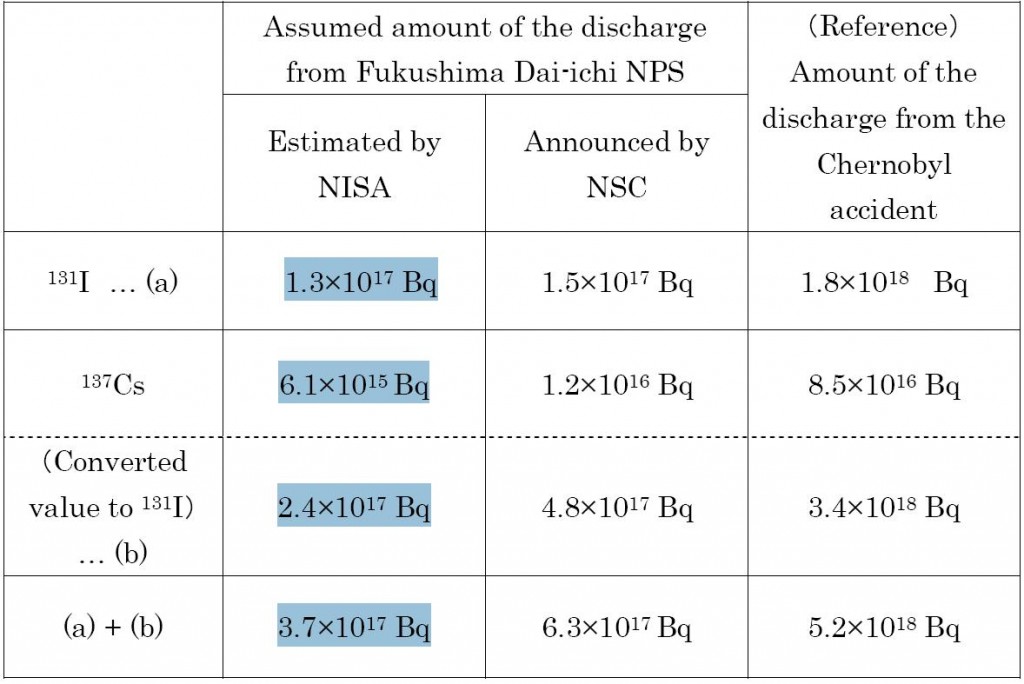
Yesterday NISA released this info about how much activity has escaped from the Fukushima reactors and compare it to Chernobyl.

Like I said yesterday its roughly 10%. The move from 5 to 7 on the INES scale has gotten a lot of media attention, but what does it really mean? Nothing became worse yesterday than it has been, no dramatic event changed the rating etc. What happened is that NISA estimated that the release of I-131 and Cs-137 is beyond a treshold of what is considered “Major release of radioactive material” acording to the level 7 definition:

Level 7.

  • Major release of radio active material with widespread health and environmental effects requiring implementation of planned and extended ­countermeasures

That is all, NISA hasn’t made any statement about health impacts. They certainly don’t claim the effects will be as severe as the effects where from Chernobyl. One can at this point exclude the possibility that Fukushima will be as severe. So what are the differences?

  1. In Chernobyl 134 workers got exposed to high enough radiation(over 1 Sievert) to develop symptoms of acute radiation sickness, 28 of them died during the first year following the accident,  two others died from injuries not related to radiation. A lot of kids got exposed to I-131 due to no quick warnings not to drink milk and no supply of iodine pills. 4000 kids got thyroid cancer and 15 died due to it. 600 000 liquidators where exposed to doses around 100 mSv.

    In Fukushima so far 22 workers have been exposed to over 100 mSv, the highest getting 198 mSv, thus there where 30 000 times as many people exposed to 100 mSv or more in Chernobyl compared to Fukushima so far! The only two deaths at the power plant was direct deaths due to the tsunami. No one has died due to the nuclear accident itself, not from any of the explosions, not from radiation etc. Dose estimates for the people outside of the evacuation zone, especially the people within 30km, has not been given so far.

  2. In Chernobyl the radionuclide release was directly into the atmosphere and it was going on for several days driven by the graphite fire. Other radionuclides than I-131 and Cs-137 could easily escape and was spread (even though Cs-131 is the biggest issue). The areas around Chernobyl where not quickly evacuated. The core blew apart due to a runaway chain reaction(a inherent weakness to that design that was well know, but the Russians ignored it and built them anyway),

    In Fukushima it is still not entirely clear what caused the majority of release, it was either the venting of the containments or due to the breach in the number 2 wetwell. Regardless of the cause the atmospheric emissions was much smaller in magnitude, took place during a shorter time period, after the civilian population had already been evacuated! We are seeing pretty much only Iodine and Cesium(trace levels of other radionuclides have been detected, but no large release of them has been reported). The cores are largely intact, two of the containment vessels are likely breached but by far from cracked open like eggs. The cause of the emissions are partial meltdowns of the cores, a much slower process than the runaway explosion in Chernobyl. After the first few days of venting where over the majority of leakage goes into the sea, although that is not a “good” thing it is unlikely it will have any measurable impact on health. Anything going into the sea will get diluted fairly quickly. Even if the total release will increase to the same size as the ones from Chernobyl the different release path means it will have much less impact on public health or the environment.

Those two points alone mean that Fukushima is not another Chernobyl. The public health effects will not be as large and the environmental impact will be smaller. It remains to be seen how large surface areas have gotten high Cs-137 fallout, that will be the determining factor in how large areas will be unfit for farming or living on.


Links(English)
Reuters Japan struggles with nuke plan
World Nuclear News Fukushima workers start emptying trench water

Blogs(English)
Atomic Insights Rational Answer to Carl Pope’s Dismissal of Nuclear Technologies
Depleted Cranium Shameful Reporting From the New York Times
NEI Nuclear Notes Wednesday Update
Atomic Power Review Boiling Water Reactors Part 1 and Part 2
Atomic Power Review Fukushima Daiichi developments… Tuesday evening
Atomic Power Review A couple of afternoon updates….

Links(Swedish)
Aftonbladet Tyvärr har jag fått rätt
SvD Fukushima inte lika allvarligt som Tjernobyl

Blogs(Swedish)
Den blinde Argus
Kortsiktighet, instabilitet och populism
Begrundat och plitat Fukushima, risken för nya olyckor, och sanningens ögonblick
Tänkvärt? Eller inte Fukushima likvärdig med Tjernobyl.
SNF’s blog Fukishima kan vara värre än Tjernobyl
Nolow Kärnkraftverk
Hovbergs blog Nukleära utrymningsområden<
Röda Berget Skräcken för strålning skapar nya offer
Harald i Uppsala Reflektioner 13 april

41 Comments

Day 32: Fukushima raised to 7 on the INES scale

11:20(CET)/09:20(UTC)/18:20

NISA has increased the level of the Fukushima accident to 7 on the INES scale, 7 is the highest level on the scale. Before Fukushima only Chernobyl was on that level,  the descriptions of levels 5, 6 and 7 are these

Level 7.

  • Major release of radio active material with widespread health and environmental effects requiring implementation of planned and extended ­countermeasures

Level 6.

  • Significant release of radioactive material likely to require implementation of planned countermeasures.

Level 5.

  • Limited release of radioactive material likely to require implementation of some planned countermeasures.
  • Several deaths from radiation.
  • Severe damage to reactor core.
  • Release of large quantities of radioactive material within an installation with a high probability of significant public exposure. This could arise from a major criticality accident or fire.

The levels are as you can see quite loosely defined. We have been expecting it to be be increased from 5 but it has not been clear if it was gonna end as a 6 or a 7. Up until today Fukushima was a 5 on the scale due to the severe core damage(any one of the items on the list for INES 5 is enough by itself to classify it as a 5). Now NISA has upgraded it due to the large releases of radioactive material, even though there is yet no assumption that the release will lead to large scale health effect.

World Nuclear News has published a map from IAEA of the fallout from Fukushima (attached at the end) and writes this about how much radioactive materials has been released in total.

“As a result of re-evaluation, total amount of discharged iodine-131 is estimated at 1.3×10¹⁷ becquerels, and caesium-137 is estimated at 6.1×10¹⁵ becquerels. Hence the Nuclear and Industrial Safety Agency has concluded that the rating of the accident would be equivalent of Level 7.”

One can see from the map that the majority of fallout has landed in a limited area, it remains to be seen how large parts of that area wont be fit for agriculture anymore.

Chernobyl released 17.6*1017 Bq of I-131 and 85*1015 Bq of Cs-137, so compared to Chernobyl we are looking at around 10% of release of the volatile fission products.

However TEPCO also announced today that the total amount of radioactive material released might exceed that of Chernobyl if they can not stop the leakage of radioactive water. It is good to keep in mind though that this release is going into the sea where it will quite quickly dilute, in Chernobyl everything went into the air and then could be spread over farmland, cities etc. Anything going into the sea will have very limited, if any, health impact.

Chief cabinet secretary Edano made this statement about the INES level.

“The change in the level reminds us the accident is very big. What’s different here from the Chernobyl accident is that we have not yet seen a direct impact on the health of the people as a result of the nuclear accident. The accident itself is big, but we will make, as our first priority, our utmost effort to avoid any health impact on the people.”

This statement is very important and it highlights a fact that media now seems to neglect, the raising of the INES level is due to the total amount of radioactivity released (most if it was released during the first week), not due to expected or already occurring health consequences. So far the Fukushima accident has not killed a single person and it seems unlikely the radiation dosages to the public have been so large that they can cause any significant(i.e detectable) increase in cancer rates. The increase on the INES scale doesn’t mean the situation has turned dramatically worse, it is just a raising of the level due to the high releases that occurred initially.

The Neutron Economy has a very good blog post, Fukushima Daiichi to INES Level 7 – Some Numbers on Why, about the INES rating, Fukushima and eventual consequences if one applies the Linear No Threshold model of the risk of radiation exposure.


Links(English)
CNBC Nuclear Power Fears at New Heights Despite Safety, Viability
World Nuclear News Fukushima moved to Level 7
CNN Japan nuclear disaster tops scale
BBC Fukushima: What happened – and what needs to be done
Reuters Japan raises nuclear crisis to same level as Chernobyl

Blogs(English)
NEI Nuclear Notes “Years of Unchallenged Mythology”
Depleted Cranium On the Ground Pictures of Fukushima
Atomic Insights As Fukushima gets moved from 5 to 7 remember that 0 (deaths) is still an applicable number
Idaho Samizdat Fukushima accident rating from 5 to 7 on INES?
Atomic Power Review Fukushima Accident: Level 7.
Atomic Power Review Level change note…
Atomic Power Review APRA Special: Observations on Fukushima Daiichi

Links(Swedish)
SvD Fukushima inte lika allvarligt som Tjernobyl
Aftonbladet Lika allvarligt som Tjernobyl
Expressen Japan skakat av nya skalv idag
SvD Japan uppgraderar kärnkrafthaveriet
DN Fukushimaolyckan på Tjernobyl-nivå

Blogs(Swedish)
Röda Malmö Vidden av katastrofen växer
APSO sverige Spridningen av Cesium 137
Blott sverige svenska preppers har Fukushima på samma nivå som Tjernobyl
Den svenska argus Sjuan kom

22 Comments