Skip to content

Category: English

Fukushima Answers – new site

There is a new website where you can see answers about the Fukushima events.

http://fukushima-answers.com/

Don’t fear the unknown. Ask!

Anxiety, fear, panic or resignation and passiveness . That’s what many people experience under the current overload of information spread by media and various interest groups. We believe that a sound mind doesn’t need other people to tell it what to think, what to fear or what to trust. It needs clear facts.Here you can find explanations in plain language from nuclear professionals . Ask questions, learn the facts and form your own opinion.

3 Comments

Day fifteen after the tsunami

Update 15:00(UTC)/16:00(CET)/00:00(JST)

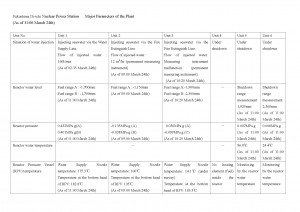
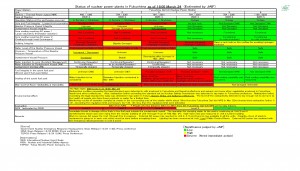
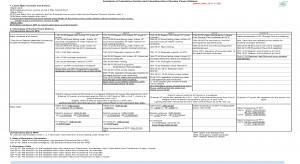
NISA has released their update, link 1, link 2, link 3. I have also reattached the earlier JAIF figures at the bottom of the last update to see if it will fix the bug that gives an error when one clicks on the pictures.

As usual the NISA figures are between (). The NISA data is 3 hours older than the JAIF data.


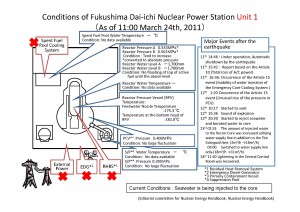
Reactor 1:
Water level in the core: 1.65(1.65)  meters below the top of fuel assemblies
Flow rate of injected water: 7.2 cubic meters per hour
Core pressure: 476 (477) kPa
Containment pressure: 270 (270) kPa *note, in the last update I misstakenly wrote 370 kPa as containment pressure.
Core temperature(feedwater nozzle): 195.3 Celsius
Core temperature(bottom head) 146.3 Celsius
Dose rate within containment: 35.1 Sv/hour

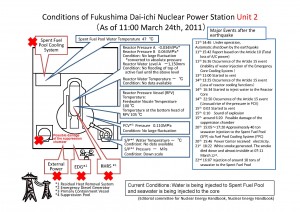
Reactor 2:
Water level in the core: 1.1 (1.1)  meters below the top of fuel assemblies
Flow rate of injected water: 18.6 cubic meters per hour
Core pressure: unknown
Containment pressure: 116 (115) kPa
Core temperature(feedwater nozzle): 107 Celcius
Core temperature(bottom head): 100 Celsius
Dose rate within containment:  43.4 Sv/hour
Spent fuel pool temperature:  57 Celsius

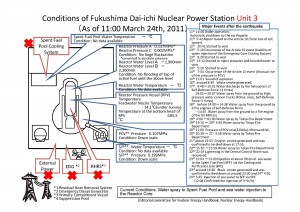
Reactor 3:
Water level in the core: 2.3  meters below the top of fuel assemblies
Flow rate of injected water: 14.5 cubic meters per hour
Core pressure: 139 (139) kPa *note, I wrote the wrong pressure in the last update
Containment pressure: 106.6 (106.6) kPa
Core temperature(feedwater nozzle): 37.6 Celsius (sounds like an error on equipment)
Core temperature(bottom head): 106.1 Celsius
Dose rate within containment:  36.1 Sv/hour

Due to my error with containment pressure in the last update I withdraw my speculation that its hard to control the pressure in number 1. Rather it seems like the situation is fairly stable. Otherwise not much new information.

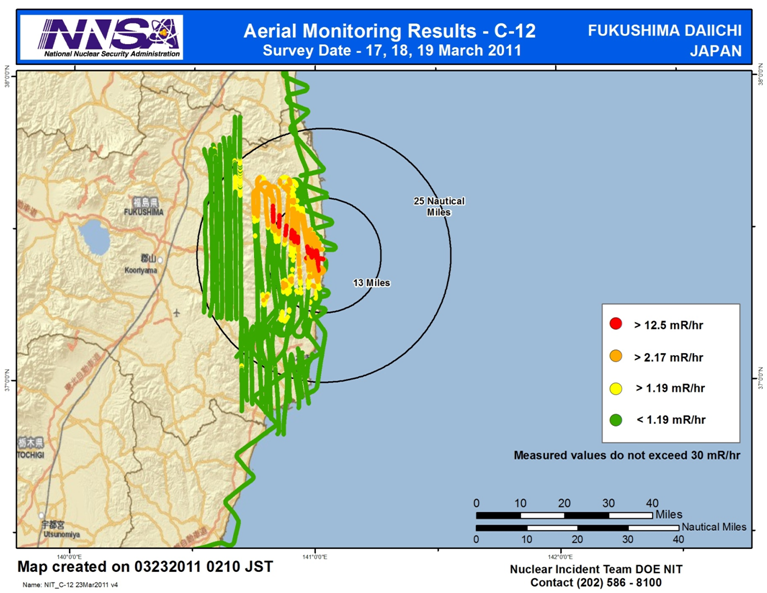
The US Department of Energy has done some arial surveys around Fukushima Daiichi and released the data. I have one pictures from it below(hats of to http://neutroneconomy.blogspot.com/ where I found the pictures). The dose rate unit used on the picture is millirad. 1 millirad=10 microgray =* 10 microsievert
*that equality between gray and sievert is only valid for gamma radiation. Gray measures the energy deposited while sievert is weighted in such a way that it expresses a cancer risk.  For gamma the weighting factor is 1.
Update 12:00(UTC)/13:00(CET)/21:00(JST)

No NISA updates have been released yet today, JAIF has released their update as usual(one hour old as of writing this).

Reactor 1:
Water level in the core: 1.65  meters below the top of fuel assemblies
Core pressure: 476 kPa
Containment pressure: 370 kPa
Core temperature(feedwater nozzle): no new data
Core temperature(bottom head) no new data
Dose rate within containment:  no new data

Reactor 2:
Water level in the core: 1.1  meters below the top of fuel assemblies
Core pressure: unknown
Containment pressure: 116 kPa
Core temperature(feedwater nozzle): no new data
Core temperature(bottom head) no new data
Dose rate within containment:  no new data

Reactor 3:
Water level in the core: 2.3  meters below the top of fuel assemblies
Core pressure: 202 kPa
Containment pressure: 106.6 kPa
Core temperature(feedwater nozzle): no new data
Core temperature(bottom head) no new data
Dose rate within containment:  no new data

All 3 reactors are now cooled with freshwater instead of sea water. It seems hard for them to get the pressure in the number one reactor under complete control. In JAIF’s written update they say lights are on in all control rooms now. Levels of radioactive materials in the seawater around the plant is climbing. TEPCO is releasing updates on activity in both sea and air, I have attached levels as pictures in the bottom of this update.

The ground deposits of I-131 the prefectures around Fukushima ranges from less than 1 to 16 kBq per square meter. The cesium ground deposits ranges from less than 0.1 to 1.9 kBq per square meter(here are the last 3 MEXT updates on ground deposts link 1link 2link 3). The data form the worst effected prefectures are however omitted, we hope MEXT will make those figures available asap! As a comparison the ground deposits of cesium due to Chernobyl ranged from a couple of hundreds to a couple of thousand kBq per square meter.


Update, March 26, 12:00 (UTC) / 13:00 (CET) / 21:00 (JST)

Not much to add today. The radiation levels in the sea outside Fukushima I are sky-high. The long term effects are hard to predict now since a sea contamination is entirly different from a land contamination, where land is basicly a 2D area, which leads to a thin and high concentration on the surface, and where rains soon concentrate the contamination to “hotspots”.  The sea on the other hand is a 3D volume where currents quickly dilute any contaminant by dispersing them over very wide areas.

The JAIF updates from 10:00, 16:00 and 21:00 (JST) for March 26 are pretty much uniform. The big news is that freshwater injection to the cores of 1, 2 and 3 has started as opposed to using salty sea water. Apart from that nothing new. The radiation readings at the main gate (1 km out) has stayed at 170 μSv/h all day. The west gate read 147 μSv/h at 13:30.

NISA has not said anything new since last night.


Links(english):
BBC We should stop running away from radiation
Hufftington post US brings fresh water to japan nuclear plant
NY Times Japan presses nuclear plant repair as more damage is found
Rod Adams Shaken, flooded, stressed by power outages, Fukushima Daiichi moves into second place
The Independent Fear and devastation on the road to Japan’s nuclear disaster zone

Links(swedish):
Röda berget
Dr Angels blog
DN Radioaktivt jod tusen gånger tillåten nivå i havet
Aftonbladet Strålningen ökar runt Fukushima
SvD Radioaktivt vatten i reaktorer
Tänkvärt? Eller inte!
Grön horizont


17 Comments

Day fourteen after the tsunami

Uppdate 22:45(UTC) / 23:450(CET) / 07:45(JST)

There has been no further info yet on the status of the exposed workers or the status of the reactors. Only news about the reactors is that both number 1 and number 3 have now switched to fresh water injection into the core and number 2 was supposed to follow promptly. I end todays updates with a few video clips of the explosion in one of the refineries that was hit worst by the earthquake and tsunami. This disaster has struck so many lifes, so many industries and so many towns that it is hard to fathom.


Uppdate 16:30(UTC) / 17:30(CET) / 00:30(JST)

The 2 workes taken to hospital reportedly got a dose to their feet and lower legs between 2-6 Sieverts from beta radiation.  They also got close to 200 mSv from gamma and an unknown internal dose.

They have not shown any signs of acute radiation sickness so far.  But the dose to the legs are very worrying and in the worst case might mean amputation.

Update 14:15 (UTC) / 13:15 (CET) / 22:15 (JST)

New updates from JAIF and NISA(link 1, link 2, link3). JAIF status is from 15:00 JST and NISA updates from 10:00 and 12:30 JST. As before the first number is from the JAIF update and the number within () is from the older NISA update.

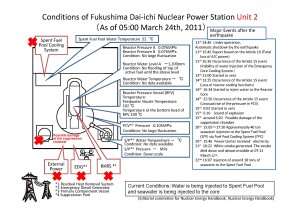
Reactor 1:
Water level in the core: 1.65 (1.65) meters below the top of fuel assemblies
Core pressure: 450 kPa (450 kPa)
Containment pressure: 295 (295) kPa
Core temperature(feedwater nozzle): 197.8 Celsius
Core temperature(bottom head) 153.6 Celsius
Dose rate within containment:  38.9 Sievert/hour

If one looks at the JAIF status updates one can see a very encouraging piece of information, they have switched from seawater to fresh water injection into the pressure vessel! That is one significant step in the direction of stabilizing the reactor since seawater injection could never be a permanent solution. They are still not using the internal pumps however. The temperature of the core seems to have been brought under control and the high containment pressure is on a slowly declining trend. We can only keep our hopes up that they will be able to avoid venting the containment.

Reactor 2:

Water level in the core: 1.20 (1.2) meters below the top of fuel assemblies
Core pressure:  unknown
Containment pressure: 120 (120) kPa
Core temperature(feedwater nozzle): 107 Celsius
Core temperature(bottom head) 105 Celsius
Dose rate within containment:  45.6 Sievert/hour

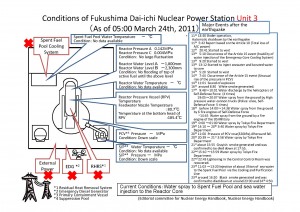
Reactor 3.
Water level in the core: 2.3 m below the top of fuel assemblies.
Core pressure: 139 (139) kPa
Containment pressure:  107 kPa
Core temperature(feedwater nozzle): 42.8 Celsius (probably junk)
Core temperature(bottom head) 111,6 Celsius
Dose rate within containment:  51 Sievert/hour

Preparations are being made to switch from seawater to fresh water for reactor 2 and 3. If it goes as quickly as for number one it should be done within half a day. Work with electrical equipment on going.

We have earlier warned for the possibility that molten material in the core can be lying on the bottom of the vessel and eating its way through, now that seems unlikely considering how low the bottom head temperatures of the vessel are. All of them are below 200 degrees.

Dose rate at main gate around 200 micro sievert per hour.

Update 12:30 (UTC) / 11:30 (CET) / 20:30 (JST)

TEPCO is preparing to switch from salt water to fresh water for the core cooling. From NHK:


TEPCO says it intends to switch over from pumping sea water to pumping fresh water into the 3 reactors, as salt in the sea water could cause corrosion and buildup, hampering the smooth flow of water inside the structures.

The company has been pumping seawater as an emergency measure.

The power company also says preparations to switch to fresh water were completed at the No.1 reactor on Friday afternoon.
Operations to pump fresh water into reactors No.2 and No 3 are expected to start later in the day.

Update 10:00 (UTC) / 11:00 (CET) / 19:00 (JST)

Here are the status tables from the JAIF update described below and summary.

Reactor 1:
Water level in the core: 1.7 meters below the top of fuel assemblies
Core pressure: 465 kPa
Containment pressure: 310 kPa
Core temperature(feedwater nozzle): no new info yet today
Dose rate within containment:  no new info yet today

Pressure has decreased by about 60-80 kPa in both vessel and containment since yesterday.

Reactor 2:
Water level in the core: 1.10 meters below the top of fuel assemblies
Core pressure: unknown
Containment pressure: 120 kPa
Core temperature (feedwater nozzle): no new info yet today
Dose rate within containment: no new info yet today

Reactor 3.
Water level in the core: 2.3 m below the top of fuel assemblies.
Core pressure: 139 kPa
Containment pressure:  107 kPa
Core temperature (bottom head): no new info yet today
Dose rate within containment: no new info yet today

Containment damage is again suspected on number 3, otherwise no major changes since yesterday. Let’s hope the containment is not damaged! Luckily the reactors in the possibly damaged containments are behaving more stable than the number one reactor (that has a undamaged containment).

Picture of reactor number 3 building

Update 08:45 (UTC) / 09:45 (CET) / 17:45 (JST)

The 16:00 JAIF update for March 25 has been published. Two changes:

…so far seventeen workers have been exposed to more than 100 mSv of radiation.

100 mSv is the limit where an increase in cancer risk has been proven. At 100 mSv, the lifetime risk of getting cancer increases from about 25-32% to 29-36%.

Keep in mind that this does not say whether or not any of these workers will actually get any cancer, much less die from it. It is safe to assume that just as after Hirosima/Nagasaki, the medical authorities will keep those exposed under very close watch, meaning their chances of getting diagnosed early and thus surviving any cancer will be quite good.

The other change is that the radiation reading at the main gate has gone up again:

The Main Gate: 259.0μSv/h at 11:00, Mar. 25

The pressure in the #1 containment vessel is moving up and down.  #2 is stable. The #3 pressure is slowly decreasing. With the worries of a leak from #3, this may have more than one explanation, not all of them good.

Update 07:20 (UTC) / 08:20 (CET) / 16:20 (JST)

The 10:00 (JST) JAIF update for March 25 has the following new entries:

Monitoring results of seawater sampled at the coast near the Fukushima Dai-ichi NPS on Mar. 23rd showed that radioactive Iodine, Cesium, Ruthenium, and Tellurium exceeding the regulatory limit were detected. Also, monitoring results of seawater sampled at coasts within about 16km from the Fukushima Dai-ichi NPS in Mar. 23rd showed that radioactive Iodine and Ruthenium exceeding the regulatory limit were detected.

Nuclear Safety Commission of Japan reported the result of preliminary calculation of exposure dose in the surrounding area of Fukushima Dai-ichi NPS.

The dose rate mesaured at the main gate has dropped slightly, from 209.4μSv/h at 12:00, Mar. 24 to 193.8μSv/h at 06:00, Mar. 25.

The high exposure of three workers in the number three turbine hall suggests that #3 may have a leak after all, says the government’s Nuclear and Industrial Safety Agency.

Water supplies continue to show taints of Iodine-131, but the readings fluctuate and it’s still hard to make out a general trend. Tokyo is no longer under a recommendation not to drink the tap water, but concerned citizens continue to use bottled water to some extent.

Following the latest findings, the Tokyo officials said it will no longer warn against consumption of tap water in the metropolitan area.

”I believe readings will go up and down. But even if levels exceed standards temporarily, it will be no problem as long as they stay (most of the time) within the range throughout the year,” Tokyo Gov. Shintaro Ishihara said at a news conference. ”I hope people in Tokyo would act calmly.”

Still, people in the capital area — located about 220 kilometers from the crippled Fukushima Daiichi nuclear plant — and elsewhere continued to buy up limited supplies of bottled water from shops and vending machines.

The government has asked that people in the 20-30 km zone around the crippled Fukushima plant to evacuate volontarily out of concern for supplies for daily necessities.

The Japanese government has encouraged people living within 20 to 30 kilometers of the troubled nuclear plant in Fukushima Prefecture to leave voluntarily, with concerns over access to daily necessities rather than resident safety prompting the advice, top government spokesman Yukio Edano said Friday.


Länkar:

SvD mycket troligt en läcka i 3an
Flute
Kommunisternas blogg
Martin Mobergs blogg
Röda berget
Aktieskolan
Cornucopia
Röda malmö
Divage

DN Kärnan kan vara skadad (den person som valde den här rubriken borde sluta använda google translate….)
DN cesium i grönsaker i Tokyo
Aftonbladet hotet i japan är osynligt

31 Comments

Day thirteen after the tsunami

Update 22:30(UTC)/23:30(CET)/07:30/(JST)

I end todays updates with some heartbreaking pictures from the tsunami disaster. Its very hard to even just watch these pictures, I hope the resilience of the great japanese people will astonish the world when they rebuild after this disaster.

http://blogs.denverpost.com/captured/2011/03/18/captured-japan-earthquake-and-tsunami-one-week-later/2838/

Update 21:20(UTC)/22:20(CET)/06:20(JST)

Some Austrian researchers have analysed data from detectors used to verify the comprehensive test ban treaty and their analysis show that the emissions of iodine and cesium from Fukushima is approaching the same level as from the Chernobyl accident. Fukushima emitted around 1,3*10^17 Bq iodine per day the first days and the total emission from Chernobyl was 1,7*10^18 Bq. By now the iodine emissions must be much lower due to the short half life of iodine and they haven’t reported any containment venting for about a week if my memory serves me right. The core inventory of I-131 is now reduced by more than half due to decay(half life 8.02 days) and the other iodine isotopes have even shorter half life. It will be interesting to see more data on this.

It’s good that the evacuation from the area around the reactor was brisk and that iodine pills have been supplied. So far the ground fallout data from MEXI doesn’t look very bad but it might be due to the  direction of the wind as stated in the article.


Update 19:15(UTC)/20:15(CET)/04:15(JST)

It is in the middle of night in Japan right now and the news flow is always a bit slower then for obvious reasons. But NISA has still released a new update (values from 18:05 which makes it older than the JAIF updated I wrote about in the last blog update. They have released a PDF with pictures from the control rooms and plant area, here is a direct link to it. They are ne day old and that is why the control room for reactor 1 is dark(they restored power to it today).

17 workers in total has exceeded a total dose of 100 mSv.

Uppdate 16:00(UTC) / 17:00(CET) / 01:00(JST)

New JAIF and NISA(link 1, link 2, link 3) updates. NISa has added a new file to its update that gives more data, among them the dose rates within the containments. The NISA uppdate is from 11:00 and the JAIF update from 22:00 JST. JAIF numbers first followed by NISA within ().

Reactor 1:
Water level in the core: 1.7 meters(1.7m) below the top of fuel assemblies
Core pressure: 523 kPa (532 kPa)
Containment pressure: 390 kPa (400 kPa)
Core temperature(feedwater nozzle): 175 Celsius
Dose rate within containment:  43.5 Sv/hour

Reactor 2:
Water level in the core: 1.15 meters(1.15m) below the top of fuel assemblies
Core pressure: unknown
Containment pressure: 110 kPa (110 kPa)
Core temperature(feedwater nozzle): 100 Celsius
Dose rate within containment: 48.4 Sv/hour

Reactor 3.
Water level in the core: 2.3 m (2.3 m) below the top of fuel assemblies.
Core pressure: 137 kPa  (137 kPa)
Containment pressure:  unknown
Core temperature(bottom head): 185.,5 Celsius
Dose rate within containment: 55.9 Sv/hour

The pressure in number 1 went up a bit and then started going down. Temperature has been lowered about 70 degrees Celsius. Dose rate by main gate seems to be on a slow decline. Iodine levels in Tokyo water has gone down below the infant limit of 100 Bq/liter. Testing of pumps are ongoing in reactor number 3. More and more vegetables with levels far exceeding the limits for cesium and iodine is found.


Uppdate 9:00(UTC) / 10:00(CET) / 18:00(JST)

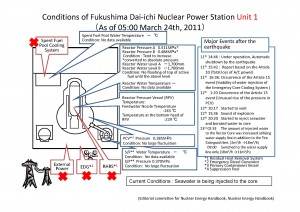
During night(swedish) JAIF(link 1, link 2) and NISA(link 1, link 2) has released new updates. The NISA updates(the schematics of the reactors attached at the end of the post) is by the time of writing 13 hours old and the JAIF update 2 hours old. I will write the JAIF numbers below first and the NISA numbers within parenthesis so one can se the change over the last 11 hours.

Reactor 1.
Water level in the core: 1,7 meters(1,7m) below the top of fuel assemblies
Core pressure: 510 kPa (511 kPa)
Containment pressure: 385 kPa (385 kPa)
Core temperature(feedwater nozzle): 243 Celsius

The situation has been stable for the last 11 hours. Containment pressure and core pressure is up about 20 kPa since yesterdays update. The containment pressure is a bit to high for comfort I would say. All though the highest it has reached during the entire accident was about 800 kPa in one of the reactors so it can plausibly handle even a doubling in an emergency, but if it doesn’t go down soon I am afraid TEPCO are going to have to vent the containment. Venting now could be problematic since the steam will contain quite a lot of activity and it could hamper work for hours due to radiation levels. On a positive note, the lights are now on in the number 1 control room showing that there is some progress in restoring electricity. Lets hope the pace will accelerate soon and that the coolant pumps are functional or at least easy to replace!

Reactor 2.
Water level in the core:  1,2m (1,2m) below the top of the fuel assemblies
Core pressure: Unknown(the readings claim below atmospheric pressure so the gauge is most likely broken)
Containment pressure:  105 kPa (105 kPa)
Core temperature(feedwater nozzle):  102 Celsius

Compared to yesterday pretty much nothing has changed. The core temperature and both core pressure and containment pressure remains low. Nothing new about the radiation levels in the turbine building(reported to be around 500 mSv/hour yesterday) that prevents access for repairing equipment.

Reactor 3.
Water level in the core: 2,3 m (2,3 m) below the top of fuel assemblies.
Core pressure:  (142 kPa)
Containment pressure:  unknown(JAIF states “downscale”)
Core temperature(feedwater nozzle): 80,7 Celsius

The JAIF update has changed the status of the containment from “might be not damaged” to “not damaged”, that is very good news indeed! It means the only damaged containment is on reactor 2 that appears to be quite stable and cool. Sometime during yesterday they seem to have been able to hook up a pump to one of the pipes leading to the spent fuel pool and they can now provide seawater through the cooling and purification line. Hopefully that means there is no need anymore for blind spraying of the number 3 building. Yesterday they managed to restore lights to the control room, but no news about instrumentation or the filtration system to bring down radiation levels inside the control room.

Reactor 4.

The concreter pump truck continues to deliver water to the spent fuel pool at a rate of 50 000 liters per hour.

General remarks:

We have been hoping for the electricity to be restored to the pumps etc since Saturday now. There is no explanation on what problems they have encountered or the status of the pumps. In the Fukushima Daini plant they had to replace pumps after the quake and tsunami so perhaps pumps needs to be replaced at Daiichi as well. The situation appears stable at the moment, but seawater cooling can not continue forever. At some point the salt depositions in the core will start to cause real problems but I do not know what time span we are talking about. If one estimates the salt deposition from the amount of water that could have been evaporated by the decay heat so far one ends up with several tens of cubic meters of salt. It’s hard to know where all of this salt has been deposited though since we don’t know the flow path of the water. On the bright side it seems like the workers are able to access more of the reactor building now as indicated by the fact that they have switched the path of seawater injection for the number 3 spent fuel pool and the number 1 reactor.

Three workers have been exposed to close to 200 mSv. It’s encouraging that they manage to keep the worker doses below 200 mSv so far. If TEPCO is being honest then its unlikely we will see any acute radiation sickness in workers.

Iodine levels in water and vegetables in prefectures close to Fukushima continues to be high.

We’ll try to keep it in english from now on…

Update 07:30 (UTC) / 16:30 (JST)

JAIF just released their 16:00 update. One bit of happy news there is that they now write that the number 3 containment vessel is “Not damaged”.

Screenshot of the update will follow soon when the guy that has access to saving PDF to JPG gets to his computer. 🙂

Radiation levels in the Tokyo water also seem to be dropping again… but it’s too soon to speak of any general trends. Also no new word on Caesium-137 in farmlands or water.

The work to bring electricity to Fukushima I continues (slowly).

11 Comments

Patrick Takahashi doesn’t estimate the situation correctly

Uppdate,

I realised that I forgot to counter the 5th argument by Takahashi. I have now added it.

In the Huffington post Patrick Takahashi flaunts some misconceptions about nuclear and the technological impact the Fukushima accident will have on future new builds.  We will take a look at some of the flaws here on his 4 point list.

1. Economics
Patric states that due to increasing regulatory demands on nuclear after this accident the price of nuclear will escalate into the industries oblivion. But that doesn’t necessarily have to be the case and should not be the case of the issue is treated rationally by the regulatory bodies.  What Fukushima has shown us is that one can not rely on emergency diesel generators for core cooling and that spent fuel pools are sensitive. Let’s look into those two issues.

31 Comments

George Monbiot: “Why Fukushima made me stop worrying and love nuclear power”

I can’t say I fully agree with George Monbiot on this one… he may very well be jumping to conclusions. At NPYP we are so far very cutiously optimistic and extremely tense until we get the reassuring word that “all six reactors at Fukushima Dai-ichi are now in cold shutdown”.

Still… I think we are going to see lots more of this sentiment like the one he posted in The Guardian, headlined “Why Fukushima made me stop worrying and love nuclear power“:

You will not be surprised to hear that the events in Japan have changed my view of nuclear power. You will be surprised to hear how they have changed it. As a result of the disaster at Fukushima, I am no longer nuclear-neutral. I now support the technology.

A crappy old plant with inadequate safety features was hit by a monster earthquake and a vast tsunami. The electricity supply failed, knocking out the cooling system. The reactors began to explode and melt down. The disaster exposed a familiar legacy of poor design and corner-cutting. Yet, as far as we know, no one has yet received a lethal dose of radiation.

Some greens have wildly exaggerated the dangers of radioactive pollution. For a clearer view, look at the graphic published by xkcd.com. It shows that the average total dose from the Three Mile Island disaster for someone living within 10 miles of the plant was one 625th of the maximum yearly amount permitted for US radiation workers. This, in turn, is half of the lowest one-year dose clearly linked to an increased cancer risk, which, in its turn, is one 80th of an invariably fatal exposure. I’m not proposing complacency here. I am proposing perspective.

3 Comments

Femte dagen av tsunamikatastrofen – 2

Uppdatering 23:27

Inget nytt om ny elledning ännu. IAEA släppte just en lista på status för använt bränslebassängerna. De har ingen info om bassäng 4, vilket är olycksbådande med tanken på NRC’s uttalande om att de tror den är torrlagd. Ännu har ingen bekräftelse av det påståendet skett och NRC har inte förklarat hur de dragit den slutsatsen.

I en lite positivare ton så skriver Reuters att IAEA uttalat att stråldosnivåerna stadigt sjunkit de senaste 12 timmarna.

Snart börjar det bli dags

The IAEA can confirm the following information regarding the temperatures of the spent nuclear fuel pools at Units 4, 5 and 6 at Fukushima Daiichi nuclear power plant:

Unit 4

14 March, 10:08 UTC:  84 ˚C

15 March, 10:00 UTC:  84 ˚C

16 March, 05:00 UTC:  no data

Unit 5

14 March, 10:08 UTC:  59.7 ˚C

15 March, 10:00 UTC:  60.4 ˚C

16 March, 05:00 UTC:  62.7 ˚C

Unit 6

14 March, 10:08 UTC:  58.0 ˚C

15 March, 10:00 UTC:  58.5 ˚C

16 March, 05:00 UTC:  60.0 ˚C

Uppdatering 21:25

Äntligen lite goda nyheter.

En ny elledning så hela kraftverket återigen får tillgång till extern el vore jäkligt fint. Just nu pumpar man havsvatten in i reaktorerna med hjälp av brandpumpar. Kapaciteten på pumparna är nog rätt begränsade och kan förklara varför man inte klarar av att fylla härdarna till toppen. Om man kan få igång elen igen så kan man börja köra reaktorernas nödkylningssystem på allvar. Om man ska ta hänsyn till Murphy så finns det dock två svarta moln, har pumpar odyl klarat av explosionerna i 1an och 3an och är vattenintagen från havet öppna eller helt igen täppta med skrot från tsunamin? Oavsett de två punkterna så är det alltid bra om man har mer el!

Från Yahoo:

New power line may ease crisis at Japan nuke plant

FUKUSHIMA, Japan – A nearly completed new power line could restore cooling systems in Japan’s tsunami-crippled nuclear power plant, its operator said Thursday, raising some hope of easing the crisis that has threatened a meltdown and already spawned dangerous radiation surges.

The conditions at the plant appeared to worsen, with white smoke pouring from the complex and a surge in radiation levels forcing workers to retreat for hours Wednesday from their struggle to cool the overheating reactors.

As international concern mounted, the chief of the U.N. nuclear agency said he would go to Japan to assess what he called a “serious” situation and urged Tokyo to provide better information to his organization.

Tokyo Electric Power Co. spokesman Naoki Tsunoda said the new power line to the Fukushima Dai-ichi plant is almost finished and that officials plan to try it “as soon as possible,” but he could not say exactly when.

The new line would revive electric-powered pumps, allowing the company to maintain a steady water supply to troubled reactors and spent fuel storage ponds, keeping them cool. The company is also trying to repair its existing disabled power line.

Comments closed

Donations to Japanese Red Cross & Save the Children Sweden

On this link you can donate money to the Japanese Red Cross for the disaster relief efforts, a google account is needed:

http://www.google.co.jp/intl/en/crisisresponse/japanquake2011.html

The American Red Cross is also involved in the efforts, donations can be made through Amazon: click here.

Here is a link to donate money through the Swedish Red Cross (in Swedish).

Man kan även donera pengar till Japanska Röda Korset via det svenska Röda Korset:

http://www.redcross.se/teman/tsunami-japan/ge-en-gava-till-japan/

Here is a link to Rädda Barnen (Save the Children Sweden) who also collect donations for Japan:

På svenska här.

1 Comment

Nuclear friends: this is a call to arms


The worst disaster Japan has seen in modern time is unfolding live on TV, right before our eyes. And yet they havn’t even been allowed to bury and mourn their dead before the anti-nuclear opinion makers use and abuse their plight to gather support for their own cause.

This must not be allowed to stand unopposed!

Steve Packard at the Depleted Cranium blog has posted a call to arms, and we are following suite. Everyone in support of nuclear power must take these b-tards head on. Yes, I’m cussing here because it makes me furious that the anti-nuclears are so singlemindedly focused on abolishing nuclear power that they do not even allow the dead to cool before they try to use them!

I am copying Steve’s rally here.

Pro-nukes can’t take this sitting down. There are some things we should have learned by now:

  • Don’t apologize.
  • Go on the offensive right away. Don’t take this sitting down. Get up in the faces of the anti-nukes and call them on their dishonesty. Shame them for instilling panic on a nation which is already dealing with tragic events. Drive hone the higher ethical authority that honesty brings. Pull no punches in showcasing their disgraceful media-whoring. Be sure not to forget the victims in this are the people of Japan who have endured the earthquake and call the anti-nukes for subjecting them to a campaign of fear.
  • Focus on the fact that the damage is confined to the plant. Remember that this was an enormous earthquake that destroyed nearly every industrial structure and facility. The plant will take a long time to repair, but bear in mind that this is the real concern, that it will take time to repair and that in the meantime, there can be power shortages.
  • Don’t forget that there are thousands dead from the quake and tsunami or that there’s an oil refinery burning. This is not a nuclear event. A nuclear plant may have been damaged, but this is not a nuclear disaster, it’s an earthquake.
  • Be careful about saying that newer reactors are “safer” or have better systems. While this may be true, it can also imply that the technology is inherently unsafe.
  • Avoid talking about a “disaster being averted” as that implies that the situation posed a threat of a disaster. Never acknowledge that any significant risk of a regional event existed, because it didn’t.
  • Take on the most ridiculous claims of a global disaster or the possibility of a meltdown causing deaths as far as the United States. Show these claims to be part of a campaign of fear that reaches the level of absurdity.
  • Don’t be afraid to call names. A liar is one who lies. If you lie, you’re a liar. When you catch someone lying call them a liar. It’s not an ad-hom attack, it’s a fact. They lied.
  • Comment! Comment! Comment! There are a lot of news stories out there (thousands) and most of them online allow readers to comment. It’s critical that the alarmist stories do not go unchallenged and without solid information to back the up. We need as many pro-nukes to make as many comments on as many stories as possible. It’s a lot of work, don’t get me wrong. This is all the more true considering many news organizations require you to register to comment. However, it’s also very important. If you can refute these on a few sites, you’ve done something to really help. If we can get major news stories to contain several pro-nuke comments, we’ve already made a huge impact.

So… go get’em… this is our Three Mile Island. Let’s not mess this up…

/Michael

3 Comments

This is it: the ultimate trial by fire

At time of writing we are watching news footage of the explosion at the Fukushima I nuclear power plant.

From the looks of it, it is the northernmost building affected by the explosion, and without doubt the containment building has been been seriously damaged.

Fukushima I, before and after (image source: BBC/NHK)

So this is it: the ultimate trial by fire. Either the containment structure within the building and the reactor has withstood the explosion, in which case this once and for all vindicates the claim that lightwater reactors cannot harm human beings, even in cases of extreme emergencies.

Alternatively, if the contaimment structure has failed and the reactor tank has ruptured… then we were wrong. Then we have to rethink the way we look at nuclear power and say no to pressurized lightwater reactors.

We are holding our breaths waiting for the result.

Looking at the big picture…

One thing needs to be concidered here and that is the big picture: 1200 to 1600 people are reported dead in the tsunami. Oil refiners are ablaze… infrastructure and roads have been destroyed… tens of thousands of people have been injured, had their homes and lives seriously upturned.

But around Fukushima I, the area is and is being further evacuated. No matter what happens there – even if it is the worst of all possible scenarios – we are looking at mainly economic damage. The safety measures have protected that which matters the most: the people. In that aspect, the safety measures worked because they protected the people.

2 Comments