Skip to content

Category: English

Day 58: Dose rates climbing in the number 2 wetwell

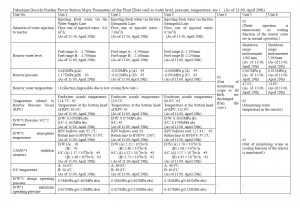
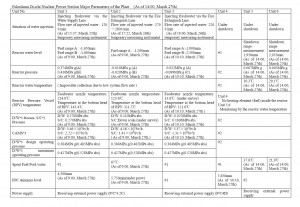
Another week has passed and more steps have been taken to get the situation under control. Lets start with the usual reactor status table  made out of NISA data:


Reactor 1 Reactor 2 Reactor 3
Water level (meter)* -1.7 -2.1 -2.15
Flow rate(m3/min) 8 7 9
Core pressure (kPa) 1390
Containment pressure (kPa) 120 60 102
Wetwell pressure (kPa) 110 183.2
Feedwater nozzle temp (Celsius) 119.8 115.6 202.1
Bottom head temp (Celsius) 96.9 151.9
Wetwell temperature (Celsius) 51.4 66.8 40.0
Containment dose rate (Sv/hour) 22.7 12.2
Wetwell dose rate (Sv/hour) 1.1 148 0.480
*Distance from top of assembly
– broken gauges or missing data

Everything looks pretty stable except the wetwell dose rater in the number 2 reactor. It has increased to well over 100 Sv/hour from 37.1 in the last update I made (i wrongly wrote 0.371).  I haven’t been able to follow the news so closely the last week so I have not seen if this has been mentioned in any TEPCO press release. Below is a graph of the increase. If anyone know of any action done on the number 2 reactor, starting the 3 or 4th of may please write a comment to this blog post.


A air filtration system has been connected to the reactor building of reactor number 1. The purpose of it is to get airflow through the building and clean out the air activity by filtrating the air. It is hoped that it will be enough to allow workers to enter the building and work safely without getting to much dose.

Kyodo reports that TEPCO plans to send in workers on monday in order to measure dose rates within the building. Seems strange that they would send in people when they have already used robots once for that purpose.

A longer video clip of the number 4 spent fuel pool can be seen over at Atomic Power Review. It doesn’t appear to be very damaged.

The big news of the week is that the prime minister of Japan has asked Chubu electric to shut down its Hamaoka nuclear power plant. Hamaoka has 3 operational nuclear power plants, all of them quite new. Started at 1987, 1993 and 2004. The newest one is a ABWR and would presumably have state of the art eartquake protection. The reason for the prime ministers request is a estimate that the site  has a high probability to be hit by a 8.0 earthquake within 30 years. If the reactors indeed can not handle such a quake then the closure request is rational. But it does smell a bit like political posturing at this point. There is no legal precedence for such a situation and it is not clear if Chubu electric has to obey the request.


Links(English)
WNN Filters for Fukushima Daiichi 1

Blogs(English)
Atomic Power Review Japan updates: Fukushima Daiichi, Hamaoka
NEI NEI Weekly Update on Fukushima Daiichi – 5/6/1

Blogs(Swedish)
Effekt Monbiot brottas med sig själv
Genusnytt En KARL ska väl tåla lite strålning…
Forskarbloggen Hur många döda efter Tjernobyl?
inas insikter Tjernobyl idag / Fukushima imorgon?
Begrundat och Plitat Cesium och Jod verkar ge spikes i Fukushima när man gläntar på dörren …

/Johan

2 Comments
Why I do not trust “We don’t need nuclear” rethorics

Dear Mr./Ms. Anti-Nuclear Activist… for decades You have been telling me “It’s easy to get off nuclear, if we just want to!”. Well, alot more powerful people than You have made similar promises…

Where do we stand today after all these promises? Pretty much exactly where we were 5-10-20-40 years ago.

So – dear Mr./Ms. Anti-Nuclear Activist – You promise me gold and green forests… but You don’t deliver. Maybe this wasn’t Your fault. Maybe You’d like to blame Big Oil or lazy politicians or a public that just won’t see things the way You do. It’s allright… You can try to shift the blame any place You want. But it doesn’t matter whose fault it is, becasue assigning blame does not alleviate the problem.

So when You – dear Mr./Ms. Anti-Nuclear Activist – today, yet again, try to tell me it’s allright to renounce nuclear power, it means I cannot trust You, because things might no go they way You promise me they will.

What will You – dear Mr./Ms. Anti-Nuclear Activist – need to do to gain my trust again?

Well it’s easy: get the replacements up and running. Get full replacements for fossil fuels and nuclear power up and running, hooked to the grids and pumping GigaWatthours of energy into them, and I’ll trust You again.

So… dear Mr./Ms. Anti-Nuclear Activist…. get to work. We’re eagerly waiting for You.

Oh… and one last thing: while we wait for you to get this work done, You do not get to say we cannot make any new nuclear power if we want to, at least on the “We’re not gonna need it in a while”-argument alone.  Just saying this FYI…

25 Comments

Day 50: First year dose estimates

As the pace of events is winding down in Fukushima so are our updates.

JAIF and NISA updated data below in the table, click the links to see the time graphs from the FNPP1 blog:


Reactor 1 Reactor 2 Reactor 3
Water level (meter)* -1.7 -2.1 -2.25
Flow rate(m3/min) 6 7 6.5
Core pressure (kPa) 1175
Containment pressure (kPa) 105 75 103.3
Wetwell pressure (kPa) 105 179.6
Feedwater nozzle temp (Celsius) 114.7 119.2 80.6
Bottom head temp (Celsius) 95.0 112.9
Containment dose rate (Sv/hour) 24.8 17.0
Wetwell dose rate (Sv/hour) 1.5 0.371 0.527
*Distance from top of assembly
– broken gauges or missing data

Temperatures, pressures etc look quite stable. Pumping of water form the tunnel connected to the number 2 turbine building is marginally successful. Spraying of a resin to bind down radioactive material to the ground, and prevent it from stirring up into the air, is ongoing all over the plant area. TEPCO has managed to get a camera in to investigate the number 4 spent fuel pool and world nuclear news report that the damage is limited, below is a picture from WNN of the pool.

Atomic Power Review writes that NISA has doubts about TEPCO’s plans to flood the containments. The doubt is regarding the structural integrity of the containments with the added strain from such a huge amount of water. Flooding the containment is a part of TEPCO’s plan to restore recirculation cooling to the reactor so it will be crucial to see how TEPCO responds to NISA and if they can show the containments can handle it. If they can not show it conclusively, then they will have to devise a new plan on how to restore cooling. In my last post I was questioning why they would want to flood the containments in the first place, but then realized that if the reactor vessels are broken and leaking, then the only way to submerge the fuel completely is to raise the level of water in the containment to the same level as the top of the fuel assemblies within the reactor vessel. I don’t see why this would be needed for the number one reactor, since it seems like it is holding pressure very well and must be pretty intact. But might be the only way for the number 2 and 3 reactors.

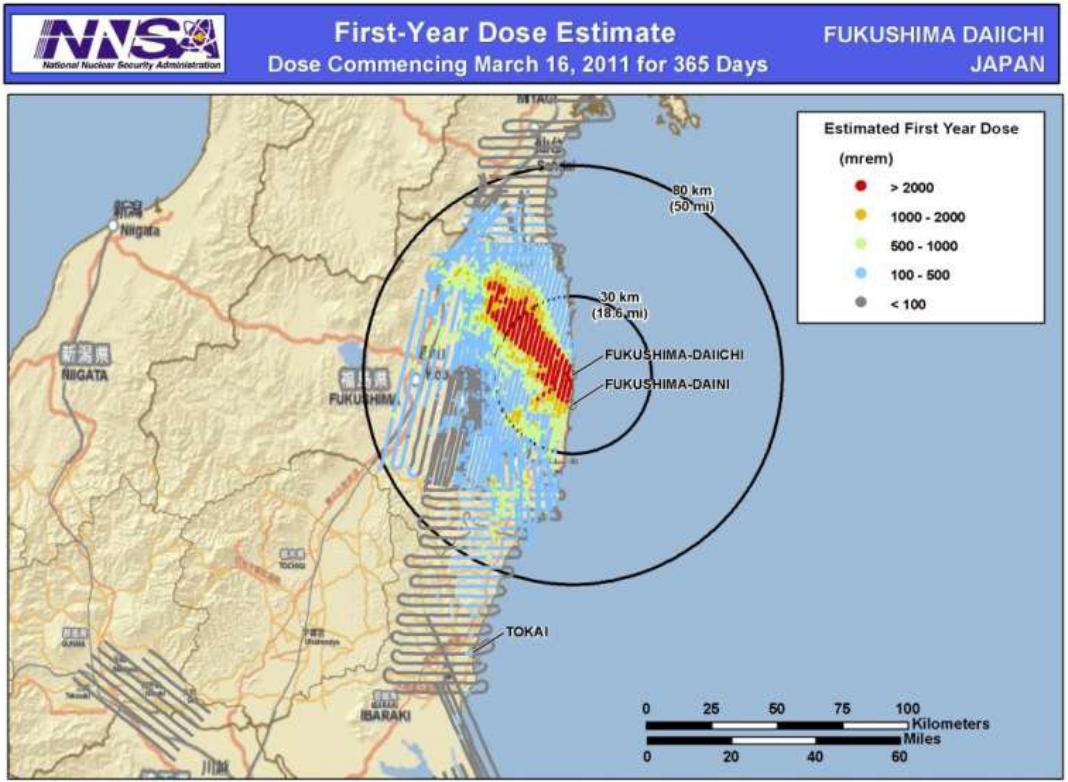
Over at The neutron economy one can read a blog post on the expected first yearly dose relased by the US department of energy, below is a map of it.

The dose rate is based on the following assumptions:

  • Assumes no reduction for spending time indoors
  • Takes into account decay of the radionuclides
  • Takes into account gamma ray from ground deposits and inhalation of stirred up particles from the ground

The map is using the common american unit millirem. One millirem is equal to 0.01 millisievert. The red area marks the area where one would get more than 20 mSv/year if one lives there given the above assumptions.  Yellow area is 10-20 mSv, green area is 5-10 mSv and blue area 1-5 mSv. Neutron Economy also shows a picture with more detail of the over 20 mSv area that can be found in this link. Close to the plant it will be up to 200 mSv and in some hot areas 100 mSv. Some of the hot areas are outside of the initial 20 km evacuation zone and that explain the new evacuation areas. It is not immiedietly dangerous to be in those areas but one probably does not want to live there. It will be interesting to hear what plans will be made to clear out the areas. Outside of Fukushima dose rates are down to natural backgrounds levels according to IAEA. Seems like bans on shipping of most kind of food products have been lifted.

More information about exposed workers have been released, so far it looks like this:

  • 200 – 250 mSv             2 workers
  • 150 – 200 mSv             8 workers
  • 100 – 150 mSv             11 workers


In summary one can say that the situation as far as radiation levels are concerned is improving. Radiation levels are decreasing everywhere. The situation with the reactors are fairly stable, but long term cooling is still a big question mark.

/Johan

Links(English)
World Nuclear News No significant damage to fuel at unit 4

Blogs(English)
NEI Nuclear NotesWeekly Updated
Atomic Power Review NISA instruction to TEPCO
The Neutron Economy Expected Doses Over a Year and Evacuation of Fukushima Towns

Blogs(Swedish)

Dagens Kotka Tre härdsmältor på samma plats
Fourfact webloggen Naturligt kärnkraftsmoratorium
Stockholmscollage Vad har uranpolitikerna att frukta
Svensson En annan värld – kampen mot kärnkraft
Akkomp’s blogg Som ett smycke


11 Comments

Scientific articles about releases from Fukushima

A bit of casual reading for the Easter holidays is offered here:

There are now a few scientific articles available from the arXiv preprint server. We may put some more detailed comments on them as soon as we have had the time to look at them closer ourselves, but they may be of interest to a broader audience.

The articles are (click on the link for each article in order to reach the arXiv page, then download the article as pdf or other format from the box in the upper right corner):

In an earlier blog post there were discussions in the comments regarding the difficulties in correctly identifying which isotopes that are found in the releases. These articles show some nice examples of pulse-height spectra from gamma spectroscopy measurements (incidentally, it is Figure 1 in all three papers). Figure 1 in the paper about analysis of rainwater in the San Franciso Bay area (page 6) clearly illustrates how difficult it can be to correctly identify relatively small peaks on a large background. The samples taken in the water pools at the Fukushima power plant have an even more complicated mix of radioactive nuclides, so this is part of the explanation to why there have been some strange reports regarding identified isotopes.

The last paper surprised me first due to the low levels of Iodine-131 detected, there was a peak value of 2.5 milli-Becquerel per cubic meter of air observed on 6 April, only slightly higher than the peak value observed in Stockholm on 30-31 March (2.15 milli-Becquerel per cubic meter, a tiny amount as explained here (in Swedish only)) and the other data are much lower, around 0.1-0.2 milli-Becquerel per cubic meter. The reason is due to the geography, Tokushima is located on the island Shikoku far to the south-west of Fukushima. Due to the dominating wind pattern, the detected radioactive nuclides have mainly traveled around the entire planet before reaching Tokushima, and therefore have much lower activity. However, the peak around 6 April is due to a temporary change in the wind pattern. Calculations from the Central Institute for Meteorology and Geodynamics (ZAMG) in Austria show examples of the wind patterns. Here is an example from 6-7 April for Iodine-131.

If anybody has any questions related to the articles, you are welcome to post them here and we will try to answer.

/Lantzelot

4 Comments

German economy minister: “To prevent paper cuts, we must cut off our arms”

Ok, now it is official: Germany has gone batshit crazy.

Power firms should invest massively in coal and gas-fired power technology and renewable energy sources, Harry Voigtsberger, economy minister of Germany’s most populous state North Rhine Westphalia, said in the Financial Times Deutschland.

The original article can be read here (in german).

Angela Markel seems to be agreeing

In a document from Friday’s meeting obtained by Reuters, Merkel and her ministers laid out a six-point plan that includes a 5 billion-euro credit programme to support renewables.

It will also require building new gas and coal plants, Merkel said. “Gas and coal power plants were discussed… an accelerated exit from nuclear energy will lead to replacement power stations,” she said.

Why? So they can get rid of nuclear power…

This is about as stupid an idea as to say that in order to prevent paper cuts to your finger you should cut off your arms!

Sure… you achieve what you aimed for… but did you really concider the side effects before you took a knife and started carving?

Diese dummen Deutschen…

13 Comments

Day 35: Parts of the fuel has fallen to the bottom of the vessels

10:00(CET)/08:00(UTC)/17:00(JST)

Just a short update for today. The number 2 turbine building basement is filling up with water as quickly as TEPCO is pumping it out. No word is said about how the similar work in number 1 and 3 is proceeding. Temperatures are on a downwards trend in all reactors. Pressure in the number 1 pressure vessel continues to climb slowly, containment pressures are stable. Not much new happening on that front.

The Japanese Nuclear Society has reported that their analysis shows that parts of the fuel of all 3 reactors has melted and dropped down to the bottom of the vessels. Small parts of molten fuel has according to their analysis dropped from the rods, solidified when hitting the water and then sunk to the bottom forming small grains. The grains are easily cooled since they have large surface area to volume ratio and they don’t form a geometry that is prone to re-criticality.

They also state it is unlikely that there is a large amount of molten fuel at the bottom due to the low temperature readings in the bottom head. Nothing really surprising there either and I pointed it out some time ago. None of this is really surprising.

Zeolite containing sandbags have been put outside the water intake for the number 2 reactors. Zeolite is a porous material that readily adsorbs different molecules (adsorbption is the process of molecules sticking to the surface layers of a material, as opposed to absorption that means its sucked into the material itself). It was used to clean contaminated water within the TMI power planet after the meltdown there.

TEPCO has ordered storage tanks from the US to use to store radioactive water in. IMO I think TEPCO is trying to do perfect when perhaps they should think about doing things adequate. It seems like the volume of water is so large that temporary solutions, like erecting temporary pools, should be considered. But then again it is always easy to be an armchair quarterback on opposite side of the Eurasian continent (other seems to share my general idea though). I haven’t seen any new published analysis of the radionuclide content of the water in the number 2 basement, it would be interesting to see what it contains. The dose rates from the water should be going down due to the I-131 decay. Over 95% of the I-131 has decayed now.

Nitrogen injection into the number 1 containment continues, but pressure in the containment has stabilized. Meaning there must be a leakage somewhere. The leakage can’t be very large however.

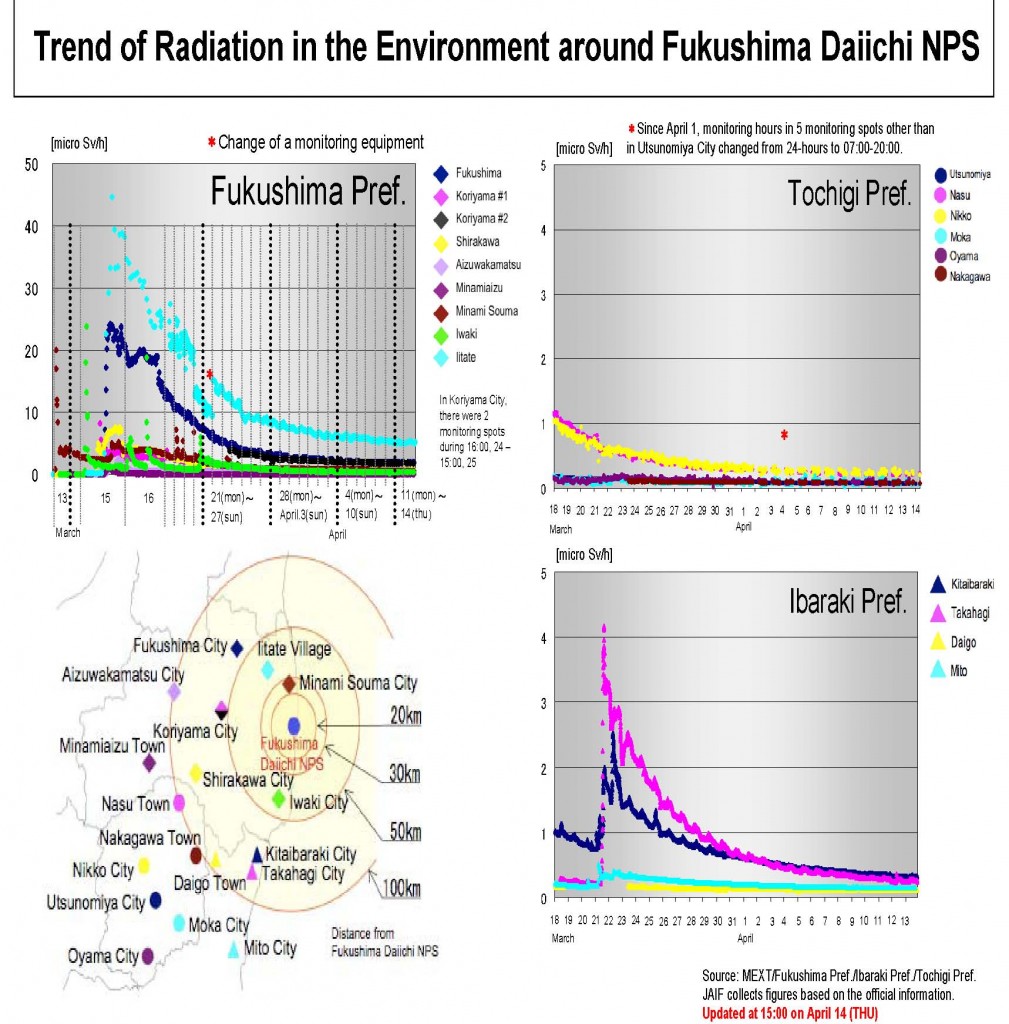
The radiation levels in the groundwater is increasing in the plant area. Otherwise radiation trends are all downwards around Fukushima. From IAEA

Gamma dose rates are measured daily in all 47 prefectures. The values tend to decrease over time. For Fukushima, on 13 April a dose rate of 2.0 µSv/h was reported. In the Ibaraki prefecture, a gamma dose rate of 0.14 µSv/h was reported. The gamma dose rates in all other prefectures were below 0.1 µSv/h.

Dose rates are also reported specifically for the Eastern part of the Fukushima prefecture, for distances beyond 30 km from Fukushima-Daiichi. On 13 April, the values in this area ranged from 0.2 to 26 µSv/h.

In addition to the 7 measurements referred to in yesterday’s brief, (note- these measurements were made at distances of 25 km and 33 km not 32 km and 62 km as reported), 13 more measurements were made on 12 April at distances of 25 to 33 km, West and Northwest from the Fukushima Nuclear Power Plant by the IAEA team. At these locations, the dose rates ranged from 0.5 to 16.5 µSv/h. At the same locations, results of beta-gamma contamination measurements ranged from 0.05 to 2.1 Megabecquerel/m2.

Analytical results related to food contamination were reported by the Japanese Ministry of Health, Labour and Welfare on 13 April that covered a total of 98 samples taken on 4 and 11 to 13 April. Analytical results for 76 of the samples of various vegetables, pork, seafood and unprocessed raw milk in nine prefectures (Chiba, Fukushima, Gunma, Ibaraki, Kanagawa, Miyagi, Niigata, Saitama and Yamagata) indicated that I-131, Cs-134 and/or Cs-137 were either not detected or were below the regulation values set by the Japanese authorities. In Fukushima prefecture on 11 April, twenty samples of various vegetables were above the regulation values set by the Japanese authorities for Cs-134/Cs-137, and one sample of seafood (sand lance) and one sample of spinach were above the regulation values set by the Japanese authorities for both I-131 and Cs-134/Cs-137.


Links(English)
Reuters Burrial of reactors tricky

Blogs(English)
Depleted Cranium Fukushima: Now a level 7, but nothing changes
All things Nuclear What Happened at Fukushima Dai-Ichi?
Atomic Power Review Brief update: Temperatures at Fukushima Daiichi 1,2,3
Atomic Power Review Fukushima Daiichi: Reactor cores
Atomic Power Review FACTS: Decommissioning of nuclear power plants

Links(Swedish)
Newsmill Japanska strålsäkerhetsmyndighetens INES 7-gradering endast temporär
Newsmill Brittisk miljöaktivist: Antikärnkraftslobbyn har bluffat om strålningens hälsorisker
Newsmill Japans unga revolterar mot kärnkraften
DN debatt ”Vi fattar inga panikbeslut om kärnkraften”
DN debatt”Att stänga två reaktorer skadar svensk basindustri”

Blogs(Swedish)
Rättvisan framför allt Långsiktighet, var god dröj.
Lotta Olsson Energipolitik är långsiktig…
In Your Face Kan du vika tranor?
Dr Angels blog Fukushima är ännu en mardröm

5 Comments

“Mummy, mummy, there’s a nuclear monster!”

One of the frustrating parts about being a proponent of nuclear power is when people rag at you for showing them facts that nuclear accidents aren’t that big a deal. After all… “everyone knows” that a nuclear accident is a catastrophe unlike all others and that a “meltdown” means instant death to thousands of people, cancer to millions and huge tracts of land made uninhabitable for centuries… as told by various groups out there.

So when you point out to them that the TMI meltdown had zero casualties, that the Fukushima triple meltdown and explosion/fire in a fuel pool is presently holding the zero and that the prognosis is slowly starting to look hopeful, and that the current death toll from Chernobyl correspond to the number of people killed in US motor vehicle accidents in one day, people tend to take great offense at you questioning the supposed “truth” about nuclear power. I have been called quite a few unflattering things for this heinous crime of not being upset about nuclear accidents and – even more blasphemous – trying to calm other people about them as well.

Therefore it was with a great sense of recognition I read Lewis Page’s piece “Mummy, mummy, there’s a nuclear monster!” in “The Register today. I won’t steal his glory but I will point out two core pieces and quote them:

This is the problem that everyone faces, who describes nuclear incidents as they really are – that is: insignificant. You are accused of being heartless, of failing to care about or empathise with people who are terribly frightened. You have committed the same sin as bracingly telling a toddler that there is no monster under his bed and that he should go back to sleep.

Part of the problem here is that in the case of nuclear dangers it is rather as though the toddler had a mentally troubled aunt or uncle who, in addition to telling the kid fairytales at story time, insists that the monsters in the stories are real.

The people in charge of story time here are the media, and like many of us finding ourselves troubled by bizarro in-laws, the media fails – seldom really even tries, often enough – to prevent the mad aunt telling the kids rubbish.

[….]

Some of us at least are getting a bit sick of the idea that you simply aren’t allowed to tell frightened people quite bluntly to act their age – and we’re getting more than just a bit sick of irrational or unscrupulous fairytale-spinners making them frightened in the first place.

That is pretty much it: you are considered a villain for telling people “Oh stop whining you baby, it’s just a nuclear accident!”. You’re being painted as an arsehole for not playing along with paranoia and prejudice. They are calling you foul names and questioning your moral character for trying to make people less scared.

It’s one of those things that makes me want to bang my head against the desk and tell people to go overdose on their stress- and angst-hormones if they are so much in love with them. It feels like getting yelled at by a drunk relative for taking his/her bottle away. Why would I bother?

Well… I must, because it’s the right thing to do. If I didn’t, then I’d be an arsehole for real, wouldn’t I? If I firmly believe that someone is wrong in their actions and beliefs, and that they are hurting because of these beliefs, would you suggest I play along? Or should do as I would to the same human being if they had been 25-75 years years younger, by telling them that there is no monster waiting to eat their toes?

The worst part is – of course – that some people have a very strong self-interest in keeping others scared of the nuclear monster under the bed. Let me show you another example…

With “information” like that, is it any wonder that people are frightened? Those who made that video are the ones that should be called heartless, for using and abusing people’s fears simply to advance their position and get more influence.

But good news are no news. It’s easier to sell a story of Doom & Destruction than telling people that things are actually not very bad at all. You’re considered the weird one for not being a paranoid alarmist professing the impending end of life as we know it.

What can we do to break the trend? How can we make people stop being scared of things that are not scary, and focus on the real dangers out there, such as fossil fuels that are killing literary millions of people every year?

Facts… keep speaking the facts… that’s how you eradicate fear, prejudice and misconceptions. I have so far not met a single person who have learned the facts about nuclear power and who has since remained genuinely scared of it! Keep pushing the facts…

Let me close up this post with a video of a fellow swede that has opened up many people’s eyes and minds by showing the cold hard facts in a very funny and interesting manner: Hans Rosling. Enjoy… I did. 🙂

EDIT: as commented below… there is more on www.gapminder.org. 😉

18 Comments

George Monbiot: “…the anti-nuclear lobby has misled us all”

George Monbiot, environmentalist and journalist… and once a strong opponent to nuclear power has faced an “unpalatable truth”: the anti-nuclear lobby lied to us.

http://www.guardian.co.uk/commentisfree/2011/apr/05/anti-nuclear-lobby-misled-world

The article is only about 30 years overdue… but I cannot stop smiling when I read this. Monbiot did what everyone should do: check the facts, think for yourself, dare to think you may have been either right or wrong.

The unpalatable truth is that the anti-nuclear lobby has misled us all

I’ve discovered that when the facts don’t suit them, the movement resorts to the follies of cover-up they usually denounce

George Monbiot

Over the last fortnight I’ve made a deeply troubling discovery. The anti-nuclear movement to which I once belonged has misled the world about the impacts of radiation on human health. The claims we have made are ungrounded in science, unsupportable when challenged, and wildly wrong. We have done other people, and ourselves, a terrible disservice.

Thank yo so much for this George. Along with Mark Lynas and Patrick Moore, you have shown that “green” does not have to mean “unscientific zeal”.

27 Comments

A litte riddle… solve it and win pins.

This is not so much an April Fools joke as it is a little riddle. It connects to a current event… and to things that happened in the last century. And of course it has something to do with nuclear power.

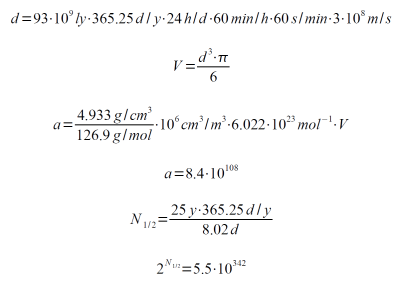
What are these equations?

This is a comparison between two estimated values… what are they?

Update: we have a winner! Tony scored a perfect bullseye. I’m quoting him here:

‘a’ is the number of iodine atoms that would fill the known universe, if the iodine were at ‘normal’ temperature/pressure.

the second number is the number of radioactive iodine atoms you would have needed, when Chernobyl exploded, in order to have one radioactive iodine atom left today.

An added trivia is that the estimated number of atoms in the known universe is approximately 10^80.

The upshot of all this is this: there is not a single atom of Iodine-131 released by Chernobyl in existence today. The last atom decayed in no more than 4 years after the accident.

/Michael

4 Comments

Day sixteen after the tsunami

Uppdate 20:00(UTC)/22:00(CET)/05:00(JST)

NISA updates

Reactor 1:
Water level in the core: 1.65 (1.65) meters below the top of fuel assemblies
Flow rate of injected water: 120 liter/minute
Core pressure: 508(517) kPa
Containment pressure: 270(270) kPa
Core temperature(feedwater nozzle): 224.8 Celsius
Core temperature(bottom head): 143.4 Celsius
Dose rate within containment: 34.6 Sv/hour

Reactor 2:
Water level in the core: 1.2 (1.2)   meters below the top of fuel assemblies
Flow rate of injected water: 270-280 liter/minute
Core pressure: unknown
Containment pressure: 110 (110) kPa
Core temperature(feedwater nozzle): 123.6 Celsius
Core temperature(bottom head): 111.2 Celsius
Dose rate within containment:  41.6 Sv/hour
Spent fuel pool temperature:  67 Celsius

Reactor 3:
Water level in the core: 2.3  meters below the top of fuel assemblies
Flow rate of injected water: 220 liters/minute
Core pressure: 130 (133)  kPa
Containment pressure: 107.3 (107.6) kPa
Core temperature(feedwater nozzle): 13.6 Celsius (obviously error)
Core temperature(bottom head): 121.6 Celsius
Dose rate within containment:  33.7 Sv/hour

No major changes to the status of the reactors. Pressure in all containments seem ok. There is total confusion regarding the measured isotopes in the water in the basements for the turbine halls. It seems impossible to sort it out in any way and we can only wait for TEPCO or NISA to give final word on what they are actually measuring. It is pretty much beyond a doubt that the activities they published yesterday are wrong, it isn’t consistent with the given dose rates.


Update 10:00 (UTC) / 12:00 (CEST) / 19:00 (JST)

No new update from NISA during the night, but a new update from JAIF(link 1, link 2).

Reactor 1:
Water level in the core: 1.65 meters below the top of fuel assemblies
Flow rate of injected water: no new data
Core pressure: 508 kPa
Containment pressure: 270 kPa
Core temperature(feedwater nozzle): no new data
Core temperature(bottom head): no new data
Dose rate within containment: no new data

Reactor 2:
Water level in the core: 1.2   meters below the top of fuel assemblies
Flow rate of injected water: no new data
Core pressure: unknown
Containment pressure: 110 kPa
Core temperature(feedwater nozzle): no new data
Core temperature(bottom head): no new data
Dose rate within containment:  no new data
Spent fuel pool temperature:  no new data

Reactor 3:
Water level in the core: 2.3  meters below the top of fuel assemblies
Flow rate of injected water: no new data
Core pressure: 130  kPa
Containment pressure: 107.3  kPa
Core temperature(feedwater nozzle): no new data
Core temperature(bottom head): no new data
Dose rate within containment:  no new data

Acording to TEPCO the dose rates from the water found in the turbin hall basement:
Reactor 1: 60 mSv/hour
Reactor 2: More than 1000 mSv/hour
Reactor 3. 750 mSv/hour

They have started to drain the water so that work can proceed to restore the pumps.

Links(english)
Kyodo News Woes deepen over radioactive waters at nuke plant, sea contamination
Reuters Soaring radioactivity deals blow to Japan’s plant
BBC Radiation soars at japan reactor
NHK extreme radiation detected at number 2 reactor

Links(swedish):
DN Arbetare evakueras efter akut strålning
SvD Fler svenskar misstror kärnkraft
SVD Nya bakslag vid Fukushima
Aftonbladet tio miljoner gånger högre strålning
Röda berget
Jinge
In your face

3 Comments