Skip to content

Tag: KBS-3

Did you think renewable power is sustainable? Think again…

“Sustainability” is a buzz-word these days. It is used often and eagerly, especially by opponents of nuclear power and proponents of renewable alternatives. There is an assumption to there that if something is renewable it is also automatically sustainable. There is also an assumption that nuclear power is not sustainable. How surprised people get when they find out that the exact opposite is true…

Let’s take a step back and for once examine what we actually mean by the concept of sustainability.  In this article, we will be focusing on sustainable power production.

What sustainability is not

There seems to be a vague notion out there that something that is sustainable we can start using now and then keep using forever, or that something that is sustainable never consumes any resources. Well even by this faulty definition, renewables are not sustainable. This is because solar panels are not built from sunshine,  nor are wind turbines built from a stiff afternoon breeze. You build them from consumable materials such as steel, copper, neodymium, gallium, arsenic, indium and other sometimes not too common materials. Also they have a finite life span after which they must be torn down and replaced. This means that solar and wind power does consume resources and in the end cannot be used forever.

But that is not the definition of sustainable, so let’s move on.

What sustainability is

“Sustainable development” was defined by the Brundtland-commission report “Our common future in June 1987 as:

…development that meets the needs of the present without compromising the ability of future generations to meet their own needs

Now let’s look at this. Does this say anything about renewables, using the same things forever, or even that using fossil fuels would be a bad thing? No it does not. The report doesn’t even say we cannot deplete a resource.

As for non-renewable resources, like fossil fuels and minerals, their use reduces the stock available for future generations. But this does not mean that such resources should not be used. In general the rate of depletion should take into account the criticality of that resource, the availability of technologies for minimizing depletion, and the likelihood of substitutes being available.

So what sustainability means is this:

  • We have needs, and we must meet them.
  • The future generations will also have needs, and we must not do anything that prevents them from getting these needs met.

People talking about sustainable development often talk about the future. But what they keep forgetting is that development that does not tend to the needs of the present as well, is not sustainable. Sustainable development must meet both current and future needs.

So now that we have established what sustainability actually means, let’s get to work applying it.

Applying the definition of sustainable to the real world

What are our needs when it comes to power? Among all needs, one is reliability.

Reliable power production means that we get have the amount of power we require, the instant we require it. Power is a perishable commodity. Especially electricity must be produced the very second we intend to consume it. If production does not meet demands, we have a power deficit. We do not accept power deficits. Not only is a power deficit annoying, but it can also be very dangerous as we are relying on electricity for a great number of critical applications, such as hospitals, tele-communications, cold food storage and pretty much anything that makes our society modern and thriving. Also power drops on the electrical grid risks damaging or destroying equipment connected to it.

Hence a source of power must be able to deliver as much as we want, the moment we want it or it is not, by definition, sustainable.

Are wind power and solar power sustainable sources of power?

Solar power and wind power are not living up to Brundtland commission definition of sustainable, for that most inane of reasons: when there is no wind, and when there is no sun, they do not deliver power. And by not doing that, they fail our need of reliability.

But surely there is always wind and sun, isn’t there? No, not always. Sun is a no-brainer, because sun does not shine 24 hours per day (except above the arctic circle in the summer but that doesn’t help us in the cold dark winter). So what about wind?
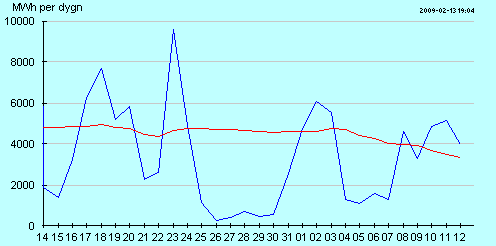
Wind power in Sweden, jan-feb 2009
Reported wind energy production in Sweden, Jan-Feb 2009

The graph above is statistics for wind power in Sweden, fetched from Vattenfall’s page www.vindstat.nu. This page represents day average wind power production in Sweden for 30 days. The reporting plants range all the way from the south tip of Sweden to the far reaching north. The image is a snapshot of the graph taken at February 14, 2009.

The amount of installed wind power, that is to say the maximum power capacity, that reports to this webpage was 695 MW for the 30 days displayed, which is about 85% of all installed wind power in Sweden. This means that theoretical maximum power production in this graph is 16 680 MWh per day. Keeping this in mind, we see that for January 25 to January 30, wind power delivered 2-4% of installed capacity. After that it made a skip up, but less than a week later is was down below 10% again for another four days.

And again we must remind you that this is day average production and does not consider fluctuations during the day. This means that wind power in Sweden at times most likely delivered less than 1% of installed capacity.

This means that development that would rely on renewables such as solar and wind to meet our power needs, would not be considered sustainable unless there was something else that could entirely replace them for low periods. Such replacements do not exist.

Are bio-fuels sustainable?

Bio-fuels is another renewable alternative that is getting much attention. Do they meet our needs? That can be questioned, because while reliability is acceptable, the guarantees of capacity are shaky at best. And even worse is that bio-fuels strike at one of our most basic needs: health and long life. Bio-fuels, just like any other combustible power sources, release gases and pollutants that are harmful to human health. While being mostly neutral when it comes to carbon balance, this does not make the emissions any less harmful to people. Improvements can be made, but it must be asked how many premature deaths we are willing to tolerate before the technology of bio-fuels have been improved to acceptable levels. Hence this leaves the sustainability of bio-fuels in doubt.

Is nuclear power sustainable?

Let’s look at the needs we have, and that the future generations will have:

  • Capacity
  • Reliability
  • Clean air, land and water
  • Health

Does nuclear power fulfill these needs? Yes it does. Nuclear power has a capacity and reliability that is matched only by hydro power and fossil fuels. It does not pollute air, land nor sea in such a manner that we cannot accept it. And it does not threaten health in such a manner we cannot accept it. In fact, the power it replaces, such as for instance coal plants, kills about 2 million people prematurely every year from air pollution. So in replacing that, nuclear power saves lives.

Nuclear waste is an issue, yes. But it is a solvable issue, solvable in such a way it will not impede future generations from having their needs met. The science needed to know how to do that has been available since the 1970’s. It is part needing to gather experience on how to do it, and mostly politics that has kept us from implementing them so far. But for instance the Swedish method for a deep geological repository KBS-3 is at such a level of maturity it may begin being implemented in the near future. And more alternatives for dealing with nuclear waste are being made available as technological development progresses. We have no reason to assume nuclear waste cannot be dealt with in a sustainable manner that meets the definition by the Brundtland commission.

If we use nuclear power, must future generations use it too?

Using nuclear power now does not force future generations to use it. Nuclear plants have a finite life span of about 40-60 years. For renewables like solar and wind, their life span is even shorter. After that, the plants must be replaced. The future generations are free to choose whatever method of production they want for these replacements. They are not locked in by our choice. If they want to use something else, they are free to do so.

And choosing something else, they most likely will. Fusion power has dodged us for some time, but the progress is very promising. The research facility ITER is being constructed as we speak. The follow-up DEMO is on the drawing board. If there are no big snags, work at these plants will be done by 2050, at which time fusion power can go commercial. If we are unlucky, it might be another 100 years before they work out the problems. Being pessimists, we can reasonably estimate that by 2150 at the latest, fission nuclear power, solar, wind and pretty much everything else we use for our base load, can be phased out. This is what the Brundtland commission report speaks of: “the likelihood of available substitutes”.

And even if fusion power never takes place, whatever opponents of nuclear power claim can be used to replace nuclear power now, can most certainly be used to replace it then. If not, their case falls apart anyway and we must keep using nuclear power and make it even more effective.

So does it really matter that we risk depleting our nuclear fuel resources? No, it does not. If we start to reach the end of such resources, something that is not likely to happen by at least 2 000-5 000 years anyway, then future generations may switch to whatever else they want to use. They are not bound by our choices, and as such, the definition of sustainable development is met by nuclear power.

Conclusion

It has been said that the person that stares too far ahead, risks tripping over their own feet. This is true also in this matter. We must not forget that our needs must also be met, and not just the needs of future generations. Otherwise we do not have sustainable development. And sadly, renewables such as wind, solar and bio-fuels do not yet meet these needs. No matter how much we spend on research, we cannot force the sun shine when we want it to, nor make wind blow on demand. Bio-fuels rely on combustion, which we do not know yet how to make non-hazardous to health. Hence they are not sustainable.

Nuclear power however is, as far as we can make out, sustainable.

14 Comments
Comment regarding corriosion in KBS-3 copper capsules

During 2008, and highlighted in articles this past week, there has been statements that the maximum rate of corrosion of copper in pure water may be higher than anticipated. This is important to the nuclear issue because copper is one of the four barriers of the Swedish Nuclear Fuel And Waste Management Company (SKB) method of storing nuclear waste: KBS-3.

Scientists from The Royal Institute of Technology and Uppsala University Peter Szakálos (KTH), Gunnar Hultquist (KTH) and Gunnar Wikmark (UU) are calling into question statements by SKB that copper is immune to corrosion in pure water devoid of oxygen. This statement is found on page 102 in the SKB report TR-06-22.

 In the absence of oxygen, copper is thermodynamically immune to corrosion in pure water. 

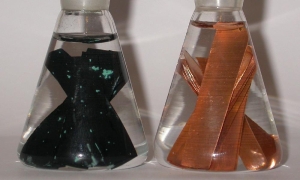
Szakálos, Hultquist and Wikmark claim that in experiments of their own, they have achieved a very high rate of corrosion of copper in pure water if hydrogen is present. The results can be viewed in their Berns presentation from 2008 (in Swedish).

Copper after 15 years in pure water
Copper after 15 years in pure water. On the left, the bottle was closed to everything but hydrogen. On the right, the bottle was closed to everything

At Nuclear Power Yes Please we are – of course – following the matter closely. Part of the foundation for our confidence in nuclear power is the ability to deal with nuclear waste in a safe manner. KBS-3 is a disposal method, one of many, that holds great promise to live up to our demands on safety and not requiring human supervision. It is currently perhaps even the most promising method considering its technical maturity and political feasibility. So if KBS-3 is called into question, this may in an extreme case force us to re-evaluate our position on nuclear power.

However there is a long way to go before we get there.

Even by the words of Szakálos, Hultquist and Wikmark, this is a solvable issue. As such it does not spell the end of KBS-3, nor does it warrant a major rethinking. Szakálos, Hultquist and Wikmark say that modifications that protect the copper capsules from corrosion in a short term perspective, that is to say 1/100’th or less of the repository’s full life expectancy, should solve the issue since it can only happen when the capsules are hot, that is to say only at the very beginning of the storage period.

We also need to remember that the experiments Szakálos, Hultquist and Wikmark performed to achieve the corrosion were very specific and may perhaps not reflect real life subterranean conditions of a deep geological repository. SKB will need to examine if the conditions stated for the experiment can be expected 500 meters down in the bedrock, or if this sort of thing can only be achieved in a laboratory.

Of relevance to that is the fact that SKB has responded and said that they themselves have not been able to reproduce the results of Szakálos, Hultquist and Wikmark, which in turns calls into question the validity of their statements since reproducibility is perhaps the most important quality of any scientific claim.

SKB is also currently conducting an experiment at their Äspö laboratory where they have buried copper capsules in conditions very similar to what it will be in the real KBS-3 repository. These capsules are scheduled to be retrieved next year, which will give us empirical data on how the capsules are affected once buried. Nothing shows us better what can happen than going out and doing it for real.

In summary: while this issue may force SKB to take one extra think before submitting KBS-3 for final review, this still does not constitute an insurmountable hurdle. So far it appears to be solvable. Even Szakálos, Hultquist and Wikmark state that they do not think this issue is a show-stopper. And as such KBS-3 can only become better from this.

Also, on a very positive note, we at Nuclear Power Yes Please are pleased to notice that this criticism has brought KBS-3 into view of the public eye. This is good(!), because very few people have until now been aware of just how far the work on KBS-3 has progressed. Constantly we are hearing people, especially opponents of nuclear power, saying “We don’t know what to do with the waste”. The issue of copper corrosion has shown everyone that we do in fact have a very good idea what to do with it and that KBS-3 is a well researched method that is approaching the point where when it will be implemented for real.

This issue will of course have to be adressed and at Nuclear Power Yes Please we are eagerly waiting to hear what SKB has to say about it. We will continue to monitor this issue with great interest.

And after all: we are on no big hurry. Nuclear waste is a very patient player and will wait for us in intermediate storage while we take the appropriate time to determine what we will do with it. 🙂

Articles:
Mediasammanfattning, vecka 7 – SKB
Kärnavfallet kan läcka ut – Aftonbladet
SKB svarar kritikerna: “Vi är öppna för granskning”

Blog posts:
Vad skall vi göra av kärnavfallet?
Slutförvaring
FRAmtidens energi och konst
Mest kärnkraft i världen
Hets mot folk

1 Comment

“Ja men vad händer om…”

Björn Wadström skriver i sin blogg angående jordskalvet som inträffade morgonen den 16 december 2008:

Min fundering, som jag inte läst någonstans än, är: Hur stor är risken att det kommer framtida stora skalv i plattan. Om vi nu tänker några hundra tusen år och börjar fundera över svenskt slutförvar av utbränt kärnbränsle. Är det så säkert eller klokt att “gömma” avfallet i den säkra? svenska berggrunden?

Det roar mig alltid hur dessa amatörtyckare tror att de är de första som kommer att tänka på olika riskmoment. Hela tiden i debatten dyker det upp invändningar i stilen

– Ja men vad händer om det rinner vatten i berget…
– Kapslarna utvecklar ju värme och det är ett okänt riskmoment…

…eller som i det här fallet…

– Vad händer om det blir jordbävning?

Humorn i det hela är att detta har sedan länge varit med i beräkningarna. Det är som att en hemmamekare står och säger åt ett F1-stall “Öh, ni har väl kollat trycket i däcken?”

Varsågod… läs och begrunda hur långt bak i diskussionen sådana här funderingar är.

Beräkningen är gjord på ett skalv på styrka 7.5, på 100 meters avstånd. Är du inte nöjd med det eller Björn?

Comments closed

Kärnkraften säker och ren. Svar till Johan Swahn, MKG

Svar till Johan Swahn, MKG

Hållbar utveckling handlar om att förse dagens generation med vad den behöver utan att offra framtida generationers möjlighet att göra detsamma. Det finns inga tvivel om att kärnkraften uppfyller det. Uran och torium finns för tiotusentals år. Föroreningar från kärnkraftens livscykel är extremt små och kan reduceras ännu mer när man går över till slutna bränslecykler. Att påstå att kärnkraft inte är hållbar är om något ett bevis på att man inte förstår vad hållbar betyder. Det är som att säga att vindkraft inte är hållbart eftersom man måste bryta koppar och stål för att bygga kraftverken. Kärnkraft kommer utan problem att kunna hålla oss med tillräckligt ren energi fram tills att nästa generation energiproduktion – fusionskraften – är på plats inom 50 – 150 år.

Idén med en plutoniumekonomi var tekniskt sund på 70-talet och den är lika sund idag. Det som satte stopp för idén då var att politiker fick den obegåvade och ogenomtänkta iden att man kan hindra kärnvapenspridning genom att hindra teknikutveckling. De glömde dock att den teknik som krävs för att producera vapenmaterial redan var allmän kännedom. Vilket halvkompetent ingenjörsteam som helst kan designa och konstruera en primitiv, luftkyld och grafitmodererad reaktor av Hanford- eller Windscaletyp som producerar utmärkt plutonium. Idéns misslyckande demonstrerades med tydlighet av att Nordkorea, ett av världens mest efterblivna länder då det gäller teknologi och ekonomi, lyckades både bygga en plutoniumproducerande reaktor samt konstruera en bomb på egen hand, och detta dessutom under hårda sanktioner. Att sticka huvudet i sanden och tro att vi kan tiga bort säkerhetspolitiska utmaningar genom att hindra teknisk utveckling har aldrig, och kommer aldrig, att fungera.

Vidare framsteg inom generell laserteknik kommer snart göra AVLIS- och MLIS-anrikning till en bagatell och då försvinner även det hindret för länder som inte har kompetensen att bygga traditionella anrikningsanläggningar. Det går inte hindra länder som vill ha kärnvapen från att skaffa sig vapen genom att hindra teknikutveckling i väst. Allt som krävs av ett land är viljan. Kunskapen kan sedan hämtas in utan större problem. Och att påstå att breeder-reaktorer i USA, EU, Kina, Ryssland, Indien eller för den delen Sverige, skulle öka vapenspridningsrisken håller inte.

Diskussioner om kärnkraftsolyckor är också något som hör hemma i 70-talet. Johan, om vi ska tala om risker, varför förespråkar du inte en avveckling av vattenkraften? Vattenkraft har bevisligen dödat långt fler människor än kärnkraft under den senaste livstid, mätt både totalt och antal döda per TWh. Endast Banqiao-katastrofen i Kina dödade 30-40 ggr fler än alla de som förutspås dö av cancer pga Tjernobyl. Ser man till riskerna vid energiproduktion är redan nuvarande kärnkraft bland de säkraste energislagen. Reaktortyper som pebble bed-reaktorer kommer i sin tur att helt eliminera ens den lilla risken för härdskador.

De verkliga mördarna i världen är biobränslen, kol, olja och andra brännbara bränslekällor. Det är dessa energislag som vi borde jobba med att påtvinga kraftiga miljöförbättrande åtgärder eller som i fallet med kol och olja minska användningen så mycket som möjligt. Att bränna upp kvistar, kolklumpar eller olja är definitivt inte modern teknologi. Och vad gäller energieffektiviseringar borde du ta en rejäl titt på Jevons Paradox. Risken är nämligen rätt hög att effektiviseringarna som du talar dig varm för får en oväntad och obehaglig effekt.

Dina prisuppgifter för kärnkraft skiljer sig stort från de uppskattningar som Vattenfall, EON, Elforsk med flera presenterar. Inte heller matchar de höga priserna du anger de kostnader man sett vid konstruktion av nya reaktorer i Japan, Korea och Kina. Vi kommer givetvis få en bättre inblick i prisfrågan då AREVA färdigställt några EPR i Europa och Westinghouse några AP1000 i Kina och USA. Den största delen i att kärnkraft blivit dyrare är dock att priserna på råmaterial ökat skarpt, råmaterial som tex vindkraft kräver betydligt mer av. Därför ger ökningar i materialkostnader kärnkraften ännu mer ekonomiska fördelar mot vindkraft, medans de båda förlorar mot kol och gas.

Sen har vi slutförvaring. Det är mycket besynnerligt att du som studerat avfallsfrågan missat att den viktigaste säkerhetsbarriären är den naturliga, dvs transuranernas låga löslighet i vatten under reducerande förhållanden, samt aktinidernas extrema affinitet för sten och lera. Du borde knallat upp till kärnkemisterna under din tid vid Chalmers Tekniska Högskola och läst på lite om aktinidkemi. Det gör inte särskilt mycket om avfallsbehållarna går sönder efter några tusen år eftersom transuranerna stannar på plats då det inte finns något som kan transportera dem vidare. De mänskliga barriärerna är enbart grädde på moset. Naturen har på ett övertygande sätt demonstrerat detta i och med de naturliga reaktorerna som uppstod några miljarder år sedan i Oklo, Gabon. Förhållandena vid Oklo var betydligt värre än de kommer vara i en svensk slutförvaring, men trots det spred sig inte transuranerna mer än någon meter som högst.

Vi är väldigt nyfikna på vilka processer MKG hävdar kan sprida transuranerna från slutförvaringen upp till ytan och där ge den mest utsatta befolkningen en dos som överstiger 0.1mSv/år. Kan du svara på det Johan?

Slutligen Johan, tycker vi det är lite smålustigt att när man slår upp den rapport som du menar på säger att svensken i gemen är emot kärnkraft, så är det första man ser siffror som säger att minst hälften är positiva till fortsatt kärnkraft och i många fall även till vidareutveckling och utbyggnad.

/Michael Karnerfors, Johan Simu, Nils Rudqvist, Mattias Lantz, Johan Kihlberg och Christoffer Willenfort, för Nuclear Power? Yes Please.

2 Comments

SNF ljuger i kärnkraftsfrågan

Jag kan inte bli annat än mäkta upprörd när Svenska Naturskyddsföreningen framför rena lögner i kärnkraftsfrågan. Påståendet att kärnkraft “genererar ett avfall som är livsfarligt i hundratusentals år, utan att någon vet det ska slutförvaras” är lögn och förbannad dikt.

SKB’s metod för kärnbränsleförvaring KBS-3 är i slutstadierna av sin forskning. Bevisen för att metoden är säker finns redan på plats och all forskning finns publicerad att läsa. Det är bara att gå till SKB’s hemsida och börja ta åt sig av kunskapen.

Vidare förutsätter påståendet att vi aldrig någonsin kommer att kunna transmutera avfallet till något som är mer kortlivat. Om SNF hade bekymrat sig att läsa det som Mark Lynas skriver istället för att komma med irrelevanta och desperata personangrepp så hade de kanske fått upp ögonen för att ny teknik är på god väg, teknik som inte bara kan minska farligheten på redan skapat avfall, utan dessutom kraftigt höja effektiviteten på kärnkraftverk så att mängden kärnbränsle som används gott och väl faller inom hållbarhetens ramar.

Att Mikael Karlsson i det läget går ut och påstår att ingen vet vad man skall göra med avfallet eller att att kärnkraft inte är hållbart är sålunda antingen avsiktlig lögn, eller en förbluffande brist på insikt i dessa frågor.

Så säg oss Micke, vilket är det? Ljuger du dina läsare rakt upp i ansiktet, eller har du bara skitit i att sätta dig in i frågan?

/Michael Karnerfors, för Nuclear Power? Yes Please

Comments closed