Skip to content

Author: Johan

Day 31: New quake temporarily stops cooling of Fukushima Daiichi

13:00(CET)/11:00(UTC)/20:20(JST)

World Nuclear News reports that the cooling was disabled for 50 minutes, probably to short to have caused any further problems. If power had been disabled for a longer time period they could have connected the fire truck pumps again or switched over to the portable emergency diesel generators that are on the site now. For days the current pumps where driven by the diesel generators before being switched to the grid. Still the incident shows that the situation is still quite fragile and I wonder how long it would take the to switch power source if the of site power is disabled for a longer time.

11:20(CET)/09:20(UTC)/18:20(JST)

Listening to the NHK newscast right now, they report that external power is once again working and the pumps are running again!

Kyodo also confirms this

NEWS ADVISORY: Coolant water injection at Fukushima’s Nos. 1-3 reactors resumed: agency (18:11)

11:10(CET)/09:10(UTC)/18:10(JST)

We just saw this news at Kyodo. No further information avaiable yet!

  • NEWS ADVISORY: Water pumping into 3 Fukushima Daiichi reactors stops: TEPCO (17:56)
  • NEWS ADVISORY: External power sources unavailable at Fukushima Daiichi reactors 1-2 (17:49)

Links(English)
Reuters No irregularities at Fukushima plant after quake: TEPCO

BBC Powerful earthquake rattles Japan
Reuters Japan expands nuclear evacuation zone as new quake hits
Kyodo News Japan to expand evacuation areas near crippled nuclear plant
NHK world One month since disaster hits nuclear plant

Blogs(English)
Atomic Power Review Sunday evening update.. Fukushima Daiichi

Links(Swedish)
DN Nytt skalv i Japan
SvD Tsunamivarning efter nytt jordskalv i Japan

Blogs(Swedish)
Ola Nordebo Ny kärnkraft är inget rationellt alternativ
The Climate ScamVäck med två reaktorer redan nu?

30 Comments

30 days after the tsunami

22:00(CET)/20:00(UTC)/o5:00(JST)

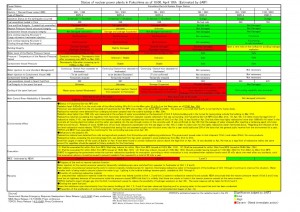
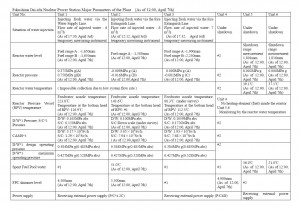
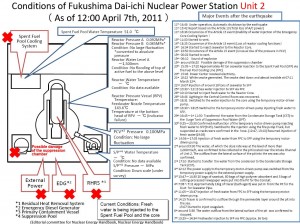
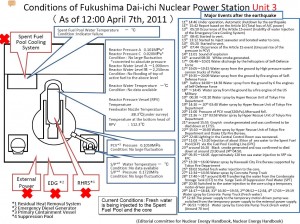
Not very much has happened this weekend, below is the status of the reactors. The first numbers are from JAIF, April 10th 18:00 and the numbers within () is from NISA, April 7th 12:00. If there is only one number given its from NISA and from the 7th of april.

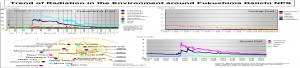
A new blog has appeared, Info on #FNPP1 and Irradiation, that updates graphs of several relevant parameters. Very nicely done! I hope they will continuously be updated, very good resource to bookmark. I direct link to the parameter pictures in the table below(i.e click on water level (meter) and you will get directed to the water level graph on the FNPP1 blog).

Core parameters(water level, pressure, dose rates)
Ibaraki and Tokyo radioactivity


Reactor 1 Reactor 2 Reactor 3
Water level (meter)* -1.60 (-1.65) -1.45 (-1.5) -2.25 (-2.25)
Flow rate(liters/min) 100 133.33 116.67
Core pressure (kPa) 939 (859) 98 (101)**
Containment pressure (kPa) 195 (165) 95 (100) 106 (105.9)
Wetwell pressure (kPa) 150 172
Feedwater nozzle temp (Celsius) 227.7 (223.8) 159.4 (143.6) 91.7 (88.3)**
Bottom head temp (Celsius) 116.9 112.3
Containment dose rate (Sv/hour) 31.7 30.5 19.3
Wetwell dose rate (Sv/hour) 12.9 0.794 0.768
*Distance from top of assembly
– broken gauges
** Probably faulty reading

Pressure in the number 1 reactor pressure vessel is continuing to climb. It is now about one seventh of normal operating pressure. The containment pressure is also rising, due to the ongoing nitrogen injection. Work proceeds in moving the radioactive water from the turbine hall basements in order to be able to access pumps and other things located in the turbine halls that are necessary to get the internal core cooling working again. After they plugged the leak into the ocean through the cable pit water levels are rising in the tunnel connecting to the pit, so TEPCO is preparing to pump the water from the tunnel to the turbine condenser within the turbine building. Steel sheets and barriers has been put up in the ocean to contain water from flowing freely from leaks into the ocean.

IAEA as usually has written an excellent summary of the status of the Fukushima plant.

I have attached a drawing of the Oyster Creek reactor, it should be very similar to the Fukushima reactors. It shows more detail compared to earlier drawings. The control rod drive pipings sure looks like a candidate for the leakage out of the number 2 reactor!


Links(English)
LA Times Japan nuclear crisis ebbing, U.S. experts say
Bloomberg U.S. Will Build Five New Nuclear Reactors by 2020, New Energy Finance Says
Reuters Factbox Japans disaster in figures

Blogs(English)
Rod Adams Opportunities and challenges: Cleaning up Fukushima Daiichi
Info on Fukushima
NEI Nuclear Notes (Ir)responsible Speculations
Idaho Saimzdat Fukushima nuclear crisis news update for April 9, 2011
The Nuclear Green Revolution Avoiding nuclear safety
Atomic Power Review Higashidori: Very nearly SBO
Atomic Power Review Sunday Afternoon Update

Links(Swedish)
Aftonbladet Här träffar vågen kärnkraftverket
Expressen Vågen träffar Fukushima
SvD Vilka reaktorer tänker Juholt stänga

Blogs(Swedish)
Peter Linden Miljöpartiet vill släcka ner Sverige
Ringborgs blogg Var finns kärnkraftsmotståndet i en kärnkraftskommun?
Flute tankar Hänt i veckan 3-9 april, del 1
Ögonblick i norr Paralleller


2 Comments

27 days after the tsunami

21:00(CET)/19:00(UTC)/04:00(JST)

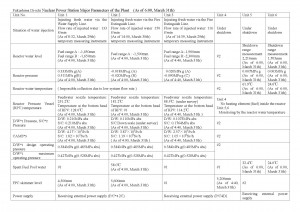
NISA has released a very well done summary of the events so far, I highly recommend reading it!

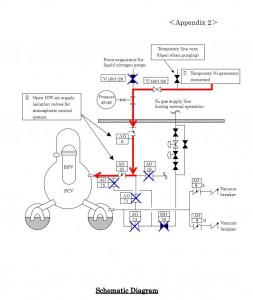
The event of today was that TEPCO started injecting nitrogen gas into the containment of reactor number 1. The nitrogen is injected in order to prevent the possibility of combustible mixtures of hydrogen and oxygen to appear. The nitrogen injection slightly raised the pressure of the containment as could be expected, the rise in pressure also shows that the containment is fairly tight and not leaking much, if anything at all.

The temperature of the feed water nozzle in reactor number one continues going down. Now it is down to 216.3 degrees Celsius, 4 degrees less than yesterday. Pressure continues to climb, now at 859 kPa, up from 733 kPa yesterday.

The other two reactors are pretty much unchanged, TEPCO is planning to fill those containments with nitrogen as well. Dose rates within containments are on a falling trend, probably consistent with I-131 decay.

In a press release today related to the nitrogen injection TEPCO confirms that they suspect that the pressure vessels of the 3 reactors might be leaking.  Which explains why they want to inject the nitrogen. They also write that there is some damage to the number 1 containment, something they haven’t stated before.

IAEA states that they see early signs of recovery at the Fukushima Daiichi plant:


”There are early signs of recovery in some functions such as electrical power and instrumentation,” Denis Flory, IAEA deputy director general and head of the department of nuclear safety and security, said at a press conference.

Nevertheless the situation at the plant ”remains very serious,” he added.


The new quake that occurred today did not have any reported impact on the Fukushima reactors. Overall another baby step towards control of the situation has been taken.


Links(English)
Reuters Major aftershock shakes Japan’s ruined northeast coast
World Nuclear News New earthquake disrupts grid power

Blogs(English)
Atomic Power Review Nitrogen inerting drywells..
All things nuclear How Many Cancers Did Chernobyl Really Cause?
NEI Nuclear Notes Here Comes Tomorrow
NEI Nuclear Notes Thursday Update

Links(Swedish)
Expressen Arbetare på kärnkraftverket i Fukushima evakuerades
DN Tsunamivarning i Japan drogs tillbaka
SvD Kärnkraftverk utryms efter nytt skalv idag

Blogs(Swedish)
Kunskapssamhället Glas stoppar läcka i Fukushima

5 Comments

26 days after the tsunami

21:30(CET)/19:30(UTC)/04:30(JST)

Another rather uneventful day. The sodium silicate injection into the pit seems to have succeed in stopping the flow of water, like I mentioned yesterday this is not a permanent solution and eventually the water will find another path into the ocean until the source of the water is plugged. But it is a good development and every day the water is kept from going into the ocean it is another day with decaying I-131 levels.

TEPCO is pumping nitrogen into the containment of the number 1 reactor and is planning to do the same with number 2 and 3. They are afraid of new hydrogen explosions, this time the source of the hydrogen would be radiolysis of water. Simply put, radiation breaks the chains connecting the hydrogen and oxygen in water and creates free hydrogen. One could also suspect further steam and zirconium reactions might have taken place during the temperature peaks in the number one reactor if the flow of water was temporarily not sufficient. Regardless of the source of hydrogen, if the containment is filled with nitrogen it prevents a combustible mixture of oxygen and hydrogen to occur.

The temperature of the feed water nozzle in the number one reactor is creeping downwards. Now it is at 221.6 degrees Celsius, yesterday it was 233.5 and the day before 242.6. The pressure is showing the opposite trend and is slowly rising, hitting 733 kPa today, 720 kPa yesterday and 704 kPa the day before. Like I also mentioned yesterday this isn’t much of an issue because it is just one tenth of normal operating pressure. Only problem I could imagine is that if the pressure climbs to high the temporary pumps they are using might not be able to match it, but flow rate is steady so far. Containment pressure is steady at 150 kPa.

IAEA reports that instrumentation now has power in reactor number 3. I hope it means they will soon be able to give more detailed information about the status of the reactor. Perhaps my pessimism about the drenched switchboard was wrong, we will see!

There has been reports that detected levels of Tellurium-129 hints of re-criticality, due to the short half live of Te-129 (69.6 minutes). But that ignores that a excited state of Te-129 is also created as a fission product, the excited state has a half life of 33.6 days and of course decays into the ground state. So finding Te-129 now is not very strange at all.

Nothing new about the status of fallout in the prefectures around Fukushima.


***************

Links(English)
Reuters Japan stop nuclear plant leak

Blogs(English)
Atomic Power Review Wednesday early afternoon update
Idaho Samizdat NRC threat assessment of Fukushima risks
NEI Nuclear Notes Wednesday Update

Links(Swedish)
DN Flytande glas har lyckats täta läckan

Blogs(Swedish)
Hög radioaktivitet i fisk
Tellurium 129 tyder på reaktion i Fukushima
Om miljökatastrofer som räddare av ekosystem
“Oberoende” kärnkraftsexperter avlönas av atomindustrin
Vad händer i Fukushima?
Fukushima news and explanations

4 Comments

25 days after the tsunami

Unfortunately we haven’t had time to update the blog today so here is a quick and dirty update.

JAIF’s latest update can be found here, NISA’s latest here. A quick glance shows that the pressure within the number 1 reactor pressure vessel continues to climb, but the containment pressure is unchanged and the feedwater nozzle temperature is going down. The pressure in the pressure vessel is still very much lower than normal operating pressure so its not a problem as long as the integrity of the vessel is sound. The spent fuel pools seems to be nice and cool in all 4 reactors.

Dose rates within all the containments are going down, likely due to the constantly decaying levels of I-131(3 half lifes have passed which mean only one eight of the original inventory is still there, in another eight days only one 16th will be left and so on). Flow rates have been somewhat lowered.

Cs-137 has been detected in fish, 526 Bq per kg to be specific. The limit is 500 Bq so the fish isn’t unsafe to eat. But it’s not a nice trend. Of course with time the Cs-137 should dilute into insignificance so its unlikely to pose much of a long term problem either.

NHK and Kyodo reports that the injection of sodium silicate into the pit with the leak to the ocean has been somewhat successful in lowering the leakage rate. It has to be emphasized though that this is in no means a permanent solution, it just means the water will have to take another path and will eventually end up in the ocean anyway. Any delay is good though since it allows more I-131 to decay before it gets spread. But to permanently fix the issue TEPCO needs to restore internal circulation inside reactor number 2, as long as water is put into the core, then steam blown into the leaking wet well radioactive water will continue to be spread.

Dealing with the radioactive water in the turbine halls seems to be exceptionally slow work and even when the water is removed it will likely take some time before one gets the pumps repaired or replaced. If the summary by Murray Mills is correct (link) its going to be a lot of work to get the control rooms and equipment running again.

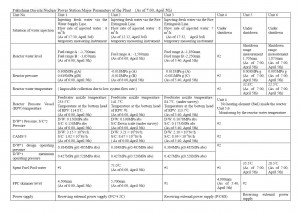
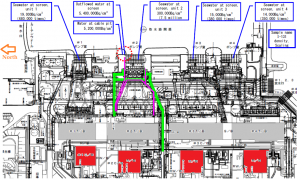
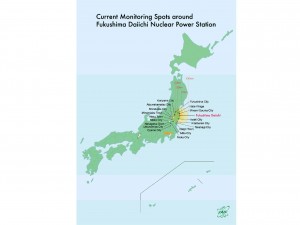
TEPCO has given a new overview of the plant, monitoring positions etc(hats of to atomic power review) that I have attached below.

Links(English)
The Guardian The unpalatable truth is that the anti-nuclear lobby has misled us all
Reuters WRAPUP 1-Japan nuclear plant operator says may have slowed radioactive leak

Blogs(English)
Depleted Cranium Numbers of Fukushima-Daiichi “Victims”
NEI Nuclear Notes Lessons from Fukushima
Atomic power review Good overhead view of Fukushima Daiichi / update

Blogs(Swedish)
Synat och bloggat om kärnkraft, ägarstyrning och miljömål!
Kärnkraftslobbyn är otroligt stark i Sverige
Fukushima i förra veckan
Flygvapnet vägrar mäta strålningen i svenskt luftrum…
Klimataktivist för kärnkraft
1000 gånger värre än Tjernobyl

Comments closed

24 days after the tsunami

Update 18:00(CET)/16:00(UTC)/01:00(JST)

There isn’t much new in the NISA and JAIF reports so I won’t write up the status of the reactors now.

The pressure in the number 1 reactor pressure vessel continues climbing, its now up to 700kPa(about a tenth of the normal operating pressure). But containment pressure is stable at 150kPa and temperature in feed water nozzle is slowly declining.

The big news of the day is that TEPCO will dump some radioactive water into the sea in order to make room for higher activity water from reactor number 2. I haven’t seen any breakdown on the isotopes found in the water intended to be flushed. IAEA writes this

TEPCO has estimated that the potential additional annual dose to a member of the public would be approximately 0.6 millisieverts (mSv), if they ate seaweed and seafood caught, from near the plant, every day for a year.

Quite a small dose(a bit more than one tenth of  what a normal Swede gets in a year from background radiation) that won’t have any measurable health consequences. I wonder how large it is at all compared to what is leaking continuously into the sea.

There is no luck in finding the leak that is pumping out all the highly active water from the number 2 reactor. NISA has released a new overview on the ducts and tunnels connecting everything.

Links(English)
IAEA Briefing on Fukushima Nuclear Accident
Reuters Japan releases radiation into sea

Blogs(English)
NEI nuclear notes Lessons from Fukushima
Atomic power review Sunday evening update

Links(Swedish)
SvD Svensk kamerateknik på väg till Fukushima

Blogs(Swedish)
Emil Isberg Jag har motionerat till #piratpartiets vårmöte #ppvm11
Mikael Ståldal Lobbyorganisationen Miljövänner för kärnkraft
In your face Hög tid för omställning


34 Comments

23 days after the tsunami

Update 16:20(CET)/14:20(UTC)/00:20(JST)

This video from CNN shows the pit that is leaking into the ocean.

http://edition.cnn.com/2011/WORLD/asiapcf/04/03/japan.nuclear.bodies/index.html?hpt=T1

Update 14:00(CET)/12:00(UTC)/22:00(JST)

We did not make any status update yesterday because the situation is not evolving very rapidly anymore. We might perhaps switch to updating less frequently depending on how the situation continues to evolve.

JAIF has released a update (data from 13:30 JST today) and NISA has an update from yesterday(06:00 JST). So there is more than one day between the values, first one from JAIF and the value within () from NISA.


Reactor 1 Reactor 2 Reactor 3
Water level (meter)* -1.65 (-1.6) -1.6 (-1.5) -2.25 (-2.25)
Flow rate(liters/min) 117 150 116
Core pressure (kPa) 648 (621) 112 (126)
Containment pressure (kPa) 155 (160) 105 (110) 106.2 (105.5)
Wetwell pressure (kPa) 160 174.8
Feedwater nozzle temp (Celsius) 252.8 (261.5) 155 90.8
Bottom head temp (Celsius) 118 119.4
Containment dose rate (Sv/hour) 45.5 36.1 24
Wetwell dose rate (Sv/hour) 16.5 0.981 0.955
*Distance from top of assembly
– broken gauges


Temperature and pressure in reactor number one core continues to be quite high but containment pressure is well within design margins. Nothing really new with the status of the reactors.

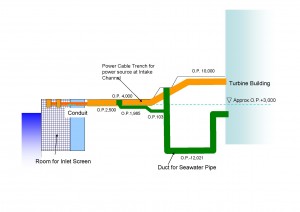
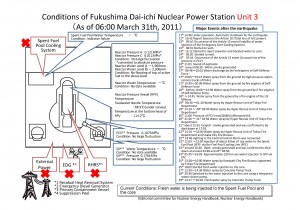
One leak path of radioactive water into the ocean has been identified. It is some kind of pit for cables reportedly close to the sea water inlet for the number 2 reactor. Below is a sketch TEPCO provides.

They have tried both filling the pit with concrete and also filling it with a water absorbing polymer normally used for diapers. The concrete reportedly did not work and no success due to the polymer injection has yet been reported. They are also adding newspaper and sawdust into the tunnel connecting to the pit. All of this is of course temporary measures until one can identify where the leak originates. Whether it is due to the failure of the wetwell reported earlier, or if the valves that are supposed to close the main feedwater lines into the core during an emergency is leaking water into the pipes connecting the reactor to the turbine. Plugging up the pit would at most just slow down the release of radioactive material until the main leak in the containment is fixed. That might end up being exceptionally hard due to the radiation levels. One can’t really weld a leaking crack in the torus with 1 gray per hour dose rates.

TEPCO is planning to use a large barge in order to get rid of the contaminated water found in the turbine buildings along with pumping it into the surge tanks for the suppression pools. Below is a chart on how they are planning to do it.

It is frustrating to have no idea on what their long term plan is. If the summary of the damage done to the reactors by Murray Miles(written on Rod Adams blog) is correct then it will be exceptionally hard to revive the control rooms. Here is a quote from the explanation:

In going the extra mile to protect from earthquakes, Tokyo Electric put the electrical switchgear in the basement. So they had electrical power after the quake. However the tsunami flooded the basements, and there was no way to pump out the basement. The water obviously shorted out the circuits.

To compound the problem, they routed the wiring for the instruments in the control room through this basement switchgear. Therefore after the flooding, all six plants were without power, without emergency diesel generators, without instrument readings to tell the status of the plants, without lights. I have not seen these two disastrous design failures discussed on television.

We might be looking at months of work to reroute all the cables connecting the instruments and equipment within the cores to the control rooms. I don’t know the minimum amount of equipment and instruments that are needed to put the reactors into cold shutdown, but lets hope its not to much. Until they get internal circulation working within the reactors they will have a problem with leakage from the reactors since they are doing a feed and bleed strategy now. I.e they feed the reactors with water that boil and then bleed the steam out into the containments. The containments of course are not infinite in volume so it is not a viable long term strategy, especially not in the number 2 reactor that has a leaking containment.

It would be very reassuring if TEPCO and NISA could present an outline of what their plan is regarding getting back the minimum needed instrumentation and equipment and what measures have to be done to achieve that and if there is any option in case they can not remove the contamination from the turbine hall basement sufficiently to work there.

TEPCO has managed to get some lighting back into the turbine halls

Checkup on the thyroids of children in the surrounding areas have shown the kids have not been exposed to I-131 over the limits. This is very good news considering that it was I-131 that was responsible for all extra cases of cancer so far detected after the Chernobyl disaster. Radiation levels in the surrounding seems to be on a stable downward trends and all the radioactive materials coming out of the reactors now are leaking into the ocean rather than being dispersed into the atmosphere. It is likely that will continue unless the need for more containment venting appears again.

The two workers that was reported missing after the tsunami hit has been found dead in a turbine building, very sad news.


Links(English)
NY Times Reactor core was severely damaged
Reuters Japan nuclear struggle focuses on cracked reactor pit

Blogs (English)
Depleted Cranium Japan’s tsunami victims upset over nuclear attention
This week in nuclear MOX Fuel in Fukshima Daiichi Adds Little Risk to Public
Nuclear Green Fukushima Dai-ichi: The Good, the Bad and the Ugly
UCS All things nuclear 3 weeks update

Links(Swedish)
SvD Klarar sig Sverige utan kärnkraft?
Expressen Döda arbetare funna vid kärnkraftverk
Aftonbladet Två arbetare hittades döda
DN Utsläppen kommer pågå i månader
DN Expert, Fukushima värre än Tjernobyl
SvD Kärnkraftsarbetare funna döda

Blogs(Swedish)
Eva Flyborg Inte rädda men beredda!
Akkomps blogg Blicka frammåt
Grön horizont 75 ton plutonium?
Radikalen Kommer Tyskland avveckla kärnkraften
Begrundat och plitat Effekter av Tjernobyl i Sverige (Och lite om Fukushima)
Dr Angels blog 100 000 gånger mer radioaktivitet i det läckta vattnet från Fukushima
 

Comments closed

Three weeks after the tsunami

Update 18:00(CET)/16:00(UTC)/01:00(JST)

The new JAIF update is out. Temperature of the core in Reactor one has gone down and pressure gone up slightly. They have added the water level of the radioactive water in the tunnels they are trying to empty. They now write that they suspect the pressure vessels of reactor number 2 and 3 are no longer airtight but they don’t think there are any holes or crack. A cryptic statement and I wish they would release more information on what they mean exactly. Doesn’t seem possible to exclude a small breach in a few control rod guide tubes due to dripping corium(molten core material). At the same time the temperature readings in the lower head of reactor 3 excludes that the entire bottom has gone out due to massive melting through the vessel. In reactor 2 one neither has any temperature reading from bottom head or any pressure reading within the vessel.

Update 11:00(CET)/09:00(UTC)/18:00(JST)

JAIF has released a update (data from 07:30 JST today) and radiation trends and NISA has an update from yesterday(06:00(JST) march 31).

Reactor 1:
Water level in the core: 1.65 (1.65) meters below the top of fuel assemblies
Flow rate of injected water: 133 liter/minute
Core pressure: 583(612) kPa
Containment pressure: 175(210) kPa
Core temperature(feedwater nozzle): 256.2 (251.2) Celsius
Core temperature(bottom head): 128 Celsius
Dose rate within containment: 41.7 Sv/hour

Reactor 2:
Water level in the core: 1.5 (1.5)   meters below the top of fuel assemblies
Flow rate of injected water: 150 liter/minute
Core pressure: unknown
Containment pressure: 110 (110) kPa
Core temperature(feedwater nozzle): 181.2 Celsius
Core temperature(bottom head): Unknown
Dose rate within containment:  38.7 Sv/hour
Spent fuel pool temperature:  58 Celsius

Reactor 3:
Water level in the core: 2.25 (2.3)  meters below the top of fuel assemblies
Flow rate of injected water: 116 liters/minute
Core pressure: 117 (121)  kPa
Containment pressure: 173 (176.4) kPa
Core temperature(feedwater nozzle): 88.5 Celsius (under review)
Core temperature(bottom head): 114.2 Celsius
Dose rate within containment:  25.7 Sv/hour


Pressures and temperatures seems to be quite stable, albeit high in the number 1 reactor. Nothing new really on the status of the 3 reactors.  A temporary pump used to pump water into the number 2 spent fuel pool has malfunctioned and we can see a increasing trend in the water temperature.

They are shifting around water in different places to be able to make room somewhere to pump away the junk water in the basements of the turbine buildings. In order to be able to access the coolant pumps needed to restore the proper cooling of the reactors.

The JAIF radiation trends show that there was big emissions during the 15th and 16th and after that a declining trend. There doesn’t seem to be any continuous emissions from the plant and the emission spikes corresponds with the venting of the containments and following explosions and fires in the reactor buildings. Unless a new need to vent the containments arises, then there shouldn’t be any new big emissions. By now the I-131 content of the reactors have decayed down to a quarter of initial amount and for every week(8 days to be precise) they can prevent venting the amount will further be cut in half. I-131 will stop being a problem after about 80 days, by that time the amount will have been reduced to one thousandth of the initial amount. Cs-137 will of course continue to be a problem with a half life of 30 years.

TEPCO has once again measured wrongly activities in water, but it is likely the ground water around the plant is contaminated. Source of the contamination is unknown but TEPCO suspects its been carried by rain after the initial ventings.

Situation is serious, but it doesn’t seem to deteriorate anymore.


Links(English)
Reuters Japan nuclear crisis drags on
George Monbiot describes the double standards used to evaluate nuclear

Blogs(English)
Charles Barton Nuclear Safety and George Monbiot
NEI nuclear notes Appeal of small reactors might increase after Fukushima
Rod Adams Monbiot debates Caldicott

Links(Swedish)
SvD Svenskar tror på kärnkraft

Blogs(Swedish)
Fröjdhpunkt Så mycket hade kärnkraft kunnat minska utsläppen
Inslag.se Pudelns kärnkraft

4 Comments

Day 20 after the tsunami

Update 12:00(CET)/10:00(UTC)/19:00(JST)

New JAIF update for today, I will compare it with the NISA update from yesterday.

Reactor 1:
Water level in the core: 1.65 (1.60) meters below the top of fuel assemblies
Flow rate of injected water: 133 liter/minute
Core pressure: 612(592) kPa
Containment pressure: 210(230) kPa
Core temperature(feedwater nozzle): 251.2 (270.1) Celsius
Core temperature(bottom head): 130.2 Celsius
Dose rate within containment: 37.7 Sv/hour

Reactor 2:
Water level in the core: 1.5 (1.5)   meters below the top of fuel assemblies
Flow rate of injected water: 133 liter/minute
Core pressure: unknown
Containment pressure: 110 (100) kPa
Core temperature(feedwater nozzle): 174.3 Celsius
Core temperature(bottom head): Unknown
Dose rate within containment:  39.6 Sv/hour
Spent fuel pool temperature:  48 Celsius

Reactor 3:
Water level in the core: 2.3 (2.25)  meters below the top of fuel assemblies
Flow rate of injected water: 116 liters/minute
Core pressure: 121 (119)  kPa
Containment pressure: 173 (164) kPa
Core temperature(feedwater nozzle): 75.3 Celsius (under review)
Core temperature(bottom head): 116.0 Celsius
Dose rate within containment:  26.8 Sv/hour
Status with the reactors are pretty much unchanged. Work is proceeding with pumping away junk water from turbine halls so one can repair the coolant pumps. Work is slow however due to lack of any place to put the radioactive water.

IAEA released a new estimate on ground fallout yesterday and its not pleasant reading. Here is a quote:

Based on measurements of I-131 and Cs-137 in soil, sampled from 18 to 26 March in 9 municipalities at distances of 25 to 58 km from the Fukushima Nuclear Power Plant, the total deposition of iodine-131 and cesium-137 has been calculated. The results indicate a pronounced spatial variability of the total deposition of iodine-131 and cesium-137. The average total deposition determined at these locations for iodine-131 range from 0.2 to 25 Megabecquerel per square metre and for cesium-137 from 0.02-3.7 Megabecquerel per square metre.

This is Chernobyl level ground deposits of Cs-137 around the plant and indicates one might have to expand the evacuation zone around Fukushima. The basis of the IAEA estimate is from the dust samples published by MEXT.


Links(English)
Bloomberg Fukushima workers face risk of uncontrolled reactions
Reuters Japan under pressure to expand evacuation
Kyodo news Kan to review plan to build more nuclear power plants from scratch

Blogs(English)
MIT nuclear information hub Plutonium in the environment
Depleted Cranium Great presentation on Fukushima Daiichi
Where are the clouds Ibakari analysis for 21 march
Atomic Insights Detectable radiation versus dangerous radiation

Links(Swedish)
Expressen Vattenbombningarna kan ha skadat reaktorerna
Aftonbladet Nivån av radioaktivt jod når nya toppmätningar
DN Kärnkraftverk kan stängas för gott
SvD USA styrka skickas till Fukushima

Blogs(Swedish)
Dr Angels Redan 1999 protesterade Greenpeace mot Fukushima
Linn Tummen upp för kärnkraft
Norah4you Dags att tala klarspråk Japan


2 Comments

Day 19 after the tsunami

Update 12:00(CET)/10:00(UTC)/19:00(JST)

Yet another day and some more updates. JAIF has released an update that doesn’t show much news. The pressure in the pressure vessel of reactor number one has gone down slightly from 603 kPa to 583 kPa. The containment pressure is down from 285 to 245 kPa. Feed water nozzle temperature down from  323.3 to 290.5 degrees Celsius. I hope it will be a start of a downward trend.

The status for the other 2 reactors are about the same as yesterday and nothing new is happening with the spent fuel pools.

The work to pump away the junk water in the turbine hall of the number 1 reactor have come to a stop after they ran out of space in the turbine condenser where they where pumping the water. This is bad news since it further delays work to restore the internal coolant pumps, the number one reactor seems to be the least stable of the three so it would be nice to get the pumps running asap.

Still no clue to what caused the leakage of the highly radioactive water found in the number 2 reactor turbine hall and in the tunnel connected to the turbine building.

Levels of Iodine in sea water are still high with a new peak today.

IAEA reports on the contamination spread by the accident so far. The worst afflicted areas has surface contamination of I-131 of 23 kBq per square meter and 0.79 kBq per square meter of Cs-137. As comparison the effected areas after the Chernobyl accident had ground contamination from 40 kBq up to 1 500 kBq.  So Fukushima is still many orders of magnitude less severe than Chernobyl. Here is a quote from the IAEA page.

On 28 March, deposition of iodine-131 was detected in 12 prefectures, and deposition of cesium-137 in 9 prefectures. The highest values were observed in the prefecture of Fukushima with 23 000 becquerel per square metre for iodine-131 and 790 becquerel per square metre for caesium-137. In the other prefectures where deposition of iodine-131 was reported, the range was from 1.8 to 280 becquerel per square metre. For caesium-137, the range was from 5.5 to 52 becquerel per square metre. In the Shinjyuku district of Tokyo, the daily deposition of both iodine-131 and cesium-137 was below 50 becquerel per square metre. No significant changes were reported in the 45 prefectures in gamma dose rates compared to yesterday.

The situation in Fukushima doesn’t change so rapidly anymore so it is likely that we will switch to updates on the situation only once a day after NISA releases their status update. If some important breaking news appear we will of course update that quicker.

Links(English)
Bloomberg TEPCO’s damaged reactors may take 30 years, 1.2 billion $ to scrap
Kyodo news Edano suggests scrapping all reactors att Fukushima Daiichi plant
BBC Japan to scrap stricken reactors
Reuters Japan orders safety upgrades at nuclear plants

Blogs on English
Next big future Theory of corrosion and backflow through feedwater lines to explain  Fukushima radioactive water leaks
The nuclear green revolution Fukushima Dai-ichi: The good, the bad and the ugly
All Things Nuclear Lochbaum senate testimony on Japan crisis
NEI Nuclear Notes Lessons learned from Japan
Energy from Thorium Fukushima and the perception of risk

Links(Swedish)
SvD Hög nivå radioaktivitet i Japan
DN Reaktorerna kan kläs i tyg
Aftonbladet Skyhög nivå radioaktivt jod
UNT Kärnkraften är och förblir farlig
UNT Kärnkraft är inte ok
UNT Vadå långsiktigt hållbar lösning?

Swedish blog posts
Röda Malmö Ingen ände på kärnkraftseländet
Kommunisternas blog Vad är det som härskar på jorden
Viskningar och rop Röster om kärnkraft

Comments closed