Skip to content

Category: Analysis

Shame on you, Janette Sherman and Joseph Mangano!

On several web sites there has recently been references to an article published on the web site Counterpunch with the title Is the Dramatic Increase in Baby Deaths in the US a Result of Fukushima Fallout?A 35% Spike in Infant Mortality in Northwest Cities Since Meltdown.

The article, published on 10 June 2011, is authored by Janette D. Sherman and Joseph Mangano, both renowned persons in the anti-nuclear movement. In the text the authors claim a statistically significant increase of infant mortality deaths with 35% after the Fukushima accident in eight selected cities on the U.S. west coast.

They write

The recent CDC Morbidity and Mortality Weekly Report indicates that eight cities in the northwest U.S. (Boise ID, Seattle WA, Portland OR, plus the northern California cities of Santa Cruz, Sacramento, San Francisco, San Jose, and Berkeley) reported the following data on deaths among those younger than one year of age:

4 weeks ending March 19, 2011 – 37 deaths (avg. 9.25 per week)

10 weeks ending May 28, 2011  – 125 deaths (avg.12.50 per week)

This amounts to an increase of 35% (the total for the entire U.S. rose about 2.3%), and is statistically significant.   Of further significance is that those dates include the four weeks before and the ten weeks after the Fukushima Nuclear Power Plant disaster.

Furthermore, they try to link the releases of radioactivity from Fukushima and Chernobyl to the relatively high infant mortality rate in the U.S. A look at the data used by Sherman and Mangano does indeed seem to indicate an increase in the number of infant deaths in northwest U.S. after Fukushima, see the plot below:
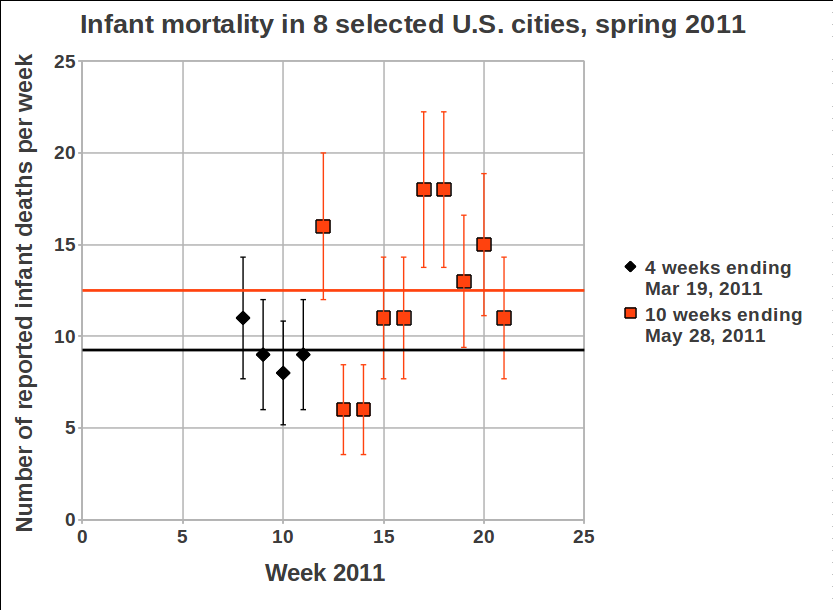
Infant mortality for 8 northwest U.S. cities, as reported by Sherman and Mangano

The Fukushima events started on March 11, i.e. by the end of week 10. Then it took slightly more than a week for the first release of radioactivity to reach the nortwest part of the U.S. The data do show an increased infant mortality rate after Fukushima. The black line shows the average value for the 4 weeks before March 19, and the orange line shows the average value for the 10 weeks after that. The error bars on each data point indicate the statistical uncertainties.

But why are the 10 weeks after Fukushima compared with only 4 weeks before? There seems to be a reason for it, commonly referred to as cherry-picking, i.e. you select the data that supports your theory without showing the full picture. To show the full data set may falsify what you want to show. This is quite common in politics and by people who have an agenda that is more important than the truth.  But here we have two persons in medicine, one Medical Doctor and one Master of Public Health, they should be trustworthy professionals who are keen on giving people honest information, right? Let’s check their deck of cards closer.

So, if we include data for, say, the first 7 weeks of 2011, we get a very different idea about the situation:
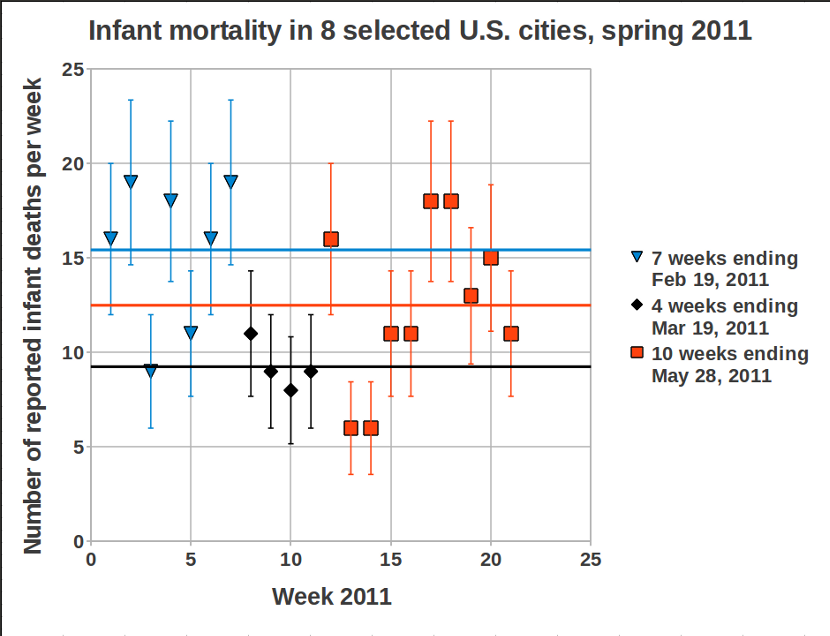
Infant mortality for 8 northwest U.S. cities, less biased version

Very interesting, the first seven weeks of 2011 actually has higher infant mortality than the weeks after Fukushima, quite different from what Sherman and Mangano wants us to believe. There is no spike after Fukushima, instead there is a dip during the 4 weeks before! A more detailed report on the closer scrutiny of Sherman and Mangano’s article is found in our Deep Repository.


So, why does a Medical Doctor mistreat official data in this way? It is quite remarkable, and embarrasing, especially since Janette Sherman writes about herself on her web page (http://janettesherman.com/about/):

Dr. Sherman’s primary interest is the prevention of illness through public education and patient awareness.

She seems to have forgotten about her primary interest in this case, I fail to see how cherry-picking data can be part of public education and public awareness. And if anybody can see how you can prevent illness through scaring people with false statistics, then please explain it to me. Embarrasing, Janette Sherman…

Joseph Mangano already has a track record of handling data in not so honest ways, we may come back to that in other blog entries (a few links to examples, as requested by a commenter: http://neinuclearnotes.blogspot.com/2005/08/joseph-mangano-and-art-of-deception.html and http://www.nei.org/resourcesandstats/documentlibrary/safetyandsecurity/factsheet/scienceonradiationhealtheffectsdispelstoothfairyproject/).

What baffles me the most is that he and Sherman try to get away with this alarmistic claim by such a lousy handling of official data. Anybody can easily check it for themselves and see that Sherman and Mangano are wilfully interpreting data so that they agree with their already decided view on things. What is worse, they are scaring a lot of people with their claims, for no reason at all. Therefore: Shame on you!

/Mattias Lantz – member of the network Nuclear Power Yes Please


Follow-up blog entries on the same subject

19 June 2011: More bullshit from Joseph Mangano, take 2

21 June 2011: CounterPunch verifies infant mortality was alarmism but seems keen to create more of it

27 July 2011: Sherman & Mangano admits errors – or do they?

21 December 2011: 3 strikes and you’re out! Sherman & Mangano does it again…

29 August 2012: Joseph Mangano never stops, and he never gets it right

Update 24 June 2011

Several other people have scrutinized the Sherman-Mangano joke (by now I do not want to mis-use the word “study” in connection with these people), most notably in Scientific American. Here is a list:

  • The Buzz Blog on Physics Central comments on the scrutiny done in Scientific American and asks the question why Sherman and Mangano is doing this nonsense: “Beware the Evil Scientists”
  • The uvdiv blog has a guest post by Alexey Goldin that hopefully is enjoyable also for non-statistics nerds, and he shows data for several years back: A curious case of cherry-picking data for the greater good. I can only agree with his final statement: At this point it is worthwhile to question either the scientific integrity or statistical competence of Sherman and Mangano. They might be decent people and believe in what they say, but allow themselves to say “small lies” in a service of “Greater Truth”. This never ends up well. Because they are likely to kill some unstable people with their small lies.

Update 25 June 2011

Several persons have asked about how to get access to the raw data. I put a summary of the links I have used on the follow-up post regarding the strange results from the CounterPunch re-analysis of the data (here), but I will now put them here as well. The last link on the list is the one that is the easiest one to use. Some information will appear if you hold the pointer over each link:

http://www.cdc.gov/

http://www.cdc.gov/mmwr/mmwr_wk/wk_cvol.html

http://www.cdc.gov/mmwr/preview/mmwrhtml/mm6010md.htm?s_cid=mm6010md_w#tab3

http://wonder.cdc.gov/mmwr/mmwrmort.asp


61 Comments
Scientific articles about releases from Fukushima

A bit of casual reading for the Easter holidays is offered here:

There are now a few scientific articles available from the arXiv preprint server. We may put some more detailed comments on them as soon as we have had the time to look at them closer ourselves, but they may be of interest to a broader audience.

The articles are (click on the link for each article in order to reach the arXiv page, then download the article as pdf or other format from the box in the upper right corner):

In an earlier blog post there were discussions in the comments regarding the difficulties in correctly identifying which isotopes that are found in the releases. These articles show some nice examples of pulse-height spectra from gamma spectroscopy measurements (incidentally, it is Figure 1 in all three papers). Figure 1 in the paper about analysis of rainwater in the San Franciso Bay area (page 6) clearly illustrates how difficult it can be to correctly identify relatively small peaks on a large background. The samples taken in the water pools at the Fukushima power plant have an even more complicated mix of radioactive nuclides, so this is part of the explanation to why there have been some strange reports regarding identified isotopes.

The last paper surprised me first due to the low levels of Iodine-131 detected, there was a peak value of 2.5 milli-Becquerel per cubic meter of air observed on 6 April, only slightly higher than the peak value observed in Stockholm on 30-31 March (2.15 milli-Becquerel per cubic meter, a tiny amount as explained here (in Swedish only)) and the other data are much lower, around 0.1-0.2 milli-Becquerel per cubic meter. The reason is due to the geography, Tokushima is located on the island Shikoku far to the south-west of Fukushima. Due to the dominating wind pattern, the detected radioactive nuclides have mainly traveled around the entire planet before reaching Tokushima, and therefore have much lower activity. However, the peak around 6 April is due to a temporary change in the wind pattern. Calculations from the Central Institute for Meteorology and Geodynamics (ZAMG) in Austria show examples of the wind patterns. Here is an example from 6-7 April for Iodine-131.

If anybody has any questions related to the articles, you are welcome to post them here and we will try to answer.

/Lantzelot

4 Comments

Chris Busby and “The Tall Tale Of Ten Tons Uranium Gone Missing”

Professor Chris Busby is a man that has made himself somewhat of a career in being the golden boy of nuclear opponents, saying just the things they want/need to hear. There is only one problem with this: he doesn’t have a foot to stand on when it comes to his tall tales about the evils of nuclear power. Previously we have exposed his claims that the Chernobyl disaster supposedly caused an increase in breast cancer in Sweden. This turned out to be an unfounded conclusion, based on frivolous interpretation of data along with some outright cherry-picking and willful suppression of data that didn’t fit the claim.

In the case of The Tall Tale Of Ten Tons Uranium Gone Missing, Busby and his colleague Cecily Collingridge have issued a report where they claim that there has been a leak of enriched uranium from the British nuclear power plants at Hinkley Point in the order of about 10 000 kg. We analyzed the data which he used to make his claim, and took the same steps as he did, following his chain of reasoning from data to conclusion. The result is hardly flattering for the Busby and Collingridge, because the claims they make hinge on…

– Unsupported postulates

– Sparse and highly uncertain data

– Graph fitting done on this data, while ingoring uncertainties

– Low resolution geological surveys

– Misreading of said surveys

– Ignoring local variations in said surveys

– Ignoring missing indicators that must be present if their claim was true

All over the place...
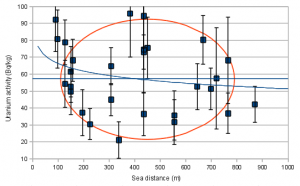
When you can fit any random graph of the data, in this case an elipsoid, something is not right.

The full analysis can be found in our forum. But I’ll just cut right to the chase and ask the obvious question: how would 10 tonnes(!) of uranium go missing without anyone noticing? And more important: why didn’t anything else go missing? The data that Busby uses to make his claim shows barely detectable levels of fission products, such as Cobalt-60 or Cesium-137. Considering that uranium is a lot less mobile than these products, if uranium goes missing but not the fission products, there cannot be a leak in the reactors because any such leak would have seen more fission products escape than uranium.

This leaves only one path as to how 10 tonnes of uranium could escape into the environment: when reactor fuel arrived fresh at the plants, someone took some fuel elements aside, stripped them of their cladding, ground them to dust and blew them out over the surrounding areas. Alternatively someone made a bonfire with them. And all of it happened without anyone noticing.

Since this is clearly not a reasonable explanation, we must conclude that Busby and Collingridge are wrong: there has not been a leak of 10 tonnes of uranium from Hinkley Point. The data they rely on does not support the claim, and it is only through their frivolous interpretation of the data, misreading some of it, and making unsupported assumptions that they arrive at the claim.

This begs a final question: claims have been made that there are numerous health problems around Hinkley Point, such as an increased incidence of childhood leukaemia. If there are no leaks from Hinkley Point, how would this be explained? Well… to find that answer, maybe you should go ask the one person making the claims: a certain professor Chris Busby.

/Michael Karnerfors and Mattias Lantz – members of Nuclear Power Yes Please

13 Comments

The WWF cheats on the climate scorecards

The World Wildlife Foundation continuously makes so called “climate scorecards” for the G8 countries. Since the issue of whether a nation is acting in an environmentaly sound manner or not is a very complex one, the WWF is making these scorecards that summarize the G8 countries and gives them a ranking which makes it easier to see how they are doing.

In July 2009, the three top ranked countries were Germany, the United Kingdom and France. As you are probably aware, Germany and the UK rely heavilly on coal (24% and 28% of total respectively) and gas (23% and 35% respectively) for their energy production while France only gets 5% from coal and 14% from gas. That is 1/5 the amount of coal and about 1/2 to 1/3 the amount of gas. France’s emissions per produced kilowatthour of electricity is 86 grams carbon dioxide, while Germany outputs 495 grams per kilowatthour and the UK a whooping 572 grams per kilowatthour.

One would imagine that this should give France a great advantage over Germany and the UK and easily beat them at the top. Right?

Wrong!

The WWF ranks both Germany and the UK higher than France. Why? Because the WWF changed the figures. In the climate scorecard for France, we find the following footnote:

1 WWF does not consider nuclear power to be a viable policy option. The indicators “emissions per capita”, “emissions per GDP” and “CO2 per kWh electricity” for all countries have therefore been adjusted as if the generation of electricity from nuclear power had produced 350 g CO2/kWh (emission factor for natural gas). Without the adjustment, the original indicators for France would have been much lower, e.g. 86 g CO2/kWh.

There it is, in plain writing. They changed the numbers, simply because they don’t like nuclear power, thus down-ranking France despite being the lowest emitter of carbon dioxide by far of the G8 countries. They cheated on the scorecard by tweaking the numbers.

And it’s not some small tweak either. From 86 grams to 362 grams… that is upping the numbers to 400% of their actual value! What is their reasoning for this? “[The] WWF does not consider nuclear power to be a viable policy option”. In short: they don’t like it. So they quadrupled the number, just like that.

The WWF also ranked Sweden, there boosting of the numbers even more. For Sweden they change the number from 47 grams per kilowatthour to 212 grams. That is 450% of its original value.

UPDATE: At the Energy From Thorium forum, a person got in touch with Allianz Insurance and asked them what was the meaning of this obvious manipulation of number. The reply was this:

Re measurement in the report: We received criticism last year for not acknowledging the fact that some countries (i.e. France) have lower CO2 emissions thanks to nuclear power. But neither WWF nor Allianz wants to encourage nuclear power as the power source for the future. The fact that there is no solution for ultimate storage is a particular concern. And we think that this world needs a different strategy for its energy needs (renewables, efficiency) – which also leads to different investments in grids and other infrastructure.

They don’t want to “encourage” the use of nuclear power. But why would anyone be enouraged? Because it is environmentally friendly of course! And here I foolishly assumed that WWF was in it for the environment… but apparently not, because they don’t want people to be “enouraged” by the fact that nuclear power has extremely low emissions. So they changed that number outright.

Not only that but they are dead wrong when they say there are no viable solutions. KBS-3 is in the final stages of development. The work to grant the method environmental approval starts next year.

This is quite simply outtrageous. It is neither scientific, nor honest. This kind of smearing and badmouthing of nuclear power is what made us start this website, because even though one would hope that this is simply an isolated incident, it is not. This kind of deception is taking place constantly. The only thing unique about this particular case is the gall they have in admitting that they actually did it.

How are we meant to trust bodies like WWF when they do this sort of thing? Had this kind of behaviour taken place at a nuclear plant, their permit would have been rescinded and the people in charge would most likely be facing criminal charges for falsifying information! But the WWF gets away with it. Why? Why should they be allowed to cheat on the numbers just to make them fit the policy, rather than fitting the policy after the numbers? Science gets ripped to shreds because the truth is too unpalatable for the nuclear opponents to swallow. What gave them the right to do so?

And maybe the most important question of all: how is the climate, the environment and the population of this planet benefiting by bodies like the WWF lying to us? What gave them the right to defend their policy first rather than the environment? What becomes better from this?

60 Comments

No, we do not need to mine uranium domestically!

One argument being used quite frequently against nuclear power here in NPYP’s home country Sweden is this:

If we do not allow uranium to be mined in Sweden, we cannot have nuclear power since it would be immoral to let people in other nations take the devastating environmental impact of the uranium mining.

This argument is flawed in many ways, which will take some time to get to the bottom with, so let me first summarize where the argument goes wrong:

  1. Unlike what is being hinted, we do not have a ban against mining uranium in Sweden.
  2. Uranium mining does not have a higher environmental impact other mining other minerals.
  3. We import other produce, products and commodities to Sweden as well, most of which like uranium are not locally produced.

First I should say that this argument is not actually used against nuclear power per se but rather being thrown in the face of proponents of nuclear power trying to mark them as hypocrites. This is a type of ad hominem attack, that is to say you’re not attacking a person’s arguments but instead the person itself in order to try to win the debate by default. This is, of course, a very dishonest and cheap way of doing debate.

Anyway… on to the flawed reasoning behind the argument.

Like I said, we do not have a ban on uranium mining in Sweden. What we have is a right for municipal councils to veto uranium extraction in that municipality. We do not have a general ban on uranium mining in Sweden.  This means that unless the target of the argument has said that we should have a general ban on uranium mining in Sweden, the argument is dead in the water right there.

The second fault of the argument is to assume that uranium mining has a severe impact which causes unacceptable damage to people and the environment, and that uranium mining is worse than everything else. This too is wrong. All mining, no matter what you are extracting, can have quite a hefty impact and be very detrimental to both worker health and the surrounding environment if it is not done with care and caution. Indeed historical mining all the way up to the 70’s and 80’s have had severe problems with this.

Current mining in the early 2000’s however is different, and has all the protection and monitoring techniques needed to live up to any modern worker-, population- and environment protection standard out there. This includes uranium mining.

To illustrate by example: a Swedish miner in the LKAB iron mines in the 70’s received an accumulated yearly dose of radiation that was approximately 2000% higher than what an Australian uranium miner receives today.

It is simply just not true that we cannot do uranium mining without protecting people and the environment. We have all the tools that are needed. This still means that we have to ensure that they are used, of course, but they do exist.

The final leg of the flawed argument is the general notion that we cannot consume or use anything which we ourselves are not producing domestically, lest someone will call us hypocrites. This one is just plain stupid, because all I need to do is lift my eyes and look around me where I’m sitting to realize that not much of what I have in my room or indeed in my life, is produced domestically.

Take for instance metal, since that is produced in a nearly identical manner to uranium, which is to say: first you mine it from the ground, then you refine it. Metal is an integral part of our lives. Metal is all around us: in our computers, our furniture, appliances, jewelry, buildings, eating utensils, cars, keys, phones, power lines, wind turbines, water dams… there is metal just about everywhere.

Now I ask you, who use immense amounts of metal: are you prepared to have an iron mine in your back yard, with all the pollution and environmental hazards this implies? Are you prepared to have a steel mill as your next door neighbour with all the coal being burned in the furnaces to refine iron to steel?

You’re not? Well how can you be using all this metal then! Doesn’t that make you a hypocrite, just dumping all these environmental problems on someone else so you can sit there and read this very article on your metal-laden computer and its screen?

Of course you’re not a hypocrite. Or… maybe you are! How do you know you’re not? When was the last time you took the time to check that all the goods you’re using has been produced in a way that does not affect some other person or persons in an unacceptable manner? All this metal around you was once extracted from the ground in a mine. How do you know no-one suffered ill effects from this? How do you know that your lifestyle has not caused an environmental disaster somewhere?

With this you realize that you cannot go around and worry like that or you’d have to give up living altogether. There has to be a better way to deal with this issue than just saying no to everything that potentially caused problems when it was produced. And there is.

The ethics of importing goods, or indeed simply using goods produced by anyone other than myself, is a universal issue and it does not apply only to uranium. Uranium is not a special case and is subject to the same considerations as everything else (and then some more, since it is a controlled substance). And unsurprisingly, the Swedish nuclear companies does indeed have strict rules to abide by when it comes to seeing to that the uranium used in Swedish nuclear reactors have been produced in a sound manner that does not harm people or the environment in an unacceptable manner.

So in the end, does the argument turn those that do not want to have a uranium mine in their back yard but still want nuclear power into hypocrites? Does the argument successfully render their stance for nuclear power null and void? Must we produce uranium domestically just to have nuclear power?

No, we do not. It is a narrow-minded, simplistic and silly argument. The issue of assuring that the things which we use and consume in our lives are produced in an ethical manner is very important, and it is not being done any favours by the anti-nuclear lobby trying to dumb it down to fit their agenda. They are abusing the issue just to try to add some fuel to their waning struggle.

So don’t fall for it. Treat the issue with the respect it demands. And don’t let anyone try to abuse it just to push their point across unless it’s actually relevant.

18 Comments

Did you think renewable power is sustainable? Think again…

“Sustainability” is a buzz-word these days. It is used often and eagerly, especially by opponents of nuclear power and proponents of renewable alternatives. There is an assumption to there that if something is renewable it is also automatically sustainable. There is also an assumption that nuclear power is not sustainable. How surprised people get when they find out that the exact opposite is true…

Let’s take a step back and for once examine what we actually mean by the concept of sustainability.  In this article, we will be focusing on sustainable power production.

What sustainability is not

There seems to be a vague notion out there that something that is sustainable we can start using now and then keep using forever, or that something that is sustainable never consumes any resources. Well even by this faulty definition, renewables are not sustainable. This is because solar panels are not built from sunshine,  nor are wind turbines built from a stiff afternoon breeze. You build them from consumable materials such as steel, copper, neodymium, gallium, arsenic, indium and other sometimes not too common materials. Also they have a finite life span after which they must be torn down and replaced. This means that solar and wind power does consume resources and in the end cannot be used forever.

But that is not the definition of sustainable, so let’s move on.

What sustainability is

“Sustainable development” was defined by the Brundtland-commission report “Our common future in June 1987 as:

…development that meets the needs of the present without compromising the ability of future generations to meet their own needs

Now let’s look at this. Does this say anything about renewables, using the same things forever, or even that using fossil fuels would be a bad thing? No it does not. The report doesn’t even say we cannot deplete a resource.

As for non-renewable resources, like fossil fuels and minerals, their use reduces the stock available for future generations. But this does not mean that such resources should not be used. In general the rate of depletion should take into account the criticality of that resource, the availability of technologies for minimizing depletion, and the likelihood of substitutes being available.

So what sustainability means is this:

  • We have needs, and we must meet them.
  • The future generations will also have needs, and we must not do anything that prevents them from getting these needs met.

People talking about sustainable development often talk about the future. But what they keep forgetting is that development that does not tend to the needs of the present as well, is not sustainable. Sustainable development must meet both current and future needs.

So now that we have established what sustainability actually means, let’s get to work applying it.

Applying the definition of sustainable to the real world

What are our needs when it comes to power? Among all needs, one is reliability.

Reliable power production means that we get have the amount of power we require, the instant we require it. Power is a perishable commodity. Especially electricity must be produced the very second we intend to consume it. If production does not meet demands, we have a power deficit. We do not accept power deficits. Not only is a power deficit annoying, but it can also be very dangerous as we are relying on electricity for a great number of critical applications, such as hospitals, tele-communications, cold food storage and pretty much anything that makes our society modern and thriving. Also power drops on the electrical grid risks damaging or destroying equipment connected to it.

Hence a source of power must be able to deliver as much as we want, the moment we want it or it is not, by definition, sustainable.

Are wind power and solar power sustainable sources of power?

Solar power and wind power are not living up to Brundtland commission definition of sustainable, for that most inane of reasons: when there is no wind, and when there is no sun, they do not deliver power. And by not doing that, they fail our need of reliability.

But surely there is always wind and sun, isn’t there? No, not always. Sun is a no-brainer, because sun does not shine 24 hours per day (except above the arctic circle in the summer but that doesn’t help us in the cold dark winter). So what about wind?

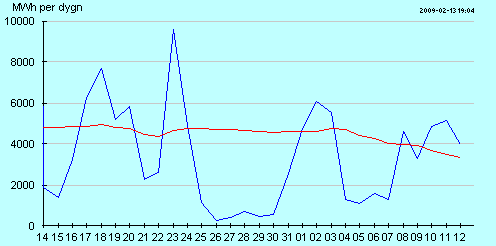
Wind power in Sweden, jan-feb 2009
Reported wind energy production in Sweden, Jan-Feb 2009

The graph above is statistics for wind power in Sweden, fetched from Vattenfall’s page www.vindstat.nu. This page represents day average wind power production in Sweden for 30 days. The reporting plants range all the way from the south tip of Sweden to the far reaching north. The image is a snapshot of the graph taken at February 14, 2009.

The amount of installed wind power, that is to say the maximum power capacity, that reports to this webpage was 695 MW for the 30 days displayed, which is about 85% of all installed wind power in Sweden. This means that theoretical maximum power production in this graph is 16 680 MWh per day. Keeping this in mind, we see that for January 25 to January 30, wind power delivered 2-4% of installed capacity. After that it made a skip up, but less than a week later is was down below 10% again for another four days.

And again we must remind you that this is day average production and does not consider fluctuations during the day. This means that wind power in Sweden at times most likely delivered less than 1% of installed capacity.

This means that development that would rely on renewables such as solar and wind to meet our power needs, would not be considered sustainable unless there was something else that could entirely replace them for low periods. Such replacements do not exist.

Are bio-fuels sustainable?

Bio-fuels is another renewable alternative that is getting much attention. Do they meet our needs? That can be questioned, because while reliability is acceptable, the guarantees of capacity are shaky at best. And even worse is that bio-fuels strike at one of our most basic needs: health and long life. Bio-fuels, just like any other combustible power sources, release gases and pollutants that are harmful to human health. While being mostly neutral when it comes to carbon balance, this does not make the emissions any less harmful to people. Improvements can be made, but it must be asked how many premature deaths we are willing to tolerate before the technology of bio-fuels have been improved to acceptable levels. Hence this leaves the sustainability of bio-fuels in doubt.

Is nuclear power sustainable?

Let’s look at the needs we have, and that the future generations will have:

  • Capacity
  • Reliability
  • Clean air, land and water
  • Health

Does nuclear power fulfill these needs? Yes it does. Nuclear power has a capacity and reliability that is matched only by hydro power and fossil fuels. It does not pollute air, land nor sea in such a manner that we cannot accept it. And it does not threaten health in such a manner we cannot accept it. In fact, the power it replaces, such as for instance coal plants, kills about 2 million people prematurely every year from air pollution. So in replacing that, nuclear power saves lives.

Nuclear waste is an issue, yes. But it is a solvable issue, solvable in such a way it will not impede future generations from having their needs met. The science needed to know how to do that has been available since the 1970’s. It is part needing to gather experience on how to do it, and mostly politics that has kept us from implementing them so far. But for instance the Swedish method for a deep geological repository KBS-3 is at such a level of maturity it may begin being implemented in the near future. And more alternatives for dealing with nuclear waste are being made available as technological development progresses. We have no reason to assume nuclear waste cannot be dealt with in a sustainable manner that meets the definition by the Brundtland commission.

If we use nuclear power, must future generations use it too?

Using nuclear power now does not force future generations to use it. Nuclear plants have a finite life span of about 40-60 years. For renewables like solar and wind, their life span is even shorter. After that, the plants must be replaced. The future generations are free to choose whatever method of production they want for these replacements. They are not locked in by our choice. If they want to use something else, they are free to do so.

And choosing something else, they most likely will. Fusion power has dodged us for some time, but the progress is very promising. The research facility ITER is being constructed as we speak. The follow-up DEMO is on the drawing board. If there are no big snags, work at these plants will be done by 2050, at which time fusion power can go commercial. If we are unlucky, it might be another 100 years before they work out the problems. Being pessimists, we can reasonably estimate that by 2150 at the latest, fission nuclear power, solar, wind and pretty much everything else we use for our base load, can be phased out. This is what the Brundtland commission report speaks of: “the likelihood of available substitutes”.

And even if fusion power never takes place, whatever opponents of nuclear power claim can be used to replace nuclear power now, can most certainly be used to replace it then. If not, their case falls apart anyway and we must keep using nuclear power and make it even more effective.

So does it really matter that we risk depleting our nuclear fuel resources? No, it does not. If we start to reach the end of such resources, something that is not likely to happen by at least 2 000-5 000 years anyway, then future generations may switch to whatever else they want to use. They are not bound by our choices, and as such, the definition of sustainable development is met by nuclear power.

Conclusion

It has been said that the person that stares too far ahead, risks tripping over their own feet. This is true also in this matter. We must not forget that our needs must also be met, and not just the needs of future generations. Otherwise we do not have sustainable development. And sadly, renewables such as wind, solar and bio-fuels do not yet meet these needs. No matter how much we spend on research, we cannot force the sun shine when we want it to, nor make wind blow on demand. Bio-fuels rely on combustion, which we do not know yet how to make non-hazardous to health. Hence they are not sustainable.

Nuclear power however is, as far as we can make out, sustainable.

14 Comments

Comment regarding corriosion in KBS-3 copper capsules

During 2008, and highlighted in articles this past week, there has been statements that the maximum rate of corrosion of copper in pure water may be higher than anticipated. This is important to the nuclear issue because copper is one of the four barriers of the Swedish Nuclear Fuel And Waste Management Company (SKB) method of storing nuclear waste: KBS-3.

Scientists from The Royal Institute of Technology and Uppsala University Peter Szakálos (KTH), Gunnar Hultquist (KTH) and Gunnar Wikmark (UU) are calling into question statements by SKB that copper is immune to corrosion in pure water devoid of oxygen. This statement is found on page 102 in the SKB report TR-06-22.

 In the absence of oxygen, copper is thermodynamically immune to corrosion in pure water. 

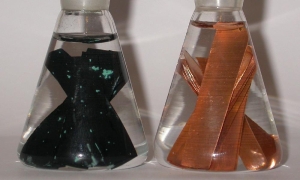
Szakálos, Hultquist and Wikmark claim that in experiments of their own, they have achieved a very high rate of corrosion of copper in pure water if hydrogen is present. The results can be viewed in their Berns presentation from 2008 (in Swedish).

Copper after 15 years in pure water
Copper after 15 years in pure water. On the left, the bottle was closed to everything but hydrogen. On the right, the bottle was closed to everything

At Nuclear Power Yes Please we are – of course – following the matter closely. Part of the foundation for our confidence in nuclear power is the ability to deal with nuclear waste in a safe manner. KBS-3 is a disposal method, one of many, that holds great promise to live up to our demands on safety and not requiring human supervision. It is currently perhaps even the most promising method considering its technical maturity and political feasibility. So if KBS-3 is called into question, this may in an extreme case force us to re-evaluate our position on nuclear power.

However there is a long way to go before we get there.

Even by the words of Szakálos, Hultquist and Wikmark, this is a solvable issue. As such it does not spell the end of KBS-3, nor does it warrant a major rethinking. Szakálos, Hultquist and Wikmark say that modifications that protect the copper capsules from corrosion in a short term perspective, that is to say 1/100’th or less of the repository’s full life expectancy, should solve the issue since it can only happen when the capsules are hot, that is to say only at the very beginning of the storage period.

We also need to remember that the experiments Szakálos, Hultquist and Wikmark performed to achieve the corrosion were very specific and may perhaps not reflect real life subterranean conditions of a deep geological repository. SKB will need to examine if the conditions stated for the experiment can be expected 500 meters down in the bedrock, or if this sort of thing can only be achieved in a laboratory.

Of relevance to that is the fact that SKB has responded and said that they themselves have not been able to reproduce the results of Szakálos, Hultquist and Wikmark, which in turns calls into question the validity of their statements since reproducibility is perhaps the most important quality of any scientific claim.

SKB is also currently conducting an experiment at their Äspö laboratory where they have buried copper capsules in conditions very similar to what it will be in the real KBS-3 repository. These capsules are scheduled to be retrieved next year, which will give us empirical data on how the capsules are affected once buried. Nothing shows us better what can happen than going out and doing it for real.

In summary: while this issue may force SKB to take one extra think before submitting KBS-3 for final review, this still does not constitute an insurmountable hurdle. So far it appears to be solvable. Even Szakálos, Hultquist and Wikmark state that they do not think this issue is a show-stopper. And as such KBS-3 can only become better from this.

Also, on a very positive note, we at Nuclear Power Yes Please are pleased to notice that this criticism has brought KBS-3 into view of the public eye. This is good(!), because very few people have until now been aware of just how far the work on KBS-3 has progressed. Constantly we are hearing people, especially opponents of nuclear power, saying “We don’t know what to do with the waste”. The issue of copper corrosion has shown everyone that we do in fact have a very good idea what to do with it and that KBS-3 is a well researched method that is approaching the point where when it will be implemented for real.

This issue will of course have to be adressed and at Nuclear Power Yes Please we are eagerly waiting to hear what SKB has to say about it. We will continue to monitor this issue with great interest.

And after all: we are on no big hurry. Nuclear waste is a very patient player and will wait for us in intermediate storage while we take the appropriate time to determine what we will do with it. 🙂

Articles:
Mediasammanfattning, vecka 7 – SKB
Kärnavfallet kan läcka ut – Aftonbladet
SKB svarar kritikerna: “Vi är öppna för granskning”

Blog posts:
Vad skall vi göra av kärnavfallet?
Slutförvaring
FRAmtidens energi och konst
Mest kärnkraft i världen
Hets mot folk

1 Comment

Study says German nuclear power causes child cancer… or does it?

A German report (summary) on cancer incidence seems to indicate that there is a higher frequency of cancer cases, mainly leukaemia in children, around nuclear power plants in Germany. The report was written at the Federal Office for Radiation Protection in Germany and based on two articles [1, 2].

The report was quickly embraced by the Swedish movement against nuclear power (SNF, Schlaug) and has also created a few headlines in Swedish newspapers (AB, HN).  These newspaper articles claim that people living in the vicinity of Swedish nuclear power plants are worried by this report. Lars Barregård at the Centre for Medical Enviromental Sciences wants to investigate the incidence of leukaemia around Ringhals nuclear power plant. However, he says to HN:  “…the radiation levels are very low and should not be able cause an increase in cancer frequency, though a study can be good to lessen the worries“. (translated from Swedish)

The Swedish Radiation Safety Authority (SSM) however does not consider it important to perform another study in Sweden as such studies have already been conducted with consistent negative results. A study in 1995 found no increase in numbers of cases of leukaemia. Also the number of cases of child leukaemia has been more or less constant at around 60 cases per year over the past 30 years, a period of time which includes the gradual phase-in of nuclear power in Sweden. SSM states that further epidemiological studies trying to blame cancer on nuclear power are not needed. Instead, there is a need of a larger knowledge base and more studies that tries to find the underlying reason for child leukaemia in general [6].

Still this leaves us with the German report. Does it give us due cause to worry? Not really, because in the conclusion of the report, the authors state:

…the present status of radiobiologic and epidemiologic knowledge does not allow the conclusion that the ionising radiation emitted by German [nuclear power plants] during normal operation is the cause.

What this means is that in order for nuclear plants to have caused these cancers, there must be some completely unknown effect in play; some kind of cause that science does not know anything about yet.

They further note that…

This study can not conclusively clarify whether confounders, selection or randomness play a role in the distance trend observed.

…and…

…these estimates are rather inconclusive because they are based on a very small number of cases

This means that they have not been able to rule out that other factors may explain the results, factors such as: carcirogens unrelated to the nuclear plants, errors in the study, or pure chance due to the amount of data being much to small.

Reading further we find that they have not measured the level of radioactivity around the plants or even include any kind of estimate of this:

This study is not able to state which biological risk factors could explain this relationship. Exposure to ionising radiation was neither measured nor modelled

One amusing interpretation of this would be that closeness itself, and not radiation, is a cancer causing agent. That is to say being 100 meters from a non-leaking plant would be more dangerous than being 200 meters from a wrecked one, because distance is what they have looked at, not radiation.

This is perhaps not odd concidering that radiation is not significantly or even measurably higher around these plants. The report concludes (again) that radiation cannot be a factor in this study on account of the additional exposure from nuclear powerplants being staggeringly small.

Annual exposure in Germany to the natural radiation background is approximately 1.4 mSv and the annual average exposure through medical examinations is approximately 1.8 mSv. Compared to these values, the exposure to ionising radiation in the vicinity of German NPPs is lower by a factor of 1,000 to 100,000. In the light of these facts, and based on the present status of scientific knowledge, the result of our study cannot be explained radiobiologically.

A far more serious thing to be remarked is that the second article notes that the study goes against findings of other studies made previously [2]:

….this observation is not consistent with most international studies, unexpected given the observed levels of radiation, and remains unexplained. We cannot exclude the possibility that this effect is the result of uncontrolled confounding or pure chance.

Looking at French studies [4,5], similar to the German one, we see that they indeed could not find any significant relation between cancer incidence and absorbed dose or closeness to a nuclear power plant.

Further reading reveals that they have not been able to process data considering children moving around prior to the cancer notice, nor the importance of lifestyle or whether the time the children spend in their homes is of relevance.

All of this summed up leaves us with a report that in effect states: “We think there might be slightly more cases of child cancer around some nuclear power plants, but we don’t really know why. And in order for the nuclear plants to be the actual cause, instead of something else, 60 years of radiobiological science must have completely missed something here”.

This notwithstanding the Swedish self-proclaimed enviromental movement beats the big drum and claims that it would be “irresponsable to concider constructing new nuclear power plants before it is clear whether children that live around existing plants suffer from conditions like leukaemia more often than the general public” (translated from [3]).

At Nuclear Power Yes Please we find this kind of alarmism to be just as irresponsible. We do not oppose performing epidemiological studies on nuclear power plants because science, openness of information and continuous review is one of the pillars that support our confidence in nuclear power. If anything we would welcome an exhaustive, well conducted study that settles the matter once and for all so we can either go happily about our lives, or get to work on a solution should one be needed.

But to spread fear of nuclear power among the general public without a solid scientific reason is reprehensible, especially with a report that even by its own words state that the results are vague, inconclusive and goes against most previously made scientific studies.

In light of the movement bringing this up just as there are huge political shifts in the view on Swedish nuclear power, possibly lifting the three decade old ban on building new nuclear power plants, we at Nuclear Power Yes Please are left to wonder what the real cause of the alarmism is. Why is the movement against nuclear power bringing this up now? Is it a genuine worry about public health, or is it a desperate attempt by the movement to try to justify their anti-nuclear stance? If it is the latter, we cannot express enough our outrage at such reckless abuse of science in order to try to make a political point.

1: Peter Kaatsch, Claudia Spix, Renate Schulze-Rath, Sven Schmiedel and Maria Blettner. Leukaemia in young children living in the vicinity of German nuclear power plants.

2: Case–control study on childhood cancer in the vicinity of nuclear power plants in Germany 1980–2003. Claudia Spix, Sven Schmiedel, Peter Kaatsch, Renate Schulze-Rath and Maria Blettner.

3: http://www.naturskyddsforeningen.se/natur-och-miljo/aktuellt/?news=7104

4: M.L. White-Koning, D. He’mon and D. Laurier et al.. Incidence of childhood leukaemia in the vicinity of nuclear sites in France, 1990–1998.

5: A.-S. Evrard, D. He’mon and A. Morin et al., Childhood leukaemia incidence around French nuclear installations using geographic zoning based on gaseous discharge dose estimates.

6: http://www.stralsakerhetsmyndigheten.se/Om-myndigheten/Aktuellt/Nyheter/SSM-Tysk-studie-ger-inga-nya-ron/


News articles:
Tysk forskarrapport som borde oroa

Blog entries:
Kärnkraft, barncancer och sannolikhetskalkyler
Ett (o)sannolikt ställningstagande av Centern
Barnleukemi, kärnkraft och Maud Olofsson

17 Comments

The day wind power nearly blew out Europe

On November 4, 2006, Europe suffered one of the largest disturbances in its electrical power grid of the past half century. 15 million households were disconnected from the grid for 20-40 minutes. A trivial error that should not have meant any significant disturbances cascaded and spanned much of continental Europe. This nearly threw the continent into a blackout that would have dwarfed the North American power-out in 2003. While the direct cause of the 2006 disturbance was operator error, a root cause of the problem and a significant factor in delaying getting the grids back online, was wind power and combined heat and power (CHP) plants.

Background

The European power grid has been constructed, basically from scratch, since the end of World War II. The grid in itself is divided between a number of different Transmission System Operators (TSOs), like for instance E.ON (Germany), RTE (France) and TenneT (The Netherlands). Each country’s domestic power grid is serviced by one or more TSOs. In order to provide stability and safety of the power supply TSOs are connected to each other. The basic idea was that if an area suffers a major disruption, neighbouring TSOs can help by pushing power from their grids into the affected area.

However over time things have changed. With the increased use of supposedly more environment friendly power plants, such as wind turbines and CHP plants, coupled with requirements to cut down on emissions, TSOs today are required to accept power from neighbours if the latter has a surplus of low-emission power. While this sounds good in theory as it forces TSOs to use “greener” power, instead of for instance coal power, this means that the power grid is used in a way which it was not designed for. Shunting power from one area to another puts high loads on the power transmission lines. In effect the European power grid is often operated close to maximum of what it can handle. To rectify this problem, more power lines should be built, but this is becoming increasingly more difficult and thus we are stuck with the problem.

Due to environmental reasons, the development of the transmission system is more and more affected by stricter constraints and limitations in terms of licensing procedures and construction times. The reality today is that many UCTE TSOs face significant difficulties to build new overhead lines due to long authorization procedures and regulatory regimes.

Final Report
System Disturbance on 4 November 2006
union for the co-ordination of transmission of electricity

The windy weekend

November 4, 2006, was a Saturday. The event took place in the evening, starting at 22:10 CET. While power consumption is low in evenings and even more so during weekends, the load on the grid was still high. The reason for this was that TSOs use these low-periods to disconnect some power lines to perform maintenance on them. This means that remaining lines still operate at near full capacity even if demand is low.

Such conditions also meant that the fraction of intermittent and distributed power production such as wind and CHPs was higher than normal, something that was further compounded by the fact that Germany was experiencing windy conditions that evening. Large amounts of power was therefore being routed into The Netherlands and Poland, straining the power lines.

Problems begin

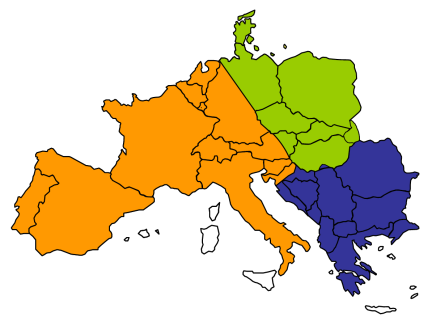
E.ON Netz was to disconnect a power line. Calculations had predicted that this should have been alright without compromising the safety of the power grid. However due to changes in the conditions – Germany’s unforeseen windy weather, and a rescheduling that was communicated late to the other TSOs – the disconnect and rerouting of power overloaded the remaining lines. These power lines tripped (automatically disconnected) in order to protect them from becoming damaged. This caused more overloads in other power lines,  causing further trips. This is what is know as a cascade. The cascade had within seconds divided the European power grid into three isolated “islands”: west, north east and south east.

The disturbance of nov. 4 2006 divided Europe's power grid into three parts
The severe disturbance of nov. 4 2006 divided Europe

The west area, having lost the connection to eastern Germany where much power was coming from, suffered a large deficit in power production. In order to protect the power grid and equipment connected to it, TSOs started load shedding, that is to say they started disconnecting customers from the grid in order to lighten their load. For each TSO 3-20% of all customers were disconnected and suffered power outs. In total approximately 15 million European households were affected by this.

In the north east area, the problem was the opposite. With the consumers in the west disconnected, the power generators surged as there was no-one that could accept the power they produced. Windmills are particularly sensitive to this and automatically disconnected from the power grid. Within a minute the north east area stabilized.

The south east area suffered a rather small power deficit in comparison and the impact was therefore smaller.

Trying to get back online

The west area started up power generation reserves to counter the production deficit. Within fifteen minutes the west area had stabilized to nominal production, although they were still disconnected from the north east.

In the north east however the different TSO operators had big problems. This was because the windmills and CHP plants that had tripped, automatically reconnected themselves, again causing a production surplus. There was no way to keep the windmills from doing this. To counter it the TSO operators had to manually prevent overloading the grid by instructing other power plants to cut down on production or shut down completely, and engaging power buffers such as pump storage units. This was while they at the same time tried to diagnose what had happened and why they had a disturbance in the first place. There was much confusion and which meant that the north east area was delayed in getting things back to normal.

In order to help counter the production surplus from the uncontrollable windmills, the control block leader for CENTREL (TSOs in Poland, the Czeck Republic, Hungary and Slovakia) somewhat unconventionally agreed to accept much of the surplus. However this meant that huge amounts of power was suddenly being routed eastwards, overloading some power lines up to as much as 140% of normal capacity, severely risking splitting the power grid again. Luckily this did not happen.

As the power levels were restored they tried to get the different areas connected again. Starting at about 25 minutes after the problems began, they tried to resynchronize the different networks. However for another quarter hour, the networks would not connect to each-other because they were fluctuating too much or not lining up to each-other. Either they wouldn’t even attempt a connection or they would trip out again after a few seconds. At 22:47 did the networks begin to connect properly, and not until over an hour later, at 23:57, were things back to normal.

Conclusion

Opponents of nuclear power and proponents of “green” power such as wind and CHPs often argue that nuclear power leads to poor safety and reliability of the power production. The argument is that “putting all eggs in one basket” puts us at a risk of a serious power shortage. They argue that distributed power such as wind is better because it spreads the risk.

However the events of November 4, 2006, point to the exact opposite. While the grid was always made to handle large single-point outages, such as a nuclear power plant going offline, with fairly local load balancing, it was not made to being operated the way we are forced to do with intermittent power. With wind power being essentially uncontrollable and fluctuating there is a need to shunt power long distances through power grids that were never built to handle it. This in turn puts strain on the grids, lessening the margins and risking cascading chaotic failure of an entire continent.

With increased use of wind and other intermittent power sources, this risk can only be increased unless we basically tear out our entire transmission grid and build a new one. This is an investment that will not come cheap. Those arguing for large scale power production using intermittent sources, such as wind, must seek an answer to the following question:  

Is it prudent, economical, or even feasible to replace the entire power grid of a continent, just to accommodate a notoriously troublesome source of power?

/Michael Karnerfors, for Nuclear Power? Yes Please

Source: UCTE – Final Report, System Disturbance on 4 November 2006

3 Comments