Lembit Sihver, professor i kärnteknik på Chalmers, kom tisdags kväll hem från Japan efter en vistelse på ett forskningslaboratorium i Chiba, strax öster om Tokyo. Under onsdagen deltog han i Sveriges Radios chat, länkad här.
Comments closedCategory: Uncategorized
Här är några bra och informativa artiklar/inslag vi snappat upp i mediaflödet
Ny Teknik: Varierande hälsorisker från utsläppen
Jan Blomgren (Bumpen), föreståndare för SKC – Svenskt Kärntekniskt Centrum, förklarar vilka radioisotoper som kan förväntas från reaktorerna, och deras hälsoeffekter.
SVT Aktuellt kl. 21.00
Intervju med Janne Wallenius, KTH, om vad som händer i Fukushima
Intervju med expert om risker vid upptag av radioaktivitet, finns i det fulla inslaget, här,
SR Radio Sweden: Swedish nuclear power under microscope
Intervjuer (på engelska) med Lars-Olov Höglund (känd från Forsmarksincidenten 2006), Martina Kreuger (Greenpeace), vår egen Michael Karnerfors (NPYP), och Lars Gunsell (Strålsäkerhetsmyndigheten).
Atomic Insights: It is never safe to panic and it is wrong to appear uncertain when you know what to do
Atomenergiaktivisten Rod Adams ger sin syn på hur svåra problemen är i Fukushima. Vi gillar följande bit:
I do add a caveat to that advice for people that happen to be employed at the Fukushima Daiichi nuclear power station. If you are there and reading this – you are doing a find job. Now, stop reading, get a nice cold glass of water, have a snack, and then get back to work.
Och så några mindre trevliga nyheter:
Aftonbladet: Ökad efterfrågan på jodtabletter
DET FINNS INGEN ANLEDNING FÖR NÅGON I EUROPA ATT ÄTA JODTABLETTER PÅ GRUND AV HÄNDELSERNA I JAPAN! När ämnena gått runt drygt halva jorden (via Nordamerika) kommer vi att kunna mäta vissa av ämnena med känsliga detektorer. Halterna är dock så pass låga att de är helt försumbara, en veckas vistelse i Bohuslän kan ge större stråldos.
Aftonbladet: Supermånen orsakade jordbävningen
Det här är bara så dumt att vi inte ens borde nämna det. Men det florerar så mycket galenskaper så vi kan i alla fall nämna en som på något sätt har en viss komik.
Comments closedFollow us on twitter at www.twitter.com/npyp for the latest updates. You can also find us at Facebook.
Come on, follow us now! What are you waiting for?
Comments closedUppdatering 19:15
Inte så mycket nytt. NISA (japanska strålskyddsmyndigheten) har inte släppt någon statusuppdatering, inte heller TEPCO eller JAIF. Toshiba och Hitatchi har skickat ingenjörer för att hjälpa till vid Fukushima.
The company said dozens of its engineers are set to instruct workers at the plant operated by TEPCO about the usage of pumps to inject water into the plant’s reactors, adding the firm has already sent motors to activate the pumps at the facility.
I en tidigare notis som jag inte har länk till så stod det att arbete var på väg att återställa elektricitet till verket, det vore fenomenalt bra ifall man lyckas med det. Kyodo har som vanligt en bra sammanfattande artikel över läget. Vi väntar ännu med andan i halsen alltså.
Uppdatering 16:51
Detta dök just upp!
TEPCO says the water level at Fukushima Daiichi no.2 reactor is recovering smoothly
Uppdatering 14:52
Det är väldigt olustigt att TEPCO inte nämner ett ord om bränslebassängerna i reaktorbyggnad 1 och 3. Vi vet att nått händer i bassängen i reaktorbyggnad 4. Av någon anledning brann det där, men olika källor påstår olika saker. Vissa säger att bränslet brann, vissa säger att det var något annat. Vatten kan ju som vi vet inte brinna, så vad var det isåfall. Om bränslet brunnit så innebar det att nivån i bassängen sjunkit över 10 meter och exponerat bränsleknippena för luften under nog lång tid för att de ska bli varma nog att kapslingen ska börja brinna. Men det verkar inte logiskt då vattenflödet som krävs för att hålla upp vattennivån i bassängen gentemot den lilla effekten knippena producerar är väldigt låg.
Just nu är det flera mysterier som pågår, men tystnaden runt bassängerna i 1an och 3an är inte betryggande.
Uppdatering 14:01
Senaste JAIF uppdateringen av läget, tidsstämplad till ungefär 3 timmar sen. Det sägs att kylningen av reaktorer 1, 2 och 3 är stabil eftersom trycket bibehålls inuti. Oklart om de menar inuti reaktortankarna eller inuti inneslutningarna. Om det är inneslutningarna så låter det lovande med tanken på brottet i 2ans inneslutning. Om man lyckas bibehålla tryck så innebär det att brottet inte kan vara jätte stort. Dock för tidigt för att säga något säkert, vi håller alla andan!
Around 18: 27 March, 15 Local time
The status of Fukushima #1 power station was reported in the evening news as
follows. These are originally mentioned by Nuclear and Industrial Safety Agency
(NISA) or the chief cabinet secretary.
・Seawater injection operation is going on at unit-1, unit-2 and unit-3. NISA
presumed that these reactors are cooled in a stable manner through this
operation based on the fact that pressure inside is maintained.
・Fire at unit-4 was burned out naturally around 11:00. NISA expressed it’s
intention to pour water into the pool immediately since fuel rods in the pool are
being heated.
・NISA described the possibility of damage to the suppression pool, which has
function of decreasing pressure inside the containment vessel.
・The chief cabinet secretary said that water temperature is steady increased in
the spent fuel pool at unit-5 and unit-6 at the press briefing held around 16:00.
・The chief cabinet secretary also mentioned radiation detected outside the
building. Numerical values he introduced were as follows.
8217 micro-Sv/hr(dvs 8,217 milli-Sv/hr – Johans anmärkning) at the border of the site
400 milli-Sv/hr in the vicinity of unit-3
Uppdatering 13:35
Ett falsk email cirkulerar just nu som påstås vara en BBC news flash. Detta stämmer INTE!
FAKE E-MAIL IN FULL
BBC Flash news : Japan Government confirms radiation leak at Fukushima nuclear plants. Asian countries should take necessary precautions. If rain comes, remain indoors first 24 hours. Close doors and windows. Swab neck skin with betadine where thyroid area is, radiation hits thyroid first. Take extra precautions. Radiation may hit Philippine at around 4 pm today. If it rains today or in the next few days in Hong Kong. Do not go under the rain. If you get caught out, use an umbrella or raincoat, even if it is only a drizzle. Radioactive particles, which may cause burns, alopecia or even cancer, may be in the rain.
Uppdatering 12:34
Stråldoserna runt reaktor 4 fortsätter vara höga
Reuters
TEPCO says there is radiation reading of 100 millisievert near the no 4 reactor building
Samtidigt går IAEA ut med detta på deras facebook sida.
Fukushima Daiichi Nuclear Power Plant Update
Radiation Dose Rates Observed at the Site
The Japanese authorities have informed the IAEA that the following radiation dose rates have been observed on site at the main gate of the Fukushima Daiichi Nuclear Power Plant.
At 00:00 UTC on 15 March a dose rate of 11.9 millisieverts (mSv) per hour was observed. Six hours later, at 06:00 UTC on 15 March a dose rate of 0.6 millisieverts (mSv) per hour was observed.
These observations indicate that the level of radioactivity has been decreasing at the site.
As reported earlier, a 400 millisieverts (mSv) per hour radiation dose observed at Fukushima Daiichi occurred between units 3 and 4. This is a high dose-level value, but it is a local value at a single location and at a certain point in time. The IAEA continues to confirm the evolution and value of this dose rate. It should be noted that because of this detected value, non-indispensible staff was evacuated from the plant, in line with the Emergency Response Plan, and that the population around the plant is already evacuated.
About 150 persons from populations around the Daiichi site have received monitoring for radiation levels. The results of measurements on some of these people have been reported and measures to decontaminate 23 of them have been taken. The IAEA will continue to monitor these developments.
Evacuation of the population from the 20 kilometre zone is continuing. The Japanese have asked that residents out to a 30 km radius to take shelter indoors. Japanese authorities have distributed iodine tablets to the evacuation centres but no decision has yet been taken on their administration.
Background on Radiation
A person’s radiation exposure due to all natural sources amounts on average to about 2.4 millisievert (mSv) per year. A sievert (Sv) is a unit of effective dose of radiation. Depending on geographical location, this figure can vary by several hundred percent.
Since one sievert is a large quantity, radiation doses are typically expressed in millisievert (mSv) or microsievert (µSv), which is one-thousandth or one millionth of a sievert. For example, one chest X-ray will give about 0.1 mSv of radiation dose.
Uppdatering 10:56
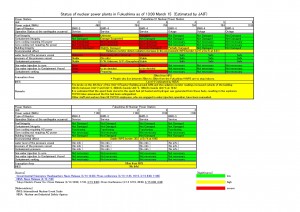
Kyodo släppte just denna statusuppdatering och TEPCO sin statusmatris
Det ser ut som att de stora stråldoserna är på grund av branden/explosionen i bränslepoolen och inte reaktor nummer 2.
The following is the known status as of Tuesday evening for each of the six reactors at the Fukushima No. 1 nuclear power plant in Fukushima Prefecture, crippled by Friday’s magnitude 9.0 earthquake and ensuing tsunami.
— Reactor No. 1 – Cooling failure, partial melting of core, hydrogen explosion, seawater pumped in.
— Reactor No. 2 – Cooling failure, seawater pumped in, fuel rods fully exposed temporarily, partial melting of core, damage to containment system.
— Reactor No. 3 – Cooling failure, partial melting of core, seawater pumped in, hydrogen explosion.
— Reactor No. 4 – Under maintenance when quake struck, fire caused by hydrogen explosion at pool holding spent fuel rods, pool water levels feared receding.
— Reactor No. 5 – Under maintenance when quake struck.
— Reactor No. 6 – Under maintenance when quake struck.
Uppdatering 10:45
Änligen positiva nyheter! Från Reuters live blog (scrollar hela tiden så nyheten kan finnas några sidor in):
Chief Cabinet Secretary Yukio Edano tells reporters radiation levels at the Fukushima Daiichi complex have fallen dramatically to 596.4 microsieverts per hour. That level is almost 700 times less than the levels reported in the morning, after two fresh blasts at the complex.
Uppdatering 09:15
Obekräftade uppgifter om kraftigt sjunkande strålningsvärden utanför Fukushima I når oss. Vi försöker få det bekräftat.
Uppdatering 08:53
Kyodo rapporterar att Edano rapporterar att vatteninpumpning i 1an och 3an fortsätter och att det inte sker kontinuerliga utsläpp från 4an. Återstår att se hur det ligger till.
BREAKING NEWS: Remains to be seen if water smoothly injected into No. 2 reactor: Edano
Uppdatering 08:22
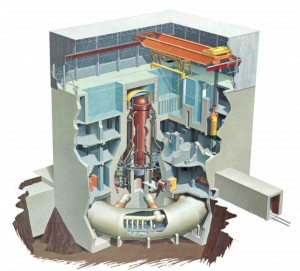
Just nu kommer ingen vettig information ut överhuvudtaget. Det vi vet är att under natten skedde någon slags explosion som förmodligen skadade pressure supression pool, ringen i botten på reaktorn på bilden jag bifogat. Detta är väldigt allvarligt då det är en del av inneslutningen och därmed så finns det en väg direkt ut till omgivningen ifall reaktortanken, den ståltank som håller härden, havererar. Det innebär också att det kan bli svårt att hålla inneslutningen och reaktortanken täckt med vatten. TEPCO ger inga detaljer överhuvudtaget om orsaken till explosionen eller nuvarande statusen.
Ungefär samtidigt som nyheten om explosionen dök upp i japansk media så meddelade man också att det brinner i reaktorbyggnaden runt reaktor nummer 4. Reaktor 4 är en av de 3 reaktorer som redan var nedstängda före tsunamin och före branden har det inte funnits någon antydan till att TEPCO skulle haft problem där eller att kylningen inte fungerar. I samband med branden uppmättes väldigt höga aktivitetsnivåer runt reaktor nummer 3, upp mot 400 mSv.
Eftersom inget nytt rapporterats om inneslutningen på 3an så kan man bara förmoda att det något händer med bränslebassängen i 3an. Bränslebassängen är en bassäng där man låter använt bränsle ligga innan det skickas vidare till en längre tids förvaring. Bassängerna i den typ av reaktor som finns i Fuhushima är inte skyddad ovanifrån och står därmed öppen för väder och vind och ingen vet hur den påverkades av explosionen. Bränsleknippena i bassängen är inte lika heta som i reaktorn, men nog heta för att kunna börja brinna ifall de avtäcks. Med tanken på att det inte finns någon inneslutning så skulle en brand i bassängen kunna vara värre än en härdsmälta i härden.
Det verkar dessvärre nu som att TEPCO inte varit väldigt öppna med den informationen som de gett ut och därmed gett sken om att situationen är mer kontrollerad än den egentligen var. Många stora frågetecken finns just nu och det är omöjligt att veta hur allvarlig situationen är fören de har besvarats. Men med tanken på att förhöjda aktiviteter uppmätts i Tokyo så har något stor och allvarligt gått fel.
Länkar
http://aftonbladet.se/nyheter/jordskalvetijapan/article8713365.ab
http://dn.se/nyheter/sverige/expert-det-som-hande-i-japans-reaktorer-kan-handa-ocksa-i-sverige
http://www.dn.se/nyheter/varlden/brand-i-reaktor-fick-stralningsnivaerna-att-stiga
2 CommentsUppdatering 07:30
Höga dosrater omkring Fukushima I just nu… siffror på så mycket som 100 mSv per timme har nämnts. Någon form av läcka har uppstått, oklart vad. Chefer för TEPCO ber om ursäkt för olyckan. Moder natur visar en smula barmhärtighet (efter att hon gav Japan en käftsmäll som heter duga): det regnar vilket kommer att snabbt slå ned nedfallet.
http://english.kyodonews.jp/news/2011/03/78123.html
Branden i reaktor 4 är släckt
http://www3.nhk.or.jp/daily/english/15_33.html
Tokyo Universitet i Ibaraki prefekturen, norr om huvudstaden rapporterade höjda mätvärden av radioaktivitet i luften, som senare föll snabbt.
http://www3.nhk.or.jp/daily/english/15_21.html
Shit just got real…
5 CommentsUppdatering 21:32
Läges sammanfattning så här nu på kvällskvisten. TEPCO har medelat att de återigen pumpar havsvatten in i reaktorerna, man får förmoda att ventilen som hade slagit igen av okänt skäl återigen är öppen, eller attt de kommit på ett sätt att komma runt det. De är som vanligt(tyvärr) väldigt sparsamma med den information som ges ut.
För varje dag som går så blir det lättare och lättare att hantera restvärmen och för varje timme de håller vattennivåerna ok så är man ett steg närmare att klara situationen. Trots frekventa bakslag så presterar japanerna fantastiskt väl. Jag kan inte föreställa mig pressen hos de som sitter i kontrollrummen nu och gång på gång hanterar allt. Jag hoppas de alla får medaljer efter detta.
Det är nedslående att se hur så många i bloggvärlden försöker utnyttja situationen att sprida sin antikärnkraftspropaganda. Smaklöst, men positivt nog så är det många som kommenterar galenheten i vad de skriver. I en stund då alla energikällor havererat katastrofalt, där raffinaderier exploderar, naturgasledningar brinner och vattendammar spolar byrt byar, då fokuserar dom helt och hållet på kärnkraft. Den energikälla som hittills orsakat minst förödelse och vars utsläpp hittills varit små och ofarliga. Kan man säga desamma om de brinnande raffinaderierna? Vars är ropen över att lägga ner svensk vattenkraft på grund av dammhaveriet i Japan? Smaklöst att utnyttja situationen på det sättet i ett billigt försök att sprida obefogad skräck och tvivel. Depleted Craniums call to arms är värd att läsa mer än en gång!
Det är dags att säga godnatt för mig för idag om inte något nytt stort händer. Här är en bra sida med statusuppdateringar.
http://www.nisa.meti.go.jp/english/index.html
Jag avslutar med en länk till ett bildspel hos Reuters över situationen i Japan. Stackars människor! Och ett väldigt läsvärt blogginlägg
6 Comments
Uppdatering 21:48
Det finns inte så mycket att säga just nu. TEPCO har inte gett några nya uppdateringar. JAEA’s hemsida är nere, ingen tidning skriver nått nytt om reaktorerna. Man kan bara förmoda att alla nödåtgärder fungerar som dom ska. TEPCO måste rapportera in alla avvikelser till myndigheterna, så om myndigheterna inte går ut med nyheter kan man inte göra annat än att anta att det fungerar.
Fukushima Daiichi reaktorerna borde nog vara helt fyllda med havsvatten vid det här laget, iallafall 1an. Det verkar som att explosionsrisken är över på Fukushima Daiichi 3. En eventuell väteansamling i överstrukturen borde vid det här laget ha diffunderat ut ur byggnaden. Det är över 8 timmar sen man varnade för risken för explosion. Daini reaktorerna är på väg mot cold shutdown enligt senaste TEPCO uppdateringen för 9 timmar sen. Intet nytt på Oganawafronten och inget mer om Tokaireaktorn som förlorade en av sina två kylpumpar.
Kort och gott, det verkar rulla på någorlunda bra. Värsta faran verkar vara över.
Uppdatering 19:53
Nya TEPCO uppdateringar.
http://www.tepco.co.jp/en/press/corp-com/release/11031312-e.html
http://www.tepco.co.jp/en/press/corp-com/release/11031311-e.html
“Cold shutdown” innebär att reaktorerna är avslagna, att trycket är sänkt till normalt atmosfärstryck och vattentemperaturen i reaktorn är under 100 grader(dvs vattnet kokar inte). Man har nått det läget i en av de 4 Daini reaktorerna och är tydligen på god väg i de andra 3. Det tyder på att man är på väg att lösa problemen med kylpumpar odyl. Extern el har inte varit något proble i Daini, problemet där har varit att kylningen inte fungerat optimalt efter jordbävningen.
Dom skriver inget nytt om Daiichi som vi inte redan visste. Tidsstämplarna på uppdateringarna antyder att de är 7-8 timmar gamla, trots att de just lades upp online. Den fortsatta tystnaden från myndigheter och media runt situationen antyder att inget nytt av intresse händer. Läget fortsätter vara relativt stabilt.
Fukushima Daiichi
Unit 1(Shut down)
- Reactor has been shut down. However, the unit is under inspection due
  to the explosive sound and white smoke that was confirmed after the big
  quake occurred at 3:36PM.
- We have been injecting sea water and boric acid which absorbs neutron
  into the reactor pressure vessel.

Unit 2(Shut down)
- Reactor has been shut down and Reactor Core Isolation Cooling System
  has been injecting water to the reactor. Current reactor water level is
  lower than normal level, but the water level is steady. After fully
  securing safety, measures to lowering the pressure of reactor
  containment vessel has been taken, under the instruction of
  the national government.

Unit 3(Shut down)
- Reactor has been shut down. However, as High Pressure Core Injection
  System has been automatically shut down and water injection to
  the reactor was interrupted, following the instruction by
  the government and with fully securing safety, steps to lowering
  the pressure of reactor containment vessel has been taken. Spraying
  in order to lower pressure level within the reactor containment vessel
  has been cancelled.
- After that, safety relief valve has been opened manually, lowering
  the pressure level of the reactor, which was immediately followed
  by injection of boric acid water which absorbs neutron, into
  the reactor pressure vessel.
Fukushima Daini
Unit 1 (shut down at 2:48pm on March 11th)
- Reactor is shut down and reactor water level is stable.
- Offsite power is available.
- At 8:19am, Mar 12th, there was an alarm indicating that one of
  the control rods was not properly inserted, however, at 10:43am,
  Mar 12th the alarm was spontaneously called off. Other control rods has
  been confirmed that they are fully inserted (reactor is in subcritical
  status)
- Status of main steam isolation valve: closed
- Injection of water into the reactor is done by Make-up Water Condensate
  System.
- We do not believe there is leakage of reactor coolant in
  the containment vessel at this moment.
- At 5:22am, Mar 12th, the temperature of the suppression chamber
  exceeded 100 degrees. As the reactor pressure suppression function was
  lost, at 5:22am, Mar 12th, it was determined that a specific incident
  stipulated in article 15, clause 1 has occurred.
- We decided to prepare implementing measures to reduce the pressure of
  the reactor containment vessel (partial discharge of air containing
  radioactive materials) in order to fully secure safety.
  This preparation work started at around 9:43am, Mar 12th and finished
  at 6:30pm, Mar 12th.
- Restoration work in reactor cooling function is in progress to achieve
  reactor cold shutdown.

Unit 2 (shut down at 2:48pm on March 11th)
- Reactor is shut down and reactor water level is stable.
- Offsite power is available.
- Control rods are fully inserted (reactor is in subcritical status)
- Status of main steam isolation valve: closed
- Injection of water into the reactor is done by Make-up Water Condensate
  System.
- We do not believe there is leakage of reactor coolant in
  the containment vessel.
- At 5:32am, Mar 12th, the temperature of the suppression chamber
  exceeded 100 degrees. As the reactor pressure suppression function was
  lost, at 5:32am, Mar 12th, it was determined that a specific incident
  stipulated in article 15, clause 1 has occurred.
- We decided to prepare implementing measures to reduce the pressure of
  the reactor containment vessel (partial discharge of air containing
  radioactive materials) in order to fully secure safety.
  This preparation work started at around 10:33am, Mar 12th and finished
  at 10:58pm, Mar 12th.
- Restoration work in reactor cooling function is in progress to achieve
  reactor cold shutdown.

Unit 3 (shut down at 2:48pm on March 11th)
- Reactor is shut down and reactor water level is stable.
- Offsite power is available.
- Control rods are fully inserted (reactor is in subcritical status)
- Status of main steam isolation valve: closed
- We do not believe there is leakage of reactor coolant in
  the containment vessel.
- We decided to prepare implementing measures to reduce the pressure of
  the reactor containment vessel (partial discharge of air containing
  radioactive materials) in order to fully secure safety. The preparation
  woke started at around 12:08pm, Mar 12th and finished at 12:13pm,
  Mar 12th.
- Reactor cold shutdown at 12:15pm, Mar 12th

Unit 4 (shut down at 2:48pm on March 11th)
- Reactor is shut down and reactor water level is stable.
- Offsite power is available.
- At 0:43PM, there was a signal indicating that one of the control rods
  may have not properly inserted. However, we confirmed that it was
  inserted completely by another signal. We will inspect the reason
  of this.
- Status of main steam isolation valve: closed
- Injection of water into the reactor is done by Make-up Water Condensate
  System.
- We do not believe there is leakage of reactor coolant in
  the containment vessel.
- In order to cool down the reactor, injection of water into the reactor
  had been done by the Reactor Core Isolation Cooling System, however,
  At 6:07am, Mar 12th, the temperature of the suppression chamber
  exceeded 100 degrees. As the reactor pressure suppression function was
  lost, at 6:07am, Mar 12th, it was determined that a specific incident
  stipulated in article 15, clause 1 has occurred.
- We decided to prepare implementing measures to reduce the pressure of
  the reactor containment vessel (partial discharge of air containing
  radioactive materials) in order to fully secure safety. The preparation
  woke started at around 11:44am, Mar 12th and finished
  at around 11:52am, Mar 12th.
- Restoration work in reactor cooling function is in progress to achieve
  reactor cold shutdown.
Uppdatering 19:20
Inte mycket nytt just nu, För ett tag sen var det en liten rapportering om att en kylpump(av två) lagt av i en reaktor i Tokai, orelaterad till Fukushima Daiichi eller Fukushima Daini. Den andra pumpen fungerar och är nog att på egen hand kyla härden.
Det ska inte vara något problem med kylningen i Oganawa där man utlöste nödläge för några timmar sen pga förhöjda nivåer av strålning. Så vitt vi vet så fortsätter inpumpningen av havsvatten i reaktor 1, 2 och 3 i Fukushima Daiichi. TEPCO har inte släppt något uppdatering på flera timmar och det är inga nya nyheter om förhöjda stråldoser. Läget verkar därmed relativt stabilt.
Uppdatering 16:28
Sammanfattning från NucNet
THE NUCLEAR COMMUNICATIONS NETWORK
Japan Update / Brief No. 58 / 13th March 2011 1548 GMT
Cooling System Fails At Fukushima-Daiichi-3, Venting ‘A Success’
13 Mar (NucNet): Tokyo Electric Power Company (Tepco) says it successfully vented the inner or primary containment vessel (PCV) at Fukushima-Daiichi unit 3 this morning after the high pressure reactor core coolant injection system stopped working.
Tepco said the venting was completed at 08:41 local Japan time. Venting is a controlled release of gases including radioactive substances via a filter system to the outside air in order to stop pressure building up.
Tepco said it then began injecting water containing boric acid, which absorbs neutrons, into the reactor system using a fire pump.
A statement said workers at the plant in northern Japan had attempted to restart the unit’s cooling system, but had failed.
Unit 3 at the plant, a boiling water reactor of 760 megawatts, uses mixed-oxide (MOX) fuel and according to the Japan Safety Agency coolant levels were 2 to 3 meters below the top of the MOX fuel rods.
Tepco said it has been seeing a rise in pressure at unit 3 and there is a risk of damage to the facility, but it is working to prevent this.
Chief cabinet secretary Yukio Edano said the core of the unit-3 reactor may have been deformed due to overheating, but denied it had led to a “meltdown”, a critical situation where fuel rods have melted.
Mr Edano said at a news conference that a hydrogen explosion might occur at the unit 3 reactor building because hydrogen may have accumulated during a period when cooling of the reactor was insufficient.
He said there might be a similar explosion to the one which occurred at unit 1 yesterday, but said even if an explosion occurs, the impact should not affect the pressure vessel and containment vessel.
Unit 1 at the six-unit plant has been shut down and is being inspected following yesterday’s explosion. Japanese authorities confirmed last night that the explosion occurred outside the PCV, not inside. Tepco said the integrity of the PCV remains intact.
Tepco said it has been injecting seawater mixed with boric acid into the reactor in an effort to cool the nuclear fuel. This measure was approved by Japan’s Nuclear and Industrial Safety Agency (NISA) and the injection procedure began at 20:20 Japan time.
Unit 2 is shut down but the backup cooling system is not working, Tepco said. Workers are trying to install equipment in order to enable cooling with seawater.
Tepco also confirmed last night that containment remains intact at Fukushima-Daiichi units 2 and 3. Units 4, 5 and 6 were already shut down for scheduled maintenance when the earthquake struck.
Unit 2 is shut down and the reactor core isolation cooling system has been injecting water to the reactor. Tepco said the reactor water level is lower than the normal level, but the water level was “steady”.
Radioactivity at the boundary of Fukushima-Daiichi has exceeded statutory limits and the incident has been rated as level 4 on the IAEA’s International Nuclear and Radiological Event Scale (INES).
Japan has also confirmed the safety of all its nuclear research reactors.
Uppdatering 15:48
http://www.reuters.com/article/2011/03/13/us-japan-quake-nuclear-expert-idUSTRE72C1MI20110313
Partial nuclear meltdown “no disaster,”: expert 2011 03 13 1406 GMT
VIENNA (Reuters) – Any partial meltdown of nuclear fuel in a quake-hit power plant in Japan “is not a disaster” and a complete meltdown is unlikely, a German industry expert said on Sunday.
Robert Engel, a structural analyst and senior engineer at Switzerland’s Leibstadt nuclear power plant, said he believed Japanese authorities would be able to manage the situation at the damaged Fukushima facility north of Tokyo.
Engel was an external member of a team sent by the International Atomic Energy Agency (IAEA) to Japan after a 2007 earthquake that hit the Kashiwazaki-Kariwa plant, until then the largest to affect a nuclear complex.
“I think nobody can say at this time whether there is a small melting of any fuel elements or something like that. You have to inspect it afterwards,” he told Reuters by phone.
But a partial meltdown “is not a disaster” and a complete meltdown is not likely, he said, suggesting he believed Japanese authorities were succeeding in cooling down the reactors even though the systems for doing this failed after the quake hit.
“I only see they are trying to cool the reactor, that is the main task, and they are trying to get cooling water from the sea,” Engel said, stressing he did not have first-hand information about events at the Fukushima facility.
Normally, he said, the water level inside a reactor core is about 3 to 4 meters above the fuel. If the rods are not covered by water for a longer time then a core melting is possible.
“I think they will be able to manage it … When the (reactor) containment is intact only a small amount of radioactivity can go out, like in Three Mile Island,” he said referring to the 1979 nuclear accident in the United States.
At Three Mile Island, a cooling fault led to a build-up of pressure in the radioactive core and resulted in a relatively small radiation leak.
Japan was working on Sunday to prevent the fuel rods in the plant from overheating after radiation leaked into the air.
The government said a building housing a second reactor was at risk of exploding after a blast on Saturday blew the roof off the facility’s No. 1 reactor, where there is believed to have been a partial meltdown of the fuel rods.
Experts say the critical issue is what has happened or is happening with the fuel — which contains nearly all the radioactivity in the plant — and whether and to what extent it is damaged.
If there is a fuel meltdown, it would release radioactivity, but Engel said there were barriers before it could escape into the atmosphere — the fuel rods, reactor vessel and containment.
Uppdatering 15:38
Man har uppmätt förhöjda strålningsnivåer vid Oganawa kärnkraftverket, det är det kraftverk där man hade en brand direkt efter jordskalvet. Som resultat har man utlyst den lägsta formen av nödläge. Ingen mer information finns tillgängligt just nu och TEPCO’s hemsida har varit stendöd i 4 timmar.
Reuters
According to our correspondent, Japanese authorities told the U.N. nuclear watchdog that the lowest state of emergency was reported by the operator at the Onagawa nuclear power plant.
“The alert was declared as a consequence of radioactivity readings exceeding allowed levels in the area surrounding the plant. Japanese authorities are investigating the source of radiation,” the International Atomic Energy Agency (IAEA) said in a statement.
Uppdatering 12:50
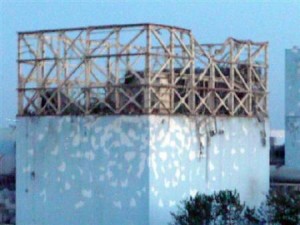
Nu pumpar man in havsvatten även i reaktor nummer 3. Tydligen stötte man på problem under början på inpumpningen vilket ledde till att vattennivåerna temporärt föll. Det kan ha orsakat vätgasbildning även vid reaktor 3 så man varnar för att det är möjligt med en liknande explosion som man såg vid 1an igår. En sådan explosion borde inte skada inneslutningen på 3an. Nu verkar inpumpningen av vatten ske utan problem. Som man kan se på denna bilden så var det “bara” den översta delen av byggnaden som förstördes av explosionen i reaktor 1. Den del där väggarna och taken i princip bara är plåt. Allt av betong står ännu kvar.
Så här ser reaktorn ut i genomskärning.
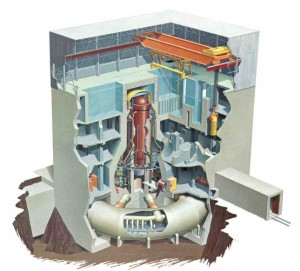
Det är betongstrukturen direkt runt reaktorn som är det viktiga. Det är den som är byggd för att klara av höga tryck och för att hålla inne allt radioaktivt material ifall själva stålkärlet som reaktorn utgörs av blir skadad.
http://english.kyodonews.jp/news/2011/03/77392.html
Uppdatering 08:39
Regeringen flaggar för risken att det kan ske en liknande explosion vid reaktor 3 som den vi såg igår vid reaktor 1. Det handlar återigen om att vätgas har bildats i härden, ventilerats ut i reaktorbyggnaden där det finns risk att det antänds. Vätgasen bildas då bränslekapslingen blir hetare än 1000 grader. Då oxiderar den och bildar vätgas och zirkoniumoxid. Eftersom 3 meter av härden i reaktor 3 vid Fukushima 1 har varit ovanför vattennivån så är det troligt att de temperaturerna uppnåtts. Myndigheterna tror att en partiell härdsmälta sker i 1an och 3an. Man håller på att fylla inneslutningarna vid reaktor 1 med havsvatten och det verkar som man planerar att göra samma vid reaktor 3.
Högsta strålningsnivåerna som uppmätts är ungefär 1,5 mSv per timme. Dosgränsen för en kärnkraftsarbetare i Sverige går vid 20 mSv per år. Den naturliga bakgrundsstrålningen ger ungefär 3-5 mSv per år. Nivåerna har alltså som max legat på ungefär 500ggr naturlig bakgrundsstrålning, högt men inte omedelbart farligt. Det som ger upphov till doserna är förmodligen de flyktiga fissionsprodukterna som är svåra att filtrera bort och som frigörs lätt ur bränslet. Plutonium, americium och andra långlivade radionuklider stannar i bränslet i princip oavsett vad som sker.
Resteffekten i reaktor 3 är nog runt 10 MW och i reaktor 1 runt 6 MW. För att ge en känsla för den vattenmängd som måste tillföras så blir det 4 liter vatten per sekund till 3an och 2 liter till 1an. Den vattenkran jag har i köket ger ungefär 0.2 liter per sekund. Så 25 gånger vattenflödet från en vanlig vattenkran.
Nedan är Kyodo’s senaste sammanfattande artikel av läget.
http://english.kyodonews.jp/news/2011/03/77319.html
Japanese authorities scrambled Sunday to control overheating reactors at the troubled Fukushima No. 1 nuclear power plant, injecting sea water into them and reducing the pressure inside, top government spokesman Yukio Edano said.
While acknowledging that the core of the No. 3 reactor at the plant may have been deformed due to overheating, the chief Cabinet secretary denied it has led to a ”meltdown,” a critical situation where fuel rods have melted.
Edano warned, however, that a hydrogen explosion similar to one that occurred at the No. 1 reactor at the same facility nearby on Saturday could occur at the No. 3 reactor because large amounts of hydrogen were created when the water injection procedure briefly ran into trouble.
The plant’s operator, Tokyo Electric Power Co., began injecting fresh water into the reactor to deal with the problem that the tops of MOX fuel rods were 3 meters above the water in the reactor following a magnitude 9.0 earthquake which hit northeastern and eastern Japan on Friday.
But it began injecting sea water after trouble developed with a fresh water pump, a step that will lead to the reactor’s dismantlement.
Radiation around the reactor measured 1,557 micro sievert at 1:52 p.m., Edano said, adding the figure went down to 184 about 50 minutes later. He dismissed concerns that the radiation level would affect human health.
Meanwhile, radiation monitored at the Onagawa nuclear power plant in Miyagi Prefecture on the Pacific coast shot up on Sunday, Tohoku Electric Power Co. said, adding that it was likely caused by radioactive substances let out at the troubled Fukushima No. 1 nuclear power plant in Fukushima Prefecture.
Radiation levels were very low but about 400 times as high as in normal times, the power supplier said, dismissing the possibility that the Miyagi plant was to blame.
The Nuclear and Industrial Safety Agency said Tokyo Electric Power acknowledged that the No. 3 reactor of the Fukushima plant had lost its cooling functions, while 19 people at a nearby hospital were found to have been exposed to radioactivity, in addition to three cases of exposure recorded Saturday.
It was the sixth reactor overall at the Fukushima No. 1 plant and the Fukushima No. 2 plant, which is located just south of the No. 1 plant, to undergo cooling failure since the massive earthquake and ensuing tsunami struck Japan on Friday.
The disaster raised fears of radioactive leaks from the plants after cooling systems there were hampered, most seriously at the No. 1 reactor.
An explosion Saturday at the No. 1 plant blew away the roof and the walls of the building housing the No. 1 reactor’s container.
The government and nuclear authorities said there was no damage to the steel container housing the troubled No. 1 reactor, noting that the blast occurred as vapor from the container turned into hydrogen and mixed with outside oxygen.
Tokyo Electric Power has begun new cooling operations to fill the reactor with sea water and pour in boric acid to prevent an occurrence of criticality. Edano said in a news conference Sunday morning that there had been no major changes in the results of radioactivity monitoring near the No. 1 reactor.
No significant changes in radiation levels have been monitored.
Following the explosion, the authorities expanded from 10 kilometers to 20 km the radius of the evacuation area for residents living in the vicinity of the Fukushima plants.
The Fukushima prefectural government said Saturday that three people had their clothes contaminated with radioactive substances while fleeing from the No. 1 nuclear plant.
The Fire and Disaster Management Agency said Sunday that 15 people were found to have been contaminated at a hospital located within 10 km of the No. 1 reactor. Edano said there was a possibility that nine people who fled on a bus had been exposed to radioactivity.
==Kyodo
CNN ~ Fukushima Daiichi Units #1 & 3 may have damage to reactor cores
2011 03 12 | 2058 EST
Shirakawa, Japan (CNN) — Japanese authorities are operating on the presumption that possible meltdowns are under way at two nuclear reactors, a government official said Sunday, adding that there have been no indications yet of hazardous emissions of radioactive material into the atmosphere.
The attempts to avert a possible nuclear crisis, centered around the Fukushima Daiichi facility in northeast Japan, came as rescuers frantically scrambled to find survivors following the country’s strongest-ever earthquake and a devastating tsunami that, minutes later, brought crushing walls of water that wiped out nearly everything in their paths.
Chief Cabinet Secretary Yukio Edano told reporters there is a “possibility” of a meltdown at the plant’s No. 1 reactor, adding, “It is inside the reactor. We can’t see.” He then added that authorities are also “assuming the possibility of a meltdown” at the facility’s No. 3 reactor.
Uppdatering 08:28
http://english.kyodonews.jp/news/2011/03/77319.html
Another explosion could occur outside the No. 3 reactor of the Fukushima No. 1 nuclear power plant but it is unlikely to pose new serious radiation problems, Japan’s top government spokesman said Sunday.
The chief Cabinet secretary told a press conference that part of the reactor could be deformed in the event of an explosion but the reactor can resist a blast and no situation that could be termed a meltdown is expected.
Uppdatering 08:23
TEPCO’s senaste uppdatering.
http://www.tepco.co.jp/en/press/corp-com/release/11031305-e.html
All 6 units of Fukushima Daiichi Nuclear Power Station have been shut down.

Unit 1(Shut down)
- Reactor has been shut down. However, the unit is under inspection due to
  the explosive sound and white smoke that was confirmed after the big
  quake occurred at 3:36PM.
- We have been injecting sea water and boric acid which absorbs neutron
  into the reactor core.

Unit 2(Shut down)
- Reactor has been shut down and Reactor Core Isolation Cooling System has
  been injecting water to the reactor. Current reactor water level is lower
  than normal level, but the water level is steady. After fully securing
  safety, we are preparing to implement a measure to reduce the pressure of
  the reactor containment vessels under the instruction of the national
  government.

Unit 3(Shut down)
- Reactor has been shut down. However, High Pressure Core Injection System
  has been automatically shut down and water injection to the reactor is
  currently interrupted. We are examining alternative way to inject water.
  Also, following the instruction by the government and with fully securing
  safety, steps to lowering the pressure of reactor containment vessel has
  been taken. Spraying in order to lower pressure level within the reactor
  containment vessel has been cancelled.
- Currently, we do not believe there is any reactor coolant leakage inside
  the reactor containment vessel.
Uppdatering 22:51
Och en till
http://www.tepco.co.jp/en/press/corp-com/release/11031301-e.html
Unit 1(Shut down)
- Reactor has been shut down. However, the unit is under inspection due to
  the explosive sound and white smoke that was confirmed after the big
  quake occurred at 3:36PM.
- We have been injecting sea water and boric acid which absorbs neutron
  into the reactor core.

Unit 2(Shut down)
- Reactor and Reactor Core Isolation Cooling System have been shut down.
  Current reactor water level is lower than normal level, but the water
  level is steady. After fully securing safety, we are preparing to
  implement a measure to reduce the pressure of the reactor containment
  vessels under the instruction of the national government.

Unit 3(Shut down)
- Reactor has been shut down and we continue injecting water by High
  Pressure Core Injection System. After fully securing safety, we are
  preparing to implement a measure to reduce the pressure of the reactor
  containment vessels under the instruction of the national government.
- Currently, we do not believe there is any reactor coolant leakage
  inside the reactor containment vessel.
Casualty
- 2 workers of cooperative firm were injured at the occurrence of the
  earthquake, and were transported to the hospital.
- 1 TEPCO employee who was not able to stand by his own with his hand
  holding left chest was transported to the hospital by an ambulance.
- 1 subcontract worker at important earthquake-proof building was
  unconscious and transported to the hospital by an ambulance.
- The radiation exposure of 1 TEPCO employee, who was working inside the
  reactor building, exceeded 100mSv and was transported to the hospital.
- 4 workers were injured and transported to the hospital after explosive
  sound and white smoke were confirmed around the Unit 1.
- Presence of 2 TEPCO employees at the site are not confirmed

Others
- We measured radioactive materials inside of the nuclear power station
  area (outdoor) by monitoring car and confirmed that radioactive
  materials level is higher than ordinary level. Also, the level at
  monitoring post is higher than ordinary level. We will continue to
  monitor in detail the possibility of radioactive material being
  discharged from exhaust stack or discharge canal. The national
  government has instructed evacuation for those local residents within
  20km radius of the periphery because it's possible that radioactive
  materials are discharged.

- We will continue to take all measures to restore the security of
  the site and to monitor the environment of the site periphery.
Uppdatering 22:19
TEPCO släppte just en ny statusuppdatering på reaktorerna i Fukushima 1
http://www.tepco.co.jp/en/press/corp-com/release/11031234-e.html
Unit 1(Shut down)
- Reactor has been shut down. However, the unit is under inspection due
  to the explosive sound and white smoke that was confirmed after the big
  quake occurred at 3:36PM.
- Also, we have been injecting sea water into the reactor core and then
  boric acid which absorbs neutron. However, we tentatively ceased the
  operation factoring in the impact of potential tsunami following the
  earthquake which occurred at 10:15PM.

Unit 2(Shut down)
- Reactor and Reactor Core Isolation Cooling System have been shut down.
  Current reactor water level is lower than normal level, but the water
  level is steady. After fully securing safety, we are preparing to
  implement a measure to reduce the pressure of the reactor containment
  vessels under the instruction of the national government.

Unit 3(Shut down)
- Reactor has been shut down and we continue injecting water by High
  Pressure Core Injection System. After fully securing safety, we are
  preparing to implement a measure to reduce the pressure of the reactor
  containment vessels under the instruction of the national government.
- Currently, we do not believe there is any reactor coolant leakage
  inside the reactor containment vessel.
Uppdatering 21:36
Det har klarnat lite sen imorse. Vi blev nog alla skakade när man såg byggnaden flyga i luften men hittills har explosionen inte haft några kända konsekvenser på reaktorn. Det som tydligen hänt är att en vätgasexplosion skett i reaktorbyggnaden utanför inneslutningen av reaktorn. Inneslutningen och reaktorn är dock ännu intakt och inget större läckage av radioaktiva ämnen har uppmätts. Tydligen har det skett en partiell härdsmälta med utsläpp av cesium vilket innebär att olyckan nu rankas som en 4a på INES skalan. Det är ett snäpp under Harrisburgolyckan. Vätgasen har förmodligen uppkommit pga den partiella härdsmälta, sen ventilerats ut från inneslutningen, blandats med luften utanför och exploderat. Man har för några timmar sedan börjat fylla inneslutningen med havsvatten för att långsiktigt hålla allting kylt. Om den processen fortgår utan incidenter så kan förhoppningsvis dramatiken vid Fukushima 1 vara över. De planerar att ha fyllt inneslutningen helt och hållet till söndag morgon japansk tid.
Magnituden av utsläppen från den partiella härdsmältan jämförs med en tidigare incident vid Tokaimura bränslefabriken. En arbetare vid Fukushima har exponerats för en stråldos på ca 100 mSv. Den stråldos som en vanlig svensk utsätts för på grund av naturliga strålkällor(radon, kosmisk strålning etc) i Sverige är som jämförelse runt 3-5 mSv och i vissa delar av världen kan den uppgå till närmare 100 mSv. Ventilering av inneslutningen sker då det behövs och verkar fungera.
Vid den andra reaktorn i Fukushima 1 så ligger vattennivån lågt men stabilt och TEPCO rapporterar att att läget är under kontroll. I den tredje reaktorn är det tydligen inte heller några problem att hålla vattennivåerna. I båda reaktorerna är man förberedd att ventilera inneslutningarna ifall det krävs.
Vid Fukushima 2 har man tydligen även problem med kylningen av reaktorerna enligt TEPCO’s senaste statusuppdatering
http://www.tepco.co.jp/en/press/corp-com/release/11031233-e.html
Men det verkar som att alla blocken vid Fukushima 2 har tillgång till elektricitet och kan därmed driva pumpar odyl. Man förbereder sig inför möjligheten att ventilera inneslutningarna vid de reaktorerna om trycket stiger för mycket.
Man måste applådera det enastående jobb som TEPCO’s anställda har lyckats med i det här läget. Om allting klaffar nu, om påfyllnaden med havsvatten fungerar. Då kan vi alla pusta ut. Då har en 40 år gammal reaktor och dess inneslutning visat sig kunna klara en magnitud 8.9 jordbävning, total förlust av elektricitet, förlust av kylmedel och därefter en explosion stark nog för att demolera reaktorbyggnaden ovanför. Ännu ska man inte ta ut någon seger, men just nu ser det lovande ut. För varje timme som går så sjunker resteffekten, vid det här laget är den mindre än en halv % av maxeffekt. Ju lägre den blir ju mindre är risken för en härdsmälta när kylningen har problem.
NEI har en väldigt bra uppföljning av händelsen med bra information
http://www.nei.org/newsandevents/information-on-the-japanese-earthquake-and-reactors-in-that-region
Här nedan kommer Kyodo’s senaste artikel om händelserna. Väldigt bra sammanfattning.
http://english.kyodonews.jp/news/2011/03/77204.html
Explosion did not occur at reactor, new cooling operation begins
TOKYO, March 13, Kyodo
Japanese authorities have confirmed there was an explosion at the Fukushima No. 1 nuclear power plant Saturday afternoon but said it did not occur at its troubled No. 1 reactor, brushing off concerns that the quake-triggered problem could develop into a catastrophe.
Chief Cabinet secretary Yukio Edano told an urgent press conference that the operator, Tokyo Electric Power Co., has confirmed there is no damage to the steel container housing the reactor, although the 3:36 p.m. explosion resulted in the roof and the walls of the building housing the reactor’s container being blown away.
The top government spokesman said TEPCO has begun new cooling operations to fill the reactor with sea water and pour in boric acid to prevent an occurrence of criticality, noting it may take several hours to inject water into the reactor.
In addition, it will take about 10 days to fill the container with sea water, he said. There is a great possibility that the reactor will be decommissioned as the injection of sea water containing salt and impure substances will make it difficult to operate it safely again, experts say.
TEPCO’s Fukushima No. 1 and No. 2 plants have lost their cooling functions after the area was jolted by a magnitude 8.8 earthquake Friday.
Due to failure to cool down the No. 1 reactor at the Fukushima No. 1 plant, radioactive cesium and iodine were detected near the facility Saturday.
The detection of the materials, which are created following atomic fission, led Japan’s nuclear safety agency to admit the reactor had partially melted — the first such case in Japan.
Following the blast that occurred as vapor from the container of the No. 1 reactor turned into hydrogen and mixed with outside oxygen, Edano said the authorities expanded from 10 kilometers to 20 km the radius of the area to be evacuated by residents living in the vicinity of the Fukushima plants as a precaution.
Three people had their clothes contaminated with radioactive substances while fleeing from the No. 1 nuclear plant Saturday afternoon, according to the Fukushima prefectural government.
The nuclear safety agency said no decontamination work is needed for them, but asked the Self-Defense Forces to check whether 87 others who were vacating the area with the three have been exposed to radiation.
Officials of the Nuclear and Industrial Safety Agency said new cooling operations have so far been proceeding smoothly, and the melting of the core has not been aggravated.
The melting temperature for pellets containing cesium, a nuclear fissile material, is around 2,800 degrees Celsius and the release of celsium indicates that the reactor has heated up significantly.
A partial core meltdown occurred in a major nuclear accident at Three Mile Island in the United States in 1979. About 45 percent of nuclear fuels melted in the incident, causing radioactive materials to be released.
The Fukushima prefectural government said the hourly radiation from the No. 1 plant reached 1,015 micro sievert before the explosion, an amount equivalent to that permissible for a person in one year.
Four workers — two from the company and two others from another firm — were injured in the explosion, TEPCO said. The four were working to deal with problems caused by the powerful quake, but their injuries are not life-threatening and they are conscious, it added.
TEPCO also reported the detection of high radiation levels to the state as required by a domestic law.
The nuclear agency officials said the severity of the radioactive leak this time is around the same level as a 1999 accident at a nuclear fuel processing plant run by JCO Co. in Tokaimura, Ibaraki Prefecture, in which a nuclear fission chain reaction could not be contained for nearly a full day.
The two incidents are less severe than the accidents at atomic power reactors in Chernobyl in the Soviet Union in 1986 and on Three Mile Island, they said.
Before the explosion, TEPCO successfully released pressure in the container of the No. 1 reactor to prevent a nuclear meltdown.
The depressurizing work involved the release of steam that includes radioactive materials. It is aimed at preventing the reactor containers from sustaining damage and losing their critical containment function. The government issued an unprecedented order for this to be carried out at the Fukushima No. 1 and No. 2 plants.
The nuclear agency said as a result of reducing the container’s pressure at the No. 1 plant, radioactive levels at the plant briefly went up.
It denied that the radiation amount will pose an immediate threat to the health of nearby residents, as the wind was blowing toward the sea in the Pacific coast town in northeastern Japan.
==Kyodo
Länkar
http://www.svd.se/nyheter/utrikes/svd-rapporterar-minut-for-minut_6001491.svd
http://www.dn.se/nyheter/varlden/hardsmalta-befaras-i-japan
http://www.aftonbladet.se/nyheter/article8703357.ab
http://www3.nhk.or.jp/daily/english/12_56.html
http://www3.nhk.or.jp/daily/english/13_01.html
http://www.tepco.co.jp/en/press/corp-com/release/index-e.html
http://www.svd.se/nyheter/inrikes/chatta-om-karnkraft_6003053.svd
http://www.dn.se/nyheter/varlden/han-flyr-fran-karnkraftverket
http://www.dn.se/nyheter/varlden/japanska-regeringen-hardsmalta-kan-ha-intraffat
http://www.dn.se/ledare/huvudledare/japans-nod-ar-var
http://www.svd.se/nyheter/inrikes/chatta-om-karnkraft_6003053.svd
Comments closedUppdatering 11:59
Lite experter spekulerar på Reuters
http://www.reuters.com/article/2011/03/12/us-japan-quake-experts-idUSTRE72B1BP20110312
ROBIN GRIMES, PROFESSOR OF MATERIALS PHYSICS AT IMPERIAL COLLEGE LONDON
“It does seem as if the back-up generators although they started initially to work, then failed,” Grimes, an expert in radiation damage told BBC TV.
“So it means slowly the heat and the pressure built up in this reactor. One of the things that might just have happened is a large release of that pressure. If it’s that then we’re not in such bad circumstances.
“Despite the damage to the outer structure, as long as that steel inner vessel remains intact, then the vast majority of the radiation will be contained.
“At the moment it does seem that they are still contained and it’s a release of significant steam pressure that’s caused this explosion. The key will be the monitoring of those radiation levels.”
PROFESSOR PADDY REGAN, NUCLEAR PHYSICIST FROM BRITAIN’S SURREY UNIVERSITY
“What is important is where that explosion is,” Regan told Sky News.
“It’s not clear what has exploded. The big problem would be if the pressure vessel has exploded but that does not look as though that’s what’s happened.
“If the pressure vessel, which is the thing that actually holds all the nuclear fuel … if that was to explode — that’s basically what happened at Chernobyl — you get an enormous release of radioactive material.
“It doesn’t look from the television pictures … as though it’s the vessel itself.
He said media reports suggested that a small fraction of the nuclear fuel might have melted at the core of the reactor which would not be surprising.
NUCLEAR EXPERT MARK HIBBS OF THE CARNEGIE ENDOWMENT FOR INTERNATIONAL PEACE
“We don’t have any information from inside the plant. That is the problem in this case.
“If it melts down the probability that there would be a breach or that radiation would get outside of the plant because of weakness of the structure of the plant … is much greater.”
Uppdatering 11:06
Video av explosionen, det är svårt att se vad som exploderat
http://www.bbc.co.uk/news/world-asia-pacific-12721498
11 Comments
Femte dagen av tsunamikatastrofen – 2
Published by Michael on March 16, 2011Uppdatering 23:27
Inget nytt om ny elledning ännu. IAEA släppte just en lista på status för använt bränslebassängerna. De har ingen info om bassäng 4, vilket är olycksbådande med tanken på NRC’s uttalande om att de tror den är torrlagd. Ännu har ingen bekräftelse av det påståendet skett och NRC har inte förklarat hur de dragit den slutsatsen.
I en lite positivare ton så skriver Reuters att IAEA uttalat att stråldosnivåerna stadigt sjunkit de senaste 12 timmarna.
Snart börjar det bli dags
The IAEA can confirm the following information regarding the temperatures of the spent nuclear fuel pools at Units 4, 5 and 6 at Fukushima Daiichi nuclear power plant:
Unit 4
14 March, 10:08 UTC: 84 ˚C
15 March, 10:00 UTC: 84 ˚C
16 March, 05:00 UTC: no data
Unit 5
14 March, 10:08 UTC: 59.7 ˚C
15 March, 10:00 UTC: 60.4 ˚C
16 March, 05:00 UTC: 62.7 ˚C
Unit 6
14 March, 10:08 UTC: 58.0 ˚C
15 March, 10:00 UTC: 58.5 ˚C
16 March, 05:00 UTC: 60.0 ˚C
Uppdatering 21:25
Äntligen lite goda nyheter.
En ny elledning så hela kraftverket återigen får tillgång till extern el vore jäkligt fint. Just nu pumpar man havsvatten in i reaktorerna med hjälp av brandpumpar. Kapaciteten på pumparna är nog rätt begränsade och kan förklara varför man inte klarar av att fylla härdarna till toppen. Om man kan få igång elen igen så kan man börja köra reaktorernas nödkylningssystem på allvar. Om man ska ta hänsyn till Murphy så finns det dock två svarta moln, har pumpar odyl klarat av explosionerna i 1an och 3an och är vattenintagen från havet öppna eller helt igen täppta med skrot från tsunamin? Oavsett de två punkterna så är det alltid bra om man har mer el!
Från Yahoo:
New power line may ease crisis at Japan nuke plant
FUKUSHIMA, Japan – A nearly completed new power line could restore cooling systems in Japan’s tsunami-crippled nuclear power plant, its operator said Thursday, raising some hope of easing the crisis that has threatened a meltdown and already spawned dangerous radiation surges.
The conditions at the plant appeared to worsen, with white smoke pouring from the complex and a surge in radiation levels forcing workers to retreat for hours Wednesday from their struggle to cool the overheating reactors.
As international concern mounted, the chief of the U.N. nuclear agency said he would go to Japan to assess what he called a “serious” situation and urged Tokyo to provide better information to his organization.
Tokyo Electric Power Co. spokesman Naoki Tsunoda said the new power line to the Fukushima Dai-ichi plant is almost finished and that officials plan to try it “as soon as possible,” but he could not say exactly when.
The new line would revive electric-powered pumps, allowing the company to maintain a steady water supply to troubled reactors and spent fuel storage ponds, keeping them cool. The company is also trying to repair its existing disabled power line.
Comments closed