Idag klockan 16-17 var Michael Karnerfors (NPYP) och Göran Bryntse (f.d. ordförande för Folkkampanjen mot Kärnkraft-Kärnvapen, FmKK) med i Sveriges Radio P1-programmet Studio Ett. Programmet handlade om kärnkraftsdebatten.
4 CommentsNuclear Power? Yes Please Posts
This is not so much an April Fools joke as it is a little riddle. It connects to a current event… and to things that happened in the last century. And of course it has something to do with nuclear power.
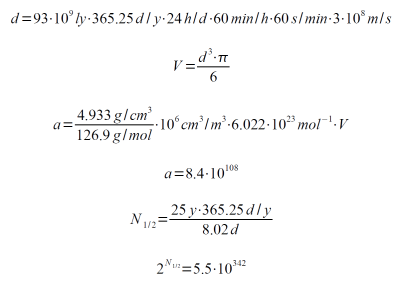
This is a comparison between two estimated values… what are they?
Update: we have a winner! Tony scored a perfect bullseye. I’m quoting him here:
‘a’ is the number of iodine atoms that would fill the known universe, if the iodine were at ‘normal’ temperature/pressure.
the second number is the number of radioactive iodine atoms you would have needed, when Chernobyl exploded, in order to have one radioactive iodine atom left today.
An added trivia is that the estimated number of atoms in the known universe is approximately 10^80.
The upshot of all this is this: there is not a single atom of Iodine-131 released by Chernobyl in existence today. The last atom decayed in no more than 4 years after the accident.
/Michael
4 CommentsUpdate 18:00(CET)/16:00(UTC)/01:00(JST)
The new JAIF update is out. Temperature of the core in Reactor one has gone down and pressure gone up slightly. They have added the water level of the radioactive water in the tunnels they are trying to empty. They now write that they suspect the pressure vessels of reactor number 2 and 3 are no longer airtight but they don’t think there are any holes or crack. A cryptic statement and I wish they would release more information on what they mean exactly. Doesn’t seem possible to exclude a small breach in a few control rod guide tubes due to dripping corium(molten core material). At the same time the temperature readings in the lower head of reactor 3 excludes that the entire bottom has gone out due to massive melting through the vessel. In reactor 2 one neither has any temperature reading from bottom head or any pressure reading within the vessel.
Update 11:00(CET)/09:00(UTC)/18:00(JST)
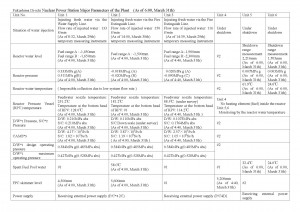
JAIF has released a update (data from 07:30 JST today) and radiation trends and NISA has an update from yesterday(06:00(JST) march 31).
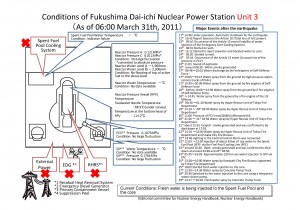
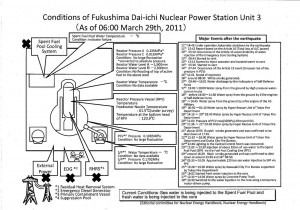
Reactor 1:
Water level in the core: 1.65 (1.65) meters below the top of fuel assemblies
Flow rate of injected water: 133 liter/minute
Core pressure: 583(612) kPa
Containment pressure: 175(210) kPa
Core temperature(feedwater nozzle): 256.2 (251.2) Celsius
Core temperature(bottom head): 128 Celsius
Dose rate within containment: 41.7 Sv/hour
Reactor 2:
Water level in the core: 1.5 (1.5) meters below the top of fuel assemblies
Flow rate of injected water: 150 liter/minute
Core pressure: unknown
Containment pressure: 110 (110) kPa
Core temperature(feedwater nozzle): 181.2 Celsius
Core temperature(bottom head): Unknown
Dose rate within containment: 38.7 Sv/hour
Spent fuel pool temperature: 58 Celsius
Reactor 3:
Water level in the core: 2.25 (2.3) meters below the top of fuel assemblies
Flow rate of injected water: 116 liters/minute
Core pressure: 117 (121) kPa
Containment pressure: 173 (176.4) kPa
Core temperature(feedwater nozzle): 88.5 Celsius (under review)
Core temperature(bottom head): 114.2 Celsius
Dose rate within containment: 25.7 Sv/hour
Pressures and temperatures seems to be quite stable, albeit high in the number 1 reactor. Nothing new really on the status of the 3 reactors. A temporary pump used to pump water into the number 2 spent fuel pool has malfunctioned and we can see a increasing trend in the water temperature.
They are shifting around water in different places to be able to make room somewhere to pump away the junk water in the basements of the turbine buildings. In order to be able to access the coolant pumps needed to restore the proper cooling of the reactors.
The JAIF radiation trends show that there was big emissions during the 15th and 16th and after that a declining trend. There doesn’t seem to be any continuous emissions from the plant and the emission spikes corresponds with the venting of the containments and following explosions and fires in the reactor buildings. Unless a new need to vent the containments arises, then there shouldn’t be any new big emissions. By now the I-131 content of the reactors have decayed down to a quarter of initial amount and for every week(8 days to be precise) they can prevent venting the amount will further be cut in half. I-131 will stop being a problem after about 80 days, by that time the amount will have been reduced to one thousandth of the initial amount. Cs-137 will of course continue to be a problem with a half life of 30 years.
TEPCO has once again measured wrongly activities in water, but it is likely the ground water around the plant is contaminated. Source of the contamination is unknown but TEPCO suspects its been carried by rain after the initial ventings.
Situation is serious, but it doesn’t seem to deteriorate anymore.




Links(English)
Reuters Japan nuclear crisis drags on
George Monbiot describes the double standards used to evaluate nuclear
Blogs(English)
Charles Barton Nuclear Safety and George Monbiot
NEI nuclear notes Appeal of small reactors might increase after Fukushima
Rod Adams Monbiot debates Caldicott
Links(Swedish)
SvD Svenskar tror på kärnkraft
Blogs(Swedish)
Fröjdhpunkt Så mycket hade kärnkraft kunnat minska utsläppen
Inslag.se Pudelns kärnkraft
Riksdagen har direktsänd debatt om kärnkraftens framtid i Sverige. Startar om 3 minuter (inget aprilskämt).
Kan ses här: http://svtplay.se/t/102527/svt_forum
Uppdatering: Ok, lite skämt blev det… kärnkraftsdebatten föregås av debatt om svenska Libyen-insatsen.
http://www.riksdagen.se/webbnav/?nid=43&doktyp=t-lista&dok_id=GY0J20110401&rm=2010/11&bet=20110401
Kärnkraftsdebatten börjar om 2 timmar… + slasktid mellan talare
Comments closed
Update 12:00(CET)/10:00(UTC)/19:00(JST)
New JAIF update for today, I will compare it with the NISA update from yesterday.
Reactor 1:
Water level in the core: 1.65 (1.60) meters below the top of fuel assemblies
Flow rate of injected water: 133 liter/minute
Core pressure: 612(592) kPa
Containment pressure: 210(230) kPa
Core temperature(feedwater nozzle): 251.2 (270.1) Celsius
Core temperature(bottom head): 130.2 Celsius
Dose rate within containment: 37.7 Sv/hour
Reactor 2:
Water level in the core: 1.5 (1.5) meters below the top of fuel assemblies
Flow rate of injected water: 133 liter/minute
Core pressure: unknown
Containment pressure: 110 (100) kPa
Core temperature(feedwater nozzle): 174.3 Celsius
Core temperature(bottom head): Unknown
Dose rate within containment: 39.6 Sv/hour
Spent fuel pool temperature: 48 Celsius
Reactor 3:
Water level in the core: 2.3 (2.25) meters below the top of fuel assemblies
Flow rate of injected water: 116 liters/minute
Core pressure: 121 (119) kPa
Containment pressure: 173 (164) kPa
Core temperature(feedwater nozzle): 75.3 Celsius (under review)
Core temperature(bottom head): 116.0 Celsius
Dose rate within containment: 26.8 Sv/hour
Status with the reactors are pretty much unchanged. Work is proceeding with pumping away junk water from turbine halls so one can repair the coolant pumps. Work is slow however due to lack of any place to put the radioactive water.
IAEA released a new estimate on ground fallout yesterday and its not pleasant reading. Here is a quote:
Based on measurements of I-131 and Cs-137 in soil, sampled from 18 to 26 March in 9 municipalities at distances of 25 to 58 km from the Fukushima Nuclear Power Plant, the total deposition of iodine-131 and cesium-137 has been calculated. The results indicate a pronounced spatial variability of the total deposition of iodine-131 and cesium-137. The average total deposition determined at these locations for iodine-131 range from 0.2 to 25 Megabecquerel per square metre and for cesium-137 from 0.02-3.7 Megabecquerel per square metre.
This is Chernobyl level ground deposits of Cs-137 around the plant and indicates one might have to expand the evacuation zone around Fukushima. The basis of the IAEA estimate is from the dust samples published by MEXT.


Links(English)
Bloomberg Fukushima workers face risk of uncontrolled reactions
Reuters Japan under pressure to expand evacuation
Kyodo news Kan to review plan to build more nuclear power plants from scratch
Blogs(English)
MIT nuclear information hub Plutonium in the environment
Depleted Cranium Great presentation on Fukushima Daiichi
Where are the clouds Ibakari analysis for 21 march
Atomic Insights Detectable radiation versus dangerous radiation
Links(Swedish)
Expressen Vattenbombningarna kan ha skadat reaktorerna
Aftonbladet Nivån av radioaktivt jod når nya toppmätningar
DN Kärnkraftverk kan stängas för gott
SvD USA styrka skickas till Fukushima
Blogs(Swedish)
Dr Angels Redan 1999 protesterade Greenpeace mot Fukushima
Linn Tummen upp för kärnkraft
Norah4you Dags att tala klarspråk Japan
2 Comments
Update 12:00(CET)/10:00(UTC)/19:00(JST)
Yet another day and some more updates. JAIF has released an update that doesn’t show much news. The pressure in the pressure vessel of reactor number one has gone down slightly from 603 kPa to 583 kPa. The containment pressure is down from 285 to 245 kPa. Feed water nozzle temperature down from 323.3 to 290.5 degrees Celsius. I hope it will be a start of a downward trend.
The status for the other 2 reactors are about the same as yesterday and nothing new is happening with the spent fuel pools.
The work to pump away the junk water in the turbine hall of the number 1 reactor have come to a stop after they ran out of space in the turbine condenser where they where pumping the water. This is bad news since it further delays work to restore the internal coolant pumps, the number one reactor seems to be the least stable of the three so it would be nice to get the pumps running asap.
Still no clue to what caused the leakage of the highly radioactive water found in the number 2 reactor turbine hall and in the tunnel connected to the turbine building.
Levels of Iodine in sea water are still high with a new peak today.
IAEA reports on the contamination spread by the accident so far. The worst afflicted areas has surface contamination of I-131 of 23 kBq per square meter and 0.79 kBq per square meter of Cs-137. As comparison the effected areas after the Chernobyl accident had ground contamination from 40 kBq up to 1 500 kBq. So Fukushima is still many orders of magnitude less severe than Chernobyl. Here is a quote from the IAEA page.
On 28 March, deposition of iodine-131 was detected in 12 prefectures, and deposition of cesium-137 in 9 prefectures. The highest values were observed in the prefecture of Fukushima with 23 000 becquerel per square metre for iodine-131 and 790 becquerel per square metre for caesium-137. In the other prefectures where deposition of iodine-131 was reported, the range was from 1.8 to 280 becquerel per square metre. For caesium-137, the range was from 5.5 to 52 becquerel per square metre. In the Shinjyuku district of Tokyo, the daily deposition of both iodine-131 and cesium-137 was below 50 becquerel per square metre. No significant changes were reported in the 45 prefectures in gamma dose rates compared to yesterday.
The situation in Fukushima doesn’t change so rapidly anymore so it is likely that we will switch to updates on the situation only once a day after NISA releases their status update. If some important breaking news appear we will of course update that quicker.
Links(English)
Bloomberg TEPCO’s damaged reactors may take 30 years, 1.2 billion $ to scrap
Kyodo news Edano suggests scrapping all reactors att Fukushima Daiichi plant
BBC Japan to scrap stricken reactors
Reuters Japan orders safety upgrades at nuclear plants
Blogs on English
Next big future Theory of corrosion and backflow through feedwater lines to explain Fukushima radioactive water leaks
The nuclear green revolution Fukushima Dai-ichi: The good, the bad and the ugly
All Things Nuclear Lochbaum senate testimony on Japan crisis
NEI Nuclear Notes Lessons learned from Japan
Energy from Thorium Fukushima and the perception of risk
Links(Swedish)
SvD Hög nivå radioaktivitet i Japan
DN Reaktorerna kan kläs i tyg
Aftonbladet Skyhög nivå radioaktivt jod
UNT Kärnkraften är och förblir farlig
UNT Kärnkraft är inte ok
UNT Vadå långsiktigt hållbar lösning?
Swedish blog posts
Röda Malmö Ingen ände på kärnkraftseländet
Kommunisternas blog Vad är det som härskar på jorden
Viskningar och rop Röster om kärnkraft
Update 19:00(CET)/17:00(UTC)/02:00(JST)
New NISA and JAIF updates. NISA from 06:00 and JAIF from 20:00. Same as usual JAIF number first and NISA after within ().
Reactor 1:
Water level in the core: 1.60 (1.60) meters below the top of fuel assemblies
Flow rate of injected water: 141 liter/minute
Core pressure: 603(603) kPa
Containment pressure: 285(280) kPa
Core temperature(feedwater nozzle):323.3 Celsius
Core temperature(bottom head): 139.4 Celsius
Dose rate within containment: 36 Sv/hour
Reactor 2:
Water level in the core: 1.5 (1.5) meters below the top of fuel assemblies
Flow rate of injected water: 117 liter/minute
Core pressure: unknown
Containment pressure: 100 (110) kPa
Core temperature(feedwater nozzle): 153.7 Celsius
Core temperature(bottom head): 77.7 Celsius
Dose rate within containment: 40.4 Sv/hour
Spent fuel pool temperature: 45 Celsius
Reactor 3:
Water level in the core: 2.3 (2.3) meters below the top of fuel assemblies
Flow rate of injected water: 200 liters/minute
Core pressure: 135 (135) kPa
Containment pressure: 108.5 (108.5) kPa
Core temperature(feedwater nozzle): 61.5 Celsius (obviously error)
Core temperature(bottom head): 120.9 Celsius
Dose rate within containment: 29.2 Sv/hour
Number one is quite hot, otherwise no major change. Running a bit short on time so Kyodo has a good summary of the situation and IAEA.


Update 08:30(CET)/06:30(UTC)/15:30(JST)
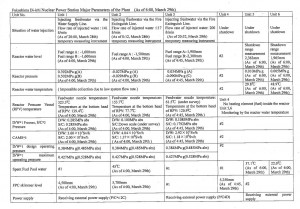
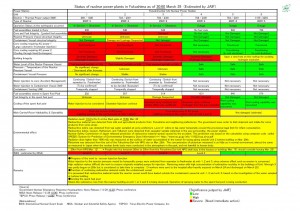
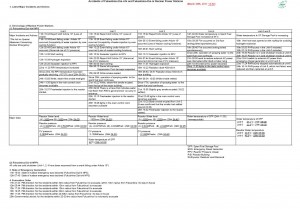
JAIF and NISA updates. NISA hasn’t released any new information on flow rates, temperatures or containment dose rates. There is no big change in the pressures or water levels of the reactors so I will omit the normal list of parameters I write down. If NISA release temperatures I will include it.
The Asahi Shimbun reports that TEPCO admits there is possible damage to the lower parts of the reactor pressure vessels. TEPCO states that the breaches can not be very large since the pressure in pressure vessels are maintained at a higher level than in the containment structure.
There seems to be a problem again in keeping the number 1 reactor cool. The temperature of the core increased to over 300 degrees celsius again and TEPCO had to increase the flow of water into the core.
Links (English)
Reuters Japan finds plutonium at stricken plant
NEI nuclear notes We should stop running away from radiation
Union of Concerned Scientists Where did all the water in the spent fuel pools go
Links(Swedish)
SvD Plutonium sprids i Fukushima
DN Plutoniumfynd vid Fukushima
Aftonbladet Plutonium i marken vid Fukushima
Expressen TEPCO chefen kan ha flytt från Japan
Röda Malmö
Krassman
Jinge
Röda berget
Uppkäftiga Uppsala
2 Comments
Update 23:20(CET)/21:20(UTC)/06:20(JST)
NISA has not released any new update today, JAIF has released one more update since this morning. I won’t paste updated tables this time, but they can be seen in the link provided. There is no major changes to any reactor. Both number 2 and number 3 reactors are now getting their freshwater pumped with temporary electric pumps that have replaced the fire pumps used up untill now. In their latest written report they say that they have found highly contaminated water in a tunnel with pipes and cables connected to the turbine hall, the activity level is similar to the water found in the turbine hall basement and they are investigating the source of the water. They continue to se high levels of, among other things, I-131 in the seawater and suspect it is due to the contamination in the tunnel.
Kyodo reports that plutonium has been found in the soil outside the reactors. The source of the plutonium is unknown and the level is comparable to what was found in japan after the nuclear tests done by Russia and the US during the cold war. TEPCO has provided a report that gives the concentration as about 1 Bq/kg of soil of Pu-239 and less than 0.5 Bq/kg of soil of Pu-238. The levels are very low and one could practically eat tons of soil before ingesting getting a dangerous amount. There is 0.44 billionths of a gram of Pu-239 per kg of soil*, a lethal dose of plutonium-239 is half a gram. So one would have to eat more than one million metric tons of soil to get a lethal dose of the plutonium contained within the soil. That is how low the amount is (that also gives a good example how exceptionally low concentrations of radioactive materials can be detected).
NHK reports that the 3 exposed workers have been sent home and that they don’t show any symptoms of radiation sickness.
It seems like the number 2 reactor is leaking quite significant amounts of radioactive water. It’s not clear if it is coming through a breach in the containment or if it is through some of the pipes. If for instance the valves, closing the reactor from the pipes that are coming in through the containment, is leaking. The highly radioactive water is a big problem since it prevents access to the turbine halls and delays work to restore the reactors internal coolant pumps. They have found similar build ups of radioactive water in the number 1 and 3 reactors turbine halls, but not as strongly radioactive. Since it is a problem in all three reactors to some extent my bet would be that it is the valves that are leaking.
Update 09:30(CET)/07:30(UTC)/06:30(JST)
JAIF has released their update but not NISA. I will wait to write down the status of the reactors until the NISA update arrives and for now I just paste JAIF’s tabels.
Kyodo reports that TEPCO measured the radionuclide content of the water in the turbine halls wrongly, they overestimated it by a factor of a hundred. Confirming our suspicion that they are measuring wrong. Kyodo also reports that the Nuclear Safety Comission states that there has been a partial meltdown in the number 2 reactor. I am a bit surprised by this statement because it has been quite clear since the first few days that there has been a partial meltdown.
The workers that where exposed to radiation while working in the turbine hall basement have left the hospital and are reportedly in perfect health.
According to TEPCO’s latest update they have switched the cooling of the number 2 reactor from the fire pumps to temporary electric pumps.
Reuters report that the levels of radioactive material in the sea outside the plant is dropping.


Links(english)
Kyodo FOCUS: Little sense of crisis over tsunami in Japan’s nuclear power industry
Reuters Japan raps nuclear operator over radiation mistake
Links(swedish)
DN larm om hög strålning var fel
DN samtidigt ökar oron för Fukushima
Aftonbladet strålningslarmet var ett misstag
Expressen Härdsmälta i kraftverket
Two days ago we first got the report that there is highly radioactive water in the turbine building basement of reactor 1. NISA released this list of isotopes found in the water and its activity per cubic centimeter. I added half lives to the list to make it more understandable.
| nuclide | activity(Bq/cm³) | half life | Q value (keV) |
| Cl-38 | 1,60E+006 | 37,24 min | 4916,53 |
| As-74 | 3,90E+002 | 17,77 days | 2151 |
| Y-91 | 5,20E+004 | 58,51 days | 1544,82 |
| I-131 | 2,10E+005 | 8,025 days | 970,86 |
| Cs-134 | 1,60E+005 | 2,065 days | 1233,38 |
| Cs-136 | 1,70E+004 | 13,04 days | 2548,22 |
| Cs-137 | 1,80E+006 | 30,08 years | 1175,63 |
| La-140 | 3,40E+002 | 1,679 days | 3762,22 |
We see that there is one peculiar things, a high activity of Chloride-38. The only way for Chloride-38 to be created is by Chloride-37 in seawater absorbing a neutron and turning into Cl-38. This would indicate there is still a considerable neutron flux in the core. Forum discussions have been going on about it. The other peculiar thing is the activity levels, the activity per cm³ is just crazily high. I suspect they are really measuring activity per liter and mistakenly report it as cubic centimeter and I will give 2 arguments for that.
1. The activity of the water
They reported that 3 workers had been working in the water for more than an hour, their dosimeters showed a dosage close to 200 mSv and two of the workers didn’t wear rubber boots so they got a large surface dose on their ankles and feet from beta radiation(some reports say up to 6 gray). But this does not match with the activity levels seen in the table I pasted above. If one multiplies the activity in Bq/cm³ with the Q value, i.e the energy released in the decay of one atom, and massage the numbers a bit to get the numbers in joules instead of keV and in cubic meters instead of cubic centimeters. Then one finds that the water is putting out 1.68 Watts per cubic meter of water. Something like 20% of that energy is from gamma rays, the rest is beta rays and recoil energy in the decaying nuclei.
1.68 Watts doesn’t sound like a lot given that a normal water kettle can have a power of 1000 W. But in terms of ionizing radiation 1.68 W is just crazy. Radiation dose is measured in Grays, one Gray is equal to one joule absorbed by one kg of tissue and a Watt is as we know one Joule per second. A one Gray whole body dosage is enough to get radiation sickness, 10 Grays will kill you slowly(over a few days) and 100 Grays kills you instantly.
These workers where working in water that is putting out watts of radiation, that means they should have gotten hundreds of Grays in an hour. It was stated they where knee deep in this water! Now if we instead consider that perhaps they mean activity per liter, misstakenly reported as cubic centimeters, then everything goes down by a factor of 1000(there are one thousand cubic centimeters in a liter). Instead of hundreds of Gray the workers would have gotten hundres of milligray, that is consistent with their dosimeter readings.
2. The neutron flux needed to create Cl-38
The probability that a Cl-37 atom will absorb a neutron and turn into Cl-38 is quite low, 1 barn(this probability is measured in a unit called barns, one barn=10^-24 cm², uranium has as comparison a fission probability of about 600 barns). So one needs a lot of neutrons to create any significant quantity of Cl-38. If one assumes the water concentration of Cl-38 has dropped by a factor 1000 when traveling from the reactor vessel to the water in the turbine hall basement(dilution, decay etc). Then one can make a rough approximation of the neutron flux needed in the core in order to create the Cl-38 concentration seen in the turbine hall(technically solving the Bateman equation for a equilibrium case with one group cross sections).
Neutron flux ends up being around 10¹² neutrons per square centimeter and second. A reactor running at full power produces on the order of 10^14 n/cm²*s. The core would have to be running at about 1% of its full power(10-20 MW thermal) to produce that flux, but I might as well be off by a factor of 10 in my estimate of dilution, which would put the power in the rage from 1-100 MW. We can exclude 100 MW since we have not seen a pressure and temperature spike that high in reactor number 1. We can not exclude 1-10 MW power levels because it is on the same order as the decay energy. But if we also again here assume they mean Bq/liter instead of Bq/cm³ then the needed flux to produce the Cl-38 goes down to something around 1*10^9 neutrons/cm²*s. That kind of neutron flux could plausibly be around from radioactive decay or a very very low power level.
Those 2 factors together makes me believe they are reporting activity levels wrongly. Lets see if I will have to change my opinion when new information arrives.
Notes for the interested.
To convert from the unit eV(electron volt) to joule one multiplies 1 eV with 1.602*10^-19
The Bateman equation describes the time dependent concentration of radionuclides. For the case of a nuclide created by a neutron flux and destroyed by decay one gets this equation
dN/dT= N_37*sigma_37*flux – N_38*lambda_38
Where:
N_37=number of Cl37 atoms per cubic centimeter(I assumed saturated salt water at 100 degres, which gives 0.39 grams of salt per cm² which gives 9,74*10^20 Cl37 atoms per cm³)
sigma_37=neutron capture cross section, around 1*10^-24 cm²
flux=neutron flux in neutrons per cm² and second
N_38= Number of Cl-38 atoms per cm³.
lambda_38 = decay constant for Cl-38(equals to Ln(2)/half life)
If one assumes equilibrium then dN/dT=0 and one gets that
flux=N_38*lambda_38/(N_37*sigma_37)
One get N_38 from dividing activity with decay constant and then multiplying by a dilution factor.
Here are all the numbers I plugged in in case someone can spot an error.
| Find flux | |||||
| Avogadros number | 6,02E+023 | ||||
| Salt density(gram per cm3) | 3,90E-001 | Dilution factor(from vessel to puddle) | 1000 | ||
| Molar mass sodium | 2,30E+001 | Cl37 capture cross section | 1,00E-024 | ||
| Molar mass chlorine | 3,55E+001 | Cl37 number density (per cm³) | 9,74E+020 | ||
| Moles of NaCl | 6,67E-003 | Cl38 lambda | 3,10E-004 | ||
| Fraction Cl-37 | 2,42E-001 | Cl38 number density (per cm³) | 5,16E+009 | ||
| Moles Cl-37 | 1,62E-003 | ||||
| Number of Cl-37 per cm³ | 9,74E+020 | Flux | 1,64E+012 | ||
Links(english)
Kyodo News Woes deepen over radioactive waters at nuke plant, sea contamination
Reuters Soaring radioactivity deals blow to Japan’s plant
BBC Radiation soars at japan reactor
NHK extreme radiation detected at number 2 reactor
Links(swedish):
DN Arbetare evakueras efter akut strålning
SvD Fler svenskar misstror kärnkraft
SVD Nya bakslag vid Fukushima
Aftonbladet tio miljoner gånger högre strålning
Röda berget
Jinge
In your face
Kunskapssamhället
Svensson
Kommentarer om Studio Ett.
Published by Michael on April 2, 2011Studio Ett på Sveriges Radio ringde på lunchen idag fredag och frågade om jag kunde vara med i en liten debatt om kärnkraftsdebatten, något som vi i NPYP önskat länge (om än inte just där). Eftersom eftermiddagen ändå såg ut att drabbas av akut arbetsbrist fick jag chefens tillåtelse att flexa ut tidigt och pös iväg ned till SR i Malmö för andra gången på kort tid. Lite allmäna kommentarer om inslaget…
Att tyskarna är på hugget som inslaget nämner är sant, men bilden är långt ifrån så enhetlig som man ger sken av. Sedan Fukushima-krisen kom igång har vi fått ett antal förfrågningar från tyskar – och en ifrån italien – om användning av grafiken med Den Leende Atomen. Jag var också på en affärsresa till Berlin i december, och hade då på mig en knapp med “Nuclear Power Yes Please”… och på bara en dag fick jag två spontana mycket uppskattande kommentarer från tyskar. I Sverige har jag hittils fått en sådan kommentar på över ett år.
Sedan noterar jag att tyskarna nu är på väg att göra exakt samma misstag som vi i Sverige gjorde 1980 och framåt: snabba, panikslagna beslut som enbart går på känslor, och inte överväger fakta. Det finns ingen fakta från Fukushima att tillgå än… idag har man exakt samma fakta som man hade för 4 veckor sedan. Beslutet att snabbstoppa 7 reaktorer i Tyskland har redan i ökade stoft- och koldioxidutsläpp gjort mer skada än vad Fukushima gjort i Japan. Minns att ungefär 25 personer per TWh dör en för tidig död på grund av luftföroreningar från kolkraft. De är lite som att försöka stoppa potentiall blödning i handen genom att skilja armen ifrån kroppen.
Göran säger att det var ca 500 personer på deras möte på Sergels Torg. Faktum är att en sympatisör till oss där och kollade runt lite, så vi räknade för skojs skull hur många som syntes på bilderna. Resultatet kan ni kolla på bilden nedan om ni känner för. Vi fick det till ca 220, plus lite som kom och gick. 🙂
13m 35s får jag frågan varför debatten är så “lam” i Sverige. Saken är den att politikerna ville aldrig ha debatten, utom möjligen Torbjörn Fälldin, han som vände Centern emot kärnkraft från att ha varit pionjärerna för kraftformen. Alla fyra kärnkraftskommunerna var starka Centerfästen och de ville ha kärnkraft hos sig. De kämpade med näbbar och klor för att få den, vilket de också lyckades med. Men sedan kom som sagt Fälldin och började ställa till oreda i frågan, vilket orsakade en het och infekterad debatt. Fälldin krävde en folkomröstning om kärnkraft men detta ville inte moderaterna eller sossarna gå med på, och inte heller fick han stopp på kärnrkaften som han trodde att han skulle få vilket slutade med att regeringen Fälldin I tvingades avgå 5 oktober 1978.
Det som är lite skrämmande är att nu uppför sig dagens Centerparti på ungeför samma sätt, det vill säga de går med på en uppgörelse med en förhoppning att den i praktiken ändå inte kommer att betyda något.
Efter regeringen Fälldins avgång övergick makten till Ola Ullstens Folkparti-regering, och tiden knatade på mot valet på hösten 1979. Socialdemokraterna hade redan sedan tidigare gnällt på Centern och anklagade dem för att fördröja kärnkraftsutbyggnaden, och som följande video från 1977 visar ansåg Palme att kärnkraften behövdes.
Men sedan slog olyckan på Three Mile Island till. Om opinionstrycket mot kärnkraft var starkt tidigare blev det bedövande nu. Problemet för politikerna var dock att vi var beroende av att av energi. Utbyggnaden av älvarna var stoppad och 70-talets oljekris låg färskt i minnet. Dessutom var miljörörelsen under uppseglande och påminde alla om hur miljövidrigt olja var. Ingen av politikerna ville ta vare sig det ena eller andra beslutet. Att ge med sig och tillåta kärnkraft var livsfarligt, vilket regeringen Fälldins avgång bevisade. Och att snabbt stänga kärnkraften skulle innebära att Sverige blev mycket starkt oljeberoende (igen).
Palme satt i en räxsax för att hälften av sossarna ville ha kärnkraft, andra hälften vill ha bort den. SAP var på väg att spricka på mitten. Så för att rädda partiet inför valet 1979 gick han med på en folkomröstning. På det viset undvek han att kärnkraften blev en valfråga 1979.
Så till slut det blev halv-mesyren att man skulle stänga kärnkraften… om 30 år. På det viset slängde man den heta potatisen ifrån sig och kunde andas ut. Nu var kärnkraften någon annans problem…
…vårt problem.
Vis 15m 00s får Göran en fråga och svarar att han anser svenskarna vara “godtrogna” och antyder att vi är lättlurade. Inte bra där Göran. Inte förolämpa intelligensen hos de du försöker övertyga. 🙂
Sedan anklagar Göran politikerna för att inte ha följt folkomröstningsresultatet. Faktum är att omröstningsresultatet – om man nu skall bry sig om det – var följande: “Kärnkraften avvecklas i den takt som är möjlig med hänsyn till behovet av elektrisk kraft för upprätthållande av sysselsättning och välfärd. För att bl.a. minska oljeberoendet och i avvaktan på att förnybara energikällor blir tillgängliga används högst de 12 kärnkraftsreaktorer som i dag är i drift, färdiga eller under arbete.“. Här står alltså i klartext att kärnkraften skall inte stoppas förrän ersättning är på plats! Om då ersättningen vägrade infinna sig, tja, då är det enligt omröstningen rätt att rekatorerna finns kvar, för det var det man röstade på!
Att jag sedan tycker att hela omröstningen är en fars och inget annat än politiskt rävspel gör dock detta ganska irrelevant. 😀
Göran gnäller på pressen – speciellt Bonnier-koncernen – och tycker att han får inte föra fram “Sanningen om kärnkraft”. Tja Göran… det är kanske för att det är din “sanning” du försöker framföra, och att du inte argumenterar den så bra. Vi har på NPYP petat hål på din argumentation tidigare. Särskilt spännande är det när du i samma artikel refererar till tre olika personer där en av dem säger tvärt emot de två andra.
Göran påstår att kärnkraftsindustrin har en väldigt stark lobby som gör mycket väsen av sig och att FmKK och andra anti-kärnkraftere inte kan tävla med detta. Argumentet är “De har helsides-annonser”. Det är ingenting i sammanhanget… det är bara helt vanlig reklam och innebär nästan ingen påverkan alls. Jag har under de senaste åren när jag nu varit aktiv i debatten sett betydligt mer av Göran än vad jag har sett av bolagen.
Förr vågade man sticka ut lite… “Fälldin-läge”.. sådant ser man inte idag. 🙂
Riksdagdebatten kommenterar vi mer när programmet kommer upp på SVT Play.
4 Comments