Update 16:20(CET)/14:20(UTC)/00:20(JST)
This video from CNN shows the pit that is leaking into the ocean.
http://edition.cnn.com/2011/WORLD/asiapcf/04/03/japan.nuclear.bodies/index.html?hpt=T1
Update 14:00(CET)/12:00(UTC)/22:00(JST)
We did not make any status update yesterday because the situation is not evolving very rapidly anymore. We might perhaps switch to updating less frequently depending on how the situation continues to evolve.
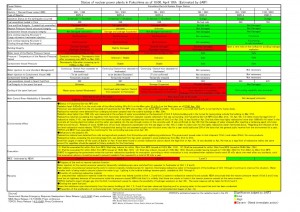
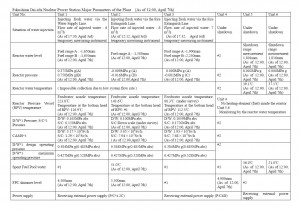
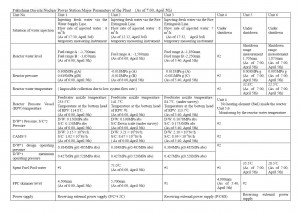
JAIF has released a update (data from 13:30 JST today) and NISA has an update from yesterday(06:00 JST). So there is more than one day between the values, first one from JAIF and the value within () from NISA.
|
Reactor 1 |
Reactor 2 |
Reactor 3 |
| Water level (meter)* |
-1.65 (-1.6) |
-1.6 (-1.5) |
-2.25 (-2.25) |
| Flow rate(liters/min) |
117 |
150 |
116 |
| Core pressure (kPa) |
648 (621) |
– |
112 (126) |
| Containment pressure (kPa) |
155 (160) |
105 (110) |
106.2 (105.5) |
| Wetwell pressure (kPa) |
160 |
– |
174.8 |
| Feedwater nozzle temp (Celsius) |
252.8 (261.5) |
155 |
90.8 |
| Bottom head temp (Celsius) |
118 |
– |
119.4 |
| Containment dose rate (Sv/hour) |
45.5 |
36.1 |
24 |
| Wetwell dose rate (Sv/hour) |
16.5 |
0.981 |
0.955 |
|
|
|
|
| *Distance from top of assembly |
|
|
|
| – broken gauges |
|
|
|
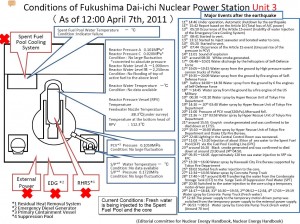
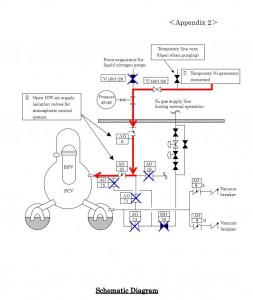
Temperature and pressure in reactor number one core continues to be quite high but containment pressure is well within design margins. Nothing really new with the status of the reactors.
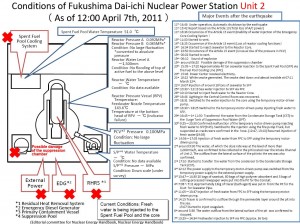
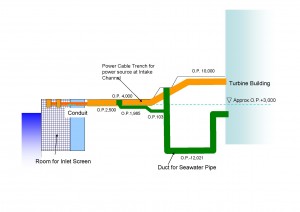
One leak path of radioactive water into the ocean has been identified. It is some kind of pit for cables reportedly close to the sea water inlet for the number 2 reactor. Below is a sketch TEPCO provides.

They have tried both filling the pit with concrete and also filling it with a water absorbing polymer normally used for diapers. The concrete reportedly did not work and no success due to the polymer injection has yet been reported. They are also adding newspaper and sawdust into the tunnel connecting to the pit. All of this is of course temporary measures until one can identify where the leak originates. Whether it is due to the failure of the wetwell reported earlier, or if the valves that are supposed to close the main feedwater lines into the core during an emergency is leaking water into the pipes connecting the reactor to the turbine. Plugging up the pit would at most just slow down the release of radioactive material until the main leak in the containment is fixed. That might end up being exceptionally hard due to the radiation levels. One can’t really weld a leaking crack in the torus with 1 gray per hour dose rates.
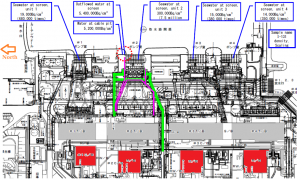
TEPCO is planning to use a large barge in order to get rid of the contaminated water found in the turbine buildings along with pumping it into the surge tanks for the suppression pools. Below is a chart on how they are planning to do it.

It is frustrating to have no idea on what their long term plan is. If the summary of the damage done to the reactors by Murray Miles(written on Rod Adams blog) is correct then it will be exceptionally hard to revive the control rooms. Here is a quote from the explanation:
In going the extra mile to protect from earthquakes, Tokyo Electric put the electrical switchgear in the basement. So they had electrical power after the quake. However the tsunami flooded the basements, and there was no way to pump out the basement. The water obviously shorted out the circuits.
To compound the problem, they routed the wiring for the instruments in the control room through this basement switchgear. Therefore after the flooding, all six plants were without power, without emergency diesel generators, without instrument readings to tell the status of the plants, without lights. I have not seen these two disastrous design failures discussed on television.
We might be looking at months of work to reroute all the cables connecting the instruments and equipment within the cores to the control rooms. I don’t know the minimum amount of equipment and instruments that are needed to put the reactors into cold shutdown, but lets hope its not to much. Until they get internal circulation working within the reactors they will have a problem with leakage from the reactors since they are doing a feed and bleed strategy now. I.e they feed the reactors with water that boil and then bleed the steam out into the containments. The containments of course are not infinite in volume so it is not a viable long term strategy, especially not in the number 2 reactor that has a leaking containment.
It would be very reassuring if TEPCO and NISA could present an outline of what their plan is regarding getting back the minimum needed instrumentation and equipment and what measures have to be done to achieve that and if there is any option in case they can not remove the contamination from the turbine hall basement sufficiently to work there.
TEPCO has managed to get some lighting back into the turbine halls
Checkup on the thyroids of children in the surrounding areas have shown the kids have not been exposed to I-131 over the limits. This is very good news considering that it was I-131 that was responsible for all extra cases of cancer so far detected after the Chernobyl disaster. Radiation levels in the surrounding seems to be on a stable downward trends and all the radioactive materials coming out of the reactors now are leaking into the ocean rather than being dispersed into the atmosphere. It is likely that will continue unless the need for more containment venting appears again.
The two workers that was reported missing after the tsunami hit has been found dead in a turbine building, very sad news.


Links(English)
NY Times Reactor core was severely damaged
Reuters Japan nuclear struggle focuses on cracked reactor pit
Blogs (English)
Depleted Cranium Japan’s tsunami victims upset over nuclear attention
This week in nuclear MOX Fuel in Fukshima Daiichi Adds Little Risk to Public
Nuclear Green Fukushima Dai-ichi: The Good, the Bad and the Ugly
UCS All things nuclear 3 weeks update
Links(Swedish)
SvD Klarar sig Sverige utan kärnkraft?
Expressen Döda arbetare funna vid kärnkraftverk
Aftonbladet Två arbetare hittades döda
DN Utsläppen kommer pågå i månader
DN Expert, Fukushima värre än Tjernobyl
SvD Kärnkraftsarbetare funna döda
Blogs(Swedish)
Eva Flyborg Inte rädda men beredda!
Akkomps blogg Blicka frammåt
Grön horizont 75 ton plutonium?
Radikalen Kommer Tyskland avveckla kärnkraften
Begrundat och plitat Effekter av Tjernobyl i Sverige (Och lite om Fukushima)
Dr Angels blog 100 000 gånger mer radioaktivitet i det läckta vattnet från Fukushima







När skall vi lära oss om energikällornas farlighet?
Published by Michael on April 8, 2011Efter att ha läst Maria Wetterstrands och Lise Nordins utspel i DN kan vi inte låta bli att fundera lite på det där med vissa energi-slags farlighet…
(Notera: nedanstående kan innehålla spår av ironi 😉 )
Efter den stora jordbävningen och tsunamin i Japan så har vi sett hur oerhört känsliga vissa energislag är när katastrofen sker. Återigen har både fossil energi och vattenkraft skördat åtskilliga liv och orsakat stor skada både omedelbart och långsiktigt.
Fujinuma dammen i Fukushima brast under jordbävningen och den efterföljande flodvågen dödade minst 4 personer. I Chiba exploderade och brann Cosmo Oils raffinaderi obehindrat i 10 dagar. Hur många liv som gick förlorade i den inledande explosionen är okänt och vilka långsiktiga effekter på hälsa och miljö den stora branden och dess giftiga utsläpp kommer få vet ingen ännu, men helt klart är konsekvenserna stora och utsläppen har vid det här laget spritts över hela norra halvklotet.
Dessa händelser manar till eftertanke. Hur intelligent är det egentligen att ha samhällen som Boden, Luleå och Umeå utefter fördämda älvar? Vill vi verkligen ha ett raffinaderi ett stenkast från Göteborgs centrum? Mitt svar är nej! Vi måste omedelbart avveckla vattenkraften, till en början de dammar som är ett direkt hot mot svenska städer. Vad många vattenkraftsförespråkare försöker dölja för allmänheten är att utsläppen från detta kraftslag tenderar att följa vattendragen ut i havet och spridas till jordens alla hav. Avsevärda delar av utsläppen dunstar dessutom och sprids med moln över hela jordens yta, stora landarealer drabbas årligen av dessa nedfall, ibland med katastrofala följder. Förra veckans monsunregn i Thailand är ett skrämmande exempel.
Dessutom måste Preems raffinaderi med omedelbar verkan läggas ner. Tror någon på allvar att Preem kommer ta ansvar om raffinaderiet exploderar och Göteborgs stad blir obeboelig för oöverskådlig framtid med cancerepidemier och andra sjukdomar som följd?
Med kärnenergi och andra moderna hållbara energikällor kan vi med lätthet ersätta vattenkraften och oljan. Det är dags att vi tar itu med det nu, innan katastrofen är ett faktum! Ska vi låta olje- och vattenkraftslobbyn stå oemotsagd med sina lakejer inom Miljöpartiet när de propagerar mot de betydligt säkrare energikällorna som kärnkraft? Ska vi låta dom lägga ner säker energiproduktion för att kunna klämma några år till ur gamla förfallna dammar och petrokemiska anläggningar som kan haverera när som helst? Vill vi verkligen förlita oss på över 100 år gammal farlig och föråldrad teknik när det finns säkra och miljövänliga alternativ? Banqiao-katastrofen visade oss redan för över 35 år sedan att vattenkraften aldrig kan vara en säker källa till energi. Trots detta har Sverige ännu inte dragit några slutsatser av denna ofattbara katastrof där vi fortfarande inte vet det totala antalet offer, vi vet bara att det rör sig om hundratusentals oskyldiga som fick sätta livet till på grund av energigirigheten och likgiltigheten hos ett fåtal styrande.
När ska vi lära oss historiens läxor? Vattenkraft och olja är föråldrade kraftslag som tillhör en era som vi måste lämna bakom oss innan vi ser fler människoliv gå till spillo.