Skip to content

Category: Commentary

Did you think renewable power is sustainable? Think again…

“Sustainability” is a buzz-word these days. It is used often and eagerly, especially by opponents of nuclear power and proponents of renewable alternatives. There is an assumption to there that if something is renewable it is also automatically sustainable. There is also an assumption that nuclear power is not sustainable. How surprised people get when they find out that the exact opposite is true…

Let’s take a step back and for once examine what we actually mean by the concept of sustainability.  In this article, we will be focusing on sustainable power production.

What sustainability is not

There seems to be a vague notion out there that something that is sustainable we can start using now and then keep using forever, or that something that is sustainable never consumes any resources. Well even by this faulty definition, renewables are not sustainable. This is because solar panels are not built from sunshine,  nor are wind turbines built from a stiff afternoon breeze. You build them from consumable materials such as steel, copper, neodymium, gallium, arsenic, indium and other sometimes not too common materials. Also they have a finite life span after which they must be torn down and replaced. This means that solar and wind power does consume resources and in the end cannot be used forever.

But that is not the definition of sustainable, so let’s move on.

What sustainability is

“Sustainable development” was defined by the Brundtland-commission report “Our common future in June 1987 as:

…development that meets the needs of the present without compromising the ability of future generations to meet their own needs

Now let’s look at this. Does this say anything about renewables, using the same things forever, or even that using fossil fuels would be a bad thing? No it does not. The report doesn’t even say we cannot deplete a resource.

As for non-renewable resources, like fossil fuels and minerals, their use reduces the stock available for future generations. But this does not mean that such resources should not be used. In general the rate of depletion should take into account the criticality of that resource, the availability of technologies for minimizing depletion, and the likelihood of substitutes being available.

So what sustainability means is this:

  • We have needs, and we must meet them.
  • The future generations will also have needs, and we must not do anything that prevents them from getting these needs met.

People talking about sustainable development often talk about the future. But what they keep forgetting is that development that does not tend to the needs of the present as well, is not sustainable. Sustainable development must meet both current and future needs.

So now that we have established what sustainability actually means, let’s get to work applying it.

Applying the definition of sustainable to the real world

What are our needs when it comes to power? Among all needs, one is reliability.

Reliable power production means that we get have the amount of power we require, the instant we require it. Power is a perishable commodity. Especially electricity must be produced the very second we intend to consume it. If production does not meet demands, we have a power deficit. We do not accept power deficits. Not only is a power deficit annoying, but it can also be very dangerous as we are relying on electricity for a great number of critical applications, such as hospitals, tele-communications, cold food storage and pretty much anything that makes our society modern and thriving. Also power drops on the electrical grid risks damaging or destroying equipment connected to it.

Hence a source of power must be able to deliver as much as we want, the moment we want it or it is not, by definition, sustainable.

Are wind power and solar power sustainable sources of power?

Solar power and wind power are not living up to Brundtland commission definition of sustainable, for that most inane of reasons: when there is no wind, and when there is no sun, they do not deliver power. And by not doing that, they fail our need of reliability.

But surely there is always wind and sun, isn’t there? No, not always. Sun is a no-brainer, because sun does not shine 24 hours per day (except above the arctic circle in the summer but that doesn’t help us in the cold dark winter). So what about wind?
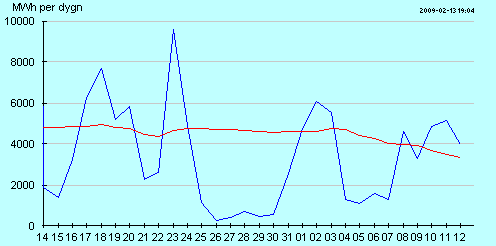
Wind power in Sweden, jan-feb 2009
Reported wind energy production in Sweden, Jan-Feb 2009

The graph above is statistics for wind power in Sweden, fetched from Vattenfall’s page www.vindstat.nu. This page represents day average wind power production in Sweden for 30 days. The reporting plants range all the way from the south tip of Sweden to the far reaching north. The image is a snapshot of the graph taken at February 14, 2009.

The amount of installed wind power, that is to say the maximum power capacity, that reports to this webpage was 695 MW for the 30 days displayed, which is about 85% of all installed wind power in Sweden. This means that theoretical maximum power production in this graph is 16 680 MWh per day. Keeping this in mind, we see that for January 25 to January 30, wind power delivered 2-4% of installed capacity. After that it made a skip up, but less than a week later is was down below 10% again for another four days.

And again we must remind you that this is day average production and does not consider fluctuations during the day. This means that wind power in Sweden at times most likely delivered less than 1% of installed capacity.

This means that development that would rely on renewables such as solar and wind to meet our power needs, would not be considered sustainable unless there was something else that could entirely replace them for low periods. Such replacements do not exist.

Are bio-fuels sustainable?

Bio-fuels is another renewable alternative that is getting much attention. Do they meet our needs? That can be questioned, because while reliability is acceptable, the guarantees of capacity are shaky at best. And even worse is that bio-fuels strike at one of our most basic needs: health and long life. Bio-fuels, just like any other combustible power sources, release gases and pollutants that are harmful to human health. While being mostly neutral when it comes to carbon balance, this does not make the emissions any less harmful to people. Improvements can be made, but it must be asked how many premature deaths we are willing to tolerate before the technology of bio-fuels have been improved to acceptable levels. Hence this leaves the sustainability of bio-fuels in doubt.

Is nuclear power sustainable?

Let’s look at the needs we have, and that the future generations will have:

  • Capacity
  • Reliability
  • Clean air, land and water
  • Health

Does nuclear power fulfill these needs? Yes it does. Nuclear power has a capacity and reliability that is matched only by hydro power and fossil fuels. It does not pollute air, land nor sea in such a manner that we cannot accept it. And it does not threaten health in such a manner we cannot accept it. In fact, the power it replaces, such as for instance coal plants, kills about 2 million people prematurely every year from air pollution. So in replacing that, nuclear power saves lives.

Nuclear waste is an issue, yes. But it is a solvable issue, solvable in such a way it will not impede future generations from having their needs met. The science needed to know how to do that has been available since the 1970’s. It is part needing to gather experience on how to do it, and mostly politics that has kept us from implementing them so far. But for instance the Swedish method for a deep geological repository KBS-3 is at such a level of maturity it may begin being implemented in the near future. And more alternatives for dealing with nuclear waste are being made available as technological development progresses. We have no reason to assume nuclear waste cannot be dealt with in a sustainable manner that meets the definition by the Brundtland commission.

If we use nuclear power, must future generations use it too?

Using nuclear power now does not force future generations to use it. Nuclear plants have a finite life span of about 40-60 years. For renewables like solar and wind, their life span is even shorter. After that, the plants must be replaced. The future generations are free to choose whatever method of production they want for these replacements. They are not locked in by our choice. If they want to use something else, they are free to do so.

And choosing something else, they most likely will. Fusion power has dodged us for some time, but the progress is very promising. The research facility ITER is being constructed as we speak. The follow-up DEMO is on the drawing board. If there are no big snags, work at these plants will be done by 2050, at which time fusion power can go commercial. If we are unlucky, it might be another 100 years before they work out the problems. Being pessimists, we can reasonably estimate that by 2150 at the latest, fission nuclear power, solar, wind and pretty much everything else we use for our base load, can be phased out. This is what the Brundtland commission report speaks of: “the likelihood of available substitutes”.

And even if fusion power never takes place, whatever opponents of nuclear power claim can be used to replace nuclear power now, can most certainly be used to replace it then. If not, their case falls apart anyway and we must keep using nuclear power and make it even more effective.

So does it really matter that we risk depleting our nuclear fuel resources? No, it does not. If we start to reach the end of such resources, something that is not likely to happen by at least 2 000-5 000 years anyway, then future generations may switch to whatever else they want to use. They are not bound by our choices, and as such, the definition of sustainable development is met by nuclear power.

Conclusion

It has been said that the person that stares too far ahead, risks tripping over their own feet. This is true also in this matter. We must not forget that our needs must also be met, and not just the needs of future generations. Otherwise we do not have sustainable development. And sadly, renewables such as wind, solar and bio-fuels do not yet meet these needs. No matter how much we spend on research, we cannot force the sun shine when we want it to, nor make wind blow on demand. Bio-fuels rely on combustion, which we do not know yet how to make non-hazardous to health. Hence they are not sustainable.

Nuclear power however is, as far as we can make out, sustainable.

14 Comments
Sverige är pro-kärnkraft!

I morse, den 13/2, presenterade flera nyhetsmedier nya undersökningar gällande kärnkraftens popularitet [SVD, DN, SVT]. Resultatet är överväldigande, DN:s undersökning visar att totalt 62% är för en nybyggnad. SVT:s undersökning som presenterades idag, visar också att en stark majoritet av den svenska befolkningen är för en nybyggnad av kärnkraften. SVT presenterar inte exakt hur stor denna majoritet är men i bilden nedan kan du se partiuppdelningen i de båda undersökningarna.

Här kan du se hur många som är för en nybyggnad av kärnkraften uppdelade i partitillhörighet. Den stora skillnaden för MP beror förmodligen på hur frågeställningen har varit.

Framförallt är resultatet hos S, V och MP intressant där även en majoritet av S-väljarna är för en nybyggnad. Siffran är något lägre hos V där bara en av fyra är pro men (hör och häpna!) enligt DN är hela 42% av miljöpartisterna för en nybyggnad av kärnkraften. Detta resultat skiljer sig visserligen kraftigt från SVT:s undersökning och beror förmodligen på frågeställningen. DN har först frågat de deltagande: “Är du för eller emot att man bygger nya kärnkraftverk i Sverige?”. De som svarade nej, eller var osäkra, har sedan fått frågan: “Är du för eller emot att man ersätter gamla kärnkraftverk med nya?”.  Staplarna för DN är den sammanlagda summan av de som svarade “ja, x” och “nej/osäkra, ja”. Detta tyder kanske på en vilja att även om man inte vill utöka antalet kärnkraftverk, kan man ändå tänka sig att ersätta de reaktorer som glider över ålderstrecket. Om detta är fallet, är det en mycket positiv signal från miljöpartiets väljare. En signal som säger att även MP kan sätta ansvarsfullhet, realism och sunt förnuft framför förlegade dogmer.

Kul att se är också att stödet inom C är starkt, där en majoritet på 65% är för en nybyggnad. I oktober 2008 visade en undersökning från Novus att 56% av centerpartisterna inte ville bygga nya kärnkraftverk, endast 17% kunde tänka sig att vid behov bygga nytt. Undersökningarna visar alltså också hur viktigt det är att en partiledning går ut och säger vad den tycker. Hoppas att även Mona Sahlin vågar göra detsamma, då skulle vi nog se uppgång i undersökningarna även där. Annars är resultatet ganska väntat där moderaternas, kristdemokraternas och folkpartiets väljare är starkt positiva.

De senaste dagarnas energidiskussion [DN] mellan blocken kanske kan ge oss “kärnkraftnördar” hopp om en blocköverskridande överenskommelse där kärnkraften tillåts överleva och en nybyggnad tillåts. Annars riskerar vi att det som alliansen har genomfört gå till spillo om den röd-“gröna” mixen vinner nästa riksdagsval. I annat fall får man hoppas att alliansen arbetar på riktigt ordentligt så att det kostar för mycket att dra tillbaka beslutet om en ny kärnkraft.

Kärnkraftsbranchen har redan under trettio år levt under ett damoklessvärd, det är dags att ta bort det nu.

7 Comments

Comment regarding corriosion in KBS-3 copper capsules

During 2008, and highlighted in articles this past week, there has been statements that the maximum rate of corrosion of copper in pure water may be higher than anticipated. This is important to the nuclear issue because copper is one of the four barriers of the Swedish Nuclear Fuel And Waste Management Company (SKB) method of storing nuclear waste: KBS-3.

Scientists from The Royal Institute of Technology and Uppsala University Peter Szakálos (KTH), Gunnar Hultquist (KTH) and Gunnar Wikmark (UU) are calling into question statements by SKB that copper is immune to corrosion in pure water devoid of oxygen. This statement is found on page 102 in the SKB report TR-06-22.

 In the absence of oxygen, copper is thermodynamically immune to corrosion in pure water. 

Szakálos, Hultquist and Wikmark claim that in experiments of their own, they have achieved a very high rate of corrosion of copper in pure water if hydrogen is present. The results can be viewed in their Berns presentation from 2008 (in Swedish).

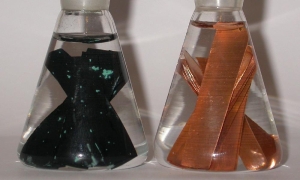
Copper after 15 years in pure water
Copper after 15 years in pure water. On the left, the bottle was closed to everything but hydrogen. On the right, the bottle was closed to everything

At Nuclear Power Yes Please we are – of course – following the matter closely. Part of the foundation for our confidence in nuclear power is the ability to deal with nuclear waste in a safe manner. KBS-3 is a disposal method, one of many, that holds great promise to live up to our demands on safety and not requiring human supervision. It is currently perhaps even the most promising method considering its technical maturity and political feasibility. So if KBS-3 is called into question, this may in an extreme case force us to re-evaluate our position on nuclear power.

However there is a long way to go before we get there.

Even by the words of Szakálos, Hultquist and Wikmark, this is a solvable issue. As such it does not spell the end of KBS-3, nor does it warrant a major rethinking. Szakálos, Hultquist and Wikmark say that modifications that protect the copper capsules from corrosion in a short term perspective, that is to say 1/100’th or less of the repository’s full life expectancy, should solve the issue since it can only happen when the capsules are hot, that is to say only at the very beginning of the storage period.

We also need to remember that the experiments Szakálos, Hultquist and Wikmark performed to achieve the corrosion were very specific and may perhaps not reflect real life subterranean conditions of a deep geological repository. SKB will need to examine if the conditions stated for the experiment can be expected 500 meters down in the bedrock, or if this sort of thing can only be achieved in a laboratory.

Of relevance to that is the fact that SKB has responded and said that they themselves have not been able to reproduce the results of Szakálos, Hultquist and Wikmark, which in turns calls into question the validity of their statements since reproducibility is perhaps the most important quality of any scientific claim.

SKB is also currently conducting an experiment at their Äspö laboratory where they have buried copper capsules in conditions very similar to what it will be in the real KBS-3 repository. These capsules are scheduled to be retrieved next year, which will give us empirical data on how the capsules are affected once buried. Nothing shows us better what can happen than going out and doing it for real.

In summary: while this issue may force SKB to take one extra think before submitting KBS-3 for final review, this still does not constitute an insurmountable hurdle. So far it appears to be solvable. Even Szakálos, Hultquist and Wikmark state that they do not think this issue is a show-stopper. And as such KBS-3 can only become better from this.

Also, on a very positive note, we at Nuclear Power Yes Please are pleased to notice that this criticism has brought KBS-3 into view of the public eye. This is good(!), because very few people have until now been aware of just how far the work on KBS-3 has progressed. Constantly we are hearing people, especially opponents of nuclear power, saying “We don’t know what to do with the waste”. The issue of copper corrosion has shown everyone that we do in fact have a very good idea what to do with it and that KBS-3 is a well researched method that is approaching the point where when it will be implemented for real.

This issue will of course have to be adressed and at Nuclear Power Yes Please we are eagerly waiting to hear what SKB has to say about it. We will continue to monitor this issue with great interest.

And after all: we are on no big hurry. Nuclear waste is a very patient player and will wait for us in intermediate storage while we take the appropriate time to determine what we will do with it. 🙂

Articles:
Mediasammanfattning, vecka 7 – SKB
Kärnavfallet kan läcka ut – Aftonbladet
SKB svarar kritikerna: “Vi är öppna för granskning”

Blog posts:
Vad skall vi göra av kärnavfallet?
Slutförvaring
FRAmtidens energi och konst
Mest kärnkraft i världen
Hets mot folk

1 Comment

Michael i Hallå P3

Idag kunde de nyfikna lyssna till ett program som heter Hallå P3 i just P3. Där kunde lyssnare ringa in och debattera och argumentera för eller emot kärnkraftens varande.

I programmets slutskede fick NPYP’s Michael Karnerfors säga vad han tyckte om folkomröstningen 1980, vad som hände vid TMI 1979 med mera. Programledaren var inte helt insatt i debatten vilket var lite tråkigt. Kul var det dock att Michael mer eller mindre fick det sista ordet i programmet. Tidigare kunde man höra personer från till exempel Grön Ungdom och allmänheten i övrigt uttala sig om kärnkraften. 

Programmet går att lyssna på i efterhand om man klickar sig in på programmets hemsida och klickar på “lyssna”. Inslaget börjar ca 00h 46m 00s och man kan snabbspola dit.

Och grattis Michael, nu är du officiellt “kärnkraftsnörd”, som programledaren så fint uttryckte det.

Micke: Heh, tackar Nils! Frågan är om jag vågar lyssna på detta. 😀

Micke, lite senare: Ok, nu har jag lyssnat på det. Alltid lika “kul” att höra sin egen röst inspelad. Huga…

Ett par missar lyckades jag med. Folkomröstningen för vänstertrafik var inte 1967, den var 1955. 1963 togs beslutet att göra omläggningen, så jag hade rätt i att det tog bara 8 år att köra över folket. Och årtalet 1967 var själva Dagen H.

Jag råkade också kalla Strålsäkerhets-myndigheten för Strålskydds-myndigheten. Förlåt alla ni på SSM som lyssnade.

6 Comments

Study says German nuclear power causes child cancer… or does it?

A German report (summary) on cancer incidence seems to indicate that there is a higher frequency of cancer cases, mainly leukaemia in children, around nuclear power plants in Germany. The report was written at the Federal Office for Radiation Protection in Germany and based on two articles [1, 2].

The report was quickly embraced by the Swedish movement against nuclear power (SNF, Schlaug) and has also created a few headlines in Swedish newspapers (AB, HN).  These newspaper articles claim that people living in the vicinity of Swedish nuclear power plants are worried by this report. Lars Barregård at the Centre for Medical Enviromental Sciences wants to investigate the incidence of leukaemia around Ringhals nuclear power plant. However, he says to HN:  “…the radiation levels are very low and should not be able cause an increase in cancer frequency, though a study can be good to lessen the worries“. (translated from Swedish)

The Swedish Radiation Safety Authority (SSM) however does not consider it important to perform another study in Sweden as such studies have already been conducted with consistent negative results. A study in 1995 found no increase in numbers of cases of leukaemia. Also the number of cases of child leukaemia has been more or less constant at around 60 cases per year over the past 30 years, a period of time which includes the gradual phase-in of nuclear power in Sweden. SSM states that further epidemiological studies trying to blame cancer on nuclear power are not needed. Instead, there is a need of a larger knowledge base and more studies that tries to find the underlying reason for child leukaemia in general [6].

Still this leaves us with the German report. Does it give us due cause to worry? Not really, because in the conclusion of the report, the authors state:

…the present status of radiobiologic and epidemiologic knowledge does not allow the conclusion that the ionising radiation emitted by German [nuclear power plants] during normal operation is the cause.

What this means is that in order for nuclear plants to have caused these cancers, there must be some completely unknown effect in play; some kind of cause that science does not know anything about yet.

They further note that…

This study can not conclusively clarify whether confounders, selection or randomness play a role in the distance trend observed.

…and…

…these estimates are rather inconclusive because they are based on a very small number of cases

This means that they have not been able to rule out that other factors may explain the results, factors such as: carcirogens unrelated to the nuclear plants, errors in the study, or pure chance due to the amount of data being much to small.

Reading further we find that they have not measured the level of radioactivity around the plants or even include any kind of estimate of this:

This study is not able to state which biological risk factors could explain this relationship. Exposure to ionising radiation was neither measured nor modelled

One amusing interpretation of this would be that closeness itself, and not radiation, is a cancer causing agent. That is to say being 100 meters from a non-leaking plant would be more dangerous than being 200 meters from a wrecked one, because distance is what they have looked at, not radiation.

This is perhaps not odd concidering that radiation is not significantly or even measurably higher around these plants. The report concludes (again) that radiation cannot be a factor in this study on account of the additional exposure from nuclear powerplants being staggeringly small.

Annual exposure in Germany to the natural radiation background is approximately 1.4 mSv and the annual average exposure through medical examinations is approximately 1.8 mSv. Compared to these values, the exposure to ionising radiation in the vicinity of German NPPs is lower by a factor of 1,000 to 100,000. In the light of these facts, and based on the present status of scientific knowledge, the result of our study cannot be explained radiobiologically.

A far more serious thing to be remarked is that the second article notes that the study goes against findings of other studies made previously [2]:

….this observation is not consistent with most international studies, unexpected given the observed levels of radiation, and remains unexplained. We cannot exclude the possibility that this effect is the result of uncontrolled confounding or pure chance.

Looking at French studies [4,5], similar to the German one, we see that they indeed could not find any significant relation between cancer incidence and absorbed dose or closeness to a nuclear power plant.

Further reading reveals that they have not been able to process data considering children moving around prior to the cancer notice, nor the importance of lifestyle or whether the time the children spend in their homes is of relevance.

All of this summed up leaves us with a report that in effect states: “We think there might be slightly more cases of child cancer around some nuclear power plants, but we don’t really know why. And in order for the nuclear plants to be the actual cause, instead of something else, 60 years of radiobiological science must have completely missed something here”.

This notwithstanding the Swedish self-proclaimed enviromental movement beats the big drum and claims that it would be “irresponsable to concider constructing new nuclear power plants before it is clear whether children that live around existing plants suffer from conditions like leukaemia more often than the general public” (translated from [3]).

At Nuclear Power Yes Please we find this kind of alarmism to be just as irresponsible. We do not oppose performing epidemiological studies on nuclear power plants because science, openness of information and continuous review is one of the pillars that support our confidence in nuclear power. If anything we would welcome an exhaustive, well conducted study that settles the matter once and for all so we can either go happily about our lives, or get to work on a solution should one be needed.

But to spread fear of nuclear power among the general public without a solid scientific reason is reprehensible, especially with a report that even by its own words state that the results are vague, inconclusive and goes against most previously made scientific studies.

In light of the movement bringing this up just as there are huge political shifts in the view on Swedish nuclear power, possibly lifting the three decade old ban on building new nuclear power plants, we at Nuclear Power Yes Please are left to wonder what the real cause of the alarmism is. Why is the movement against nuclear power bringing this up now? Is it a genuine worry about public health, or is it a desperate attempt by the movement to try to justify their anti-nuclear stance? If it is the latter, we cannot express enough our outrage at such reckless abuse of science in order to try to make a political point.

1: Peter Kaatsch, Claudia Spix, Renate Schulze-Rath, Sven Schmiedel and Maria Blettner. Leukaemia in young children living in the vicinity of German nuclear power plants.

2: Case–control study on childhood cancer in the vicinity of nuclear power plants in Germany 1980–2003. Claudia Spix, Sven Schmiedel, Peter Kaatsch, Renate Schulze-Rath and Maria Blettner.

3: http://www.naturskyddsforeningen.se/natur-och-miljo/aktuellt/?news=7104

4: M.L. White-Koning, D. He’mon and D. Laurier et al.. Incidence of childhood leukaemia in the vicinity of nuclear sites in France, 1990–1998.

5: A.-S. Evrard, D. He’mon and A. Morin et al., Childhood leukaemia incidence around French nuclear installations using geographic zoning based on gaseous discharge dose estimates.

6: http://www.stralsakerhetsmyndigheten.se/Om-myndigheten/Aktuellt/Nyheter/SSM-Tysk-studie-ger-inga-nya-ron/


News articles:
Tysk forskarrapport som borde oroa

Blog entries:
Kärnkraft, barncancer och sannolikhetskalkyler
Ett (o)sannolikt ställningstagande av Centern
Barnleukemi, kärnkraft och Maud Olofsson

17 Comments

Swedish government to lift ban on building rectors

Just this morning: the Swedish government four alliance parties have agreed to work for lifting the ban on building nuclear reactors in Sweden (in Swedish). The ban was introduced in 1980, and was part of the world wide decline in building new rectors for much of the 80’s and 90’s. But now, it may be lifted even before the next Swedish government election in 2010.

The year 2010 incidently was supposed to the year we would not have any more nuclear power in Sweden. Now instead it looks like it’ll be the year for nuclear rebirth, and will continue to hold Sweden as one of the most environment friendly nations on this planet, with record low energy generation emissions per capita.

2 Comments

Atomkraft? Ja! Tack Alliansen!

Här skulle jag just skriva ett långt inlägg om Svenska Naturskyddsföreningens senaste försök att sprida skräck och paranoja för kärnkraft med en undersökning som uttryckligen sade att kärnkraftverken i undersökningen inte kunde sägas ha något med de obeserverade cancerfallen att göra…

…men något annat fångade mitt öga, och då kändes den smutskastande Mikael Karlsson och hans mossiga kärnkraftsmotståndare inte särskilt relevanta längre.

Min förvåning över detta matchas i storlek enbart av mitt leende.

Atomkraft? Ja! Tack Alliansen!

Artiklar: SvD, SvD, SvD, SvDDN, DN, DN, Aftonbladet, Aftonbladet, Aftonbladet, Ny Teknik

/Micke

9 Comments

Per Ribbing ljuger med siffror

Amerikanerna har ett uttryck: “Guns don’t kill people… people with guns kill people”.

Inom den akademiska världen har vi ett motsvarande uttryck: “Figures do not lie, but liars do figure(s)”. På svenska förloras en del av ordvitsen, men det blir ungefär “Siffror ljuger inte, men människor kan ljuga med siffror”.

Detta bevisas i hösta grad i den tirad som Per Ribbing, civilingenjör i Teknisk Fysik från Linköpings Tekniska Högskola, levererar i Barometern. Per försöker på ett överlägset sätt visa oss “siffror” som argument för hans påståenden att kärnkraft är fel. Han ger oss fyra olika siffror som skall övertyga oss att det verksamhetsområde som han är aktiv i: vindkraft, är bättre än allting annat. Och precis som i hans förra insändare försöker han skrämma oss med terrorist-spöket (mer om det här).

Per, från en civilingenjör till en annan, trodde du verkligen inte att någon skulle märka att dina siffror är fel? Tror du det går obemärkt förbi att du tar till halsbrytande habrovinker för att motivera dina hutlösa påståenden?

De första två siffrorna Per försöker imponera oss med är olika kraftverks verkningsgrad, det vill säga hur mycket användbar energi vi får ut av den totala mängd energi som stoppas in i kraftverket (se teknisk notis nedan). Hans argument är att kraftverk med låg verkningsgrad är fel, medan de med hög verkningsgrad är bra. Han förklarar dock inte varför… av anledning som snart kommer att bli uppenbar. Men först låt oss undersöka dessa siffror.

Problemet med Pers påståenden är att den verkningsgrad han anger för vind- och kärnkraftverk är helt fel. Per räknar nämligen inte in den energi som vinden tillför och får därför en fysisk omöjlighet: en evighetsmaskin.  Den teoretiskt maximala verkningsgraden för ett vindkraftverk är 59%, inte 10 000% som han påstår. Våra vindkraftverk idag har en verkningsgrad på ca 50%. (Källa)

Den verkningsgrad Per anger för kärnkraftverken är också helt fel. Per räknar nämligen enbart med utvunnen värmeenergi. Det han inte tar i beaktande är den totala mängden energi som finns i bränslet. I själva verket är verkningsgraden så låg som under 1% eftersom vi utvinner mycket lite av den energi som finns i kärnbränslet.

Och som om dessa faktamässiga fel inte vore illa nog, har Per helt vänt på resonemanget. Det hans siffror bevisar är nämligen att förbättringspotentialen för dessa kraftkällor är helt olika. Vindkraften närmar sig taket. Släng hur mycket forskningspengar du vill på vindkraften och du kommer ändå inte att få mer än ytterligare 20% högre verkningsgrad. Efter det kan du inte klämma mer kraft ur ett vindkraftverk hur mycket du än försöker.

Men om vi däremot utvecklar kärnkraften, då kan vi få effektivitetsökningar på upp till 2500-4000%! Vad tycker du är värt att satsa på?

Som teknisk notis för den intresserade: det Per i själva verket gör är att han friskt och hejdlöst blandar ihop begreppen verkningsgrad och EROEI (Energy Returned on Energy Invested) och jämför den ena med den andra. Självklart är också detta också ett grovt fel i hans resonemang och inte något man kan förvänta sig av någon som klarat av att bli civilingenjör. Linköping, vad pågår vid er tekniska högskola egentligen?!

Nästa siffra Per försöker imponera oss med är 100 000 år, vilket är den tid som vi behöver slutförvara kärnavfall med dagens teknik, (Att vi kan minska den tiden till 500 år låter jag av barmhärtighet till Per vara osagt. Oops! För sent…). 100 000 år låter mycket, men i dessa sammanhang är siffran egentligen futtig. Om han har lagt 100 000 år på bordet höjer jag det budet till 1 700 000 000 år. Det är nämligen den tid under vilket naturens eget experiment i slutförvaring har pågått. Vid en plats som heter Oklo, i landet Gabon, Afrika, skapade naturen kärnavfall för 1.7 miljarder år sedan. Och inte lite kärnavfall heller utan mängder som mäts i tusentals ton, bland annat det ökända ämnet Plutonium som så många går och oroar sig för. Detta låg naket i berget, med vatten flödande rakt igenom det. Var tror du hände med detta kärnavfall?

Absolut ingenting. Kärnavfallet låg helt stilla i berget i ett tusen sjuhundra miljoner år, utan inblandning av människor.

Pers 100 000 år är inte ens en blinkning i sammanhanget. Följdaktligen har företaget Svensk Kärnbränslehantering AB tittat mycket noga på det som naturen lärt oss i detta experiment, och baserar därför förvaringsmetoden KBS-3 på kunskapen.

Sedan försöker Per imponera oss med talet 2, vilket enligt honom är mängden byggnader som anfölls 11 september år 2001. Även detta är fel. Siffran är 3. Han vill nämligen inte att vi skall uppmärksamma att ett tredje plan krashade i byggnaden Pentagon och där orsakade enbart minimal skada i jämförelse med World Trade Center innan det smulades i småbitar. Per vill heller inte att vi skall uppmärksamma att kärnkraftverk är mycket kraftigare byggda än Pentagon.

Redan innan vi kommit såpass långt i att förstöra Pers argument har en fråga uppenbarat sig: varför valde terroristerna att krascha in i kontorsbyggnader istället för 1-4 kärnkraftverk? Om man nu kan orsaka enorm förstörelse genom att krasha ett plan i ett kärnkraftverk, vilket Per påstår, varför gjorde man inte det?!

För att terroristerna var kunnigare än Per. Kärnkraftverk är dimensionerade som bunkrar, bland annat av anledningen att man inte skall kunna rasera dem på det här sättet. Den förstörelse man kan orsaka genom att krasha i ett kärnkraftverk är enbart lokal. Självklart kan man slå ut anläggningen så att den inte längre kan producera ström genom att haverera ställverket eller andra viktiga omkringliggande byggnader. Men man kan inte orsaka ett destruktivt radioaktivt utsläpp. Detta visste terroristerna, så de valde mål där de faktiskt kunde göra någon skada.

Så Per… jag frågar dig igen, från en civilingenjör till en annan: trodde du inte att vi skulle märka att dina siffror var uppåt väggarna fel? Hoppades du att vi inte skulle genomskåda dina bakvända resonemang? Visste inte du att vi skulle kunna se att du ljög med siffror?

Jag får tyvärr ge Per underkänt i kurserna klassisk fysik och retorik. Medan den senare är valfri på LiTH undrar jag sannerligen hur han fick ut sin civilingenjörs-examen om han på allvar tror att vi kan göra makalösa manicker med hjälp av vindmöllor.


Per Ribbings 10 000% effektiva vindmöllor
har en viss likhet med Professorns makalösa manick

/Michael Karnerfors, civilingenjör från Lunds Tekniska Högskola, D-93
(Och jag fick faktiskt 5:a på min tentamen i klassisk fysik. 😀 )

FÖRTYDLIGANDE 090204: Mer exakt vad Ribbing gör: först räknar han ut effektivitetsgrad för kärnkraftverk och kolkraftverk, utan att göra samma sak för vindkraftverk. Sedan, direkt efteråt, räknar han ut EROEI för vindkraftverk, utan att göra samma sak för de tidigare nämnda energislagen. Vad han sedan menar med dessa siffror säger han inte, utan läsaren lämnas att själv försöka få något vettigt ur en jämförelse där hälften av all data saknas! 

Hade detta varit en jämförelse mellan bilar hade han sagt: “SAABen har en bränsleförbrukning på 0.6 l/mil vid blandad körning, och Volvon kostar 295 000 i inköp”. Som läsare undrar jag direkt vad SAABen kostar i inköp och vad Volvon har för bränsleförbrukning, så jag kan jämföra dem… men Per håller inne på det.

8 Comments

(kd) gör en rimlig bedömning av kärnkraftens framtid

Göran Hägglund (kd) skriver på DN Debatt:

Förbudet mot nya reaktorer bör tas bort. Rimligt vore att ersätta befintliga reaktorer med nya. Vi älskar inte kärnkraften men inser att den under överskådlig tid kommer att vara viktig för vår elförsörjning. Vi kan inte räkna med att de förnyelsebara energikällorna räcker till om cirka 20 år då de nuvarande reaktorerna kommer att stängas av.

Detta är nog första gången som vi ser att en svensk politiker verkligen sätter fingret på grundproblemet i den svenska kärnkraftsfrågan: kärnkraft kan inte ersättas med förnybart, för vi har inga garantier att förnybart kommer att räcka till.

Motståndare till kärnkraft hävdar att förnybara kraftkällor, i Sverige då i första hand vind och vattenkraft, kommer att kunna ersätta kärnkraften. Men detta är osäkra kort. Vattenkraften är fullt utbyggd och finns det någon fråga som är heligare i Sverige än kärnkraften så är det älvarna. Det är inte rimligt att anta att vi kommer att kunna bryta exploateringsförbudet av älvarna.

Vindkraft är då ett alternativ. Men vind, om än ungefär lika miljösnål per producerad kilowatt-timme som kärnkraft, har ett inneboende problem: när det inte blåser har man ingen kraft.

En graf över producerad vindkraft i Sverige under 30 dagar. Teoretiskt max är 16 800 MWh/dag
En graf över producerad vindkraft i Sverige under 30 dagar. Teoretiskt max är 16 800 MWh/dag

Bilden ovan är hämtad från vindstat.nu, och motsvarar originalet i skrivande stund. Som mest kan man idag av svensk vindkraft få 16 800 MWh per dygn (bilden går upp till 14 000 MWh).  I går låg produktionen på ca 4% av max; dagarna innan det ännu lägre. Vi vet inte från dag till dag vad vindkraften kommer att producera. Vi vet inte ens från timme till timme. Detta är uttryckligen vad Göran Hägglund skriver: “vi har inga garantier att det kommer räcka till”.

En energikälla som när den själv känner för det levererar så lågt som 3% av installerad effekt är inte pålitlig, och ingeting vi kan bygga ett helt lands kraftförsörjning på.

Och detta är inte vindkraftens enda nackdel heller. Som vi har skrivit om tidigare är vindkraft en mardröm för kraftnäten därför att den är lynnig till sin natur, vilket gör styrning svårt och riskerar att kollapsa elnäten med mycket stora strömavbrott som följd. För att klara av att basera vår kraftförsörjning på vindkraft måste vi i princip slänga ut hela elnätet och bygga nytt. Och hur dyrt kommer det att bli? Med tanke de bökiga miljökrav som gäller att få bygga nya kraftledningar så är det frågan om detta ens är möjligt med mindre än att kraftbolagen nästan ges fritt spelrum att köra över lokalbefolkningen vid ledningsdragning. Om inte enklare regler och förkortad tillståndsprocess kommer till stånd kan kraftbolagen aldrig ta på sig den kostnad som det innebär att förnya elnätet.

Vi kan alla önska oss en framtid där vi inte behöver kärnkraftverk, eller klarar oss utan vattendammar som riskerar att kollapsa och dränka hela städer. Men vi måste också vara realistiska och börja räkna på saker och ting för att se om de räcker till eller inte. (kd) har nu gjort det. Och siffrorna ljuger inte: förnybart har inga garantier för att klara vår kraftförsörjning. Alltså måste vi inkludera ett alternativ som klarar av att leverera, samt lever upp till miljökraven: kärnkraft.

Sålunda välkomnar vi detta beslut av (kd). Kärntekniklagen 5§ måste ändras. Förbudet att bygga nya reaktorer i Sverige skall tas bort, för att säkra vår energiförsörjning.

Läs även om detta i SvD, Aftonbladet.

Comments closed

The Forsmark incident was not Chernobyl

This is the second blog response to a blog entry made by The King of the country Lagom. The previous entry dealt with his claims that opinions are sacred and how one must not speak up against them. This entry will deal with the purely factual errors of his claims about nuclear power.

The King of Lagom claims that an incident that took place in 2006 at the Forsmark nuclear power plant could have escalated into a Chernobyl-type accident.  Well… first he says that, and then he says it could have become something entirely different. If this sounds confusing it is because the King of Lagom probably doesn’t quite know what he’s talking about but rather builds this statement on misconceptions about what actually happened at Chernobyl and Forsmark respectively. So let’s examine the incidents and compare.

The 1986 Chernobyl accident

April 26, 1986. The night shift at reactor 4 at the V.I Lenin Nuclear power plant, 20 km north west of the town of Chernobyl, Ukraine, has been ordered to do a test. Due to operator error, they accidentally poison the RBMK-type reactor which makes it almost grind to a halt. They don’t know why the reactor is giving so little power though because they were mostly coal plant workers, inexperienced with nuclear power, and oblivious to things such as nuclear poisoning. The shift boss, determined to finish the test, gives orders to proceed, telling the operators to perform actions that go against several operating rules of the reactor. This puts the reactor in an unstable state.

When the test is finished and they shut down the reactor, a fatal flaw in the reactor’s control system causes the reactivity to spiral out of control, making it output between ten to onehundred times normal thermal effect. The water in the reactor flash boils and the enormous steam pressure blows the building apart. A few seconds later a chemical explosion, when water that has been split into hydrogen and oxygen burns, rocks the complex again. The reactor is on fire for ten days, resulting in a large plume of radioactive fallout.

There are several factors that allowed this accident to happen.

First it was operated by poorly educated personnel, in a political system where safety came second. In the Soviet Union, you did not rise to attractive jobs like this one by being good at your craft but by kissing up to the communist party. Also you did not stay at jobs like this by speaking up against safety issues, because such things made the party look bad. For instance this particular test was supposed to have been run years ago when the plant was commissioned. But since it failed back then, it had to be done again, this time in secret from the Soviet nuclear regulatory authorities.

This shouldn’t have been a problem. But the second reason the accident could take place was the deliberate violations of the operating rules of the reactor. The test was to have taken place when the reactor was outputting at least 700 MW; they started when it was at 200 MW. They were not allowed to withdraw more than a certain number of control rods; they withdrew almost all of them. They were not allowed to increase water flow in the reactor past a certain amount when operating at low power; they did. They were not allowed to disengage the safety systems that would have shut down the reactor when they did any of the aforementioned; but they did indeed disable them.

All of this made reactor come into an unstable state that let its most critical design flaw come into play: the positive void coefficient. The void coefficient is a quality in a nuclear reactor that tells us what happens when it gets too hot. When coolant boils in a reactor that has a positive void coefficient, the nuclear reaction increases. This makes the reactor hotter, which makes more water boil. This speeds up the reaction more, making it even hotter… and so forth. And not only was the void coefficient in the RBMK-reactors of the Chernobyl plant positive, it was also dangerously high.

Finally, because the reactor had no real core vessel, nor any concrete containment, the force of the explosion wrecked the building completely. A fire started in the hundreds of tons of graphite that was in the reactor. Also the building itself that was supposed to have been made from fireproof material, was not, and the debris caught fire as well.

This is what is known as a criticality accident, when the nuclear reaction goes out of control. In this case it produced so much heat that the entire reactor blew up from all the thermal energy. This accident was not a nuclear meltdown.

The 2006 Forsmark incident

July 27, 2006. At the switch-yard for Forsmark-1, an electrical arc causes a short circuit which leads to the unit being disconnected from the power grid. This is serious as the plant relies on power to keep all pumps going.

If a nuclear reactor does not have working pumps, eventually the cooling water in the reactor will boil away. If that starts to happen you must engage the emergency core cooling, reserves of water kept for this very purpose. If this too fails and the reactor boils dry, the heat can be such that the reactor core becomes damaged, popularly called a meltdown. This can happen even when the nuclear reaction has been stopped because decay heat continues to be produced a few hours after a reactor is shut down as very short-lived nuclear waste falls apart. This is what happened at Three Mile Island in 1979.

So when a nuclear plant becomes disconnected from the power grid, the reactor is shut down and on-site diesel generators start to provide power for the pumps to deal with the decay heat, and this was what happened at Forsmark 1. However in this case, two out of the four diesel generators did not start, disabling two safety trains out off four. But the two remaining diesel generators were more than enough to drive the pumps. Hence the reactor was cooled and emergency core cooling was not necessary. The reactor shutdown proceded normally.

Similarities?

No, there are no similarities between these two incidents. The Chernobyl disaster was the case of a criticality accident that caused an extremely violent explosion that completely wrecked the reactor core; the building it operated in; burned for days. The Forsmark incident was the case of  slight degradation of safety features while the reactor and its cooling operated normally. The cooling system was operational the whole time; the emergency cooling did not need to be engaged; the reactor core was not damaged; the reactor tank was in no way threatened; the over one meter thick reactor contaiment remained perfectly safe. And fire? Naw… there is no graphite in Forsmark-1. Water handles that job instead.

So when the King of Lagom says that the Forsmark incident could have become another Chernobyl, he is wrong. There is no way that Forsmark-1 or any of the other Swedish nuclear reactor could undergo the process that led to the explosion in Ukraine in 1986. And this is not just because we employ people that know what they are doing; care about safety first; follow procedure; don’t do things behind the back of the nuclear regulatory authorities. No, the most important reason why a Chernobyl-type criticality accident cannot happen in Sweden is the reactors themselves. Because unlike the RBMK-reactors of the Soviet Union, our boiler- and pressurized water reactors do not have a positive void coefficient. We did it the opposite way, so that when water starts boiling in the reactor, the nuclear reaction slows down because of inescapable laws of physics. It’s nature’s own choke collar on nuclear reactions.

Conclusion

The RBMK-type of reactor was employed only in the Soviet Union. The international community is working hard to get the twelve RBMK’s that are still in operation closed. Even though I’m a nuclear friend I’m not an idiot, and as such I am very glad that one of the remaining RBMK’s. Ignalina-2, will be shut down in 2009, meaning that Lithuania no longer operates them. Now we just need to get Russia to shut down theirs and we’ll finally be rid of this blight.

When discussing nuclear safety, anyone that uses Chernobyl as an example of what could go wrong in nuclear reactors is ignoring reality. The BWR/PWR reactors of the world hold about as much in common with the RBMK-design of the Soviet Union as does slavery to common work; as does forced child soldiers to commissioned adults. There just is no comparing them as they operate differently down to subatomic level.

The Forsmark incident was not, and could not have become, another Chernobyl. This is not an opinion, it is physical reality.

/Michael

ADDENDUM: As I posted a link to this entry in his blog,  and called him on his Ad hominem attacks, he first approved the entry, then he cencored it and claimed that I was violating his right to have “free opinions”, i.e. he doesn’t want anyone telling him he’s wrong.

2 Comments