Skip to content

Category: Commentary

Utmaning till kärnkraftsmotståndare

Translation of the earlier post to Swedish

Det har alltid förbryllad mig (och jag tror att jag kan tala för oss alla inom NPYP) att någon kan vara anti mot någon energikälla. Anta till exempel att någon säger sig vara anti-kemisk energi, då skulle den logiska uppföljningsfrågan förstås vara “vilken typ av kemisk energi?”. Helt enkelt eftersom det finns så många olika sätt man kan utvinna kemisk energi på, allt från att elda kodynga i hyddor till förbränningen av bensin i din bilmotorn till högteknologiska gasturbiner till dynamit. Snubben som yttrade påståendet har antagligen inte ens tänkt på de distinktionerna när han gjorde sitt uttalande. Men låt oss säga att han funderar lite grann och specificerar att han är anti-kol. Även detta uttalande kan ifrågasättas. Uttalandet måste följas av en hel del villkor för annars är det idiotiskt. Om han är anti-kol på grund av luftföroreningar, borde han då inte ändra sig om man blir kvitt föroreningarna? Om någon utvecklar ett filter som minskar utsläppen till obetydliga nivåer, är kol då ok enligt honom? Logiskt sett borde han tycka det. Om han är anti-kol på grund av den oerhört destruktiva kolbrytning, skulle han ändra sig om miljövänligare brytningsmetoder utvecklades? Killen är förmodligen egentligen “anti luftföroreningar” eller” anti smutsiga gruvor”, inte anti kemisk energi eller anti kol. Han har bara aldrig brytt sig om att försöka specificera eller förstå vad för egenskaper hos kemisk energi han egentligen motsätter sig.

Detsamma kan sägas om vilken energikälla som helst, det finns det ingen rationell anledning att vara emot en energikälla i sig, snarare är man emot en viss oönskad effekt som uppkommer på grund av den nuvarande tillämpningen av en energikälla. Vi NPYPare är inga kolfantaster, men jag vågar svära på att om det fanns bra lösningar på problemen med kol, då skulle vi inte motsätta oss dess användning. Det finns ingen anledning att vara mot bruket av en energikälla om dess problem har lösts.

Fördelen med att gräva djupt och ange exakt vad man egentligen motsätter sig är väldigt konstruktivt, för det öppnar upp möjligheten att söka efter lösningar! Om någon bara säger att de är anti vindkraft så dör diskussionen ganska snabbt utan att ha kommit någonvart. Om personen i stället anger att buller från vindkraftverk är problemet, då kan diskussionen svänga in på möjliga lösningar för att minska buller. Alla vinner på det! Det finns ingen anledning att vara fruktansvärt känslomässig och klamra sig fast vid en “anti-något” idé så hårt att man blockerar alla slags givande diskussioner och blundar för lösningar.

Det viktigaste att diskutera är alltså vilka egenskaper hos en viss energikälla som gör att du motsätter dig den och och hur den kan förbättras så att du inte längre har några invändningar. Det mest frustrerande med kärnenergidebatten är att man aldrig tycks nå den punkten. Fråga ledande miljöaktivister den frågan och de kommer att häva ur sig 58 olika ursäkter utan att vara det minsta intresserade av eventuella lösningar.

Om någon är mot kärnkraft på grund av avfallsproblem så säger vi “Ok, men vad menar du exakt med avfallsproblemet och vad är det med avfallet som du anser vara så destruktivt?” Om du besväras av möjligheten att avfallet kommer att skada framtida generationer så kan vi börja diskutera hur man säkert kan förvara eller förstöra avfallet. Om du är anti kärnkraft eftersom du besväras av säkerheten, då är vår motfråga “hur säkert är säkert nog och hur ska vi uppnå det?”. Uppenbarligen måste det finnas en nivå där en verksamhet anses vara tillräckligt säker, annars skulle personen i fråga aldrig kliva ur sängen och gå till duschen av rädsla för att halka och dö.

Men diskussionen slutar alltid som sagt innan den nått denna punkt. “Anti-personer” verkar i regel aldrig vara intresserade av lösningar på de problem de nämner och för det mesta kan de inte ens specificera vad problemet är från första början. Det gäller inte bara för kärnkraftsdebatten, man ser precis samma tendenser i alla typer av diskussioner där det finns en tydlig anti-sida. Anti genteknik, anti bilar, anti kött, anti utforskning av rymden, anti vad som helst! Det verkar vara väldigt svårt för människor att släppa den trygga känslomässiga bindning som uppkommer när man är kraftigt mot något och istället inleda en meningsfull diskussion om problemen och lösningar. Det är alltför lätt att bara vara emot något, det är väldigt mycket svårare att faktiskt söka lösningar!

Så för att försöka vrida kärnenergidebatten i en mer givande riktning så skulle det vara fantastiskt om några kärnkraftsmotståndarna kunde ange vilka villkor kärnkraft måste uppfylla för att vara en godtagbar energikälla. Tro det eller ej så har även vi sådana villkor. Jag tror till exempel inte att någon av oss vill se fler RBMK byggas (den typ av reaktorn som Tjernobyl tillhörde) och personligen har jag ganska högt ställda krav på hur kärnenergi ska utvecklas på lite längre sikt för att vara en acceptabel energikälla. Jag är inte anti kärnkraft, men jag är verkligen anti mot vissa sätt att utvinna kärnenergi.

För att sammanfatta utmaningen:

Vilka villkor måste kärnkraften uppfylla för att du ska godta kärnkraften som en acceptabel energikälla?


14 Comments

Examining some old Fukushima news

An old news article is circulating around that states that 68 tons of fuel has melted in reactor number 1 and that it was close to breaching the bottom of the containment. The article is several months old but for some reason I have seen it pop up again on facebook so I though it is worth examining the article briefly. In particular I want to examine this statement.

Only 37 centimeters of concrete remains between the fuel and the vessel’s outermost steel wall in the most damaged area, TEPCO said.

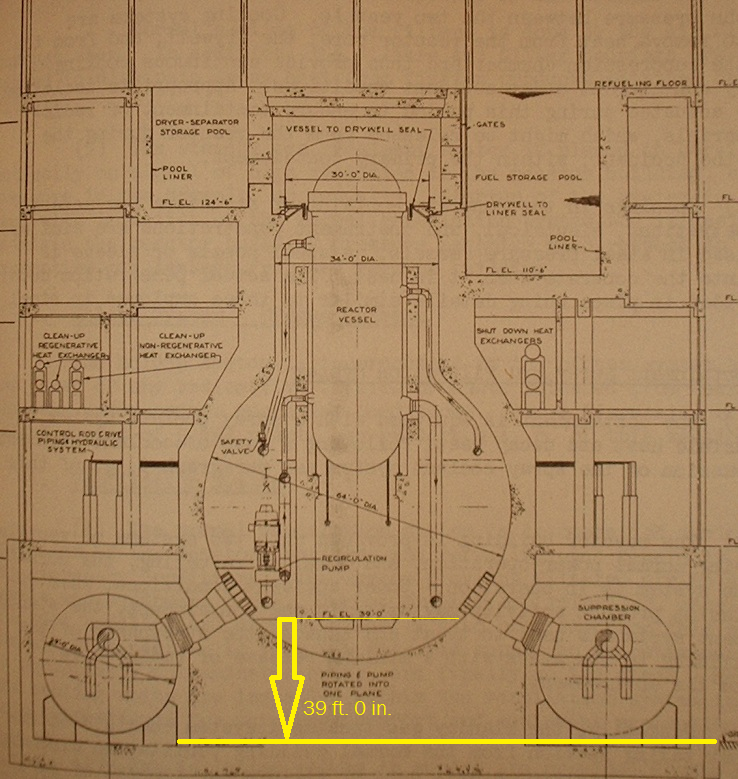
This wording is repeatedly used by anti nuclear sources to imply that a much worse disaster was very close to happening. What the articles fail to mention however is that there is A LOT more concrete between the ground and the molten core. The reactor building itself is a very thick concrete structure. Will Davis, on his excellent blog Atomic Power Review, talked about this the first time the news about the number one vessel failure showed up last November. Some of what he wrote is worth repeating and I hope he doesn’t mind me repeating it here and also posting a picture from his blog.

The NHK report indicates a melt depth of about 2.1 feet(64 cm, my note /Johan). The distance to the ground is roughly eighteen times this depth from the dry well interior floor to grade. Below is a drawing from WASH-1082 which I’ve marked to show the distance from the dry well floor to the grade outside, which on the particular plant shown is 39′ 0″(11.8 meters, my note /Johan). I do not presently know the exact measurement at Fukushima Daiichi No. 1 but it is likely within ten percent of this measurement… meaning that in the worst case that TEPCO is describing, by its own data, the core material may have melted only about as much as 5% of the distance to the grade.

I encourage everyone to read the rest of his blog as it is by far the best information source for the Fukushima accident.


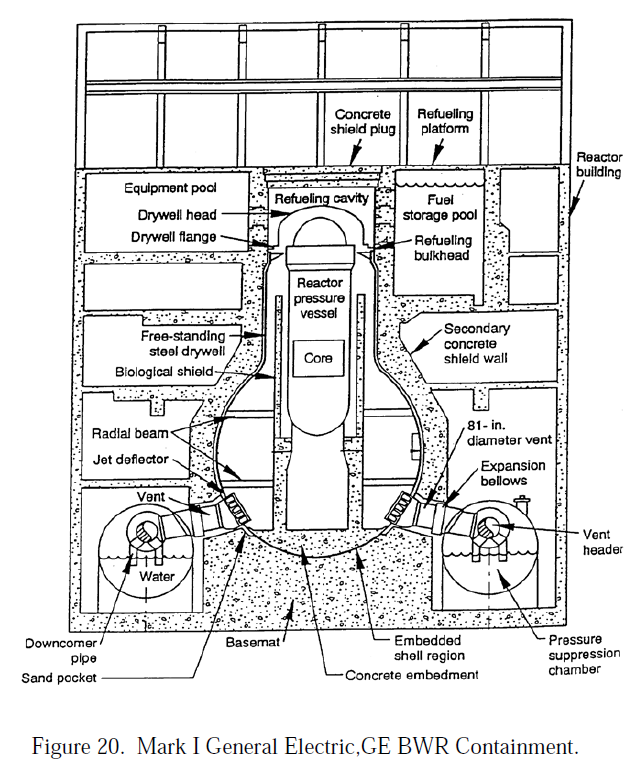
I also want to add this picture of the mark I containment that schematically shows the thick concrete even more clearly! Picture found at the blog “The capacity factor”.

So we see that there is a tremendous amount of concrete below the shell of the containment structure. The hints and suggestions that the core would only have to melt another 37 centimeters for a unnamed disaster to take place is obviously false. In reality the shell of the containment is integrated into a thick concrete structure and the molten core would have to melt through several more meters, likely around 10 meters, to get out of the reactor building itself.

The cleanup of the containment is going to be a very hard and messy job, much worse than the cleanup of TMI was. But the core is still a long long way from the ground.


/Johan


Comments closed

Challenge to nuclear opponents

It has always mystified me (and I think I can speak for all of us in NPYP) that someone can be anti-something when it comes to energy. Lets suppose for instance that someone declares himself to be anti-chemical energy, the logical follow up question to the fellow would of course be “what kind of chemical energy?”. The question is logical because there are so many different ways one can extract chemical energy, everything from burning cow dung in huts to the engine in your car to high tech gas turbines to dynamite. Our friend there probably didn’t even think of those distinctions when he made his statement, but what if he did? Let’s say he rebukes by stating he really means that he is anti coal. Even that statement can be challenged, it must by necessity be conditional otherwise it is moronic. If he is anti coal because of air pollution, then would he change his mind if there was a solution to the pollution? If someone developed a filter that reduced pollution levels to insignificant amount is fossil fuels then ok? Logically he should think so. If he is anti coal because of the immensely destructive coal mining, would he change his mind if environmentally sound mining practices where developed? The guy is presumably actually anti air pollution or anti dirty mines, not anti chemical energy or anti coal. He just never bothered to go through the chain of reasoning to understand what he really opposes in chemical energy.

Same can be said of any energy source, there is no rational reason to be against the energy source itself, rather one is against some undesirable effect due to the present application of the energy source. NPYP are not fans of coal by any means, but I dare say that if there was solid solutions to its problems, then none of us would oppose its use. There just isn’t any justifiable reason to oppose it if the problems are solved. There is no other way to rationally look at energy production.

The advantage with digging deep and specifying exactly what one is actually opposed to means opening up to the possibility of finding solutions! If someone simply state that they are anti windmills then the discussion pretty much ends right there. If the person instead states that the noise from windmills is disturbing then the discussion can turn to possible solutions to reduce noise. Everyone wins on that! There is no reason to be horribly emotional about the whole thing and cling to an anti-something idea so hard that one blocks any fruitful discussion and becomes blind to solutions.

A discussion goes no where until one gets to the core of the argument, which is, what properties of a specific energy source makes you oppose it and and how can it be improved so you no longer oppose it?

The frustrating thing in the nuclear debate is that the discussion never seems to reach that point. Ask leading environmentalists that exact question and they will squirm like a worm on a hook.

If someone specifies that they are opposed to nuclear energy due to the waste problem. Fine we say, but what exactly do you mean by the waste problem and what effect does the waste have that you find repulsive? If you are bothered by the possibility that the waste will hurt future generations, then lets discuss how to safely dispose of the waste. If you are anti nuclear because you are bothered by the safety of nuclear installations, then specify what level of safety is safe enough (obviously there must be a level where an activity is considered safe enough, otherwise the person in question would never get out of bed to shower for fear of slipping and dying) and lets discuss how to reach that.

But the discussion always ends before reaching that point because the “anti person” generally never  seems to be interested in solutions to the posed problems and they are usually not even able to state clearly why they consider the issue as a problem in the first place. This is not only valid for the nuclear debate, one sees the same tendencies in all kinds of discussion where there is a clear anti side. Anti genetic engineering, anti cars, anti meat, anti space exploration, you name it! It seems very hard for people to go past the simple emotional attachment of being against something and instead engage into a meaningful discussion about the issues. It is too easy to just be opposed to something, it is damned much harder to actually find solutions.

So to move the nuclear discussion into a more fruitful direction it would be enlightening if some nuclear opponents could specify what conditions nuclear would have to fulfill to be an acceptable energy source. Believe it or not even we have such conditions. I don’t think for instance anyone in NPYP wants to see more RBMK reactors built (the type of reactor at the Chernobyl plant) and just to speak for myself I have quite strict demands on what nuclear energy should be in the long run to be an acceptable energy source. I am not anti nuclear, but I am certainly anti towards some ways of extracting nuclear energy.

To summaries and to state the challenge again clearly.


What conditions would have to be fulfilled for you to consider nuclear an acceptable energy source?


26 Comments

The world has forgotten the real victims of Fukushima

I just had to make a quick post about this excellent article.

The world has forgotten the real victims of Fukushima

It was at this point, at around day three, that I realised that something had gone seriously wrong with the reporting of the biggest natural disaster to hit a major industrialised nation for a century. We had forgotten the real victims, the 20,000-and-counting Japanese people killed, in favour of a nuclear scare story.

/Johan

2 Comments

Weekend reading

Activity is not very high here lately so I though I would provide you all with some nice weekend reading material.

First is the article “Energy as the ultimate raw material” by the nuclear energy pioneer Alvin Weinberg. Weinberg used to think of the big picture and this article showcases that. He outlines a few approaches to a asymptotic state of civilization, a state where humanity is using resources at a rate that is practically infinitely sustainable. In such a state humanity uses a lot of energy in order to produce the necessary raw materials from common rock, seawater etc.The article is from 1959 but well worth reading even today.

The second article is a blog post from Will Davis over at Atomic Power Review, “Vogtle COL approval vote indicates perspective on “nuclear renaissance”. I selected it because in it Will describes some the various reactors that where developed during the first decades of nuclear energy. In my opinion it speaks volumes of how restricted the view of nuclear energy has become, nuclear power today is pretty much identical to light water reactors, but that is just a fluke of history and some day tinkering with other designs will charge on at full speed again.

As the third article I give you Gismags “Feature: Small modular nuclear reactors – the future of energy?”. Aside from a few glaring technical errors or statements that doesn’t make a whole lot of sense, it gives a good overview of the developments going on with small modular reactors.

I also end the post with a small section from Freeman Dysons book “Disturbing the universe”. A fantastic book by a fantastic scientist! Any spelling errors are mine since I wrote out the paragraphs below.

The fundamental problem of the nuclear power industry is not reactor safety, not waste disposal, not the dangers of nuclear proliferation, real though all these problems are. The fundamental problem of the industry is that nobody any longer has any fun building reactors. It is inconceivable under present conditions that a group of enthusiast could assemble in a schoolhouse and design, build, test, license and sell a reactor within three years. Sometime between 1960 and 1970, the fun went out of the business.

The adventurers, the experimenters, the inventors, were driven out, and the accountants and managers took control. Not only in the private industry but also in the government laboratories, at Los Alamos, Livermore, Oak Ridge and Argonne, the groups of bright young people who used to build and invent and experiment with a great variety of reactors where disbanded. The accountants and managers decided that it was not cost effective to let bright people play with weird reactors. So the weird reactors disappeared and with them the chance of any radical improvement beyond our existing systems.

We are left with a very small number of reactor types in operation, each of them frozen into a huge bureaucratic organization that makes any substantial change impossible, each of them in various ways technically unsatisfactory, each of them less safe than many possible alternative designs which have been discarded. Nobody builds reactors for fun anymore. The spirit of the little red schoolhouse is dead. That, in my opinion, is what went wrong with nuclear power.

– Freeman Dyson


/Johan

Comments closed

Kärnkraft + Konst = Sant

Ett av PopAtomic Studios förslag på hur man kan dekorera kyltornen på ett kärnkraftverk. Klicka på bilden för att se det tråkiga grå originalet.


Enligt Folkkampanjens ordförande Solveig Ternström så är kvinnor som har en positiv inställning till kärnkraft inte riktiga kvinnor. Denna åsikt uttryckte hon klart och tydligt i SVT Debatt under den första veckan av Fukushimakatastrofen i mars 2011. Det här är bara en av många demoniserande bilder som vissa kärnkraftsmotståndare försöker klistra på oss som inte delar deras syn på kraftslaget: Vi är män, teknokrater, röstar alltid höger, kallsinnigt beräknande, bryr oss inte om miljön, köpta av kärnkraftsindustrin, onda, osv (vi har under det senaste året även blivit kallade avsevärt värre saker än detta). Eller så är vi bara lite korkade eller vilseledda och förstår inte de stora sammanhangen

Därför är det alltid välkommet med exempel som bryter mot denna bild. Idag tar vi upp konstnären Suzy Hobbs Baker som grundat projektet PopAtomic Studios (se även deras Facebooksida), vars syfte är att sprida information om energiformen kärnkraft med hjälp av snygga och informativa (och ibland provocerande) postrar, logos, konstverk och dekorationer. Deras bilder är fria att distribuera så länge som man anger var de kommer ifrån, och Suzy och hennes vänner är alltid öppna för förslag till nya alster.

Så vad är det som driver henne till denna verksamhet? Man kan sammanfatta det som så att hon fick tillfälle att ifrågasätta den farliga bild som uppmålats för henne i skolan, och kom fram till att den inte stämde med verkligheten. Så hon vill försöka bemöta den bilden med hjälp av sitt konstnärskap. Men hon förklarar det hela så mycket bättre på egen hand, nedan är ett TEDx-talk som hon nyligen höll. Och ja Solveig, Suzy är inte bara konstnär, hon är kvinna också.

Youtubeklippet är taget från denna länk.

Här är ett par andra weblänkar av och om Suzy Hobbs Baker:

8 Comments

Good news of 2011 in review

2011 was in many ways a depressing year for nuclear energy. The Tōhoku earthquake and tsunami that caused the Fukushima accident changed many things. Germany’s political leaders went into unreasonable panic and Merkel immediately ordered the shut down of 10 reactors and soon followed that up by a decision to reinstate the previous nuclear phase out plans. With a bit of humor one can state that the Japanese Tōhoku earthquake and tsunami permanently shut down more reactors in Germany than it did in Japan. Switzerland also decided on a phase out plan that is in many ways similar to the phase out plan Sweden was following for many years. Maby the swiss will look at Sweden and learn how badly it worked, only time will tell. Fukushima also temporarily put a break on the rapid nuclear build in China and the future of nuclear in Japan is very unsure.

But this blog post is not about the bad things that happened in 2011, instead we will look at the good things that happened! Here comes a partial list of things that makes us all raise our glasses in cheers of a promising future.

The biggest good news is the rationality that most countries showed after the Fukushima accident. Germany’s panic didn’t spread and most countries that had plans to expand, renew or start a new nuclear fleet has publicly stated they will stick to the plans. In China, without a doubt the most important country for new nuclear projects, their ambitious program has only been downsized slightly and the focus has been shifted towards generation 3 reactors like AP1000 rather than the indigenous generation 2 designs. Plans in the US seems to be going straight ahead after the recent approval by NRC of the AP1000 design and the developing countries are one by one embracing nuclear as a clean and safe energy source for the future. We applaud the maturity most government have shown despite the, at times, ridiculous media coverage.

The year has been an exciting one for small modular reactors (reactors with an electric power less than 300 MW). NuScale was brought back from the brink of bankruptcy by an hefty investment from the engineering company Flour, one of the largest engineering firms in the US. The NuScale design is quite interesting and innovative and I encourage everyone to check out their homepage and have a look. Babcock and Wilcox and their 125MWe mPower design seems to be steaming on right ahead with a cooperation announced with TVA to build 6 reactors at their Clinch river site. The first unit is supposed to be constructed by 2020 and we hope that ambitious time plan will hold up. All depends on the ponderous NRC review process.
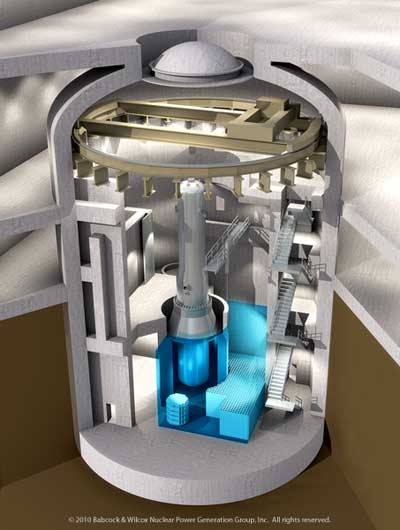
B&W’s mPower within its containment structure

Westinghouse doesn’t want to be left in the dust on the small modular market and they presented their own design this year, abandoning their earlier IRIS modular project. The new small reactor is about double the size of mPower at 225 MWe. The whole reactor will be sited underground (a common feature of many small modular reactors) and construction time is projected to be 18 months.

China, not surprisingly, also has a modular PWR in the works, a 100-150MWe design, I haven’t read much about it but it is going to be an interesting fight on what modular PWR will hit the market first. If I was to make a bet then I bet on the Chinese, due to the slow pace of NRC. But mPower sure looks promising and B&W has long experience with submarine reactors which should speed up their development process significantly.

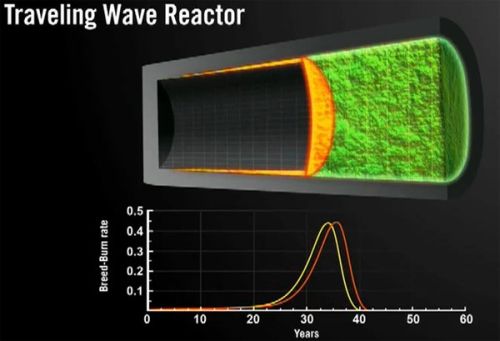
All modular reactors however aren’t light water reactors. There are also several generation 4 designs in the works and news have popped up on several of the during 2011. Bill Gates have several time made the news discussing the traveling wave reactor concept that is being developed by Terrapower, with Gates as one of the biggest investors. The latest information is that Gates was in talks with China about the reactor. The traveling wave concept is a cool one, the basic idea is that one has a fairly large core where most of it is subcritical and composed out of depleted uranium. In the center, or at one edge of the core depending on design, one “ignites” the core with a load of highly enrichment uranium. The area closest to the critical zone will slowly get it is depleted uranium converted to plutonium and become critical while the starting critical zone slowly gets depleted.  The whole thing is a fast spectrum reactor with liquid metal coolant so it is capable of breeding. In this fashion a criticality wave travels through the reactor over a time span of say 50 years, continuously producing power. The appeal of the design is that one can basically bury the whole thing, push the on button and then walk away and let it produce power for decades without any need for refueling or major maintenance. The reactor is still in the basic design stage at this point in time and god knows what roadblocks Terrapower will stumble upon. But it is very heartening to see a man like Gates involved and if China gets interesting things can move on quickly.
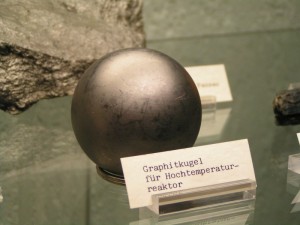
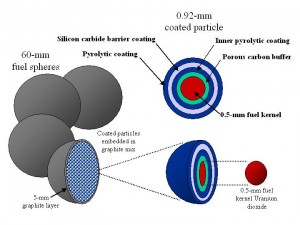
When talking about China, China is already building a generation 4 modular reactor, the Chinese version of the pebble bed reactor. I worked for a year with Pebble bed reactors and it is a very interesting type of reactor. They don’t have the high fuel utilization of fast breeders but they have plenty of other perks, most of all it’s passive safety. A pebble bed reactor is as close to idiot proof as even the most gifted idiot can imagine. The fuel in a pebble bed reactor consists of tiny particles of uranium surrounded by thin but extraordinarily sturdy layers of silicon carbide and pyrolytic carbon. All these particles is compressed into a ball together with a bunch of graphite and this ball is then surrounded by another layer of graphite to make a pebble about the size of a tennis ball. To fuel the reactor one throws in a whole bunch of these balls into a cylinder that is made out of even more graphite. The whole thing is cooled by blowing Helium through it. What makes this reactor so safe is the thermal intertia of the whole system, the extreme durability of the fuel particles and the very strong negative feedback.
If the temperature of the reactor goes up all the neutrons getting slowed down in the graphite will get slowed down slightly less, this makes fission a bit less probably for each time a neutron hits a uranium atom and the fission chain reaction dies. However we all know that even though fission has ceased, heat is still being generated by decay products and this is where the thermal inertia comes into play. The reactor is pretty much a immense volume of graphite with some fuel particles in there. All that graphite can soak up huge amounts of heat and the whole core is very large in size so there is a lot of surface area to radiate away the heat. Combined this means that even if the cooling systems fail completely the equilibrium temperature of the system, due to decay heat production, will be far less than the temperature required to compromise the fuel particles. One can pull out all the control rods, shut down the cooling systems, go for a 2 week vacation in the Maldives and then return to a intact and naturally shut down reactor. All that is needed to resume operation is to just turn on the cooling again. No damage to system, no catastrophic meltdown, no electric systems needed at all for emergency situations. If the Fukushima reactors, or Chernobyl, or TMI had been pebble beds nothing at all would have happened. Pebble bed reactors also has more versatility than light water reactors due to the fact that they produce much higher temperature heat. The massive industrial heat market then opens up for nuclear energy and it is a market that is larger than the electricity market. The Chinese pebble bed reactor is a potential game changer that one should follow carefully.
More exciting developments in China is the grid connection of Chinas fast experimental reactor. It is a tiny reactor at 20 MWe but it is a strong sign that China is not leaving any stone unturned in their strive for nuclear dominance. The follow up to this fast reactor will be the construction of two BN-800 fast sodium cooled reactors China is buying from Russia with planned construction start in 2013. All the talk of generation 4 reactors being sci-fi is obvious nonsense.

Perhaps the most intriguing news during 2011, at least to me, was the launch of a very high profile Chinese project to develop a molten salt reactor using a thorium fuel cycle. In 20 years they expect to have a commercial molten salt reactor running. So far China has been very secretive with any kind of details about the project. There are many ways to make a molten salt reactor and we are eagerly awaiting any information. But some industry insider information I have heard tells me the project is a big deal politically and already to big to be allowed to fail. I am greatly looking forward to finding out more about the project and reading the first papers they publish. One can only hope they won’t keep it all secret for long but the fact that they dont participate in the generation 4 cooperation regarding the molten salt reactor hints that they want to do this all by themself. The molten salt reactor is perhaps the most promising of all the generation 4 designs, it is however also the design with the most question marks attached to it.

A even more surprising development is the attempts by General Electric to launch their sodium cooled fast reactor design in Sweden and the UK. It is surprising because it shows a lot of confidence in their design and it would be very interesting if one got built in Europe. Sweden is an unlikely market since it would (unfortunately) not fit the general plan in Sweden to treat spent nuclear fuel as waste instead of a resource. For the same reason I doubt the idea will get approval in the UK, but one can always hope.

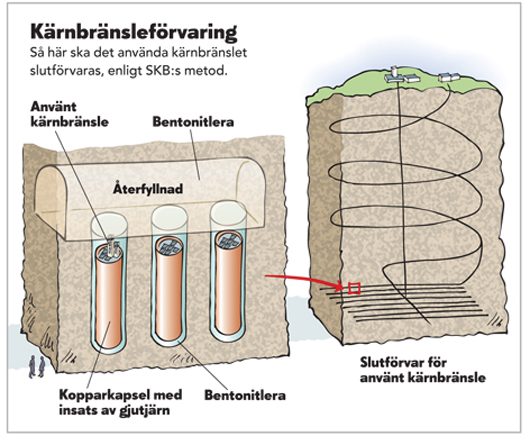
As far as waste goes developments are happening in Sweden. The company in charge of developing and building a repository (SKB) for the Swedish spent nuclear fuel has progressed to the point that they have handed in an application to start building the repository. If built this would be the first civilian repository in the world and the second repository in operation. The first repository in operation is the american Waste Isolation Pilot Plant that is used to store military transuranic waste (elements heavier than uranium). One can only hope that once the Swedish repository is in action the old mantra “there is no solution to the nuclear waste problem” by the anti nuclear crowd will finally be silenced. But they didn’t go silent after WIPP started so I guess that is to much to hope for. The swedish anti nuclear NGO’s like Naturskyddsföreningen and MKG are fighting SKB tooth and nail now when they are on the verge of loosing the waste fight. Spreading FUD wherever and whenever they can.
Those are a small selection of the good news from 2011 that I can remember of the top of my head. Many other things have of course happened, like the approval to build one more reactor in Finland and the developments in the Czech republic, Poland and many other countries. If I have missed some big happy news please let me know in the comments!

Hope all readers of this blog will get a splendid 2012!

Johan
6 Comments

New year’s resolution: 12 reasons to love nuclear power in 2012

Hello nuclear friends everywhere, and a big hello to our antagonists as well… hope you all had some great holidays these past days.

Here is a new year’s resolution from Nuclear Power Yes Please:

In 2012, we will give you 12 reasons to love nuclear power

Here’s how it’s going to work: at the beginning of every month we will give the headline for a reason to love nuclear power. During the month we will be authoring an article that details everything behind the reason with links, referenes, diagrams, illustrations and the logic behind the argument. By the end of the month, the article will be given a permanent link on the website that you can reference whenever you want and use the material.

So… kicking off, here’s reason number one:

Nuclear power saves lives

In Feburay 1, the article for this will be presented, along with the next reason.

Happy New Year everyone!

Comments closed

3 strikes and you’re out! Sherman & Mangano does it again…

Join the chanting!

Once again the would-be world savers Janette Sherman (MD) and Joseph Mangano (something) are pushing for another round of scaremongering dressed in a scientific coat. They have got their nonsense about increased US infant mortality due to Fukushima published in a peer-reviewed journal. This time they have extended their faulty study and extrapolated the effect for the entire US. Lo’ and behold, 14 000 deaths so far, they claim! The article, published in the International Journal on Health Services, can be found here. For a bit more easy reading, the press release here will probably do.

We will not spend too much time on scrutinizing this study, and others are already on to it, for instance Michael Moyer in Scientific American, and Barbara Feder Ostrov in Reporting on Health. Furthermore, S&M have not made any amends for their first two faulty attempts (our comments here and here), and since the new article follows the same line of reasoning, we can only condemn them for trying to push the same lousy trick a third time. This is political activism from anti-nuclear icons, it is not science.

Joseph Mangano shows the size of his remaining credibility

From the media releases about this, we find some interesting statements by Mangano in Medpage Today:

In a telephone press conference, Mangano said the finding is a “clarion call for more extensive research.”

But he told MedPage Today that the researchers can’t rule out factors other than the Fukushima radiation that might have accounted for the excess.

“There are probably a variety of factors that could be linked to this excess of 14,000 deaths,” he said. “But it does raise a red flag.”

This is indeed a clarion call. It is a call for celebrities like Alex Baldwin and Christie Brinkley to start contemplating what kind of nut-crack that they support financially. And it does raise a red flag, the umpire raises the red flag after three strikes. Sherman & Mangano, you’re OUT!

Other posts in various media on the same subject

  • 2011-12-16: Eric McErlain on NEI Nuclear Notes, “Note to Reporters: Be Sure to Fact Check Joseph Mangano, Janette Sherman and Robert Alvarez”
  • 2011-12-19: Eric McErlain on NEI Nuclear Notes “Joseph Mangano Contradicts His Own Press Release on Fukushima Research”
  • 2011-12-20: Rod Adams on Atomic Insights, “Mangano and Sherman have released another bogus study seeking to scare people about radiation”
  • 2011-12-20: Barbara Feder Ostrov in Reporting on Health “Fukushima: Alarmist Claim? Obscure Medical Journal? Proceed With Caution”
  • 2011-12-20: Michael Moyer in Scientific American “Researchers Trumpet Another Flawed Fukushima Death Study”
  • 2011-12-20: Will Davis on Atomic Power Review “Radiation deaths in US due to Fukushima Daiichi: Nope.”
  • 2011-12-21: Barbara Feder Ostrov in Reporting on Health“Fukushima Fallout and Infant Deaths: International Journal of Health Services’ Vicente Navarro Responds”
  • 2011-12-21: Linda Carroll on MSNBC Vitals blog “Experts dicount claims of U.S. deaths from Japan radiation”
  • 2011-12-21Nuit Blanche blog “Pre-publication Peer Review and Lazy Science Reporting”
  • 2011-12-23: Eric McErlain on NEI Nuclear Notes, “Dr. Robert Emery Disputes Joe Mangano’s Findings on Radiation and Fukushima”
  • 2011-12-23: Eric McErlain on NEI Nuclear Notes“Dr. Robert Peter Gale’s Statement on the Mangano-Sherman Report on Fukushima Fallout”
  • 2012-01-08: Alfred Körblein in Strahlentelex Nr. 600-601, scrutinizes the study and finds serious flaws, “14.000 Tote in den USA?” (in German)
  • 2012-01-11: Josh Bloom writes in Forbes, “Garbage In, Anti-Nuclear Propaganda Out: The 14,000 Death Fukushima Lie”
6 Comments

Brittiska miljöpartiet rensar i de egna leden, dags för svenska organisationer att göra detsamma

Vi noterar i dagarna en artikel som publicerades den 21 November i den brittiska tidningen The Guardian, där Chris Busbys pillerförsäljning uppmärksammas. I artikeln, skriven av George Monbiot och Justin McCurry, redovisas de organisationer och websiter kring Busby som på sistone börjat sälja piller med mineraler som sägs rensa ut radioaktiva ämnen ur kroppen. Ett antal forskare inom olika ämnesområden avfärdar metoden och Busbys uttalanden som grundlösa och absurda.

Det hela började efter att Chris Busby i september lagt upp ett filmklipp på Youtube (här är filmen, och här är vår nedskrivna text av vad han säger) där han pratar om piller som de skall distribuera till självkostnadspris åt barnen i Fukushima. Artikeln i The Guardian visar tydligt att man säljer dessa piller till ockerpriser, tvärtemot vad Busby hävdar. Notervärt är även att vissa av websiternas länkar för donationer leder till ett konto i Wales kopplat till Busbys organisation Green Audit.

Chris Busby har tidigare varit vetenskaplig rådgivare åt det brittiska Green Party. Men nu tycks partiet äntligen ha insett att han går för långt, och distanserar sig från honom och hans senaste uttalanden.

Vi välkomnar detta uppvaknande och hoppas att de svenska organisationer och politiker som brukar frottera sig med Busby nu tänker om. Den bristfälliga forskning och de alarmistiska uttalanden han gör inom diverse olika ämnesområden har inte mycket med verkligheten att göra, och de som fortsätter hänvisa till hans studier undergräver sitt eget förtroendekapital.

En av artikelförfattarna, George Monbiot, har idag (22 november 2011) lagt upp lite mer information om Chris Busby på sin blogg (här).


/Nuclear Power Yes Please


Länkar:

Länkar till våra tidigare blogg- och foruminlägg om Chris Busby

4 Comments