Skip to content

Tag: Fukushima

Examining some old Fukushima news

An old news article is circulating around that states that 68 tons of fuel has melted in reactor number 1 and that it was close to breaching the bottom of the containment. The article is several months old but for some reason I have seen it pop up again on facebook so I though it is worth examining the article briefly. In particular I want to examine this statement.

Only 37 centimeters of concrete remains between the fuel and the vessel’s outermost steel wall in the most damaged area, TEPCO said.

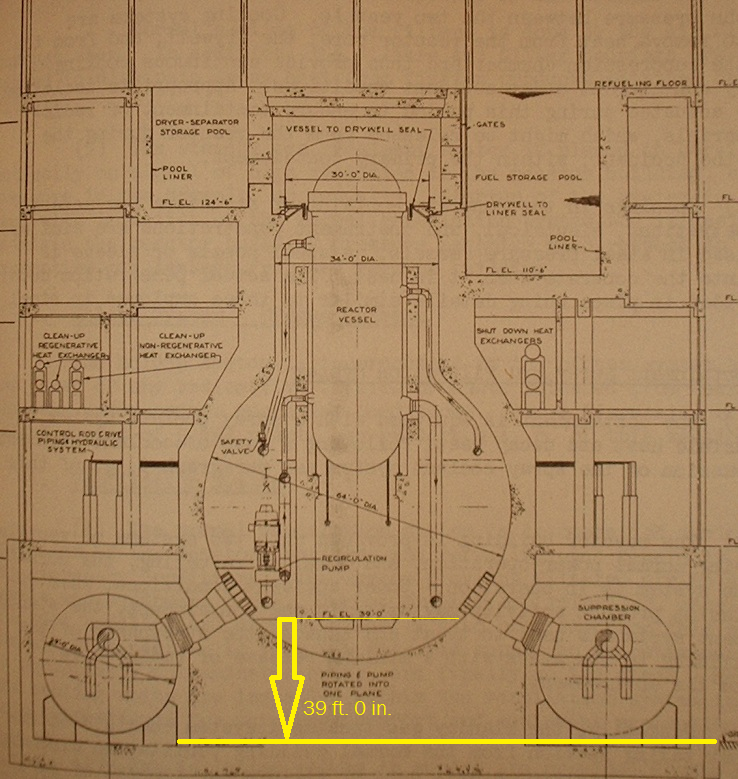
This wording is repeatedly used by anti nuclear sources to imply that a much worse disaster was very close to happening. What the articles fail to mention however is that there is A LOT more concrete between the ground and the molten core. The reactor building itself is a very thick concrete structure. Will Davis, on his excellent blog Atomic Power Review, talked about this the first time the news about the number one vessel failure showed up last November. Some of what he wrote is worth repeating and I hope he doesn’t mind me repeating it here and also posting a picture from his blog.

The NHK report indicates a melt depth of about 2.1 feet(64 cm, my note /Johan). The distance to the ground is roughly eighteen times this depth from the dry well interior floor to grade. Below is a drawing from WASH-1082 which I’ve marked to show the distance from the dry well floor to the grade outside, which on the particular plant shown is 39′ 0″(11.8 meters, my note /Johan). I do not presently know the exact measurement at Fukushima Daiichi No. 1 but it is likely within ten percent of this measurement… meaning that in the worst case that TEPCO is describing, by its own data, the core material may have melted only about as much as 5% of the distance to the grade.

I encourage everyone to read the rest of his blog as it is by far the best information source for the Fukushima accident.


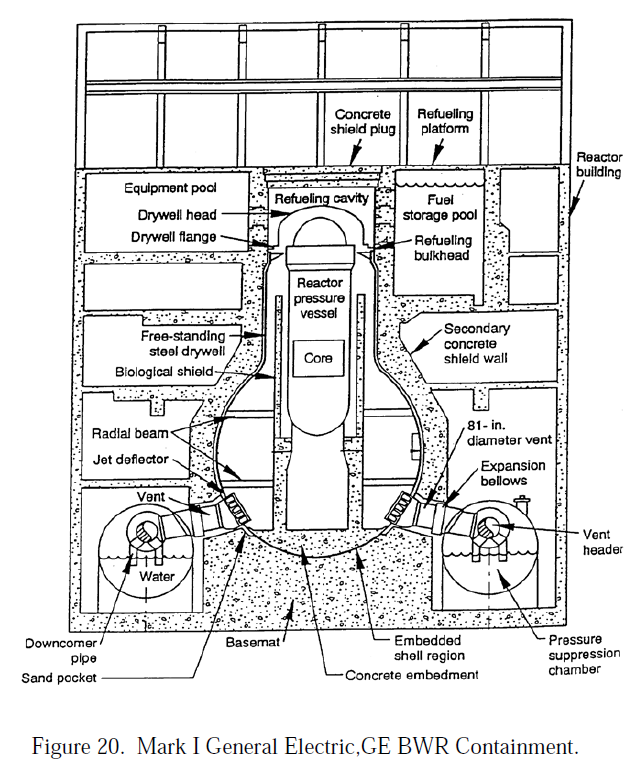
I also want to add this picture of the mark I containment that schematically shows the thick concrete even more clearly! Picture found at the blog “The capacity factor”.

So we see that there is a tremendous amount of concrete below the shell of the containment structure. The hints and suggestions that the core would only have to melt another 37 centimeters for a unnamed disaster to take place is obviously false. In reality the shell of the containment is integrated into a thick concrete structure and the molten core would have to melt through several more meters, likely around 10 meters, to get out of the reactor building itself.

The cleanup of the containment is going to be a very hard and messy job, much worse than the cleanup of TMI was. But the core is still a long long way from the ground.


/Johan


Comments closed

Welcome Fukushima progress

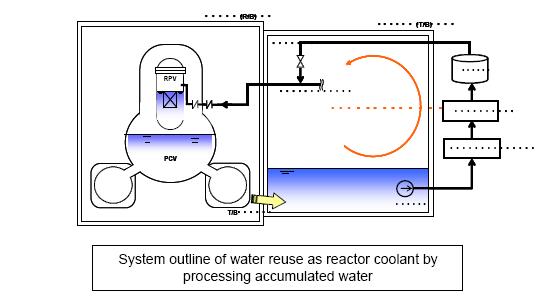
We are now over 3 months into the Fukushima accident, progress is creeping along at a steady pace. Since our last update there has been lots and lots of new and I won’t try to cover it all. The biggest news I want to share now is that TEPCO has gotten some kind of recirculation cooling working, it was reported today by Will Davis at Atomic Power Review(by far the best blog to keep an eye on for Fukushima news, I highly recommend to read it).

In short water is leaking out of the containment buildings into the turbine buildings, the water is pumped from the turbine buildings into the water treatment facility, then from there its pumped back into the reactor. Its like I described in the last update on may 18th (shown on the picture below) and one of the steps in the plan TEPCO released that month.

If everything goes well now the volumes of contaminated water will start to creep down, a proper toast is in order!

Another fairly recent news is that NRC announced that the spent fuel pools in Fukushima never went dry. That really calls into question Chairman Jaszco’s recommendation for a larger evacuation zone for american citizens in Japan than what the Japanese authorities had decided.

There has also been a lot of bullshit flying around about the situation in Fort Calhoun due to the river flooding around the nuclear power plant. Claims about goverment cover ups, Russian authorities warning about disaster etc. I haven’t bothered to look more in detail into it yet, but so far the reactor has both working diesels and connection to the external grid and quite a bit of margin before the river even comes near to flood over the flood protections. Here is a good post by Neutron Economy about the situation.

Why I’m not worrying about Fort Calhoun (and you shouldn’t either)


Links(English)
Rod Adams Ted Rockwell – Fukushima: It’s Not About Radiation, It’s About Tsunamis
NEI Nuclear Notes Friday Update
World Nuclear News Fukushima cover on its way
The Neutron Economy Expected Doses Over a Year and Evacuation of Fukushima Towns
Will Davis How the Misinformation Superhighway affects Nuclear Energy
Will Davis JAIF Public Opinion Poll Data


Links(Swedish)
Med örat mot rälsen Kärnkraften igen
Kultur Ska vi glömma Fukushima?
Seppo Laine Mycket värre än man kunde tro


Status for each reactor

/Johan

4 Comments

Day 68: Video of work at Fukushima and a encouraging PDF

TEPCO has released a video that shows work being done at the Fukushima plant. Very interesting to watch.

One gets a real sense for the devastation the tsunami inflicted while watching that clip.

TEPCO also recently released this PDF file that gives an overview of work being done. I will add some pictures from it:

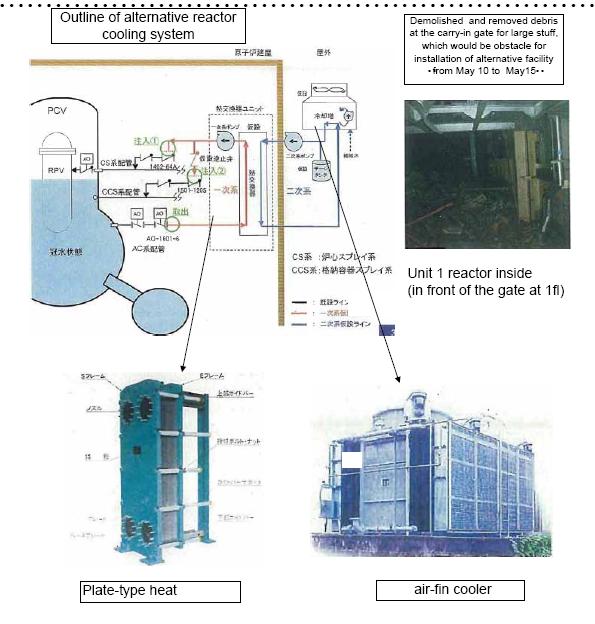
In the above picture one can see how they plan to rig up the new heat exchangers for reactor 1. Within the reactor building, but outside the containment, they will put a water to water heat exchanger. They will pump water from within the containment through this heat exchanger, where it transfers the heat to a secondary circuit that in turn flows to a heat exchanger outside of the reactor building that dumps the heat to the air. This is the original plan TEPCO had before they realized the full extend of the damage to the number 1 core and containment, so it is not sure they will progress as described. But the secondary heat exchanger and its piping is already being built.

Tepco also shows the above picture on how they plan to reuse leaking water from the containment as cooling for the reactor. It is not clear how the two plans are connected to each other. I would assume the second plan is the one that is going to be used instead of the first plan. Instead of taking water directly out of the containment they will use the existing leakage paths, purify the water and pump it back into the reactor.

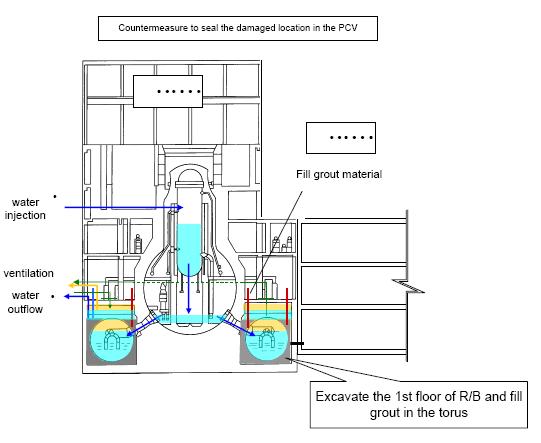
For the number 2 reactor shown above the main problem is to stop the leakage from the suppression pool. They plan to excavate the reactor building in order to access the room where the suppression pool is housed and then fill the entire volume with grout. Considering that (probably) the suppression pool is leaking at number one as well then maby this plan will be implemented there as well (just my speculation).

Both in unit 2 and 3 are they planning to reuse the leaking water in the same manner as in unit 1.

In the rest of the document they give some basic information on how they plan to clean the massive amounts of contaminated water that exists on the site, some details on the protective building they want to build around the reactors and how to prevent more contamination of soil, water etc. Well worth scrolling through, massive work is certainly ongoing at the site and it seems TEPCO has a solid plan that they are implementing.  Of course more surprises will without a doubt pop up during work, but it looks promising. We are still waiting for more in depth information on the situation of the number 2 and 3 reactors.

English blogs:
All Things Nuclear TEPCO Says Core of Unit 1 Melted
Atomic Power Review Fukushima Daiichi update, Weds. morning 5/18

English News:
New York Times Venting Failure in the Nuclear Reactors at Fukushima Daiichi
Reuters UK nuclear power gets green light

/Johan


6 Comments

Day 67: Complete meltdown of the number 1 core

During the last days a lot of news has been released by TEPCO. TEPCO has released this presentation that gives more details of the events that took place in the number 1 reactor from the beginning of the earthquake up until now. To summarize the content of the presentation.

  • The water level gauge has been giving wrong readings, the reading has been stating that the water level is about 1.7 meters below the top of the fuel assemblies. In reality the water level has been 8 meters below the top of the fuel assemblies, this means the entire length of the fuel has been uncovered completely.
  • TEPCO now assumes the RCIC system failed after the tsunami (another news release indicates it was manually shut down!!)
  • 16 hours after the earthquake the entire core had suffered a meltdown and all of it dropped down to the lower part of the pressure vessel.
  • The temperature readings on the vessel indicate that the core is still mostly within the vessel and adequately cooled.
  • Some parts of the core is suspected to have melted small holes in the bottom of the containment, which explains why they could not increase water level despite increasing pump rate.

They don’t mention the reading of the pressure gauge that indicates the vessel pressure is about 14 atmospheres. I was personally fooled by this reading and assumed the number 1 vessel is in better shape than the number 2 and 3 reactors. The question is what readings can be trusted at all.

Due to this new information on the status of the reactor TEPCO has decided to scrap the original plan to flood the containment up to the level of the fuel assemblies. Since all the fuel is now located at the bottom of the vessel there is no need to flood the containment that high.  The containment is also confirmed to be breached and water leaking out of the it like in the case with reactor number 2.

Another theory for the explosion in the number 4 reactor building has appeared. The videos from the pool show that it is largely intact and no major fuel damage can be seen. That means it seems unlikely hydrogen from a zircalloy+water reaction in the spent fuel pool can be the cause of the explosion. Instead TEPCO now believes hydrogen leaked into the number 4 building from a shared ventilation system with the number 3 reactor.

TEPCO is going to do more complete analysis of the status of reactor 2 and 3 and the information will be released within days. It will be interesting to see if the RCIC system (see this blog post for a description of the system) worked in the other 2 reactors and, if it did, to what extent it mitigated the consequences of the station blackout.

Work is progressing on all fronts to build a enclosure around the number 1 reactor, to build a water processing plant, create more redundancy in the electricity supply, clear the area of debris and to pump away the junk water from the turbine halls and trenches. IAEA as usual reports the release of radioactive material and dose rates.

The Fukushima accident has unfortunately seen its first death with a 60 year old worker that lost consciousness  while working on a drainage system to the radioactive waste storage. He was brought to a hospital but could not be revived. So far there is no report that the death was related to radiation.


News English:
WNN Fukushima fuel melt confirmed
WNN Theory for Fukushima Daiichi 4 explosion
WNN Revisions to Fukushima restoration roadmap

Blogs English:
Depleted Cranium Worker Dies at Fukushima Nuclear Plant
Atomic Power Review Core totally demolished at Fukushima Daiichi No. 1

Blogs Swedish:
TEM funderingar <Är kärnkraft förnybart?
Den blinde Argus Kärnkraft och rädsla
Supermiljöbloggen IPCC: Förnybart kan ersätta fossila bränslen
Fourfact Blinkar jätten?
Skattepolitik och samhällsfilosofi Inga elbilar i Sverige om Tyskland stänger kärnkraften?
Ann-Kristine Johansson Kärnkraftsdiskussion
Nina Drakfors Japan, kärnkraftshaveriet fortsätter och kräver strålningsdödstal
Supermiljöbloggen Amerikansk kärnkraft dåligt rustad för katastrofer

/Johan

Comments closed

Day 58: Dose rates climbing in the number 2 wetwell

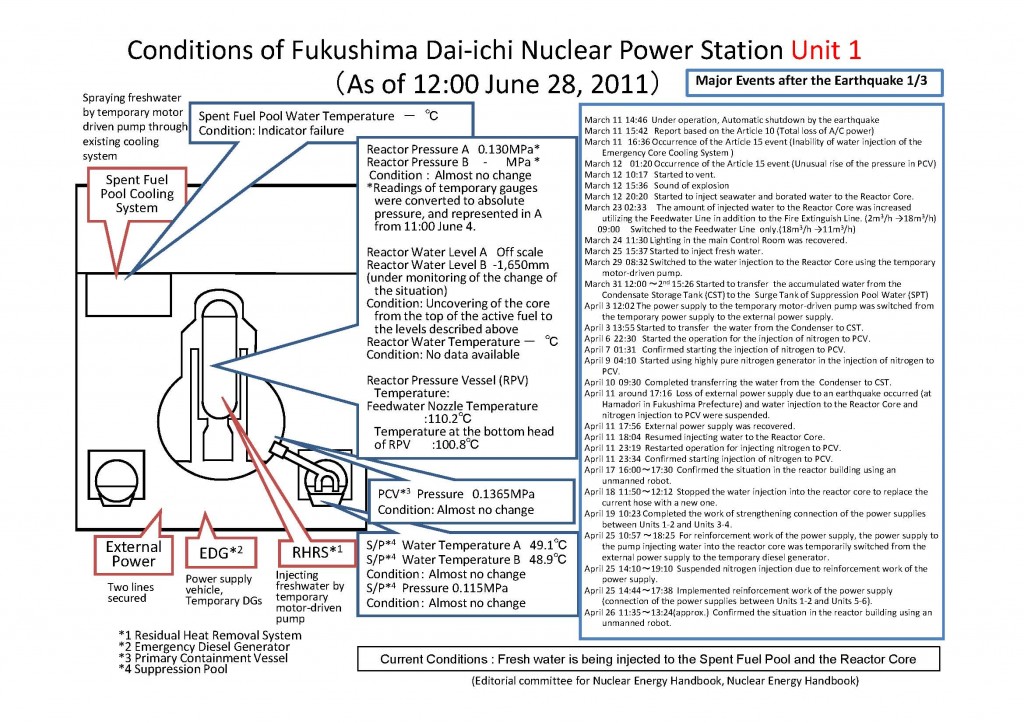
Another week has passed and more steps have been taken to get the situation under control. Lets start with the usual reactor status table  made out of NISA data:


Reactor 1 Reactor 2 Reactor 3
Water level (meter)* -1.7 -2.1 -2.15
Flow rate(m3/min) 8 7 9
Core pressure (kPa) 1390
Containment pressure (kPa) 120 60 102
Wetwell pressure (kPa) 110 183.2
Feedwater nozzle temp (Celsius) 119.8 115.6 202.1
Bottom head temp (Celsius) 96.9 151.9
Wetwell temperature (Celsius) 51.4 66.8 40.0
Containment dose rate (Sv/hour) 22.7 12.2
Wetwell dose rate (Sv/hour) 1.1 148 0.480
*Distance from top of assembly
– broken gauges or missing data

Everything looks pretty stable except the wetwell dose rater in the number 2 reactor. It has increased to well over 100 Sv/hour from 37.1 in the last update I made (i wrongly wrote 0.371).  I haven’t been able to follow the news so closely the last week so I have not seen if this has been mentioned in any TEPCO press release. Below is a graph of the increase. If anyone know of any action done on the number 2 reactor, starting the 3 or 4th of may please write a comment to this blog post.


A air filtration system has been connected to the reactor building of reactor number 1. The purpose of it is to get airflow through the building and clean out the air activity by filtrating the air. It is hoped that it will be enough to allow workers to enter the building and work safely without getting to much dose.

Kyodo reports that TEPCO plans to send in workers on monday in order to measure dose rates within the building. Seems strange that they would send in people when they have already used robots once for that purpose.

A longer video clip of the number 4 spent fuel pool can be seen over at Atomic Power Review. It doesn’t appear to be very damaged.

The big news of the week is that the prime minister of Japan has asked Chubu electric to shut down its Hamaoka nuclear power plant. Hamaoka has 3 operational nuclear power plants, all of them quite new. Started at 1987, 1993 and 2004. The newest one is a ABWR and would presumably have state of the art eartquake protection. The reason for the prime ministers request is a estimate that the site  has a high probability to be hit by a 8.0 earthquake within 30 years. If the reactors indeed can not handle such a quake then the closure request is rational. But it does smell a bit like political posturing at this point. There is no legal precedence for such a situation and it is not clear if Chubu electric has to obey the request.


Links(English)
WNN Filters for Fukushima Daiichi 1

Blogs(English)
Atomic Power Review Japan updates: Fukushima Daiichi, Hamaoka
NEI NEI Weekly Update on Fukushima Daiichi – 5/6/1

Blogs(Swedish)
Effekt Monbiot brottas med sig själv
Genusnytt En KARL ska väl tåla lite strålning…
Forskarbloggen Hur många döda efter Tjernobyl?
inas insikter Tjernobyl idag / Fukushima imorgon?
Begrundat och Plitat Cesium och Jod verkar ge spikes i Fukushima när man gläntar på dörren …

/Johan

2 Comments

Debattartikel i Aftonbladet: “Kärnkraftdebatten behöver långsiktighet”

Av nätverket Nuclear Power Yes Please, och Göran Bryntse, f.d. ordföranden för Folkkampanjen mot Kärnkraft-Kärnvapen
Publicerad på i Aftonbladet Debatt 2011-04-26

Kärnkraftsdebatten behöver långsiktighet

Det har inte undgått någon att svensk kärnkraft sett stora motgångar under de senaste åren. Mängden levererad el i förhållande till kapacitet var lägst i Europa under 2009 och 2010. Strålsäkerhetsmyndigheten (SSM) har vid flera tillfällen behövt ta kärnkraftsbolagen i örat och kräva uppsträckning, vilket efterföljts, men det är anmärkningsvärt att det skall behövas.

Grundorsaken till den svenska kärnkraftens nuvarande ställning är årtionden av kortsiktig politik och bristande kunskap och vilja hos beslutsfattare. Olyckorna vid Three Mile Island (TMI) och Tjernobyl innebar att en del märkliga och skadliga beslut togs:

  • En folkomröstning genomfördes där folket fick välja mellan två olika avvecklingsalternativ, fördelat på tre linjer.
  • I beslutet om avveckling saknades en reservplan för att hantera den situation som skulle uppstå om beslutet inte genomdrevs.
  • En lag som förbjöd oss att planera för nya reaktorer infördes.
  • En lag som tillät regeringen att utan riksdagsbeslut stänga reaktorer infördes.

Med detta kom svensk kärnkraftsindustri att sakna incitament och möjlighet för långsiktig planering. Konsekvenserna blev att produktionskapaciteten för de svenska reaktorerna dalat till historiskt låga nivåer. Säkerhetsarbetet har försvårats då industrin utarmats på kompetens. SSM konstaterar att det tar cirka 20 år att ersätta specialister inom kärnkraftssäkerhet och strålskydd. Myndigheten flaggar för att naturliga avgångar i kombination med att få valt att utbilda sig inom viktiga kompetensområden kan medföra ökade risker i framtiden. Resultatet av kärnkraftspolitiken från 1980 och framåt blev sålunda bland annat att Sverige fick sämre verktyg för att bedriva kärnteknisk verksamhet med högsta möjliga tekniska och säkerhetsmässiga standard.

Anledningen till att besluten blev sådana är bland annat:

  • Allmänheten har fått för lite och för dålig information om kraftformen och relaterade fenomen
  • Många som besitter viktig kunskap är frånvarande i den öppna debatten

Inom kärnkraftindustrin, myndigheter och forskningen finns stora kunskaper om kärnkraft. Men få, speciellt ifrån de lägre leden, vågar uttala sig i den öppna debatten trots att det är där kunskapen om hur kärnkraft fungerar i praktiken är som störst. Debatten måste utökas med dessa röster, speciellt som allmänheten vill höra vad de har att säga.

Just nu krävs att vi analyserar de enorma mängder fakta som händelserna vid Fukushima kommer att ge oss, samt kritiskt granskar den politik och den debatt som hittills förts. När vi därefter har ett faktamässigt beslutsunderlag i hand måste vi ta gemensamma och långsiktiga beslut.

Vad besluten sedan än blir så får det inte vara ytterligare ett obeslutsamt mellanting, utan något som är kristallklart och långsiktigt. Antingen stoppar vi kärnkraften med hjälp av en tidsbestämd avvecklingsplan, eller så måste vi acceptera kärnkraften som en del av vår energiförsörjning under överskådlig tid. Oavsett väg för kärnkraften skall också arbetet med att energieffektivisera och bygga ut förnybara kraftkällor fortsätta enligt bästa förmåga.

Det är viktigt att visa stor ödmjukhet inför dessa frågor och inte vara rädd för att erkänna att man kan ha haft fel. Detta budskap riktar vi till såväl kärnkraftsmotståndare som kärnkraftskramare. Debatten om kärnkraft är viktigare än åsikten om densamma.

Michael Karnerfors, civ. ing, grundare av nätverket Nuclear Power Yes Please

Göran Bryntse, tekn dr, f.d. ordf. i Folkkampanjen mot Kärnkraft-Kärnvapen

Göran Bryntse är civilingenjör i teknisk fysik från LTH, och teknisk doktor i papperteknik. Han var tills den 26/3 ordförande för Folkkampanjen mot Kärnkraft-Kärnvapen. Artikeln författade vi och satte underskrifter på 5 dagar innan det. Nya ordföranden för FmKK var inte road och stoppade vårt första försök att få artikeln utgiven i Dagens Industri.

Comments closed

Nedlagd kärnkraft kräver ansvar av motståndarna

Av Michael Karnerfors, publicerad på SVT Debatt, 2011-04-18
Rubriken är annorlunda där för att SVT Debatt satte en annan rubrik än den jag valde.

Miljöpartiets energipolitiske talesman Per Bolund skriver på SVT Debatt att vi har goda förutsättningar att avveckla kärnkraften. Han understödjer sitt resonemang med samma argument som vi hörde 1980. Men den här gången går jag inte på det, tomma löften räcker inte. Det skriver Michael Karnerfors, Medgrundare av nätverket Nuclear Power Yes Please.

Miljöpartiets energipolitiske talesman Per Bolund frågar på SVT Debatt: ”Vad krävs då för att det ska vara möjligt att stänga svensk kärnkraft?  De svenska kärnkraftsförespråkarna har ett ansvar att leverera ett svar i  debatten: Vilka förutsättningar krävs egentligen för att det ska vara  aktuellt att avveckla kärnkraftsreaktorer i Sverige?”

Per Bolund, svaret du efterfrågar är enkelt:

– Det krävs att ni som inte vill ha kärnkraften tar bort de fossila bränslena först, för de dödar oss.
– Det krävs att ni tar ansvar för att ersättare för det fossila och kärnkraften kommer på plats.
– Det krävs att ni visar att ni tror på det ni säger, och inte bara kommer med tom skrämselretorik.

Sista punkten är den som avslöjar falskheten bakom din artikel Per  Bolund. Precis som när du i riksdagen gjorde dina anföranden inför  kärnkraftsbeslutet 17 juni 2010, går denna artikel ut på att skrämmas.  Ditt budskap till läsarna och svenska folket är ”Var rädd och känn skräck för kärnkraft”. Du använder dig av skrämselpropaganda.

Samtidigt säger du ändå inte ”Lägg ned all kärnkraft idag”. Du försöker  påstå att kärnkraften är skrämmande och oacceptabel, men – för att  parafrasera Tage Danielsson – bara nästan(!) oacceptabel, det är det som  är det konstiga. Efter alla skräckhistorier du framför vågar du ändå  inte framföra kravet att kärnkraften skall läggas ned idag.

Riksdagsledamoten Cecilie Ternfjord-Toftby (m) satte fingret på denna hyckleriets motsättning när hon 17 juni frågade dig:

”Om Miljöpartiet verkligen tycker att kärnkraften är ett potentiellt  katastrofscenario tycker jag att ert argument om att avveckla  kärnkraften successivt är oansvarigt, ansvarslöst och extremt cyniskt.  Eller är det så att er argumentation i dag bara är ren retorik?”

Om du verkligen hade trott på dina ord hade du krävt ett snabbstopp nu, i  denna sekund. Men det gör du inte. Alltså är du inte ens själv  övertygad att dina egna ord bär vikt. Du vill bara utnyttja dessa falska  påståenden för att sprida skräck och genom rädsla få svenskarna att  anpassa sig till er politiska linje om kärnkraften. Eftersom inte du  tror på orden tänker inte heller jag tro på dem. Varför skulle jag göra  det när du själv inte har övertygelse nog att faktiskt agera efter dem?

Att orden faktiskt är falska bekräftas dessutom av fakta, när vi  gemensamt ser vad dessa påståendevis ”fruktansvärda” olyckor faktiskt  (inte) har ställt till med. Harrisburg, Tjernobyl och Fukushima har  hittills dödat färre människor än vad som dör i trafikolyckor i världen  under en helt vanlig dag. Vad som är än värre är att under samma dag dör  tio gånger så många människor av luftföroreningar, främst orsakade av  fossila bränslen. I Sverige allena dör 5 000 människor per år en för  tidig död på grund av fossil bränslanvändning. Inte ens FNs mest  pessimistiska prognoser över Tjernobyl kommer upp i de siffrorna totalt  räknat.

Ändå vill du, Per Bolund, och ditt parti att allt eventuellt överskott  vi får i energiproduktionen skall användas för att lägga ned kärnkraft;  inte för ersätta de 200 TWh fossila bränslen Sverige fortfarande  använder varje år; inte för att sälja el till våra grannländer Tyskland,  Danmark, Polen, Estland, Lettland och Litauen, vars energiproduktion är  80 till 100% beroende av  fossila bränslen. Du och andra  kärnkraftsmotståndare tycker att överskottet i den svenska  energiproduktionen enbart skall läggas på att jaga bort Sveriges  koldioxidsnålaste och renaste kraftkälla, kärnkraften.

År 1980 blev vi i Sverige lovade av landets kärnkraftsmotståndare att  till år 2010 skulle de fossila bränslena och kärnkraften vara borta,  detta dessutom utan att de orörda älvarna byggdes ut. Vi vet idag att  det var ett tomt löfte. Kärnkraften finns kvar. De fossila bränslena  utgör fortfarande 1/3 av tillförseln till den svenska energibalansen.  Påståendena om att det är lätt att avskaffa det fossila och kärnkraften  uppfylldes inte.

Nu försöker ni, Per Bolund, dina partikamrater och andra  kärnkraftsmotståndare, att dra samma vals igen. ”Det går att”,  ”vi har  potential att”, vi kan ”utan problem” stänga ned kärnkraften. Samma ord  som vi hörde då. Samma löften. Och samma avsaknad av garantier.

Den här gången går jag inte på det. Per Bolund, du och alla  kärnkraftsmotståndare måste visa att ni tror på det ni säger och att ni  håller det ni lovar. Den här gången räcker det inte med tomma löften.  Prognoser är inte gott nog. Skräckhistorier är inte tillräckligt.

Vill ni – du Per Bolund, Miljöpartiet och andra kärnkraftsmotståndare –  lägga ned Sveriges renaste och säkraste kraftkälla krävs följande  förutsättningar. Antingen…

– Krav på totalt snabbstopp nu. Ni lägger snarast en motion att alla Sveriges tio reaktorer skall vara nedstängda inom en månad.

…eller…

– Ett helt fossilfritt Sverige.
– Att ersättare för kärnkraften finns på plats och är i drift.
– Personligt ansvar av alla som krävt och tagit besluten.

Dessa är förutsättningarna som krävs. Tänker ni inte ställa upp på dessa  krav stänger ni inte en enda reaktor i det här landet, utan ger  kärnkraften ert fulla stöd och arbetar för att den skall fungera väl.  Detta är valet ni har att göra och ansvaret ni har att ta för era krav,  annars är era ord tomma och inget värda.
3 Comments

German economy minister: “To prevent paper cuts, we must cut off our arms”

Ok, now it is official: Germany has gone batshit crazy.

Power firms should invest massively in coal and gas-fired power technology and renewable energy sources, Harry Voigtsberger, economy minister of Germany’s most populous state North Rhine Westphalia, said in the Financial Times Deutschland.

The original article can be read here (in german).

Angela Markel seems to be agreeing

In a document from Friday’s meeting obtained by Reuters, Merkel and her ministers laid out a six-point plan that includes a 5 billion-euro credit programme to support renewables.

It will also require building new gas and coal plants, Merkel said. “Gas and coal power plants were discussed… an accelerated exit from nuclear energy will lead to replacement power stations,” she said.

Why? So they can get rid of nuclear power…

This is about as stupid an idea as to say that in order to prevent paper cuts to your finger you should cut off your arms!

Sure… you achieve what you aimed for… but did you really concider the side effects before you took a knife and started carving?

Diese dummen Deutschen…

13 Comments

Day 35: Parts of the fuel has fallen to the bottom of the vessels

10:00(CET)/08:00(UTC)/17:00(JST)

Just a short update for today. The number 2 turbine building basement is filling up with water as quickly as TEPCO is pumping it out. No word is said about how the similar work in number 1 and 3 is proceeding. Temperatures are on a downwards trend in all reactors. Pressure in the number 1 pressure vessel continues to climb slowly, containment pressures are stable. Not much new happening on that front.

The Japanese Nuclear Society has reported that their analysis shows that parts of the fuel of all 3 reactors has melted and dropped down to the bottom of the vessels. Small parts of molten fuel has according to their analysis dropped from the rods, solidified when hitting the water and then sunk to the bottom forming small grains. The grains are easily cooled since they have large surface area to volume ratio and they don’t form a geometry that is prone to re-criticality.

They also state it is unlikely that there is a large amount of molten fuel at the bottom due to the low temperature readings in the bottom head. Nothing really surprising there either and I pointed it out some time ago. None of this is really surprising.

Zeolite containing sandbags have been put outside the water intake for the number 2 reactors. Zeolite is a porous material that readily adsorbs different molecules (adsorbption is the process of molecules sticking to the surface layers of a material, as opposed to absorption that means its sucked into the material itself). It was used to clean contaminated water within the TMI power planet after the meltdown there.

TEPCO has ordered storage tanks from the US to use to store radioactive water in. IMO I think TEPCO is trying to do perfect when perhaps they should think about doing things adequate. It seems like the volume of water is so large that temporary solutions, like erecting temporary pools, should be considered. But then again it is always easy to be an armchair quarterback on opposite side of the Eurasian continent (other seems to share my general idea though). I haven’t seen any new published analysis of the radionuclide content of the water in the number 2 basement, it would be interesting to see what it contains. The dose rates from the water should be going down due to the I-131 decay. Over 95% of the I-131 has decayed now.

Nitrogen injection into the number 1 containment continues, but pressure in the containment has stabilized. Meaning there must be a leakage somewhere. The leakage can’t be very large however.

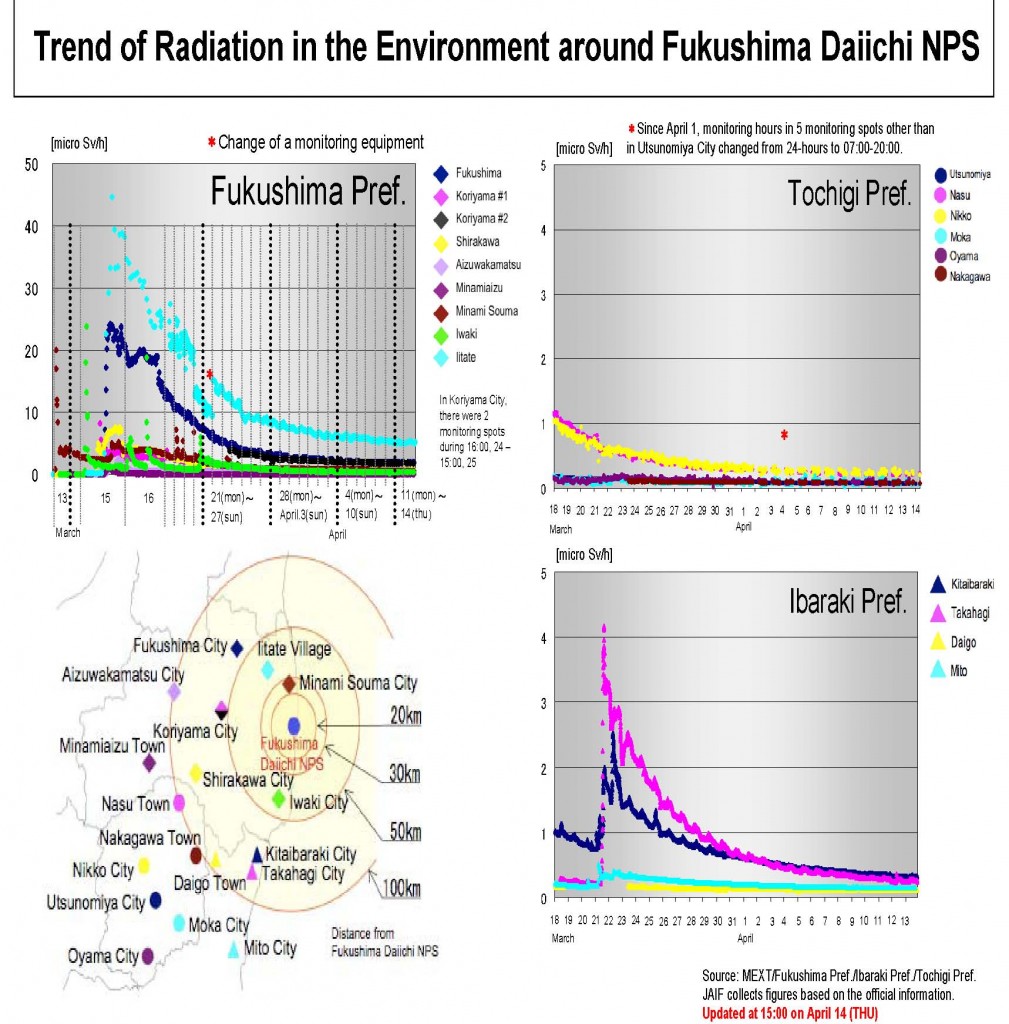
The radiation levels in the groundwater is increasing in the plant area. Otherwise radiation trends are all downwards around Fukushima. From IAEA

Gamma dose rates are measured daily in all 47 prefectures. The values tend to decrease over time. For Fukushima, on 13 April a dose rate of 2.0 µSv/h was reported. In the Ibaraki prefecture, a gamma dose rate of 0.14 µSv/h was reported. The gamma dose rates in all other prefectures were below 0.1 µSv/h.

Dose rates are also reported specifically for the Eastern part of the Fukushima prefecture, for distances beyond 30 km from Fukushima-Daiichi. On 13 April, the values in this area ranged from 0.2 to 26 µSv/h.

In addition to the 7 measurements referred to in yesterday’s brief, (note- these measurements were made at distances of 25 km and 33 km not 32 km and 62 km as reported), 13 more measurements were made on 12 April at distances of 25 to 33 km, West and Northwest from the Fukushima Nuclear Power Plant by the IAEA team. At these locations, the dose rates ranged from 0.5 to 16.5 µSv/h. At the same locations, results of beta-gamma contamination measurements ranged from 0.05 to 2.1 Megabecquerel/m2.

Analytical results related to food contamination were reported by the Japanese Ministry of Health, Labour and Welfare on 13 April that covered a total of 98 samples taken on 4 and 11 to 13 April. Analytical results for 76 of the samples of various vegetables, pork, seafood and unprocessed raw milk in nine prefectures (Chiba, Fukushima, Gunma, Ibaraki, Kanagawa, Miyagi, Niigata, Saitama and Yamagata) indicated that I-131, Cs-134 and/or Cs-137 were either not detected or were below the regulation values set by the Japanese authorities. In Fukushima prefecture on 11 April, twenty samples of various vegetables were above the regulation values set by the Japanese authorities for Cs-134/Cs-137, and one sample of seafood (sand lance) and one sample of spinach were above the regulation values set by the Japanese authorities for both I-131 and Cs-134/Cs-137.


Links(English)
Reuters Burrial of reactors tricky

Blogs(English)
Depleted Cranium Fukushima: Now a level 7, but nothing changes
All things Nuclear What Happened at Fukushima Dai-Ichi?
Atomic Power Review Brief update: Temperatures at Fukushima Daiichi 1,2,3
Atomic Power Review Fukushima Daiichi: Reactor cores
Atomic Power Review FACTS: Decommissioning of nuclear power plants

Links(Swedish)
Newsmill Japanska strålsäkerhetsmyndighetens INES 7-gradering endast temporär
Newsmill Brittisk miljöaktivist: Antikärnkraftslobbyn har bluffat om strålningens hälsorisker
Newsmill Japans unga revolterar mot kärnkraften
DN debatt ”Vi fattar inga panikbeslut om kärnkraften”
DN debatt”Att stänga två reaktorer skadar svensk basindustri”

Blogs(Swedish)
Rättvisan framför allt Långsiktighet, var god dröj.
Lotta Olsson Energipolitik är långsiktig…
In Your Face Kan du vika tranor?
Dr Angels blog Fukushima är ännu en mardröm

5 Comments

Miljöpartiets kärnkraftsutspel förkastlig populism

Världens kärnkraftsmotståndare har kastat sig över olyckan i Fukushima med ohöljd frenesi. Innan man ens lyckats få hejd på olyckan och börjat samla in fakta eller göra analyser börjar ropen skalla på avveckling. Miljöpartiets Maria Wetterstrand och Lise Nordin säger i Dagens Nyheter 2011-04-08 “Det är hög tid att även den svenska regeringen drar några slutsatser för den svenska energipolitiken”. Att dra förhastade slutsatser och komma med ogenomtänkta beslut är det som sänkt svensk kärnkraft. Och nu vill Miljöpartiet begå samma misstag igen.

Skillnaden mellan en kärnkraftsmotståndare och någon som arbetar med eller förespråkar kärnkraft är att för motståndaren är Fukushima slutet på diskussionen, medan för arbetaren och förespråkaren så är det början. Miljöpartiet vill redan nu, innan olyckan i Japan ens är till ända, kasta fram politiska beslut om kärnkraften i Sverige. Detta är inte bara förhastat, det är farligt. Det var exakt den typen av beslut som efter händelserna på Three Mile Island och i Tjernobyl gjort att svensk kärnkraft nu fungerar sämst i Europa.

Nordin och Wetterstrand säger att man “utan problem” kan stänga två reaktorer under mandatperioden. Inte en enda villaägare som nu svär över elräkningen efter att en (1) reaktor krånglade i vintras håller med om det. De ser att förslaget inte är “utan problem”.

I vintras gick den svenska effektreserven och importen för fullt för att täcka upp bortfallet av reaktorn. Smutsig olja och gas ökade i ett slag de svenska utsläppen av koldioxid med upp till 40 000% per kiloWatt-timme. Det är inte “utan problem”.

Tyskland har i panik efter Fukushima stängt åtta reaktorer i tre månader. Men varje TWh kolkraft och olja som ersätter kärnkraft dödar 25-35 personer på grund av luftföroreningar. Det tyska beslutet dödar alltså 5-7 personer per dag och upp till 450-650 totalt. Detta medan Fukushima, trots tre pågående härdsmältor och en explosion i en bränslepool, inte annat än lätt skadat några i räddningsstyrkan och ingen i allmänheten. Det förhastade tyska beslutet är allt annat än “utan problem”.

Ända sedan 1970-talet har vi i Sverige lyssnat på vackra löften ifrån politiker som Wetterstrand och Nordin; politiker som lovar stort i energifrågan men levererar lite. För 30 år sedan hette det att till 2010 kommer det förnybara att kunna ersätta kärnkraften och det fossila. Vi vet att det inte blev så. Men ingen av de politiker som tog detta verklighetsfrånvända beslut finns idag kvar att utkräva ansvar ifrån.

Nu säger det avgående språkröret Maria Wetterstrand att det “utan problem” går att stänga fler reaktorer, trots att den sortens löften havererat svensk kärnkraftsindustri. Det kan hon göra, för hon vet att inte ens under denna mandatperiod kommer hon att behöva ta ansvar för vad som händer om beslutet är dåligt.

Vi säger att det räcker nu. “Prognoser” är inte gott nog. “Potential” är inte gott nog. Att politiker i en debattartikel påstår att nedstänging är “utan problem” är inte gott nog.

Maria Wetterstrand och Lise Nordin, om ni vill stänga svensk kärnkraft kräver vi att ni tar personligt och fullt ansvar för att ersättare kommer på plats. Era vackra ord ger oss inte en enda kiloWatt-timme. Kraftverk är vad som ger oss energi, inget annat. Först när ni har sett till att dessa finns på plats och är i produktion är det tillfälle att kräva nedstängning av reaktorer i Sverige, inte en sekund tidigare.

Tvåhundra TWh fossil energi går in i den Svenska energibalansen varje år, energi som årligen dödar ca 5 000 svenskar och orsakar miljardkostnader i sjuk- och hälsovård. Det påstådda energiöverskottet på 23 TWh som Maria Wetterstrand och Lise Nordin utlovar kommer att lämna 90% av det fossila kvar. Trots detta vill de istället stänga ren svensk kärnkraft. Det är inte “utan problem”.

för det oberoende nätverket Nuclear Power Yes Please

Michael Karnerfors, civ. ing, Lund
Johan Kihlberg, fysikstuderande, Stanford
Mattias Lantz, forskare i fysik, Uppsala universitet
Johan Kreuger, ekonomistuderande, Handelshögskolan i Stockholm
Nils Rudqvist, doktorand i strålningsfysik, Göteborgs universitet
Klas Färd, Elektroingenjör Stockholm

Bloggar om artikeln:

92 Comments