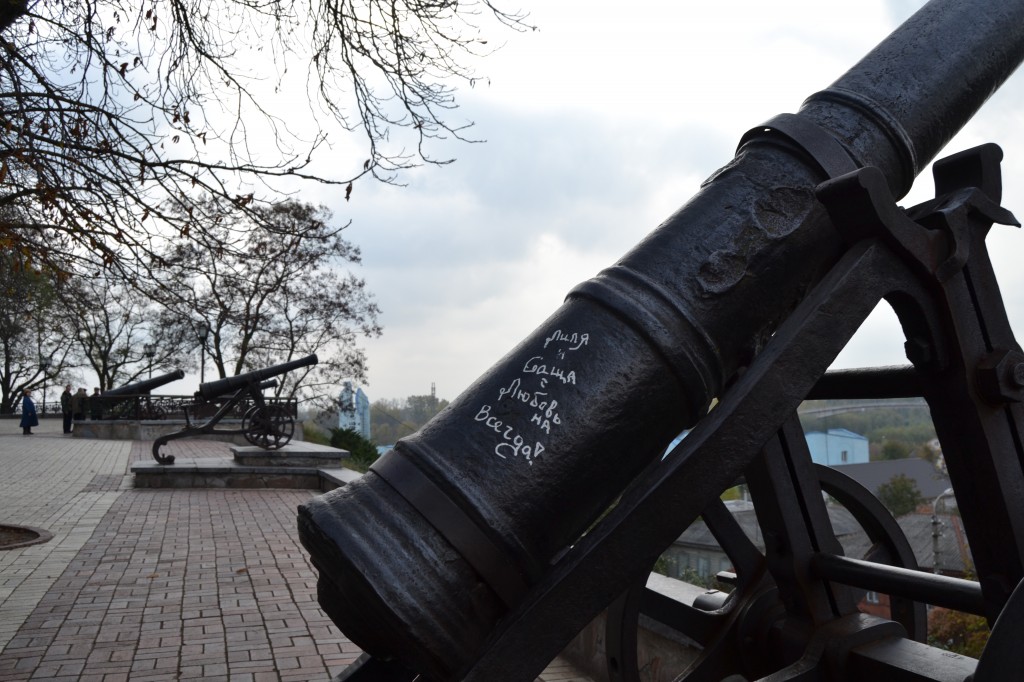
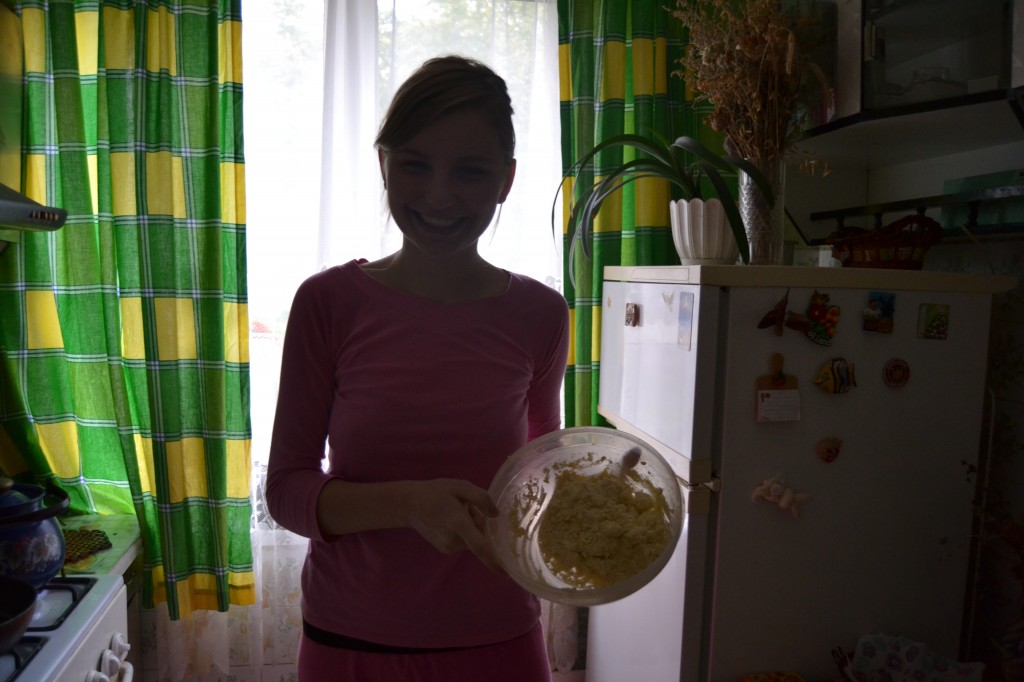
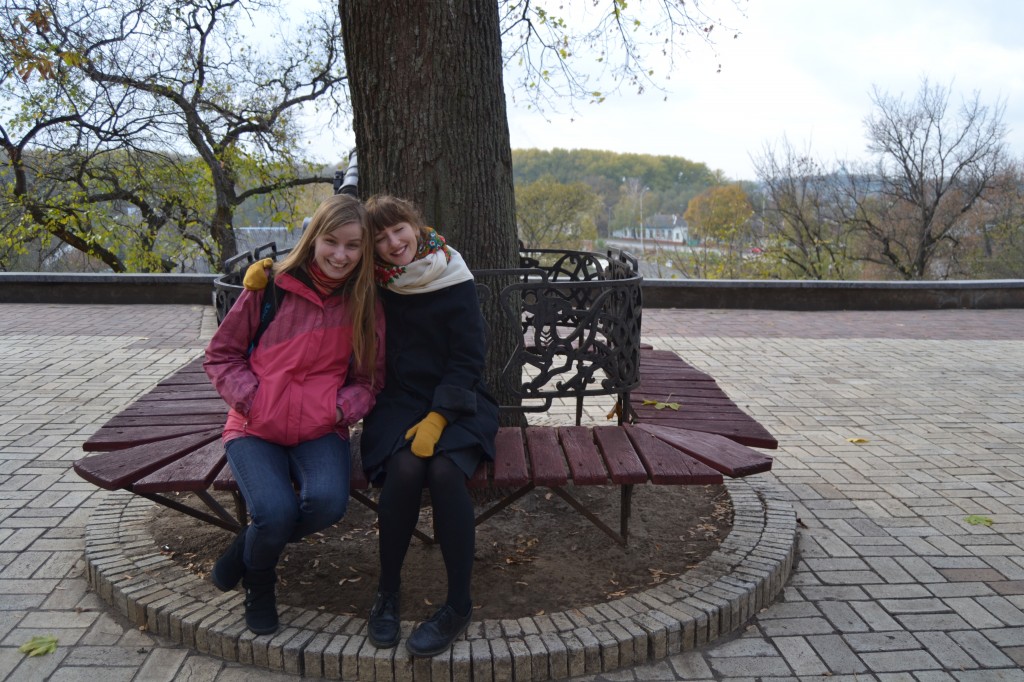
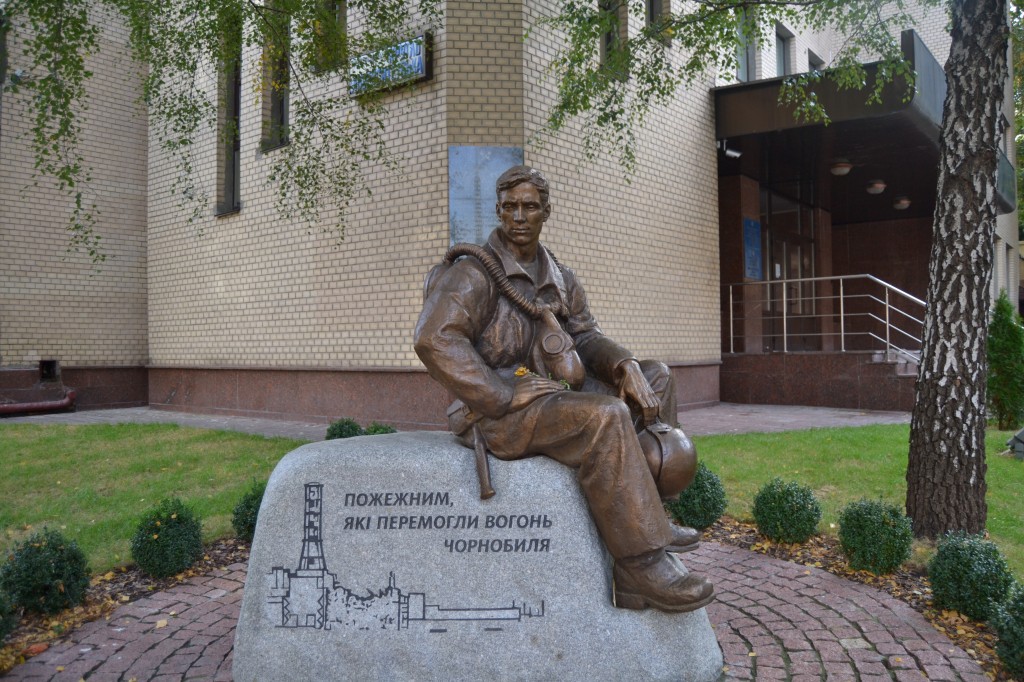
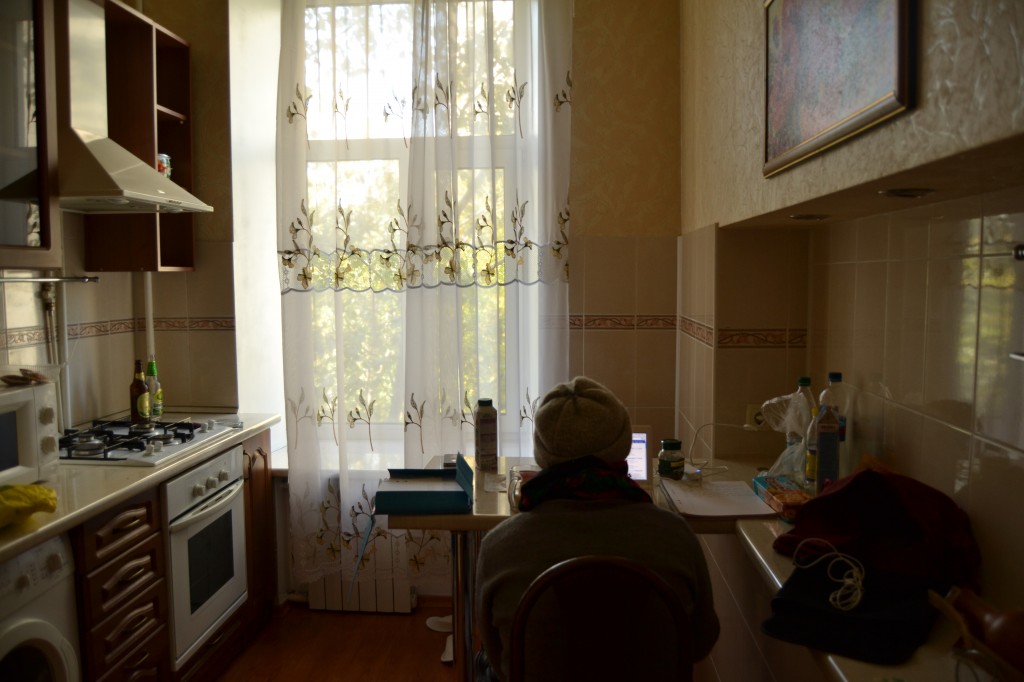
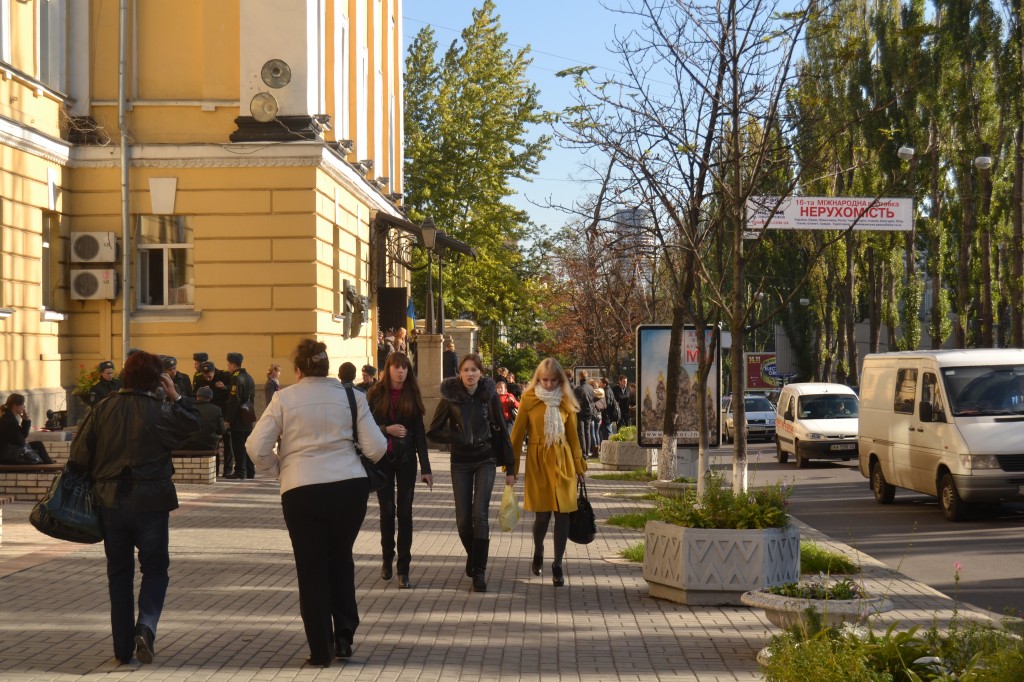
Igår hade vi ett otroligt givande möte på svenska ambassaden där vi träffade Mårten Ehnberg och hans assistent och diskuterade vad ligger bakom attityderna till kärnkraft här (lovar att uppdatera mer ingående). Sedan tog vi en minibuss till Tjernihiv. En relativt stor stad på väg till Vitryssland. Där möttes vi av en fantastisk student vid namn Olga. Hon bjöd oss in på traditionell ukrainsk mat samt sightseening och intressanta diskussioner kring kärnkraft. Nu är vi så så himla trötta efter en middag med Yuliya & Tanya i en av Kievs förorter. Imorgon åker vi till TJERNOBYL. Ofattbart. Hela resan. Allting. Här kommer några bilder. Vi skriver mer imorgon.
Igår träffade vi en man som heter Mykola. Han arbetar som ambulanssjuksköterska på ett av Kievs statliga sjukhus. Mykola visade oss fallfärdiga byggnader som ingen av oss hade gissat var sjukhusbyggnader, tillsammans med teknik och resurser som kan dateras till minst 20 år tillbaka i tiden. Men det var en sak som sjukhuset satsade på, nämligen att läkarna skulle ha goda kunskaper i engelska. Dessa läkare tjänar omkring 2500-4000 svenska kronor i månaden och är högutbildade akademiker. Vi fick följa med på en engelsklektion för dessa läkare, då Mykola såg möjligheten för oss att få ställa frågor. Hela lektionen på en timma och trettio minuter ägnades åt att prata politik, kärnkraft, miljö och EU-medlemskap. Under lektionen skämtade en man om att han borde arbetat med “tuffens” istället, då syftade han på en politisk karriär.
Vi fick berätta om vår tes och vårt projekt. Jämförde även med Tyskland och deras starka opinion mot kärnkraft. Att med sviterna relativt färskt i minnet av Tjernobyl borde opinionen vara stark och misstänksamheten stor mot kärnkraftverk i Ukraina. Men vi har fått tänka om, jag och Sara. Doktorerna (och andra vi pratat med) berättar om överlevnad när matpriserna ökar, om hopplösheten efter orangea revolutionen och om oron för framtiden.
Det blev nästan pinsamt att fråga om ukrainier är miljömedvetna, då miljömedvetenhet har blivit en klassfråga. En bastant man med hårigt bröst och guldring sade: “Tjernobyl hade varit en större katastrof i erat land idag om det hade inträffat där 1986. Här är det någonting som inträffade 25 år sedan.”
Den miljömedvetenhet som finns tolkar jag som en längtan från människor att bli en del av västeuropa. Där miljömedvetenhet är en livsstil som kan uppnås vid välfärd. Och det är välfärden de ukrainier vi pratat med önskar men inte vågar hoppas på för mycket.
En sak som som uppdagades som en möjlig konsekvens av Tjernobylolyckan var en ökad frekvens av cancerpatienter. Men dokterna blev väldigt oeniga (och började prata ukrainska istället) då ökad stressnivå, alkolism, AIDS-fall och bristsjukdomar också måste tas med i sådant resultat. En annan kvinna ansåg emellertid också att kärnkraft var bra då det var billigt och effektivt men att ukrainska staten inte hade sett över säkerheten sedan Tjernobylolyckan tillräckligt och därför var kärnkraft något dåligt. Annars var det ingen av doktorerna som varken uttalade någon ståndpunkt i frågan, då de alla höll med om att andra frågor är så mycket viktigare.
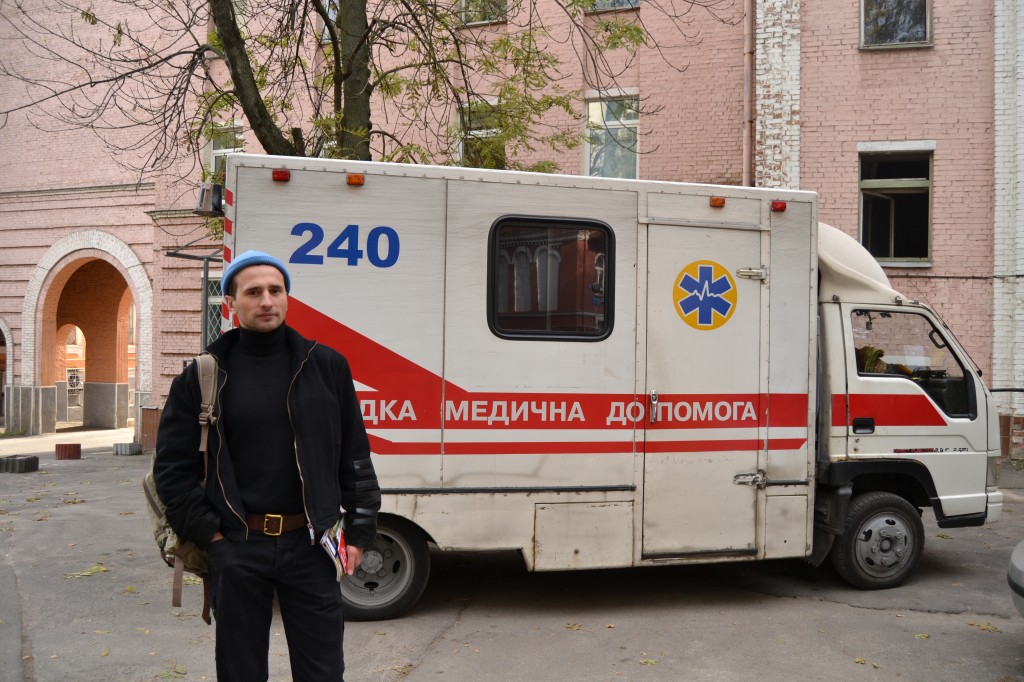
Det var ett starkt möte på deras engelsklektion, de var nyfikna på oss och ville gärna veta varför vi var där. Av hänsyn kände vi inte fotografera dem då vi hade pratat om väldigt känsliga ämnen och lovat dem att vara anonyma. Men vi tog ett kort på vår kontaktperson Mykola bredvid en av sjukhusets ambulanser.
Dag 2 i Ukraina snart avslutad. Idag har vi upplevt Kiev mycket ingående då vi bland annat hamnat på en engelskkurs för ukrainier på en sportbar i ett gigantiskt köpcentra. Vi började dagen med att åka (fel) till Universitetet och genomförde två mycket lyckade fältstudier i den varma höstsolen. Frågorna som studien rörde var :
1. Är du miljömedveten?
2. Vet du om vilka energikällor Ukraina använder sig av och vad tycker du om det?
3. Vad tycker du om kärnkraft?
Vi valde att göra frågeställningen öppen (utom fråga tre, som kom till efteråt) och visst kunde de flesta svara på våra frågor, men de flesta av svaren kom att handla om det politiska läget och sociala frågor. De tendenser vi kan se av våra fältstudier från idag är
– De vi pratade med upplever att de inte blir lyssnade till av politikerna även om de skulle ha en åsikt om kärnkraft
– Kärnkraft ska inte ägas utav “fel personer”
– Kärnkraft är bra för då är Ukraina inte beroende av den ryska oljan
– Det finns ett intresse för miljöfrågor, men det finns ingen organisation som för en debatt kring energikällor (kärnkraft, vindkraft etc)
– Det finns andra frågor som prioriteras högre (både bland folket och politiskt) eftersom det råder ett missnöje kring hur den politiska, ekonomiska och sociala stabiliteten sköts.
Sedan gick vi på Tjernobylmuseet och det gav oss en nytt perspektiv på den fakta vi har. Bland annat insåg vi att okunskapen kring effekten av strålning och kärnkaft var så låg vid katastrofen att man tog till ett religiöst begrepp för att förklara händelsen. Museet var fyllt av religiös symbolik i form av bland annat änglar, äppelträn och ikoner. Vi träffade en väldigt intressant man från Sidney som forskade kring myter kring arkeologiska platser. Han hjälpte oss att förklara mytbilden som finns kring Tjernobyl, där människor såg strålning som Döden i materia. Även idag finns det en misstänksamhet mot Tjernobylområdet då Sideykillen berättade om en klasskamrat som bott hemma hos en dam i Kiev, åkt på en dagstur till Tjernobyl och när han/hon kom hem så hade damen burit ut alla dennes möbler på balkongen.
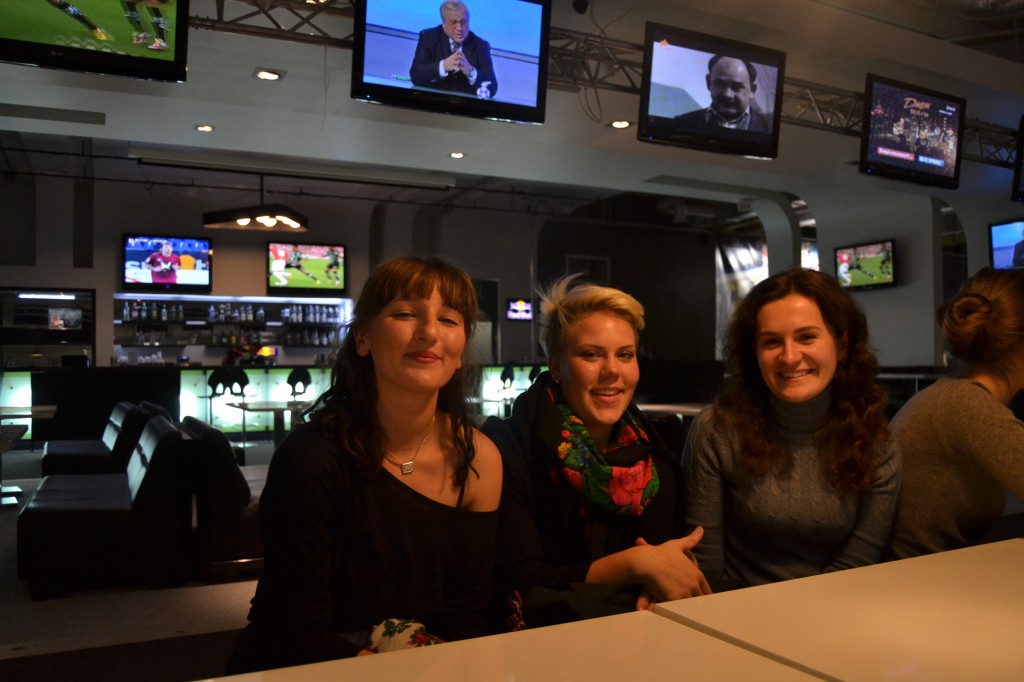
Kvällen spenderades på en sportbar där vi också passade på att göra några fältstudier, men också att lära känna ungdomar. De var jättetrevliga och vi är nu hembjudna på ukrainsk middag hos en tjej som heter Julia. Vi fick även hjälp att skaffa ett ukrainskt simkort = hurra!
Dagen i bilder:
Nu är vi landade och klara. Tullen var ungefär en fjärdedelen så nogrann som växlingskontoren där man fick ett fint certifikat på att vi klarade av uppgiften. Det märks att vi är i forna Sovjetland, landet saknar egen kultur och använder mycket rubel. Vi bor i en lägenhet som är ganska fin, ett stort betongkomplex mitt i blaffan bland bilvägar och supermarkets. Imorgon ska vi besöka Tjernobylmuseet och göra fältstudier (för mer info om vårt projekt – se tidigare inlägg från oss). Det är lite oroväckande att engelskkunskaperna är så låga här. Vi hade inte väntat oss att kunskaperna skulle vara speciellt fenumenala, men efter att ha försökt konversera/fråga om hjälp av framför allt flera unga, har vi insett att det här med kommunikation kommer bli en utmaning! Det är dock inget som slår ned oss, och vi hoppas på att kunna skrapa ihop rikligt med material om attityder till kärnkraft här i Kiev och Tjernihiv. Vi tänkte ställa oss utanför Universitetet och fråga folk, vi tror att engelskakunskaperna kan vara fler där. Vi träffade dock en tjej i Kiev idag som kunde engelska, hon skulle förövrigt till Stockholm imorgon för att spela bordtennis (!!?!). Nu ska vi sova och invänta morgondagen 🙂
Hej!
Vi har fått den stora äran att gästblogga på denna organisations website. Det tycker vi ska bli väldigt trevligt! På måndag vecka 42 lyfter Aerosvit VV270 från Arlanda terminal 5, som ska ta oss till Ukrainas stolta huvudstad Kiev. Anledningen till att vi ska bege oss dit är för att göra vårt projektarbete, som skall genomföras i årskurs tre på gymnasiet. I Ukraina ska vi bo hemma hos Olga i Tjernihiv, besöka Tjernobyls mark, möta ställföreträdande ambassadören Mårten och en ambulanssjuksköterska med flera!
Varför ska vi utsätta oss för strålning, försöka förstå kyrilliska alfabetet utan att komma vilse och fråga människor på gatorna om de är miljömedvetna? JO: Vårt syfte med projektarbetet är att undersöka attityder till kärnkraft i Ukrainas norra region Polissia.
Vi som ska genomföra detta projekt är:
Namn (från vänster): Sara Gommel & Alice Grudd Ålder: 18 respektive 18 år Program och skola: Samhällsvetenskapliga programmet, inrikting beteendevetenskap, Falu frigymnasium, Falun Politisk ideologi: Liberal respektive partipolitiskt obunden vänster Inställning till kärnkraft: Positiv respektive negativ
Följ oss gärna då vi kommer uppdatera våra intryck och upplevelser under vår tid i Ukraina. Detta kommer bli både en reseskildring och åsiktsventilatör kring kärnkraft och vårt projekt.
Vi hörs! / Sara Gommel & Alice Grudd, Falun, Sverige
Strålsäkerhetsmyndighetens (SSM) egen tidning Strålsäkert har just kommit ut med ett nytt nummer, nr 2-3 2011. Flera artiklar handlar om Fukushima. Tidningen går att läsa i html eller pdf-format på följande länk:
All we have to fear is fear itself, not the fearmongers who spread it
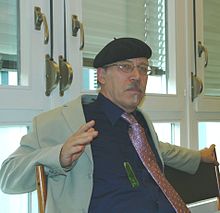
Chris Busby
The outcome of the events in Fukushima are far from over, and there are many facts that will take years before they become available. There are a number of things that can be handled better, not the least the flow of information from TEPCO and Japanese authorities.
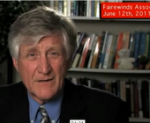
Arnie Gundersen
Meanwhile, the suffering, fears and worries of the people affected is made even worse than it need to be, thanks to a number of fearmongers who exaggerate the effects.
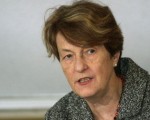
Helen Caldicott
We will not speculate here about the motivations of the fearmongers, some of them surely believe in what they are saying, even when proven wrong. Some of them seem to have a need to inflate their resumees, or refer to what sounds like scientific reasoning in order to impress people. And some of them claim to speak from a higher moral ground.
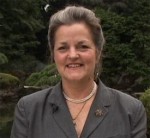
Leuren Moret
They may be right about a number of things, and sometimes they have correct things mixed into their gospel. But the main objective of it is not to give us good advice and proper information, the objective is to scare you into thinking like them.
Joseph Mangano
The effects are clearly seen on a number of blogs and news sites, many times the commentary fields are full of discussions that completely have lost connection with reality. The fearmongers are referred to as trustworthy authorities in the field, no matter what crazy things that comes from their mouths.
Janette Sherman
Six months have passed since the events in Fukushima started. The first round goes to the fearmongers. They will surely continue with their dark gospels, in whatever forms they preach them. And we will have to counter more of their nonsense in the future. Only one thing is clear: We will not leave them unopposed.
Warning: The following text may contain personal attacks and wild speculations about certain people. This will not make any future attempts of dialogue with them any easier, but in my humble opinion they have had their chances.
By concentrating only on the CDC (Centers for Disease Control) data – incomplete at best – and ignoring the on-going radioactive releases from Fukushima, it is apparent that the pro-nuclear forces are alive and active.
Hey, wait a minute. It was not the pro-nuclear forces (whatever that is, but let’s embrace the term with a jolly “Fooorward!”) who started tampering with the CDC data in a way that would flunk any undergraduate student in Statistics 101, it was you, remember? This does not mean that we ignore the rest of the issue, but we do take offence when anti-nuclear forces fail to use the information from Fukushima to their advantage and have to cook up alarmistic results in order to make the situation look worse than it is. This is indeed very remarkable, aren’t the actual events in Fukushima bad enough for you?!?
If I had the mindset of S&M, I would write
By mis-treating the CDC data – incomplete at best – and ignoring all knowledge about radiation effects, and actual radiation levels in the US due to Fukushima, it is apparent that the anti-nuclear scaremongers are alive and active.
This is clearly not a way forward, at least not if you hope for a dialogue and an improvement of the nuclear debate. Oh well, let’s move on.
The second section explains that the titles of the previous articles (there are two versions, one in CounterPunch, and one in San Francisco Bay View) includes question marks in order to
stimulate interest and prompt demand for governments – Japan and the U. S. at least – to provide definitive and timely data about the levels of radioactivity in food, air and water.
Hm, Janette and Joe. May I kindly ask: Wouldn’t it be better to try to stimulate this interest in a way that does not include cherry-picking, unfounded alarmism that scares the heck out of millions of parents to infants, and a way of throwing random pieces of data around that should reduce whatever credibility you might have had before to a new low point?
Next section:
We received many responses, some in support of our concerns and some critical about how we used CDC data, including outright ad hominid attacks accusing us of scaremongering and deliberate fraud.
Oh really? I guess that I personally have to plead guilty to this charge, but they link to the blog entry by Michael Moyer in Scientific American as an example of an ad hominid attack. I re-read Moyers scrutiny of the CounterPunch article, but fail to see any personal attacks there. Ok, he uses words like “scaremongering”, “froth up”, “data fixing”, “critically flawed – if not deliberate mistruths”. Still, Moyer attacks S&M’s actions, not their personal traits.
Or do S&M really mean ad hominid attacks? My first assumption was that they mixed up “ad hominem” and “ad hominid“, but maybe they do know the difference? I bring the rest of us up to date by quoting the text on this link: “The former [ad hominem] is a criticism of a particular person; the latter [ad hominid] is a commentary upon a species.” So, have Moyer, myself, or anybody else involved in this issue, referred to S&M as neanderthals, platypus, or similar? Not that I can see, but it could be an interesting path to digress upon. Anyhow: Sensitive bunch, those scaremongers…
Now it becomes interesting:
Given the fallibility of humankind, we may have erred, and if so, will admit it. Given the delay in collecting data and the incompleteness of the collection, the criticism may be valid. MMWR (CDC’s Morbidity and Mortality Weekly Report) death reports have certain limits – representing only 30 percent of all U.S. deaths. They list deaths by place of occurrence, while final statistics are place of residence and deaths by the week the report is filed to the local health department, rather than date of death. Finally, some cities do not submit reports for all weeks. The CDC data are available at http://www.cdc.gov/mmwr/mmwr_wk/wk_cvol.html.
So, they admit that they may have erred, or do they say that they may admit it if proven to be the case? Or…? I am not sure, but this is probably as close to admitting anything that they will ever be. It is of course not their fault, it is the limitations of the CDC data that we should put the blame on, not a second thought about their method.
My first interpretation from reading the section is that they admit to that the statement in the first articles about a statistically significant 35% increase in infant deaths may not be correct (no matter who to blame). Unfortunately, it turns out that I am severely mistaken in my interpretation:
Since the article was originally published, we have had the chance to further analyze the CDC data. Historically, the change in infant deaths for the previous six years in eight Pacific Northwest cities from weeks 8-11 (pre-Fukushima) to weeks 12-21 (post-Fukushima) is about 6 percent – never above 11 percent. But in 2011, the change was 35 percent, far above anything ever experienced.
The same eight cities, the same comparison – four weeks 8-11 vs. 10 weeks 12-21 infant deaths:
2005 +4.1 percent
2006 +10.0 percent
2007 +5.1 percent
2008 +5.5 percent
2009 +2.8 percent
2010 +10.9 percent
The average for 2005-2010 is + 6.1 percent for a total of 1,249 infant deaths.
2011 +35.1 percent (162 infant deaths)
Before 2005, there were missing data. But the years 2005 to 2010 are about 98 percent complete.
Argh! Now I really do want to turn ad hominid on these people, whatever species (sparsis timoris?) they may belong to! First they say that maybe they were wrong and if so they maybe will admit it. Then they go on and make more “analysis” from the CDC data base, using the same lousy way of handling the data!
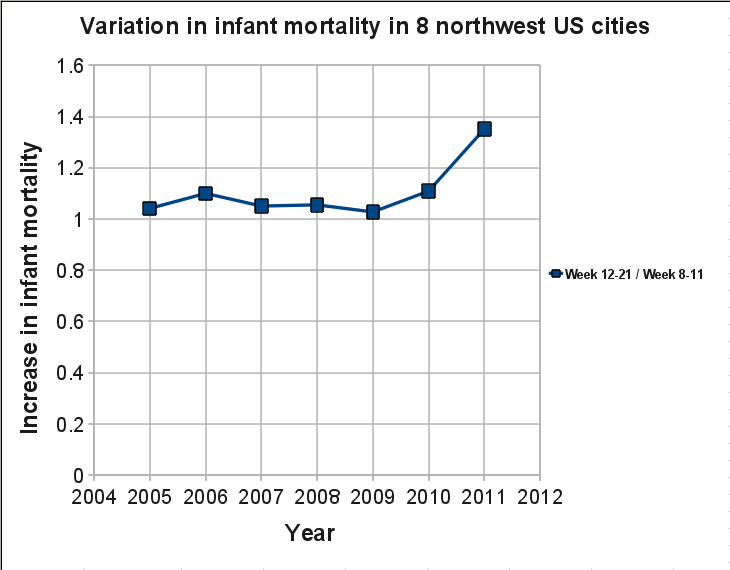
There has been plenty of text here, so let’s lighten up with a few plots, showing the CDC data S&M are mistreating. The plots from my previous posts about S&M should be enough for saying that this is rubbish, but one more round with the CDC data base will not hurt, in case that somebody still believes in S&M’s fables. We start with plotting the change in infant deaths between weeks 8-11 and weeks 12-21 for the years 2005-2011, i.e. the ones that S&M now claim to have done a more careful analysis on.
Change in infant deaths between weeks 8-11 and weeks 12-21 for the years 2005-2011
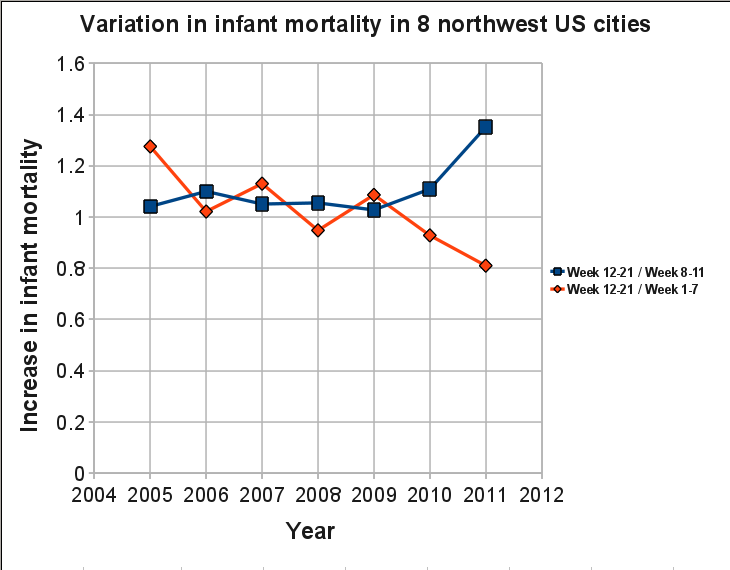
The blue squares show the data as given by S&M. Nothing wrong in the data, this is what you get when you do the same treatment as S&M, weeks 12-21 give a higher weekly infant mortality rate than weeks 8-11, with a few percent every year. Except for 2011 where the 35% increase looks really alarming. But we know from before that they have cherry picked the weeks by only using four weeks before Fukushima and 10 weeks after. If we also plot the ratio of weeks 12-21 over weeks 1-7, shown as red diamonds, we get the following trend:
Change in infant deaths, blue squares as in previous figure, red diamonds for weeks 1-7 and weeks 12-21
Quite interesting that there is a decreasing trend, and that the decrease is at its lowest level this year, a 20% reduction while it before usually was a slight increase (the 30% for 2005 is almost as much as the 35% that S&M have made so much noise about). In other words, if we compare the weeks after Fukushima with weeks 1-7, there seems to be a very beneficial effect on child mortality. Could it be that hot particles are beneficial for infants? This is rubbish, of course, but so is the question asked by S&M.
Still, why the drastic increase this year if they only used four weeks for the years 2005-2010 as well? And why does the results look completely opposite if we instead compare with weeks 1-7 instead of weeks 8-11. The answer is: statistical variations. We are watching random noise, not real trends due to a single cause that can be easily deduced. For this we need to look at longer time spans (for a start, we probably need to do a lot more as well, but let us not confuse the S&M-fans by introducing too much real scientific reasoning). But in order to understand the discepancy, we have to remember that they present the ratio between the two time periods, not the actual numbers. In the original articles S&M talks about increased infant mortality (you may remember that the articles start with “U.S. babies are dying at an increased rate.” Let’s take a look at this.
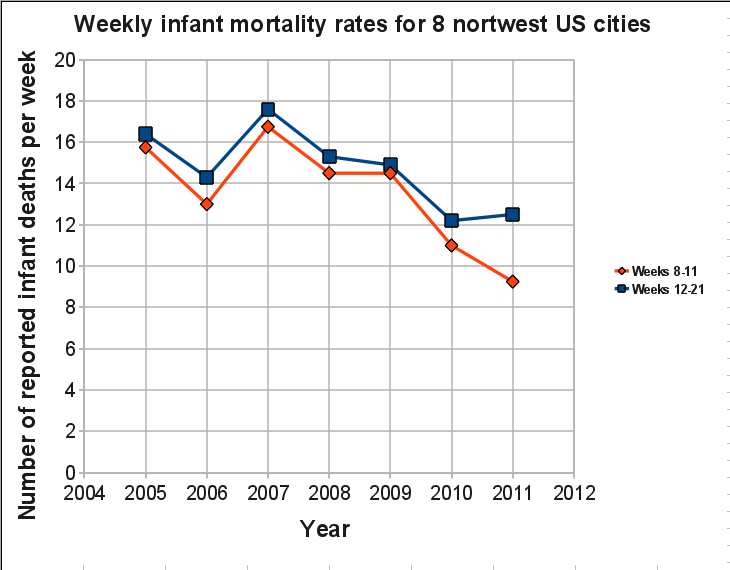
Number of infant deaths for weeks 8-11 and weeks 12-21
Now we see something interesting. Not only are the number of infant deaths for weeks 8-11 at an all time low during 2011, the number of infant deaths for weeks 12-21 are also at a very low level! U.S. babies are dying at an increased rate? I think not! S&M are shamelessly (if they really believe in their own conclusions then they are indeed very incompetent) showing results for relative numbers, not absolute numbers. Perfectly ok if you are honest with how you handle the data, can refrain from cherry picking the weeks and the areas, and do not suffer from an alarmistic version of Tourette’s syndrome. But S&M prefers to show a relative increase of 35% for this year, while the absolute numbers show a decrease when comparing with earlier years.
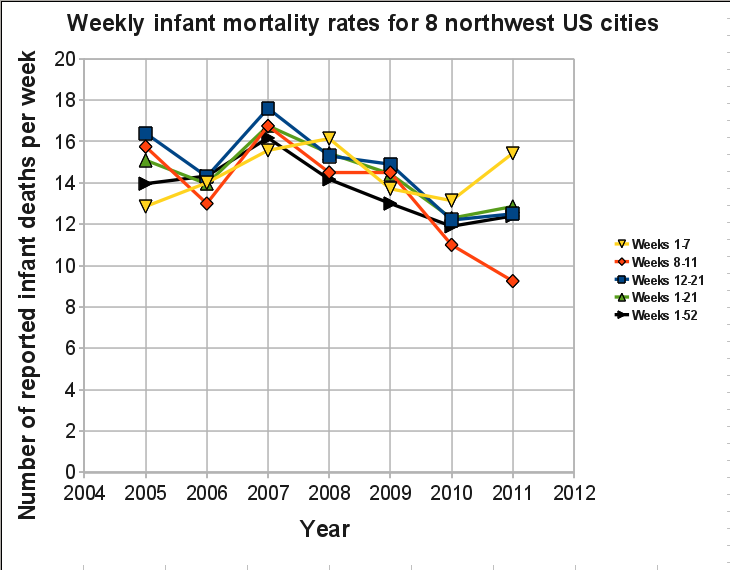
Still not convinced? Let us include weeks 1-7, weeks 1-21, and weeks 1-52 for each year. Please note that the value for 2011 in the weeks 1-52 (black line) only include the data for weeks 1-25, so it can change somewhat depending on the number of infant deaths that will occur during weeks 26-52 (S&M would probably be able to predict the future, I will not make any such attempts).
Number of infant deaths for weeks 1-7, 8-11, 12-21, 1-21 and 1-52
If anybody wants to pursue the idea that there is a drastic increase of infant deaths in northwest U.S. after Fukushima, that person will have many things to explain, for instance the drastic increase in infant mortality this year for weeks 1-7. The data does not support the idea of increased infant mortality due to Fukushima, no matter what S&M say.
One more quote from the article by S&M:
We acknowledge that many factors can cause infant deaths, but the critics who ignore Japanese fallout as possible contributing factors are acting irresponsibly.
So, cheating with the CDC data is a more responsible way to act? Nobody is ignoring the fallout. We are just fed up with false claims wrapped in an alarmistic package. Therefore I will, like many others, once again ignore everything else that is written in the S&M article; a mixture of some valid concerns that are heavily diluted with half-truths, advertisement about the Chernobyl book (edited by Sherman) and other reports (written by Mangano), scaremongering, claims about lies and cover up, and some more nonsense claims. It would be interesting to discuss the valid concerns that are addressed, but if we every time have to filter it out from a sea of myths then we would rather spend our time elsewhere.
Janette Sherman and Joseph Mangano: We do care about the consequences from Fukushima, many of them will surely be serious. Many of us are also annoyed by the lack of interest from the media to write properly about the present status. But we do not subscribe to your way of portraying it, as long as you show yourself unable to stick to the truth. Concerned citizens have nothing to learn from you. We do see the elephant in the room while you try to make it into a mammoth. May your methods and your dishonest claims suffer the same fate as this extinct species.
One final quote. In the beginning of the article there is a picture of a pretty baby, with the following figure caption:
Not only is it unthinkable to put our babies at risk by continued use of nuclear power plants, but infant mortality is an indication of an entire population’s health. When an unusual number of babies are dying, we are all at risk and must take a stand.
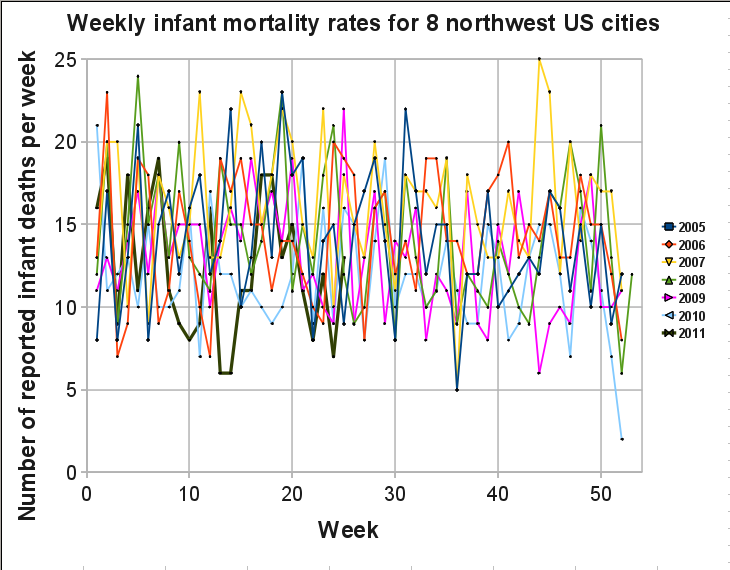
S&M must have plotted all the data from 2005 until now. If not, here I have done it for you:
Number of infant deaths per week for the years 2005-2011
Ok, I plot all years over each other, a bit messy. A better alternative would be to plot the years after each other, as done in this figure by Alexey Goldin in his entertaining statistics analysis of the S&M hoax. One may also try to see seasonal trends by plotting mean values for a number of years. In whatever way, S&M still owes us an explanation for their claim of an unusual number of babies that are dying. Can we close this chapter now, please?
Ad hominem/hominid attacks
I start to ask myself, are there Cliffs Notes for epidemiology? Is this how Mangano passed his courses for the MPH degree? Since my first encounter with Cliffs Notes about 20 years ago as foreign exchange student in the U.S., the company seems to have expanded its activities substantially, and are also available on the internet. At that time I was only aware of Cliffs Notes that cover novels that you are expected to read in school. If you are too lazy to read the novel, the Cliffs Notes gives a summary of the book, typical issues and questions that are likely to be on the exam (or good to be aware of if you want to pretend that you read the book and do not want to get expelled from the book-reading club), and a few other short cuts for the illiterate who still wants to graduate from high school. I find no Cliffs Notes for epidemiology, but there are indeed Cliffs Notes on statistics! Well Joe, if this is how you made it through college, please go back and read the following part:
In my first post on this subject the title was Shame on you, S&M! I should probably reconsider this title. If they had done this wilfully then I would stand my ground, but after reading their last article I get more and more convinced that it is just incompetence. They truly believe in what they are doing, and because they are victims of the Dunning-Kruger effect there is no way to make them understand that somewhere along the road they lost contact with reality. And just like Helen Caldicott, who in her debate with George Monbiot said “doctors can’t lie”, they are convinced that they speak from a higher moral ground.
So to tell somebody to be ashamed because they are incompetent in their field is about as useful as telling my 3-year old daughter to be ashamed for not knowing Bulgarian grammar. The difference is that my daughter may have a good chance to pick it up in a couple of years, if she would like to. For S&M, who have claimed expertise in their field for a long time, I see no hope at all. Maybe, just maybe, if they read Fooled by randomness by Nassim Nicholas Taleb, or some similar literature. They could really pick up some good lessons from a few chapters there. But it wouldn’t work, as far as I know Taleb’s books are not available in a Cliffs Notes format.
/Mattias Lantz – member of the independent network Nuclear Power Yes Please
Further comments
In the first post about S&M (here) I was criticized by a commenter for stating that Mangano has a track record of not handling data in an honest way, but I had not given any reference or link to back up this statement. That has been corrected and I have put two links in that post. But from now on it will be much easier. Three nonsense articles by Joe Mangano in slightly over two weeks, all three based on cherry picking. That is a track record as good (hrm, bad…) as any. To make it worse, good ol’ Joe has proudly put them on the RPHP web page:
And still no reaction from CounterPunch regarding their strange analysis
I have written twice to Alexander Cockburn, but have received no response. Instead there are a number of new articles that are critical of nuclear power of all kinds. Fine with me, but the lack of interest to get the strange re-analysis by Pierre Sprey corrected makes me wonder about the statement “Ours is muckraking with a radical attitude” . CounterPunch is certainly full of articles with a lot of attitude, but the muckraking seems to be missing.
For those on holiday but who cannot stay off the internet, below are a few Fukushima-related links to enjoy from the hammock:
TEPCO and the Japanese government announces that reactors 1-3 at Fukushima Daiichi now have reached the completion of the first step towards full stabilization, aiming for reaching the status “cold shutdown” by Januray 2012. There have (of course) been some setbacks, and some modifications on the schedule, but the work is continuing. More information in an understandable format (hardliners are welcome to try the TEPCO press releases) is given by Will Davis on the Atomic Power Review Blog.
A nice summary of the nuclear events at Fukushima Daiichi, as far as we know today, is given by Steve on The Neutron Economy blog.
The U.S. Nuclear Regulatory Commission (NRC) has released a report with proposed safety improvements at U.S. nuclear power plants in view of the events at Fukushima. More information, and a link to download the report, is given on the NRC blog.