Skip to content

Nuclear Power? Yes Please Posts

Shame on you, Janette Sherman and Joseph Mangano!

On several web sites there has recently been references to an article published on the web site Counterpunch with the title Is the Dramatic Increase in Baby Deaths in the US a Result of Fukushima Fallout?A 35% Spike in Infant Mortality in Northwest Cities Since Meltdown.

The article, published on 10 June 2011, is authored by Janette D. Sherman and Joseph Mangano, both renowned persons in the anti-nuclear movement. In the text the authors claim a statistically significant increase of infant mortality deaths with 35% after the Fukushima accident in eight selected cities on the U.S. west coast.

They write

The recent CDC Morbidity and Mortality Weekly Report indicates that eight cities in the northwest U.S. (Boise ID, Seattle WA, Portland OR, plus the northern California cities of Santa Cruz, Sacramento, San Francisco, San Jose, and Berkeley) reported the following data on deaths among those younger than one year of age:

4 weeks ending March 19, 2011 – 37 deaths (avg. 9.25 per week)

10 weeks ending May 28, 2011  – 125 deaths (avg.12.50 per week)

This amounts to an increase of 35% (the total for the entire U.S. rose about 2.3%), and is statistically significant.   Of further significance is that those dates include the four weeks before and the ten weeks after the Fukushima Nuclear Power Plant disaster.

Furthermore, they try to link the releases of radioactivity from Fukushima and Chernobyl to the relatively high infant mortality rate in the U.S. A look at the data used by Sherman and Mangano does indeed seem to indicate an increase in the number of infant deaths in northwest U.S. after Fukushima, see the plot below:
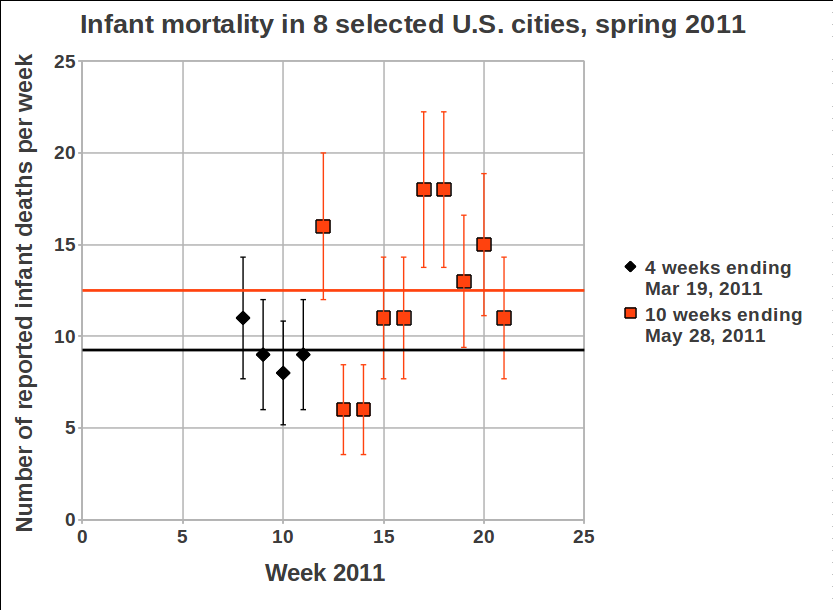
Infant mortality for 8 northwest U.S. cities, as reported by Sherman and Mangano

The Fukushima events started on March 11, i.e. by the end of week 10. Then it took slightly more than a week for the first release of radioactivity to reach the nortwest part of the U.S. The data do show an increased infant mortality rate after Fukushima. The black line shows the average value for the 4 weeks before March 19, and the orange line shows the average value for the 10 weeks after that. The error bars on each data point indicate the statistical uncertainties.

But why are the 10 weeks after Fukushima compared with only 4 weeks before? There seems to be a reason for it, commonly referred to as cherry-picking, i.e. you select the data that supports your theory without showing the full picture. To show the full data set may falsify what you want to show. This is quite common in politics and by people who have an agenda that is more important than the truth.  But here we have two persons in medicine, one Medical Doctor and one Master of Public Health, they should be trustworthy professionals who are keen on giving people honest information, right? Let’s check their deck of cards closer.

So, if we include data for, say, the first 7 weeks of 2011, we get a very different idea about the situation:
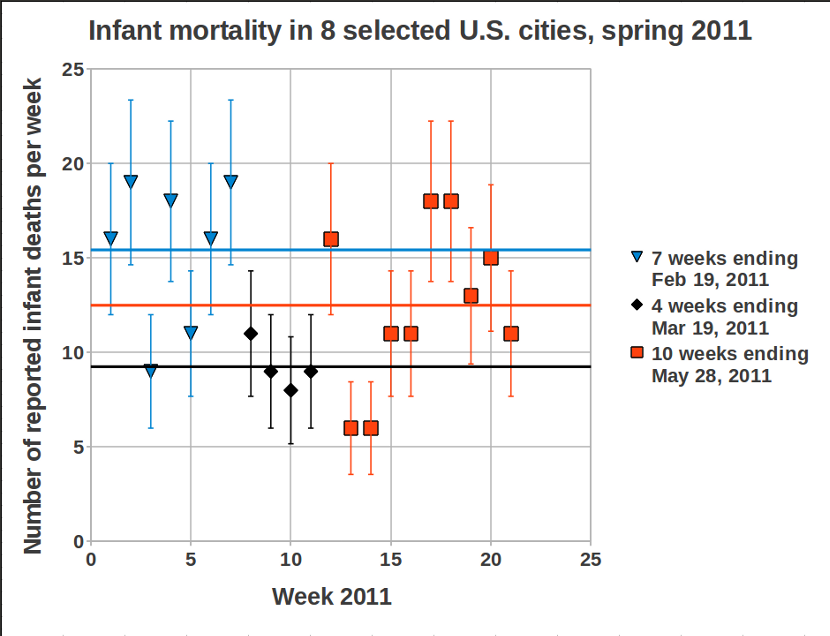
Infant mortality for 8 northwest U.S. cities, less biased version

Very interesting, the first seven weeks of 2011 actually has higher infant mortality than the weeks after Fukushima, quite different from what Sherman and Mangano wants us to believe. There is no spike after Fukushima, instead there is a dip during the 4 weeks before! A more detailed report on the closer scrutiny of Sherman and Mangano’s article is found in our Deep Repository.


So, why does a Medical Doctor mistreat official data in this way? It is quite remarkable, and embarrasing, especially since Janette Sherman writes about herself on her web page (http://janettesherman.com/about/):

Dr. Sherman’s primary interest is the prevention of illness through public education and patient awareness.

She seems to have forgotten about her primary interest in this case, I fail to see how cherry-picking data can be part of public education and public awareness. And if anybody can see how you can prevent illness through scaring people with false statistics, then please explain it to me. Embarrasing, Janette Sherman…

Joseph Mangano already has a track record of handling data in not so honest ways, we may come back to that in other blog entries (a few links to examples, as requested by a commenter: http://neinuclearnotes.blogspot.com/2005/08/joseph-mangano-and-art-of-deception.html and http://www.nei.org/resourcesandstats/documentlibrary/safetyandsecurity/factsheet/scienceonradiationhealtheffectsdispelstoothfairyproject/).

What baffles me the most is that he and Sherman try to get away with this alarmistic claim by such a lousy handling of official data. Anybody can easily check it for themselves and see that Sherman and Mangano are wilfully interpreting data so that they agree with their already decided view on things. What is worse, they are scaring a lot of people with their claims, for no reason at all. Therefore: Shame on you!

/Mattias Lantz – member of the network Nuclear Power Yes Please


Follow-up blog entries on the same subject

19 June 2011: More bullshit from Joseph Mangano, take 2

21 June 2011: CounterPunch verifies infant mortality was alarmism but seems keen to create more of it

27 July 2011: Sherman & Mangano admits errors – or do they?

21 December 2011: 3 strikes and you’re out! Sherman & Mangano does it again…

29 August 2012: Joseph Mangano never stops, and he never gets it right

Update 24 June 2011

Several other people have scrutinized the Sherman-Mangano joke (by now I do not want to mis-use the word “study” in connection with these people), most notably in Scientific American. Here is a list:

  • The Buzz Blog on Physics Central comments on the scrutiny done in Scientific American and asks the question why Sherman and Mangano is doing this nonsense: “Beware the Evil Scientists”
  • The uvdiv blog has a guest post by Alexey Goldin that hopefully is enjoyable also for non-statistics nerds, and he shows data for several years back: A curious case of cherry-picking data for the greater good. I can only agree with his final statement: At this point it is worthwhile to question either the scientific integrity or statistical competence of Sherman and Mangano. They might be decent people and believe in what they say, but allow themselves to say “small lies” in a service of “Greater Truth”. This never ends up well. Because they are likely to kill some unstable people with their small lies.

Update 25 June 2011

Several persons have asked about how to get access to the raw data. I put a summary of the links I have used on the follow-up post regarding the strange results from the CounterPunch re-analysis of the data (here), but I will now put them here as well. The last link on the list is the one that is the easiest one to use. Some information will appear if you hold the pointer over each link:

http://www.cdc.gov/

http://www.cdc.gov/mmwr/mmwr_wk/wk_cvol.html

http://www.cdc.gov/mmwr/preview/mmwrhtml/mm6010md.htm?s_cid=mm6010md_w#tab3

http://wonder.cdc.gov/mmwr/mmwrmort.asp


61 Comments
Gurke? Nein Danke…

While Angela Merkel was busy contemplating whether to close down nuclear power, 10 people died from EHEC infected cucumbers. During the same time, nuclear power in the world – including Fukushima – killed noone.

So… if nuclear power is so dangerous that it has actually not killed or seriously injured anyone and therefore needs to be banned… while German cucumbers make people bleed their intestines out to the point of actually dying… doesn’t that mean…


Gurke? Nein Danke
Gurke? Nein Danke (clickable for high-res image)

Also, as a little side note… in the 80 days that has passed since the Japanese Earthquake and tsunami disaster struck… approximately 400 to 600 people have already been sentenced to premature deaths due to Germany’s decision to close down nuclear power, from the increased emissions from fossil fuels. Now Germany plans to add another 10 000 MW of coal power to its production to replace the nuclear power, meaning another 100 000 to 250 000 people will die, due to the extra pollution this will cause.

Way to go Angela…

41 Comments

Day 68: Video of work at Fukushima and a encouraging PDF

TEPCO has released a video that shows work being done at the Fukushima plant. Very interesting to watch.

One gets a real sense for the devastation the tsunami inflicted while watching that clip.

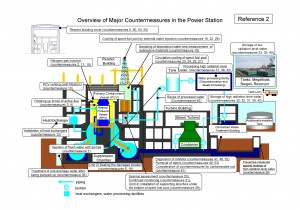
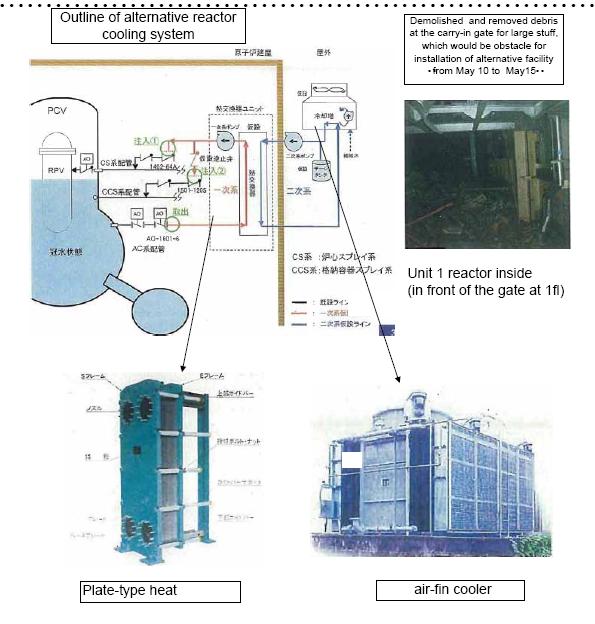
TEPCO also recently released this PDF file that gives an overview of work being done. I will add some pictures from it:

In the above picture one can see how they plan to rig up the new heat exchangers for reactor 1. Within the reactor building, but outside the containment, they will put a water to water heat exchanger. They will pump water from within the containment through this heat exchanger, where it transfers the heat to a secondary circuit that in turn flows to a heat exchanger outside of the reactor building that dumps the heat to the air. This is the original plan TEPCO had before they realized the full extend of the damage to the number 1 core and containment, so it is not sure they will progress as described. But the secondary heat exchanger and its piping is already being built.

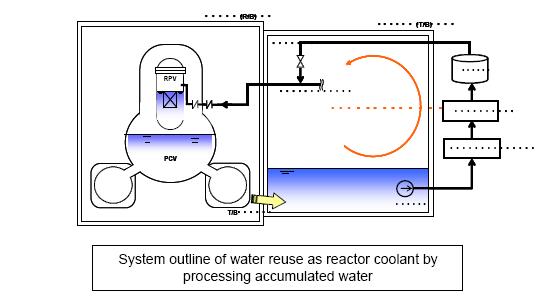
Tepco also shows the above picture on how they plan to reuse leaking water from the containment as cooling for the reactor. It is not clear how the two plans are connected to each other. I would assume the second plan is the one that is going to be used instead of the first plan. Instead of taking water directly out of the containment they will use the existing leakage paths, purify the water and pump it back into the reactor.

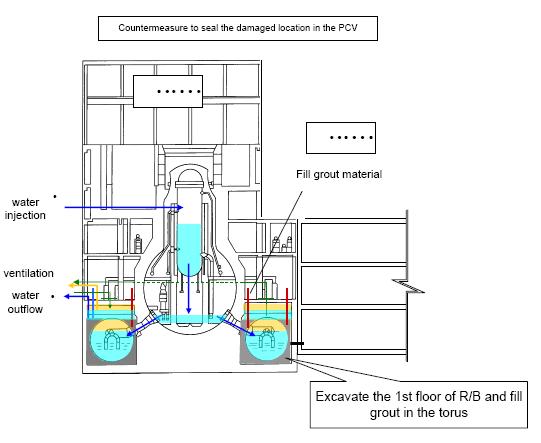
For the number 2 reactor shown above the main problem is to stop the leakage from the suppression pool. They plan to excavate the reactor building in order to access the room where the suppression pool is housed and then fill the entire volume with grout. Considering that (probably) the suppression pool is leaking at number one as well then maby this plan will be implemented there as well (just my speculation).

Both in unit 2 and 3 are they planning to reuse the leaking water in the same manner as in unit 1.

In the rest of the document they give some basic information on how they plan to clean the massive amounts of contaminated water that exists on the site, some details on the protective building they want to build around the reactors and how to prevent more contamination of soil, water etc. Well worth scrolling through, massive work is certainly ongoing at the site and it seems TEPCO has a solid plan that they are implementing.  Of course more surprises will without a doubt pop up during work, but it looks promising. We are still waiting for more in depth information on the situation of the number 2 and 3 reactors.

English blogs:
All Things Nuclear TEPCO Says Core of Unit 1 Melted
Atomic Power Review Fukushima Daiichi update, Weds. morning 5/18

English News:
New York Times Venting Failure in the Nuclear Reactors at Fukushima Daiichi
Reuters UK nuclear power gets green light

/Johan


6 Comments
Day 67: Complete meltdown of the number 1 core

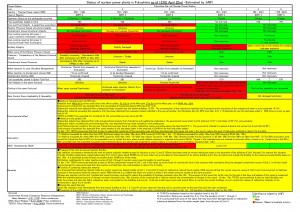
During the last days a lot of news has been released by TEPCO. TEPCO has released this presentation that gives more details of the events that took place in the number 1 reactor from the beginning of the earthquake up until now. To summarize the content of the presentation.

  • The water level gauge has been giving wrong readings, the reading has been stating that the water level is about 1.7 meters below the top of the fuel assemblies. In reality the water level has been 8 meters below the top of the fuel assemblies, this means the entire length of the fuel has been uncovered completely.
  • TEPCO now assumes the RCIC system failed after the tsunami (another news release indicates it was manually shut down!!)
  • 16 hours after the earthquake the entire core had suffered a meltdown and all of it dropped down to the lower part of the pressure vessel.
  • The temperature readings on the vessel indicate that the core is still mostly within the vessel and adequately cooled.
  • Some parts of the core is suspected to have melted small holes in the bottom of the containment, which explains why they could not increase water level despite increasing pump rate.

They don’t mention the reading of the pressure gauge that indicates the vessel pressure is about 14 atmospheres. I was personally fooled by this reading and assumed the number 1 vessel is in better shape than the number 2 and 3 reactors. The question is what readings can be trusted at all.

Due to this new information on the status of the reactor TEPCO has decided to scrap the original plan to flood the containment up to the level of the fuel assemblies. Since all the fuel is now located at the bottom of the vessel there is no need to flood the containment that high.  The containment is also confirmed to be breached and water leaking out of the it like in the case with reactor number 2.

Another theory for the explosion in the number 4 reactor building has appeared. The videos from the pool show that it is largely intact and no major fuel damage can be seen. That means it seems unlikely hydrogen from a zircalloy+water reaction in the spent fuel pool can be the cause of the explosion. Instead TEPCO now believes hydrogen leaked into the number 4 building from a shared ventilation system with the number 3 reactor.

TEPCO is going to do more complete analysis of the status of reactor 2 and 3 and the information will be released within days. It will be interesting to see if the RCIC system (see this blog post for a description of the system) worked in the other 2 reactors and, if it did, to what extent it mitigated the consequences of the station blackout.

Work is progressing on all fronts to build a enclosure around the number 1 reactor, to build a water processing plant, create more redundancy in the electricity supply, clear the area of debris and to pump away the junk water from the turbine halls and trenches. IAEA as usual reports the release of radioactive material and dose rates.

The Fukushima accident has unfortunately seen its first death with a 60 year old worker that lost consciousness  while working on a drainage system to the radioactive waste storage. He was brought to a hospital but could not be revived. So far there is no report that the death was related to radiation.


News English:
WNN Fukushima fuel melt confirmed
WNN Theory for Fukushima Daiichi 4 explosion
WNN Revisions to Fukushima restoration roadmap

Blogs English:
Depleted Cranium Worker Dies at Fukushima Nuclear Plant
Atomic Power Review Core totally demolished at Fukushima Daiichi No. 1

Blogs Swedish:
TEM funderingar <Är kärnkraft förnybart?
Den blinde Argus Kärnkraft och rädsla
Supermiljöbloggen IPCC: Förnybart kan ersätta fossila bränslen
Fourfact Blinkar jätten?
Skattepolitik och samhällsfilosofi Inga elbilar i Sverige om Tyskland stänger kärnkraften?
Ann-Kristine Johansson Kärnkraftsdiskussion
Nina Drakfors Japan, kärnkraftshaveriet fortsätter och kräver strålningsdödstal
Supermiljöbloggen Amerikansk kärnkraft dåligt rustad för katastrofer

/Johan

Comments closed

Day 58: Dose rates climbing in the number 2 wetwell

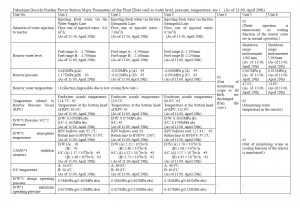
Another week has passed and more steps have been taken to get the situation under control. Lets start with the usual reactor status table  made out of NISA data:


Reactor 1 Reactor 2 Reactor 3
Water level (meter)* -1.7 -2.1 -2.15
Flow rate(m3/min) 8 7 9
Core pressure (kPa) 1390
Containment pressure (kPa) 120 60 102
Wetwell pressure (kPa) 110 183.2
Feedwater nozzle temp (Celsius) 119.8 115.6 202.1
Bottom head temp (Celsius) 96.9 151.9
Wetwell temperature (Celsius) 51.4 66.8 40.0
Containment dose rate (Sv/hour) 22.7 12.2
Wetwell dose rate (Sv/hour) 1.1 148 0.480
*Distance from top of assembly
– broken gauges or missing data

Everything looks pretty stable except the wetwell dose rater in the number 2 reactor. It has increased to well over 100 Sv/hour from 37.1 in the last update I made (i wrongly wrote 0.371).  I haven’t been able to follow the news so closely the last week so I have not seen if this has been mentioned in any TEPCO press release. Below is a graph of the increase. If anyone know of any action done on the number 2 reactor, starting the 3 or 4th of may please write a comment to this blog post.


A air filtration system has been connected to the reactor building of reactor number 1. The purpose of it is to get airflow through the building and clean out the air activity by filtrating the air. It is hoped that it will be enough to allow workers to enter the building and work safely without getting to much dose.

Kyodo reports that TEPCO plans to send in workers on monday in order to measure dose rates within the building. Seems strange that they would send in people when they have already used robots once for that purpose.

A longer video clip of the number 4 spent fuel pool can be seen over at Atomic Power Review. It doesn’t appear to be very damaged.

The big news of the week is that the prime minister of Japan has asked Chubu electric to shut down its Hamaoka nuclear power plant. Hamaoka has 3 operational nuclear power plants, all of them quite new. Started at 1987, 1993 and 2004. The newest one is a ABWR and would presumably have state of the art eartquake protection. The reason for the prime ministers request is a estimate that the site  has a high probability to be hit by a 8.0 earthquake within 30 years. If the reactors indeed can not handle such a quake then the closure request is rational. But it does smell a bit like political posturing at this point. There is no legal precedence for such a situation and it is not clear if Chubu electric has to obey the request.


Links(English)
WNN Filters for Fukushima Daiichi 1

Blogs(English)
Atomic Power Review Japan updates: Fukushima Daiichi, Hamaoka
NEI NEI Weekly Update on Fukushima Daiichi – 5/6/1

Blogs(Swedish)
Effekt Monbiot brottas med sig själv
Genusnytt En KARL ska väl tåla lite strålning…
Forskarbloggen Hur många döda efter Tjernobyl?
inas insikter Tjernobyl idag / Fukushima imorgon?
Begrundat och Plitat Cesium och Jod verkar ge spikes i Fukushima när man gläntar på dörren …

/Johan

2 Comments
Why I do not trust “We don’t need nuclear” rethorics

Dear Mr./Ms. Anti-Nuclear Activist… for decades You have been telling me “It’s easy to get off nuclear, if we just want to!”. Well, alot more powerful people than You have made similar promises…

Where do we stand today after all these promises? Pretty much exactly where we were 5-10-20-40 years ago.

So – dear Mr./Ms. Anti-Nuclear Activist – You promise me gold and green forests… but You don’t deliver. Maybe this wasn’t Your fault. Maybe You’d like to blame Big Oil or lazy politicians or a public that just won’t see things the way You do. It’s allright… You can try to shift the blame any place You want. But it doesn’t matter whose fault it is, becasue assigning blame does not alleviate the problem.

So when You – dear Mr./Ms. Anti-Nuclear Activist – today, yet again, try to tell me it’s allright to renounce nuclear power, it means I cannot trust You, because things might no go they way You promise me they will.

What will You – dear Mr./Ms. Anti-Nuclear Activist – need to do to gain my trust again?

Well it’s easy: get the replacements up and running. Get full replacements for fossil fuels and nuclear power up and running, hooked to the grids and pumping GigaWatthours of energy into them, and I’ll trust You again.

So… dear Mr./Ms. Anti-Nuclear Activist…. get to work. We’re eagerly waiting for You.

Oh… and one last thing: while we wait for you to get this work done, You do not get to say we cannot make any new nuclear power if we want to, at least on the “We’re not gonna need it in a while”-argument alone.  Just saying this FYI…

25 Comments
Day 50: First year dose estimates

As the pace of events is winding down in Fukushima so are our updates.

JAIF and NISA updated data below in the table, click the links to see the time graphs from the FNPP1 blog:


Reactor 1 Reactor 2 Reactor 3
Water level (meter)* -1.7 -2.1 -2.25
Flow rate(m3/min) 6 7 6.5
Core pressure (kPa) 1175
Containment pressure (kPa) 105 75 103.3
Wetwell pressure (kPa) 105 179.6
Feedwater nozzle temp (Celsius) 114.7 119.2 80.6
Bottom head temp (Celsius) 95.0 112.9
Containment dose rate (Sv/hour) 24.8 17.0
Wetwell dose rate (Sv/hour) 1.5 0.371 0.527
*Distance from top of assembly
– broken gauges or missing data

Temperatures, pressures etc look quite stable. Pumping of water form the tunnel connected to the number 2 turbine building is marginally successful. Spraying of a resin to bind down radioactive material to the ground, and prevent it from stirring up into the air, is ongoing all over the plant area. TEPCO has managed to get a camera in to investigate the number 4 spent fuel pool and world nuclear news report that the damage is limited, below is a picture from WNN of the pool.

Atomic Power Review writes that NISA has doubts about TEPCO’s plans to flood the containments. The doubt is regarding the structural integrity of the containments with the added strain from such a huge amount of water. Flooding the containment is a part of TEPCO’s plan to restore recirculation cooling to the reactor so it will be crucial to see how TEPCO responds to NISA and if they can show the containments can handle it. If they can not show it conclusively, then they will have to devise a new plan on how to restore cooling. In my last post I was questioning why they would want to flood the containments in the first place, but then realized that if the reactor vessels are broken and leaking, then the only way to submerge the fuel completely is to raise the level of water in the containment to the same level as the top of the fuel assemblies within the reactor vessel. I don’t see why this would be needed for the number one reactor, since it seems like it is holding pressure very well and must be pretty intact. But might be the only way for the number 2 and 3 reactors.
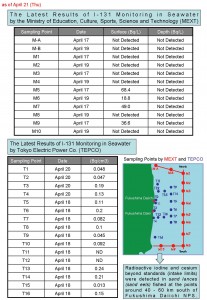
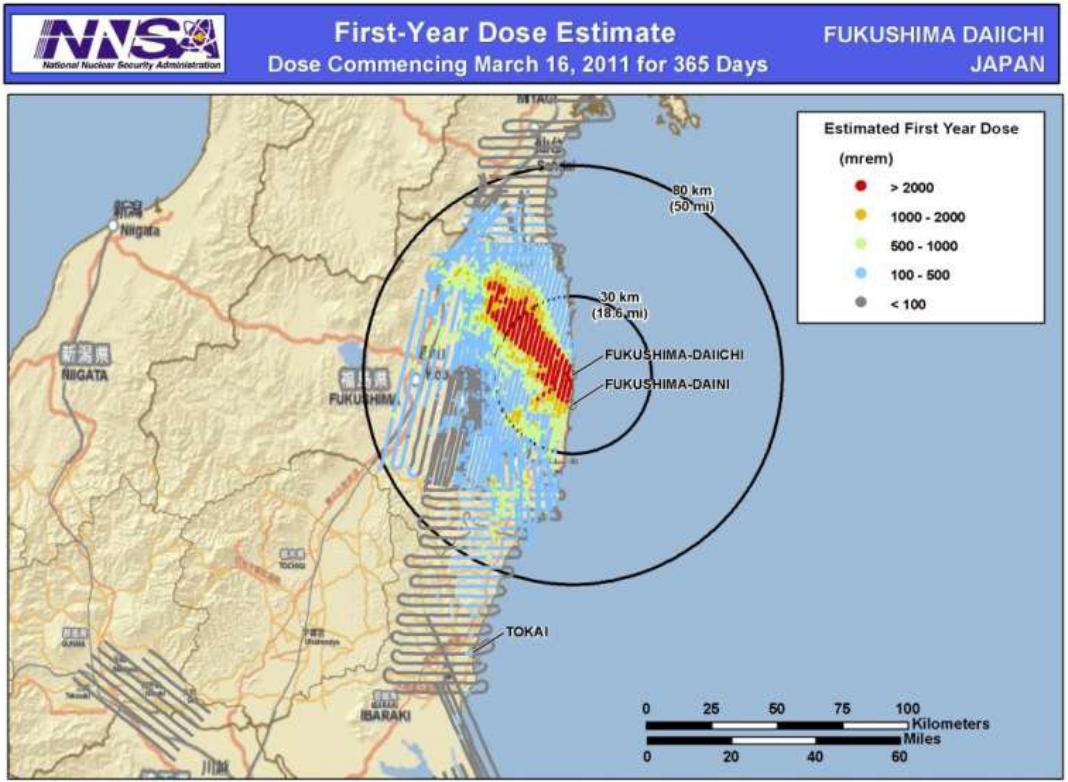
Over at The neutron economy one can read a blog post on the expected first yearly dose relased by the US department of energy, below is a map of it.

The dose rate is based on the following assumptions:

  • Assumes no reduction for spending time indoors
  • Takes into account decay of the radionuclides
  • Takes into account gamma ray from ground deposits and inhalation of stirred up particles from the ground

The map is using the common american unit millirem. One millirem is equal to 0.01 millisievert. The red area marks the area where one would get more than 20 mSv/year if one lives there given the above assumptions.  Yellow area is 10-20 mSv, green area is 5-10 mSv and blue area 1-5 mSv. Neutron Economy also shows a picture with more detail of the over 20 mSv area that can be found in this link. Close to the plant it will be up to 200 mSv and in some hot areas 100 mSv. Some of the hot areas are outside of the initial 20 km evacuation zone and that explain the new evacuation areas. It is not immiedietly dangerous to be in those areas but one probably does not want to live there. It will be interesting to hear what plans will be made to clear out the areas. Outside of Fukushima dose rates are down to natural backgrounds levels according to IAEA. Seems like bans on shipping of most kind of food products have been lifted.

More information about exposed workers have been released, so far it looks like this:

  • 200 – 250 mSv             2 workers
  • 150 – 200 mSv             8 workers
  • 100 – 150 mSv             11 workers


In summary one can say that the situation as far as radiation levels are concerned is improving. Radiation levels are decreasing everywhere. The situation with the reactors are fairly stable, but long term cooling is still a big question mark.

/Johan

Links(English)
World Nuclear News No significant damage to fuel at unit 4

Blogs(English)
NEI Nuclear NotesWeekly Updated
Atomic Power Review NISA instruction to TEPCO
The Neutron Economy Expected Doses Over a Year and Evacuation of Fukushima Towns

Blogs(Swedish)

Dagens Kotka Tre härdsmältor på samma plats
Fourfact webloggen Naturligt kärnkraftsmoratorium
Stockholmscollage Vad har uranpolitikerna att frukta
Svensson En annan värld – kampen mot kärnkraft
Akkomp’s blogg Som ett smycke


11 Comments

Därför samarbetar vi kärnkraftskramare med motståndarna

Göran Bryntse, f.d. ordförande för Folkkampanjen

Vi i Nuclear Power Yes Please har tillsammans med Göran Bryntse – nyligen avgången(*) ordförande för Folkkampanjen mot Kärnkraft-Kärnvapen – författat en artikel om debatten om kärnkraft. Den finns idag att läsa i Aftonbladet och här.

Så varför samarbetar vi kärnkraftskramare med en av Sveriges mest framträdande kärnkraftsmotståndare? Vi står ju uppebarligen på varsin kant av åsiktsspektrat. Varför skriver vi en artikel ihop?

Därför att debatten om kärnkraften är viktigare än åsikten om kärnkraften. En dålig kärnkraftdebatt medför dåligt fungerande kärnkraft, och detta vill ingen av oss skall hända.

För både Göran och oss är det viktigare att frågan avhandlas på ett sakligt och korrekt sätt, hellre än att just vår respektive åsikt “vinner”. I slaget om kärnkraften är matchen långt viktigare än resultatet… men vad som än händer får det inte bli oavgjort.

Problemet var dock att just det hände: det blev oavgjort. Svenska politiker har hittills inte sagt vare sig JA eller NEJ till kärnkraft, utan man har istället låtit kraftformen få finnas kvar, samtidigt som den har blivit hårt motarbetad. Detta är det sämsta av två världar: man får inte några fördelar av att kraftformen faktiskt försvinner, och man får inga fördelar av den tekniska utveckling som sker för kärnkraften.

Hur kunde det bli så här? Häng med oss tillbaks i tiden för en titt hur det gick till, och se vad du själv kan göra för att säkra en bra kärnkraftsdebatt nu när frågan väckts till liv igen…

Tips: se gärna Sigfrid Leijonhufvud’s föredrag tillsammans med den här artikeln, ifrån SVT Play – Energiförsörjningens risker, spola till 1 tim 09 min.

Återblick

Renforsen i Vindelälven hade kanske inte funnits kvar om inte för kärnkraften

Kärnkraften är Sveriges kanske viktigaste energipolitiska fråga sedan mer än 50 år tillbaks. Redan innan dagens 10 reaktorer ens var projekterade var de en del av den svenska energi- och miljöpolitiken.

Rädda älvarna

På 1950- och 60-talet stod striden om älvarna. Skulle fler älvar dämmas upp och brukas till vattenkraft? Sverige behövde energin, men motståndet var stort. Löftet om kärnkraft räddade älvarna. Freden i Sarek och beslutet att inte bygga ut Vindelälven möjliggjordes tack vare det hopp kärnkraften gav. Visserligen stod en del av hoppet också till billig olja som skulle användas i kraftverk. Men oljekrisen 1973 och miljömedvetenheten satte tack och lov stopp för dessa planer, varpå kärnkraften ansågs vara det givna alternativet.

“Atomkraft? Nej Tack”

Olof Palme skäller ut Centern i valdebatt 1976

Men kärnkraften var inte okontroversiell. Dess ursprung från militära tillämpningar, avfallet och säkerheten var saker som fick motståndet att växa. Frågan blev het och infekterad. När den nådde riksdag och regering skräddes inte orden. Thorbjörn Fälldin vände Centern bort ifrån kärnkraften, trots att Bondeförbundet vurmat för den, och de fyra kärnkraftskommunernas Centerpartister slitit hårt för att få de nya verken. Fälldin gjorde sitt berömda uttalande om att han inte tänkte “dagtinga med sitt samvete” och krävde folkomröstning i frågan. Olof Palme skällde ut honom efter noter i valdebatten 1976.

Socialdemokraterna förlorade förvisso valet, men kärnkraftsfrågan blev till slut för mycket för borgarna. Beslutet att ladda Barsebäck 2 med bränsle tog knäcken på regeringen Fälldin. Palme angrep hårt och anklagde Centern för “svek” (låter det bekant?). Fälldin lämnade in regeringens avskedsansökan på hösten 1978. Ola Ullsten tog över med Folkpartiet i väntan på valet året därpå.

Den störste kärnkraftsmotståndren var utskämd och förmodligen hade kärnkraftsfrågan lagt sig och varit en något mindre fråga i valdebatten. Men något hände på vägen…

“Det som hände i Harrisburg”

28 mars 1979 inträffade härdsmältan i reaktor 2 på Three Mile Island utanför Harrisburg. Trots att ingen skadades av olyckan blev opinionen fullkomligt rasande. Palme gick snabbt med på folkomröstning för att slippa ha kärnkraften som en valfråga. Socialdemokraterna krävde att få ha ett nytt alternativ i omröstningen: Linje 2. Kärnkraftsdebatten var hetare än någonsin. Tage Danielsson framförde sin odödliga och utsökta monolog om Sannolikhet.

Debatten inför omröstningen genomsyrade Sverige ("Ratte och Odjuret", Knutsson & Jansson)

In i det sista var det oklart vilken linje som skulle vinna: nedläggning inom 10 år, eller senare? Till slut visade det sig att Linje 2 – nedläggning när alternativ finns – hade vunnit omröstningen, om än nätt och jämnt över linje 3. Ett riksdagsbeslut om att kärnkraften skulle vara avvecklad till år 2010 togs.

Från 1980 till 2011

I och med kärnkraftsbeslutet 1980 var debatten stendöd. Från att ha varit den hetaste frågan på 70-talet försvann den på rekordtid från det allmänna medvetandet. Palme hade lyckats rädda det socialdemokratiska partiet ifrån att splittras. Folket var nöjda och politikerna andades ut; de hade sluppit den heta potatisen och istället lyckats kasta den ifrån sig, 30 år in i framtiden…

Tjernobyl och tankeförbudet

Varför man inte bygger reaktorer enligt sovjetiska designer från 1950-talet

Frågan vaknade kortvarigt till liv 26 april 1986 då det hände precis som kärnkraftsexperterna anat skulle hända: en reaktor av RBMK-typ exploderade i Ukraina, dåvarande Sovjetunionen. Detta var väntat eftersom RBMK-designen var ökänt farlig. Två veckor innan olyckan försökte en anställd på Vattenfall få publicerat en artikel i DN om att risken för en större olycka i denna typ av reaktorer var 1 på 3 (tidpunkt 59 min, 03 sek). Artikeln refuserades…

I de drabbade länderna har man påvisat ca 4000-7000 extra fall sköldkörtelcancer som en följd av olyckan – en ökning med ca 1000% för själva cancerformen, 4 – 7% för antalet cancerfall totalt för den påverkade gruppen – men med en överlevnadsgrad på över 99% eftersom sjukdomen är lätt att upptäcka i tid med screening (vissa “markörer” – signalämnen i kroppen – för sköldkörteln ger tydliga utslag vid minsta fel, vilket man ser tidigt med hjälp av blodprov så länge man tar dem regelbundet). Dock borde detta ha varit onödigt, därför att alla dessa cancerfall kommer av det fruktansvärda faktum att sovjetiska myndigheter stoppade inte mat och mjölk förgiftad med Jod-131, trots att det är lätt att upptäcka och sålla bort kontaminerade varor.

I Sverige rådde Becquerel-hysteri i flera år och vissa illa genomtänkta åtgärder genomfördes, som att man slaktade och kasserade onödigt många renar. Dock har man inte – trots diverse oseriösa figurers idoga försök – kunnat påvisa att vi fick några hälsoeffekter i Sverige.

Det märkligaste för svensk del var dock den så kallade tankeförbudslagen. Det sägs att Birgitta Dahl fick reda på att man klurade på vad det skulle krävas för att ersätta Oskarshamn 1 – Sverges äldra kraftreaktor i drift – med en ny, säkrare reaktor. Detta ville hon inte veta av, varpå 6:e paragrafen i Lag om Kärnteknisk Verksamhet infördes:

6 § Ingen får utarbeta konstruktionsritningar, beräkna kostnader, beställa utrustning eller vidta andra sådana förberedande åtgärder i syfte att inom landet uppföra en kärnkraftsreaktor.

Tankeförbudet var formellt sett inte ett förbud mot att vidareutveckla kärnkraftssäkerhet eller forska på kärnkraft. Dock visade sig att det var just en sådan effekt lagen fick. Tjugo år senare kröp socialdemokraterna till korset och erkände att lagen skadat svensk kärnkraftssäkerhet. Ifrån propositionen att avskaffa lagen:

Visserligen står det i 6 § kärntekniklagen att bestämmelsen endast avser åtgärder som syftar till att uppföra en kärnkraftsreaktor inom landet. Av paragrafens förarbeten framgår därtill tydligt att förbudet inte riktar sig mot t.ex. tekniskt utvecklingsarbete på kärnsäkerhetsområdet. Trots detta synes paragrafens enda praktiska effekt vara att, i strid mot intentionerna vid dess införande, inkräkta på möjligheterna att fortlöpande bedriva sådant arbete (jfr prop. 1986/87:24 s. 5). Detta är mycket otillfredsställande, då forskning och tekniskt utvecklingsarbete inom kärnteknikområdet är av stor betydelse för kärnsäkerheten och kärnavfallshanteringen. Dessa frågor kommer dessutom att vara aktuella under lång tid i Sverige, varför det är mycket viktigt att det sker en kontinuerlig kompetensuppbyggnad vid de institutioner som bedriver sådan verksamhet genom bl.a. nyrekrytering av forskare och tekniker och deltagande i internationellt samarbete. Som utredningen har konstaterat hämmas emellertid sådan kompetensuppbyggnad av den utbredda misstolkningen av 6 § kärntekniklagen som råder inom landet och som alltså går ut på att all forskning inom det kärntekniska området skulle vara otillåten. Bestämmelsen har också givits den nedsättande benämningen ”tankeförbudsparagrafen”, vilket ger oönskade associationer i en demokratisk kontext.

Avvecklingslagen

1997 började kaoset på allvar. Regeringen Persson gick ihop med Centern i en uppgörelse som innebar:

  • Barsebäck lades ned.
  • Slutdatum år 2010 togs bort.
  • Regeringen gavs rätt att när helst besluta att lägga ned reaktorer.

Tidigare var regeringen tvingen att be riksdagen om lov för att få stänga reaktorer. Men i och med avvecklingslagen kunde regeringen på eget bevåg ta sådana beslut, utan att behöva förankra dem hos de folkvalda.

I ett slag försvann alla möjligheter för kärnkraftsbolagen att planera långsiktigt. Från att ha haft ett klart och tydligt stopp-datum visste de nu inte om de skulle få nedläggningsbeskedet i morrn – på samma sätt som Barsebäck – eller om det skulle komma om 10-20-30 år. På frågan om de skulle livstidsförlänga verken för tvåsiffrigt antal miljarder eller inte fick de inga besked. Däremot sade avvecklingslagen att livstidförlängningar som fick verken att gå i över 40 år inte skulle få ersättning för dessa vid en eventuell nedläggning.

7 § När ersättningen skall bestämmas skall som särskilda förutsättningar gälla följande:

  1. Har upphörandet av driften vid en kärnkraftsreaktor medfört inverkan av någon betydelse på priset på högspänd el i Sverige, skall ersättningen beträffande den reaktorn bestämmas på grundval av det pris som skulle ha gällt om en sådan inverkan inte hade förekommit.
  2. Ersättningen skall bestämmas utifrån antagandet att en kärnkraftsreaktor inte kan nyttjas mer än 40 år efter den tidpunkt då den först togs i kommersiell drift.

Först 2005-2006 fick bolagen beskedet att de hade tillåtelse utföra livstidsförlängningarna som de hade börjat planera för. Men det var för mycket arbete på alldeles för kort tid. Tidigt på våren 2009 gick de igång med det praktiska arbetet, och misslyckades kapitalt. Över 24 reaktormånader förseningar och två oväntat extra kalla vintrar orsakade kaos i det svenska energisystemet. Avvecklingslagen landade i våra brevlådor i form av skyhöga elräkningar.

Och som inte det var nog har dessutom Strålsäkerhetsmyndigheten varnat för att vi riskerar få en brist på kunnig personal inom kärnkraftssäkerhet och strålskydd. Myndigheten säger att det tar upp till 20 år att ersätta experter inom dessa områden.

Enligt myndighetens senaste risk- och sårbarhetsanalys väntas brist på specialister inom både kärnkraftsäkerhet och strålskyddsberedskap de närmaste åren. Många av experterna i Sverige är redan pensionerade och ersättarna är för få. I rapporten konstateras att det kommer att “ta lång tid att på nytt bygga upp den saknade kompetensen”. Att utbilda en ny specialist beräknas ta omkring 20 år.

–Det är ett stort problem. Sverige har inte sett om sitt hus i tid och vi har inte klarat att överföra kunskap till nya generationer, säger Robert Finck.

Bakgrunden är att Sverige under många år planerade att avveckla kärnkraften. Efter olyckan i Tjernobyl för 25 år sedan infördes också den så kallade tankeförbudsparagrafen i kärnteknik- lagen som delvis hindrade svensk kärnkraftsforskning. Intresset för att studera kärnteknik hamnade på en bottennivå.

Dessutom har SSM vid flera tillfällern behövt att gå in och ta kärnkraftsbolagen hårt i örat, med bland annat “särskild tillsyn” av Forsmark och Ringhals.

Efter 35 års kärnkraftsdebatt har vi lyckats köra svensk kärnkraft i botten. Ingen – inte vare sig kärnkraftsförespråkare eller kärnkraftsmotståndare – kan tycka att det är en bra situation vi har idag.

Efter Fukushima: så kan DU göra debatten bra

Problemen med den svenska kärnkraften har sina rötter i en dålig svensk kärnkraftsdebatt som har lett till att politiker tagit dåliga, kontraproduktiva beslut. Orsaken till den dåliga debatten är att allmänheten inte har givits den kunskap som behövs för att få en komplett bild över vad kärnkraft är, hur den fungerar, och vad dess starka och svaga sidor är. När människor i panik köper jodtabletter för strålningsnivåer som är 15 miljoner gånger mindre än vi redan har i våra kroppar, är det uppenbart att folkbildningen om kärnkraft har misslyckats.

Bättre blir det inte när fakta och sakargument ersätts av partipolitik och politikers nycker i debatten. Då är det inte konstigt att våra folkvalda tar dåliga beslut. Resultatet blir därefter: krånglande kärnkraft, sämre förutsättningar för bra säkerhet, rusande elpriser…

Nu står vi inför en ny debatt i och med Fukushima-krisen. Den debatten måste bli långt bättre än vad som skett tidigare, annars kommer vi att ta konstiga beslut igen, och ytterligare sabotera svensk kärnkraft. Förutsättningarna för debatten är både bättre och sämre.

  • Bättre är att informationsflödet idag är totalt anorlunda. Människor kan fortbilda sig om kärnkraft på ett sätt som är ren science fiction jämfört mot hur det fungerade på 70- och 80-talet.
  • Sämre är att de som arbetar med kärnkraft – och som har absolut störst kunskap om hur Svensk kärnkraft fungerar i praktiken – inte hörs eller syns. Kraftbolagen lägger munkavle på sina anställda. De får inte uttala sig i debatten, och vad värre är får de inte heller ställa upp i media med sina expertkunskaper för att hjälpa till med att förklara hur olika säkerhetsfunktioner fungerar, något som blev extra tydligt i samband med händelserna i Fukushima. Inför folkomröstningen 1980 så talade de åtminsone från hjärtat vad de tyckte…

…men idag är tystnaden total.

Strålsäkerhetsmyndigheten har haft fullt upp och informerat människor, men de sakkunniga utför ingen folkbildning utöver att akut svara på frågor. Och inom forskningen så börjar man nu lite försynt fundera på att höja rösten då de ser vilken otrolig kunskapstörst det finns hos allmänheten, men man har inte fått upp farten än.

Det som du som läsare kan göra för att debatten skall bli bra är att söka kunskap. Informera dig. Det finns massor med information på öppna källor, som exempelvis Wikipedia, som är lätt tillgänligt för dig att ta del av. Det finns också intresseorganisationer och nätverk på båda sidor om åsiktsfrågan, som exempelvis Nuclear Power Yes Please och Folkkampanjen, som gärna berättar våra argument. Lyssna… ställ frågor… jämför… ifrågasätt.

Framför allt bör du söka kunskap hos de som kan kärnkraft. Och vill inte de komma till dig så kan du komma till dem. Maila… ring… eller åk och hälsa på! Besök hos kärnkraftverken och Svensk Kärnbränslehantering (SKB) är gratis. Anmäl en grupp kompisar, åk dit och se själva. Gör det till ett utflyktsmål på semstern. Ingen går därifrån opåverkad.

Framför allt måste vi alla vara öppna för möjligheten att vi kan ha haft fel om kärnkraft. Vi inom Nuclear Power Yes Please har vid flertalet tillfällen behövt rannsaka oss själva, speciellt nu under Fukushima-krisen, vilken fortfarande inte är slut. När faktan från Fukushima har samlats in, och analysen är klar, först då vet vi om och i så fall hur vi kan gå vidare med kärnkraft i Sverige och resten av världen.

/Michael Karnerfors, en av författarna av debattartikeln från NPYP

Nya ordföranden Solveig Ternström och Anna-Linnéa Rundberg, gillade inte artikeln alls
(*) Faktum är att när vi var färdiga med artikeln var Göran fortfarande ordförande. Vi skickade artikeln till Dagens Industri, som sade att de skulle köra den. Men innan den hann gå i tryck hade FmKK årsmöte. Göran valdes bort och två nya ordförande – Solveig Ternström och Anna-Linnéa Rundberg – valdes. De var inte alls glada åt den här artikeln och mailade DI, som vek sig direkt…

29 Comments

Debattartikel i Aftonbladet: “Kärnkraftdebatten behöver långsiktighet”

Av nätverket Nuclear Power Yes Please, och Göran Bryntse, f.d. ordföranden för Folkkampanjen mot Kärnkraft-Kärnvapen
Publicerad på i Aftonbladet Debatt 2011-04-26

Kärnkraftsdebatten behöver långsiktighet

Det har inte undgått någon att svensk kärnkraft sett stora motgångar under de senaste åren. Mängden levererad el i förhållande till kapacitet var lägst i Europa under 2009 och 2010. Strålsäkerhetsmyndigheten (SSM) har vid flera tillfällen behövt ta kärnkraftsbolagen i örat och kräva uppsträckning, vilket efterföljts, men det är anmärkningsvärt att det skall behövas.

Grundorsaken till den svenska kärnkraftens nuvarande ställning är årtionden av kortsiktig politik och bristande kunskap och vilja hos beslutsfattare. Olyckorna vid Three Mile Island (TMI) och Tjernobyl innebar att en del märkliga och skadliga beslut togs:

  • En folkomröstning genomfördes där folket fick välja mellan två olika avvecklingsalternativ, fördelat på tre linjer.
  • I beslutet om avveckling saknades en reservplan för att hantera den situation som skulle uppstå om beslutet inte genomdrevs.
  • En lag som förbjöd oss att planera för nya reaktorer infördes.
  • En lag som tillät regeringen att utan riksdagsbeslut stänga reaktorer infördes.

Med detta kom svensk kärnkraftsindustri att sakna incitament och möjlighet för långsiktig planering. Konsekvenserna blev att produktionskapaciteten för de svenska reaktorerna dalat till historiskt låga nivåer. Säkerhetsarbetet har försvårats då industrin utarmats på kompetens. SSM konstaterar att det tar cirka 20 år att ersätta specialister inom kärnkraftssäkerhet och strålskydd. Myndigheten flaggar för att naturliga avgångar i kombination med att få valt att utbilda sig inom viktiga kompetensområden kan medföra ökade risker i framtiden. Resultatet av kärnkraftspolitiken från 1980 och framåt blev sålunda bland annat att Sverige fick sämre verktyg för att bedriva kärnteknisk verksamhet med högsta möjliga tekniska och säkerhetsmässiga standard.

Anledningen till att besluten blev sådana är bland annat:

  • Allmänheten har fått för lite och för dålig information om kraftformen och relaterade fenomen
  • Många som besitter viktig kunskap är frånvarande i den öppna debatten

Inom kärnkraftindustrin, myndigheter och forskningen finns stora kunskaper om kärnkraft. Men få, speciellt ifrån de lägre leden, vågar uttala sig i den öppna debatten trots att det är där kunskapen om hur kärnkraft fungerar i praktiken är som störst. Debatten måste utökas med dessa röster, speciellt som allmänheten vill höra vad de har att säga.

Just nu krävs att vi analyserar de enorma mängder fakta som händelserna vid Fukushima kommer att ge oss, samt kritiskt granskar den politik och den debatt som hittills förts. När vi därefter har ett faktamässigt beslutsunderlag i hand måste vi ta gemensamma och långsiktiga beslut.

Vad besluten sedan än blir så får det inte vara ytterligare ett obeslutsamt mellanting, utan något som är kristallklart och långsiktigt. Antingen stoppar vi kärnkraften med hjälp av en tidsbestämd avvecklingsplan, eller så måste vi acceptera kärnkraften som en del av vår energiförsörjning under överskådlig tid. Oavsett väg för kärnkraften skall också arbetet med att energieffektivisera och bygga ut förnybara kraftkällor fortsätta enligt bästa förmåga.

Det är viktigt att visa stor ödmjukhet inför dessa frågor och inte vara rädd för att erkänna att man kan ha haft fel. Detta budskap riktar vi till såväl kärnkraftsmotståndare som kärnkraftskramare. Debatten om kärnkraft är viktigare än åsikten om densamma.

Michael Karnerfors, civ. ing, grundare av nätverket Nuclear Power Yes Please

Göran Bryntse, tekn dr, f.d. ordf. i Folkkampanjen mot Kärnkraft-Kärnvapen

Göran Bryntse är civilingenjör i teknisk fysik från LTH, och teknisk doktor i papperteknik. Han var tills den 26/3 ordförande för Folkkampanjen mot Kärnkraft-Kärnvapen. Artikeln författade vi och satte underskrifter på 5 dagar innan det. Nya ordföranden för FmKK var inte road och stoppade vårt första försök att få artikeln utgiven i Dagens Industri.

Comments closed

Day 42: How is a core cooled?

Tepco has released more information about their plan to stabilize the Fukushima reactors(link 1, link 2). Their table of measures to be taken is hard to read, but the schematic of the plan is quite enlightening and i have attached it below.

They are basically facing 4 problems, ensuring long term cooling of the cores,  ensure cooling of the spent fuel pools, prevent release of radioactive material and mitigate the consequences of the releases that will continue for a while. I want to speak a bit more about cooling in this blog post since it is the most crucial problem.

As I have written before (and I will repeat it again, bear with me), the most important thing is to get circulation cooling going again. The current way of cooling the reactor, by pumping in water, letting it boil and then venting the steam out into the containment, is not a long term solution since one is continuously adding water to the system. The volume of the containments are large, but not infinite.  One can’t put more and more water in there without it sooner or later coming out out somewhere, somehow. We are seeing that in the large leakage from the number 2 reactor. Cooling by circulation simply means one pushes water into the core somewhere and take it out somewhere else. The water taken out is then run through a heat exchanger that cools the water by dumping the heat into a heat sink (the ocean). There are a bunch of different cooling systems in a reactor.

During normal operation of a BWR(boiling water reactor), heat is carried by steam from the core, the steam passes through a turbine that generates electricity and then the seam goes through a condenser that cools it into a liquid state again, before its pumped back into the core. The condenser in turn is connected to water flow from the sea, a river or some other big body of water that keeps the condenser cool so it is able to condense the steam.

When the reactor is shut down there is still decay heat that needs to be removed. One does not want to produce steam during shutdown so the normal cooling by letting steam go through the main steam line out to the condenser is not an option. All BWR’s has recirculation pumps that takes some of the core water and recirculates it within the vessel, during normal operation this is done to control the steam level in the core. Connected to this recirculation loop is pumps and pipes that can lead water to a heat exchanger that dumps heat to some heat sink before it is circulated back. This system is used to provide cooling during shutdown and is called the Residual Heat Removal (RHR) system. It’s capable of getting rid of the decay heat (heat that continues to be produced from decay of fission products, long after the fission chain reaction is shut down) and keeping the water in the reactor at below 100 degrees Celsius.

The above two options both require electricity do drive pumps, both for the internal circulation but also to get seawater to the heat exchangers that cool the water in the internal circuit. If for some reason pumping power is lost there is a system that kicks in and can run for a short time period (hours). The system is called the Reactor Core Isolation Cooling (RCIC) system. It works by using a temporary heat sink. All BWR has something called a “wetwell”, the wetwell is a water filled volume within the primary containment below the reactor pressure vessel (that contains the core). In an emergency one can shut the main steam outlet and the main feedwater inlet to isolate the containment from the sounding environment. The steam generated in the core is instead diverted into a small turbine that drives a pump that pumps water into the core from the wetwell or from a water storage tank. After passing through the turbine the steam is dumped down into the water in the wetwell. When mixing with the water the steam will condensed and can be pumped back into the core, at the cost of heating up the wetwell water. When the wetwell water gets close to boiling point it can no longer absorb any heat and it  stops acting as a heat sink. When that happens no more water gets returned to the reactor and water level starts to drop in the core. Usually it can absorb a couple of hours worth of decay heat. This system was the system that was cooling all the Fukushima reactors for the first hours after the accident. It is almost a passive system, it doesn’t require any large amounts of electricity but it do require some small power from batteries for control.

The trouble in Fukushima started after the RCIC shut down. There was no power to start up the RHR and water level started to drop causing the fuel in the core to be damaged and release radioactive material into the water in the core. As a emergency move TEPCO then started to inject water into the core to cover the fuel again, without having anywhere to dump the steam getting produced. They have been doing that during all the time so far. The hope was that they would be able to restart the RHR system after recovering power to the reactor. But the tsunami drenched all the switchboards for the control room and also flooded the turbine hall basement where apparently a lot of the equipment related to the RHR is located. Leaks from the core afterwards contaminated this water so much that workers can not get to the equipment to restore the RHR.

The dilemma for TEPCO is that they can’t repair the equipment for the RHR as long as the cores are leaking radioactive water, but the cores will continue to leak as long as TEPCO continues to inject water into the cores without having restored the RHR circulation. So what can they do in a situation like this? They have desperately been trying to find some way to pump out enough water to be able to start repairs, but to no good. Even if they could it is doubtful the repairs can be made quickly, likely the entire system is completely trashed after having been drenched with salt water for weeks. That leaves TEPCO with only one option, create a new RHR loop.

What they are planning to do as far as I can tell is to install a bunch of heat exchangers somewhere with access to seawater. Then they will pump water out of the reactors, through the heat exchangers and then back in. Just like the RHR would do. The difference is that they are going to have to pump the water in pipes straight out of the containment and reactor building. One would normally never do such a thing since the risk of a leakage is not trivial and due to the radioactivity of the water, once they start pumping, no one will be able to be close to the pumps or pipes. It would not be very pleasant for instance if a new earthquake where to rip the pipes apart while they are pumping, but the option of not doing anything isn’t really an option at all and if they can get that cooling working then they could more briskly get to work on restoring the real RHR system.

What confuses me at this point is where they will connect the new temporary system. First they where talking about connecting it to the feedwater line and some kind of fire extinguishing system, both connecting to the reactor vessel. That would be ideal since it would prevent crap from getting out of the core and into the containment, which is the main problem, since the containment on the number 2 reactor is leaking and causing the big problem in the turbine hall basement. But now, from the plan I posted above, they indicate will instead flood the containment and connect one end of the temporary RHR to it while the other end goes into the core. They will in other words circulate water:

From core -> into containment -> out of the containment through a heat exchanger -> then back into the core.

I don’t see how this solves anything since it is the amount of water present in the containment that seems to be causing the leakage problem in the first place! But I guess their plane will become more clear in the future.

As for other news. There is nothing new about the status of the reactors as can be seen from the pictures below, temperatures in all three reactors continue to go down. Pressure in number one reactor seems to have stabilized a bit and the declining trend in radiation levels around Fukushima continues.


Links(English)
World Nuclear News Roadmap for Fukushima Daiichi restoration
World Nuclear News Plans for Fukushima basement pumping
Kyodo News Japan bans residents from remaining within 20-km of Fukushima plant

Blogs(English)
Brave New Climate Energy debates in Wonderland
Depleted Cranium Assessing the Long Term Danger to Fukushima Workers
NEI Nuclear Notes TEPCO’s Plans to Stabilize Fukushima-Daiichi
NEI Nuclear Notes Analysis of Replacing Japan’s Nuclear Plants With Other Technologies
Atomic Power Review AREVA awarded water treatment plant contract…
Damian Carrington Unsure about nuclear power? Here’s the five questions you must answer to decide
NEI Nuclear Notes ANS Nuclear Cafe – “Why is there irrational fear of radiation?”
NEI Nuclear Notes Italy, Poland (and Its Neighbor Germany), Exxon
All Things Nuclear Cleanup Lessons from TMI for Fukushima?

Links(Swedish)
Uppsala Tidning ”Ompröva kärn­kraftsbeslutet”

Blogs(Swedish)
Jinge Vad har vi lärt oss?
Svensson Fukushima lika allvarligt som Tjernobyl
Supermiljöbloggen Kina gör svängom efter Fukushima
Förbannad Pacifist Marianne Stieger: En strålande framtid
Kunskapssamhället Säkerhetszon runt Fukushima

/Johan

13 Comments